Whitmire = Bob Lanier, Vision Zero doesn't work, people prefer sprawl over walkability, and more
Clearing more from the smaller items backlog this week:
This Texas Observer piece on Houston's northside is so scattershot and random and socialist/left-wing biased it's hard to know where to start. Houston is bad because... it has gentrification, inequality, racial tensions, and suburbanization/sprawl like every other city in America?? Because it has the most affordable housing among the nation's major metros, but not affordable enough for the very poorest populations??
At the end, he calls for communities to control their own fate vs. developers, but isn't that what every other over-zoned and over-regulated city in the country has done resulting in a massive national housing affordability crisis?? The fact is that we called it right when we said Houston had the right formula for housing supply and affordability, and the rest of country is finally catching up to that. This incoherent, woke, down-with-capitalism/free-markets rant adds nothing helpful to the conversation.
While walkable neighborhoods like Clarendon offer convenience, they can be expensive and lack living space compared to suburban "sprawl."
Despite the benefits of walkable neighborhoods, surveys show that many Americans prefer the spaciousness of suburban sprawl, especially older, less-educated, and Republican-leaning individuals.
'This seems to be the basic pattern of vision zero plans across the country: impose a bunch of auto-hostile policies, ignore the fact that they don’t work, and then blame others when fatalities rise. As Lewis & Clark law professor Jack Bogdanski says, “the bureaucrats are great at spending money to make life miserable for people who drive cars, but they don’t bother to see if any of their spending actually makes any difference in improving traffic safety.”'
I got quoted! 'In many ways Whitmire is, in the words of longtime Houston blogger Tory Gattis, “the second incarnation of Bob Lanier: focused on running a good city, not caught up in the urbanist dogma"...Apparently, Bayou City voters aren’t chomping at the bit to see their city become the next Portland.” From "These Mayors Understand How to Run a City" in the City Journal.
Missing middle land use reform in HTX, Austin copying Houston min lot sizes, surveying home preferences, mapping zoning authority by state, distressed offices, and more
Some smaller items this week:
Who Zones? Mapping Land-Use Authority across the US. TX, OK, and AL are the only states that don't let unincorporated counties zone, which is very good for housing supply and affordability. Hat tip to George.
Vox: The future of cities, according to the experts - Cities aren’t going anywhere, but they do need to change. This is all over the place. “Cities are fine without families but should work to attract families.” 🙄 I do buy the argument young singles want vibrant cities, but I don’t buy the old empty nesters argument - they prefer to stay in place and have plenty of room for the grandkids to visit, not cram themselves in a 1 bedroom apartment downtown.
"Among the 68 Houston-area office properties included in the Business Journals analysis, 57 were flagged for performance issues or concerns over a borrower's ability to stay current on their mortgage."
"Reducing minimum lot sizes has worked elsewhere in Texas to boost housing construction. Houston has significantly increased its housing supply since cutting its minimum home lot size from 5,000 to 1,400 square feet in 1998. The policy change has allowed almost 80,000 new homes to be built on these smaller lots."...
"The Austin resolution draws important lessons from the Houston case that small lot single-family is something that's proven to work well for homebuyers and home builders,"
Affordable Sprawl vs. Costly Walkability. A better survey question would be, “Would you rather live in a large, affordable home with space between you and your neighbors but with multiple stores and other shops competing for your business with a wide selection of low-priced goods within easy driving distance, or would you prefer a smaller but much more expensive home with little space between you and your neighbors but with a limited selection, high-priced grocery store and a few restaurants and cafes within walking distance?” That would definitely be a more accurate description of reality.
“All Texans should be able to start their own business without jumping through hoops that serve no purpose. This minimum parking ordinance isn’t just harmful to small business owners; it also violates the Texas Constitution.”
"There may be a few cases where sidewalks can increase the level with which one engages with local communal amenities. But at large, sidewalks hardly impact community connectedness, a drastic departure from common thinking, which has long seen sidewalks as critical public infrastructure connecting the private world directly with the public. These data are particularly noteworthy for they were collected during the COVID-19 pandemic when outdoor life has dramatically increased. Even though the pandemic has driven social life for many from dining, to strolling and making outdoor displays, and increased opportunities for chance encounters, the presence of sidewalks is not changing perceptions about community social capital whatsoever.
While no one is suggesting sidewalks be eliminated, urban theorists, scholars, and planners must acknowledge that sidewalk life may not be as powerful and vibrant as the various ethnographic stories make them out to be. There may be other factors --- like homeownership, tenure of residents, or the presence of families --- that may also play a role."
Road subsidies: "According to the 2015 report, the average U.S. household spends around $1,100 a year to “subsidize” drivers’ road use — that’s on top of what individuals already pay in gas taxes and tolls." False. It's not a subsidy. Your property is plugged into a road network that gets you and your stuff (and emergency services) to and from your property whether or not you own a car, so it's perfectly reasonable for property taxes to pay for access to that network. It's not optional.
"In fact, a recent update of a U.S. DOT study estimating the actual federal subsidy by mode (federal spending minus the mode’s user taxes) found the following:
"Her internal GPS, calibrated for the Low Countries, told her that they were driving from Amsterdam to Antwerp or Rotterdam, but of course nothing of the sort was happening - they were just moving around between different parts of Houston, a metro the size of Belgium."
Tax and regulatory burden rankings, lot size reform, increasing walkability, superstar cities vs. Covid and Spiderman, and much more
I apologize for the longer delays between what are usually weekly posts. My day job in alternative education and edutech has absolutely blown up with covid and remote learning, leaving little time for blogging. But I'm using a gap hour between meetings today to get this post cranked out, so here are some catch-up items:
Houston passed the new walkable places plan in targeted locations, including all of Midtown where I live. I have not had time to investigate it deeply, but on the surface it looks like it could be really good at encouraging more pedestrian-friendly development. I'll be curious to see before and after permitting numbers in Midtown to see if it's encouraging or discouraging new projects vs. previously strong growth in Midtown.
"Returning to Texas, the Austin Business Journal piece cited a survey that found that Austin was the top-ranked city for tech workers to relocate worldwide, just ahead of Seattle and Amsterdam. That ranking is largely based on past decisions that allowed the city’s housing market to keep up with demand. But unfortunately, Austin’s city council has shifted to the left over the past few years and has become increasingly hostile to both new development and road construction, with the city becoming more expensive and congested as a result. Were it not for the fact that most other tech havens are even further to the left politically, Austin would likely lose its No. 1 ranking."
"Next, we examine how this reform impacted Houston’s neighborhoods. Did developers flock to the most affluent neighborhoods? Or did this shift subdivision activity to lower-income neighborhoods with lower land values? Using both GIS data and regression analysis, we find that the new 1,400 square foot lots were overwhelmingly developed in two types of areas: First, in neighborhoods where there was substantial underutilized former commercial and industrial land, and second, in largely underbuilt middle-income residential neighborhoods.
The scale of this change in much of western Houston is hard to overstate. Many neighborhoods, such as Shady Acres and Rice Military, have been completely transformed. In many cases, this has involved the subdivision of conventional post-war 5,000 square foot lots into three townhomes, effectively tripling population densities. We hypothesize that the wealthiest areas avoided subdivision activity through existing deed restrictions, while middle-income neighborhoods absorbed much of the demand, minimizing redevelopment pressure in low-income neighborhoods.
We draw two lessons for planning practice from this case study. First, allowing the most extreme opponents to “opt out” of land-use reform may help clear a path for citywide liberalization. While planners and policymakers should be prudent, such compromises may make sense where local politics otherwise blocks reform. In Houston, the compromise was deemed acceptable, and the result has been over 25,000 new housing units close to major job centers.
Second, citywide land-use liberalization is likely to direct growth into middle-income and underbuilt neighborhoods, barring other institutional constraints. While this comes with separate risks—such as disinvestment from lower-income areas—it may help to ease concerns regarding displacement."
NYT: Coronavirus Threatens the Luster of Superstar Cities - Urban centers, with a dynamism that feeds innovation, have long been resilient. But the pandemic could drive a shift away from density. The article does a good job looking at all the different forces involved and potential outcomes, but seems to ignore the potential of safer car-based cities to still generate plenty of innovation and support amenities - places like Houston, Austin, and Silicon Valley. Excerpts:
“A survey by the market research firm Reach Advisors found that companies facing high real estate and labor costs were the most interested in pursuing remote work into the future. “The biggest shift away from density will likely be in markets such as the Bay Area and New York City,” said the company’s president, James Chung. By shifting to remote work, “they can dramatically widen their labor pool and evade the labor-wage trap that they are in.” …
"But for a city like New York, he said, Covid-19 offers an opportunity for redemption. “New York was running into a dead end, turning into a paradise for the rich,” he said. “Culturally dead.” Moving back to a cheaper, messier, more diverse equilibrium may carry a silver lining."
Three perfect days in HTX, growth forecasts, increasing our density, reducing homelessness, protesting property taxes, and more
Happy New Year/Decade everyone! Hope you enjoyed your holidays as much as I did (OC/LA w/ family). Lots of backlogged smaller items, but before we get to them, a short word about our sponsor: if one of your new year's resolutions is to save big money on electricity this year, My Best Plan is incredible at absolutely optimizing the lowest-cost electricity plan for you. I've known David over there for years (fellow Rice MBA), and his optimization algorithm is the best, bar none. And completely unbiased too, which can't be said for some of the other optimizers out there that have been uncovered as fronts for electricity marketing companies. Send him (or me) your latest electricity bill to get an estimate of your potential savings - it's free, and you have nothing to lose while potentially saving hundreds or even thousands of dollars (as he's saved me over the years).
On to this week's items:
The Greater Houston Partnership has released its 2020 Employment Forecast. Only time will tell if their vision is 20/20... (sorry, couldn't help myself! ;-)
Speaking of density, the City is moving forward with plans to allow more density (reduced setbacks and parking) near transit, but Michael Skelly doesn't think they're going far enough. I think it's a modest start that can be expanded incrementally to minimize opposition.
$7 billion: yes, it is expensive, but he fails to mention that this is *state money* that will go somewhere else in the state if we don't use it. Houstonians are being essentially offered $7 billion in free transportation infrastructure - are we really going to turn that down??
Lost businesses and jobs: these businesses, jobs, and economic activity don't evaporate, they just move.
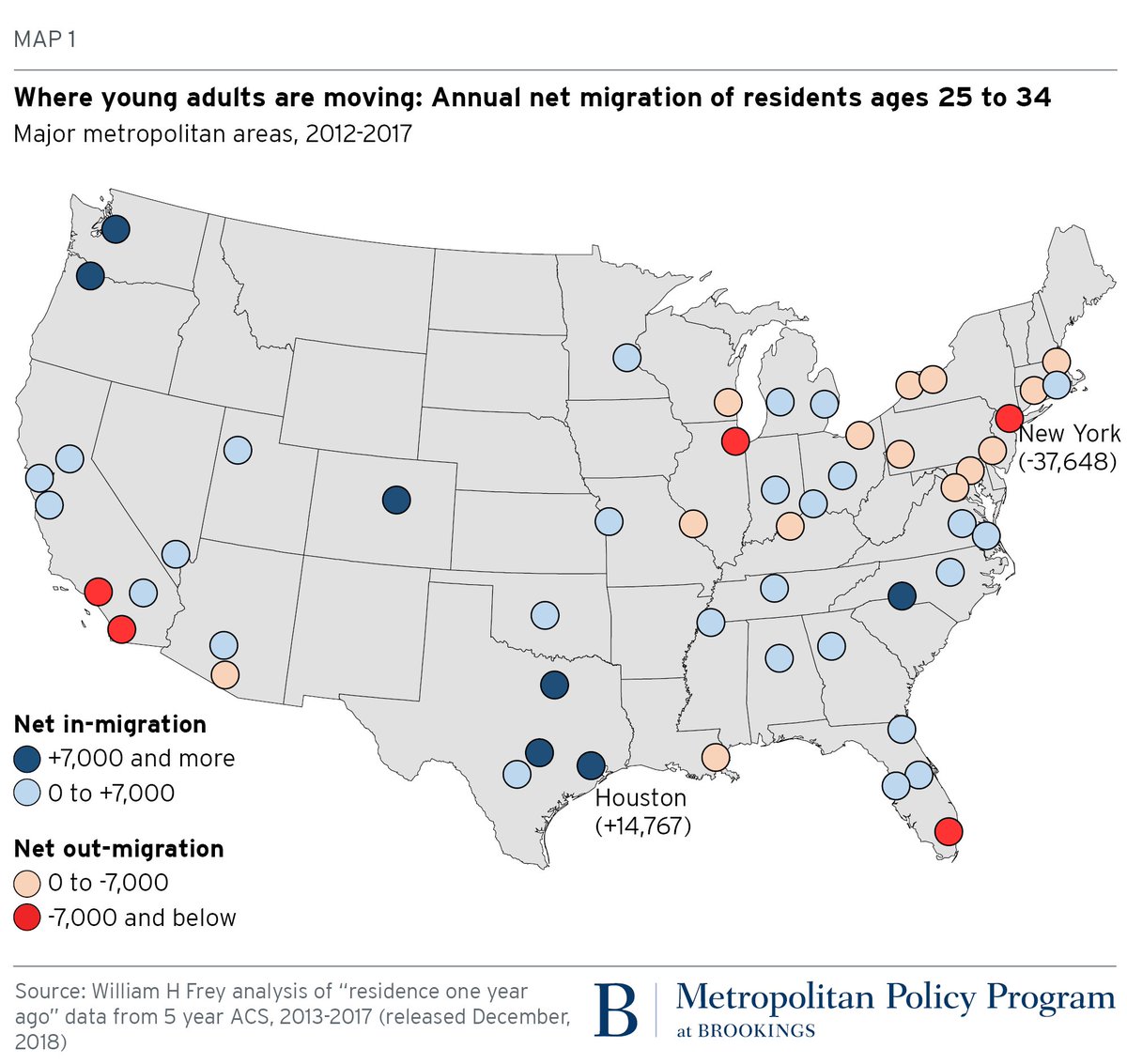
Our lack of competitiveness: then why are we consistently at the top of the metro rankings for population and economic growth? Why are people choosing with their feet to move here? And why are the top cities he lists - SF, NY, Chicago - all out-migrating?
Freeways don't benefit downtown: if we tore down all the freeways going into downtown, I'd be willing to bet a *whole* lot more companies would be moving out than new residents would be moving in. Those freeways are the lifeblood of those major downtown employers bringing their employees in from the suburbs that offer the quality of life (and schools) they want for their families. If those freeways are gone, those employers will be moving out to them (like Exxon did), not vice-versa.
Induced demand: this is exactly what we should want! It means the government built transportation infrastructure that is in high demand, and that's exactly what taxpayers should want! Would you rather they built transportation infrastructure noone wants to use? (like a lot of rail lines built in the US these days...) My favorite example that makes this clear: if an airport built a runway, and no new flights used it, that makes it a boondoggle waste. But if it fills up with new flights, that's the definition of success!
The Katy expansion was a mistake: ask just about anyone that used to drive on the old 6-lane Katy freeway, and they'll all agree it's *way* better now. Nobody wants to go back to what it was before. And it has enabled nothing less than a boom out there, including the Energy Corridor. Here's the most-liked online comment that points out the flaws in his numbers:
"What a truly garbage article, even though I agree with the premise that the I-45 expansion isn't being done correctly. All I had to do was look into the claim that "the PM commute on the Katy was up 55% since before construction". That's not true. Opening the link, that 55% rise was since 2011 - freeway construction was complete in 2008. There was no analysis of the commute times before the construction.
Making fraudulent claims like that, Mr. Speck, completely undermines your argument. And you really think getting rid of the sections of 45 where you're speeding along at 70 MPH inches away from a concrete wall will somehow decrease safety? You really don't understand that per vehicle PM emissions are higher when the vehicle is idling in traffic (and thus has its engine on) longer? No discussion on the population and economic growth in West Houston since the expanded Katy opened?
This is exactly why I got out of urban planning - unbelievable hypocrisy and ignoring of facts that don't fit your agenda. No the 45 expansion is not perfect, but leaving the freeway configured the way it is now in perpetuity is unacceptable. Go away please."
Safety: in addition to the comment above, he ignores the fact that when freeways are congested, people cut through local streets, and that is *way* more dangerous than keeping that same car on a freeway.
Air pollution: see comment above. What causes more pollution than cars zipping down a freeway? Cars stuck in congestion on a freeway, or continuously idling on surface streets.
Future vision: he pretends like these are mutually exclusive, but they are completely compatible and both are doable and actually happening. The project includes removing the Pierce between downtown and midtown and sinking it in Eado and the Museum District, which enhances rather than detracts from his walkable vision!
"If I-45 is widened, it will be remembered that, in the decade prior, Houston enjoyed a brief glimpse of a better future. Downtown and Midtown have been reborn, lifted on a demographic shift that favors urban living. Regional bike trails grace the Bayou Greenways, and a brilliant Beyond the Bayous plan lays out an ambitious path for sustainable growth. Transit ridership is up, thanks to investment in light rail and a redesigned bus network. The mayor, members of city council, and county commissioners all sing the praises of a more walkable Houston. Sadly, all these trends will be reversed if Houston doubles down on its nation-leading commitment to fossil-fuel infrastructure."
I'll also point out what I've said before: personal and commercial vehicles are never going away. They may run on fossil fuels or electricity or fuel cells or whatever, but the basic vehicle is now a foundational element in our society. These freeways will accommodate plenty of non-fossil-fuel vehicles in the future.
Congestion-based pricing: finally, one good idea in here! And good news: the 4 new MaX Lanes down the middle of 45N will almost certainly have it (as well as supporting huge transit improvements in MetroNext!). But unfortunately, congestion pricing the whole thing is not politically feasible (nor federal or state-allowed, I believe).
I'll conclude by saying I applaud TXDoT's extensive efforts to respond to community input and mitigate impacts (and hope they continue to do so), but I also wish they would commission a regional poll on support for the project, which I'm sure would show overwhelming support and quash this illusion that the public is opposed to it. Then we can get past this "do it/don't do it" debate and just focus on the "how do we make it better?" debate.
"Why does the Chronicle print this garbage and give it the prime location in the Sunday op-ed? It would take a very long post refute all the nonsense in the Speck op-ed, but here are a few points.
Most new lanes on I-45 are managed lanes, which will be a critical part of future public transit options
Downtown will be greatly improved by removing the Pierce Elevated, sinking around 2 miles of I-69 below ground, and reducing the number of freeway structures on the west side of downtown
The expansion and improved single-occupant vehicle mobility will be most beneficial to people in blue-collar and mid-skill jobs, since those jobs are outside of downtown (warehouses, industrial sites, construction, medical, etc) and the only way to get to those jobs is to drive
The idea that the growth and revitalization of downtown will be reversed by this project is absurd. Downtown Houston interests help design this project and are highly supportive. When construction of the project starts, we'll see new development as developers anticipate the improvements.
Speck's solution, congestion pricing, will disproportionately impact the lower-income population. It's ridiculous to compare Houston to NYC. NYC has extensive public transit (mostly built 100+ years ago) and people can switch to transit. That's not an option in Houston, or just about any city outside of NYC."
A Hypothesis About Airport Connectors. Metro needs to keep any airport connectors we build to affordable BRT. Excerpt on why they're politically popular but don't make economic sense:
"However, what I propose is that the high cost of airport connectors is not because the elite spends money on itself. Rather, it’s because many ordinary middle-class people fly a few times a year and wish for better airport transit, without thinking very hard about the costs and benefits. An airport connector appeals to a very wide section of the population, and may be very cheap if we divide the cost not by the number of daily users but by the number of unique annual users. Hence, it’s easier for politicians to support it, in a way they wouldn’t support an excessively costly subway line connecting a few residential neighborhoods to the city."
"Houston is easily my favorite Texas city, because it combines the best aspects of the other three... I prefer density over sprawl, big over small, new over old, and diversity over monoculture."
And here's the more extensive excerpt:
Houston
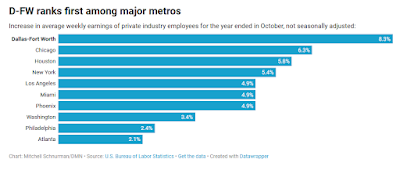
"Houston is easily my favorite Texas city, because it combines the best aspects of the other three. The metro area is similar in size to Dallas, and has the same rapid growth, ethnic diversity, and global feel. In fact, Dallas and Houston sit alone together as America’s foremost boomtowns, each growing by more than 144,000 last year throughout the metro area (the third place MSA, Atlanta, grew by a mere 95,000). But, like San Antonio and Austin, Houston has remained more tasteful than Dallas, with numerous interior neighborhoods that are urban, walkable, and separated from the innards of the city.
Not only is Houston Texas’ best city; it is among a handful of emerging ones in the U.S.—including Los Angeles, San Diego, Miami, Denver, Atlanta and Seattle—that will become the dense infill cities of tomorrow, joining the coastal legacy cities. The thing that differentiates Houston from the others, though, is that it doesn’t have the regulatory hurdles to stop this fundamentally market-oriented process. The city has no zoning code, which means a range of densities, uses and architectural styles can go anywhere in the city.
The folk wisdom is that this turned Houston into a sprawling mess like Dallas. But densification is already happening in Clutch City. This year it will lead the nation in multi-family housing construction, with 25,935 units entering the market (Dallas is #2 at 23,159). Much of this is going up rapidly via mid-rises in interior neighborhoods like Midtown, Montrose and Rice Military. Houston has the highest Walk Score of Texas’ big cities. Dallas, meanwhile, may feel more fragmented because of the low-density zoning in its central areas.
Of course, my choice, like anyone’s, is clouded by bias; I prefer density over sprawl, big over small, new over old, and diversity over monoculture."
Interviewed on PBS News Hour about post-Harvey Houston development and recommendations going forward, New Opportunity Boomtown, Big Houston, market urbanism, and more
Before getting to this week's items, PBS News Hour had a 9-minute segment this week on Houston development after Harvey, which includes about a minute interviewing me starting at the 6:50 point. They interviewed me for about a half-hour on the top of my condo midrise in Midtown on Jan 12th, and it was freezing that day, thus the heavy coat. I think they did a fair job with the sound bites and summary of our conversation – I love that they used my “don’t throw the development baby out with the hurricane bathwater” line (which is my mantra/tagline on all things Harvey) - although I wish they had included the stat about Houston land developed since 1992 would have absorbed less than 0.4% of the water that fell.
Eliminate parking requirements (agree to long-term reductions)
Scale back minimum lot sizes (agree)
Get street design right (disagree on being hostile to cars)
I like that he gives a shout-out to the flexibility and adapatability of our lack of zoning, but I'm not as opposed to development on the fringes as he is. I like that we allow both urban and suburban development and let people choose what works for their lives.
From Market Urbanist Scott Beyer: Richard Florida's book hits, then misses, the New Urban crisis: If spatial segregation is the cause of urban America’s problems, then zoning deregulation is the solution. Maybe not a surprise, but I love this and totally agree!
Another great Market Urbanism post on the history and market distortions of zoning, with something originally aimed at preventing nuisances quickly being abused to be exclusionary.
I've got more, but that's already too much for one week!
Another outsider loves Houston, top rankings, Super Bowl mobility, reducing rents with supply, insane rail costs, and more
Apologies for the posting delays - quite the backlog of items to get through:
Houston #1 in apartment construction in 2016. And all that new supply is reducing rents. And yet people still argue that relaxed restrictions and increased housing supply are not the answer to America's housing affordability crisis?
Continuing that theme, next time someone says you can't make housing more affordable by increasing supply, point them to this article on Houston doing it. Hat tip to James.
Houstonia: "In Defense of Houston’s Strip Malls: Their aesthetic merits are dubious; their environmental impact, baleful. Yet we argue there’s no purer distillation of Houston itself."
This article does a great job explaining the absolutely *insane* infrastructure costs in NYC for new subway lines, stations, and a bus terminal. $2 billion per mile for new subway?! $4 billion for one new downtown station?! $10 *billion* for a new bus terminal?! The equivalent of *thirty* NRG stadiums! Are you kidding me?! Just pull out these numbers next time anyone complains about TXDoT spending a couple of billion completely rebuilding a spoke freeway in Houston... it's a relative bargain!
"California’s bullet train could cost taxpayers 50% more than estimated — as much as $3.6 billion more. And that’s just for the first 118 miles through the Central Valley, which was supposed to be the easiest part of the route between Los Angeles and San Francisco.
A confidential Federal Railroad Administration risk analysis, obtained by The Times, projects that building bridges, viaducts, trenches and track from Merced to Shafter, just north of Bakersfield, could cost $9.5 billion to $10 billion, compared with the original budget of $6.4 billion.
The federal document outlines far-reaching management problems: significant delays in environmental planning, lags in processing invoices for federal grants and continuing failures to acquire needed property.
The California High-Speed Rail Authority originally anticipated completing the Central Valley track by this year, but the federal risk analysis estimates that that won’t happen until 2024, placing the project seven years behind schedule."
"Denver is spending billions of dollars building more than 100 miles of rail lines. When all the lines are done, promoters project they will reach just 26 percent of the region’s jobs. Since most people won’t live near a rail line, only about 2 or 3 percent of commuters are likely to use it.
Even most of the people who live near it won’t ride light rail because it is so slow. According to the American Public Transportation Association’s Transit Fact Book, the average speed of light rail is 15.6 mph while streetcars average just 7.3 mph. Not much accessibility benefit there."
"Houston, perhaps America’s least-regulated metro housing market, is the simulacrum of this 21st-century urbanism in all its messy brilliance. The fast-densifying greater downtown area has good Walk Scores and could legitimately be called "urban"; a half-dozen similar job centers--from random edge cities to tasteful towncenters--dot the metro; makeshift settlement communities pop up to house incoming immigrants; and, of course, haphazard single-family and multi-family housing sprawls in every direction. This willingness to build is why Houston can accommodate large population influxes, remain cheap...and perform so well economically."
Finally, in the practical-news-you-can-use department, James Llamas on mobility options to get around during the Super Bowl events. You can even catch a few seconds of me in the video starting at the 3:26 point. It's stock footage of media day when they opened the new rail lines. Man, did they catch me looking like a dork, lol ;-D
I've got more, but that's more than enough for this week's post. See ya next week.
P.S. Memo to the Texans: get Romo. Whatever the cost (although he should be willing to take a pay cut to get on a team with a real shot at the Super Bowl). With him and a healthy JJ Watt, next year's Super Bowl is very, very possible...
Standard of living city rankings, best city in TX?, our development future, and more
I know it's been a long time since my last post and I apologize - travel and an overloaded calendar have been conspiring against me. I have a whole lot of backlogged content, but here's a good bit of it:
"For second-ranked Houston, the challenge is much different. Houston’s average pay per job is 30 percent above the metropolitan average, which converts to a near duplicate 29 percent higher COU Standard of Living Index, when adjusted for the cost of living. Houston’s future success will require retention its favorable housing affordability and high pay per job. The upheavals in the energy industry could result in lower pay per job in the future."
"Tory Gattis, founding senior fellow at Houston-based think tank Center for Opportunity Urbanism, envisions the Houston region developing into nine suburban "villages" that would grow to have populations as large as 1 million each. Those "villages" - The Woodlands, Kingwood/Humble, Baytown, Clear Lake/League City, Pearland, Sugar Land, Katy, Cypress and Tomball - would be in addition to the 2 million to 3 million people living in Houston.
In order for that to work, Gattis said, the outer regions would have to work with the Metropolitan Transit Authority to provide express park-and-ride services to downtown, the Texas Medical Center, Greenway Plaza and other urban job centers. ... Gattis predicts more mixed-use buildings and high-rises in the urban core, a small number of which will be met with resistance from lower-density neighborhoods around them. The biggest tensions will arise from mobility challenges should more employers move away from the inner city.
In an age of the self-driving car, Gattis says people will be more apt to move farther from the city center, no matter how it affects their commutes.
"They can do email and be productive in the car," he said, "even if it's an hour and a half."
"Houston is easily my favorite Texas city, because it combines the best aspects of the other three. The metro area is similar in size to Dallas, and has the same rapid growth, ethnic diversity, and global feel. In fact, Dallas and Houston sit alone together as America’s foremost boomtowns, each growing by more than 144,000 last year throughout the metro area (the third place MSA, Atlanta, grew by a mere 95,000). But, like San Antonio and Austin, Houston has remained more tasteful than Dallas, with numerous interior neighborhoods that are urban, walkable, and separated from the innards of the city.
Not only is Houston Texas’ best city; it is among a handful of emerging ones in the U.S.—including Los Angeles, San Diego, Miami, Denver, Atlanta and Seattle—that will become the dense infill cities of tomorrow, joining the coastal legacy cities. The thing that differentiates Houston from the others, though, is that it doesn’t have the regulatory hurdles to stop this fundamentally market-oriented process. The city has no zoning code, which means a range of densities, uses and architectural styles can go anywhere in the city.
The folk wisdom is that this turned Houston into a sprawling mess like Dallas. But densification is already happening in Clutch City. This year it will lead the nation in multi-family housing construction, with 25,935 units entering the market (Dallas is #2 at 23,159). Much of this is going up rapidly via mid-rises in interior neighborhoods like Midtown, Montrose and Rice Military. Houston has the highest Walk Score of Texas’ big cities. Dallas, meanwhile, may feel more fragmented because of the low-density zoning in its central areas."
Vote for mobility solns, defending the Katy expansion, H-GAC cool tools, and more
A few quick small items this week followed by my response on debate about the Katy Freeway expansion:
The Mobility Houston traffic solution forum was launched this month (background here) to crowdsource solutions to Houston's mobility problems, and I'd like to request up-votes for my proposal on MaX Lanes as well as this proposal for intersection improvements. I know it's a slight hassle to register to up-vote, but there's not that many votes on the site, so yours can really make a difference and help good ideas get in front of public officials. Thanks in advance for your support.
Today I attended an impressive H-GAC presentation by Jeff Taebel on new mapping tools for figuring out which parts of the city are the best for investing to create dense mixed-use neighborhoods. One tool makes it easy to identify neighborhoods that have the right density and street connectivity, and the other has impressive data on commuting patterns. They are extremely slick tools, and wide open to the public, so try them out - I'm pretty sure you'll be impressed. I really like and support their approach, which acknowledges the car-centric spread-out nature of our region, but rather than trying a prescriptive, one-size-fits-all, top-down approach to planning, they figure out targeted neighborhoods to prioritize investments (like bike and pedestrian amenities) where they'll have the most impact and do the most good. An interesting data tidbit that came out of the presentation: average commute times have actually dropped in Houston since 2000, and at ~28 mins are only the 11th-worst in the country - not bad for the 5th largest metro area. I'm guessing you're incredulous at that stat, but there's a good reason: as we added more than a million jobs, all of those newcomers tried to pick housing near their new jobs (including all of those recent college grads inside the Loop), thus lowering the overall average commute times for the region.
Joel Kotkin in Forbes on America's Next Boomtowns. Houston is #6, although that's dependent on oil coming back to a more reasonable price. Really nice picture of the Chevron buildings and circular skywalk downtown.
Joe Cortright responded to my post a couple weeks ago defending the Katy freeway expansion, but strangely chooses not to address the core points of not getting proper before and after congestion data (the expansion opened in 2009, not 2011 or later, so his data just shows the added congestion of the oil boom after it had already opened) or that more employers would have given up on the core city for the suburbs. He does make a point about properly valuing external impacts like pollution, but that's not the role of transportation planners - that's the role of gas tax policy, CAFE mileage standards, and pollution control regulations (set those and then let people make choices). He raises the alternative of investing in denser housing (the private free market does this, not government - and they're free to build as much as they like wherever they like, and they do wherever there's demand) or transit - but by any measure an equivalent spend on transit would have moved far, far fewer people for the tax dollars invested. His data chart is actually a fantastic argument for Houston's freeway-heavy transportation spending: peoples' commute time tolerance is pretty much the same all over the world (roughly a half-hour), but in Houston (and DFW) they're able to go 12.2 miles during that time vs. much shorter distances in other cities. That means they were able to access a better value house in a better neighborhood with better schools while still staying within a reasonable commute of their work.
Restricting freeways has three obvious consequences: 1) housing gets much more expensive, since there's less of it within commuting range of employers, 2) employers give up on the city and move to the suburbs with better value houses, neighborhoods, and schools for their employees (reducing the tax base), and 3) a city/metro becomes less of a unified economy and more of a series of fragmented, disconnected islands where people have limited employment options without moving. I have no problem with dense or transit-oriented neighborhoods (see H-GAC bullet point above), and we have those options that people are welcome to choose. But the fact that we build freeways and they fill up mean that the majority of people are making different choices based on weighing up their own values. Since we live in a democracy, it seems reasonable for our elected representatives and their transportation planners to respond to those market choices rather than trying to force some socially-engineered alternative. I stand by my original point: the government invested in a piece of infrastructure that has proven extremely popular and highly utilized - isn't that what we want from government investments of tax dollars?
"Thus, my conclusion on Texas Central Railway is about the same as on All Aboard Florida. Both are private sector projects, to be done via project finance that must be paid back from the project's own revenues. There is little or no risk to taxpayers, federal or state, in either project."
ULI makes the economic case for increased walkability in Houston. While I do support overall efforts to increase walkability, I suspect they have their cause-and-effect a little muddled here when they claim walkability adds so much value. Walkability is a proxy for density which is a proxy for an in-demand neighborhood, so of course rents are higher, but walkability isn't necessarily the primary driver (although I'm sure it helps). That doesn't mean a developer can move a strip center up against the sidewalk and put apartments on top of it in the far suburbs along 1960 and instantly add value to it - in fact he might kill the retail with the inconvenient parking. Same reason suburban developers don't build large subdivisions of tightly packed mixed-use and townhomes up against the sidewalk. A comparable analogy would be noting that cars with a top speed over 150mph (i.e. luxury and sports cars) can charge, on average, much higher prices, so all cars should be designed to go that fast - the logic doesn't quite hold.
Aaron Renn (The Urbanophile) has an excellent piece in the City Journal: "Libertarians of Convenience: Urban progressives favor deregulation—but only for things they like or want to do." At least the urban left is starting to realize the significant negatives of urban overregulation, but let's hope they broaden that freedom over time to things that aren't part of their orthodoxy. I love the concluding paragraphs that give a nice shout-out to Houston:
"In Texas’s cities, by contrast, progressives often share, to some degree, the state’s pro-freedom, pro-market ethos. That’s why Houston, though hardly without restrictions on building, has no zoning per se and a pro-market Democrat, Annise Parker, for mayor. Unsurprisingly, it remains an affordable place to live, as do other low-regulation cities, such as Indianapolis.
At least some on the left appreciate the principle of liberty when it comes to things like free speech: they understand that odious opinions have to be tolerated, or everyone’s liberty is at risk; and that selective free expression isn’t really free. But they fail to see that selective economic freedom brings its own injustices and inequities. Progressives should embrace a broader principle of economic liberty for American cities—not only for the sake of their own pet causes but also because it’s the right thing to do."
"Forty-four of North America's largest airports have "international" in their title. Only one has the word "intercontinental." No word yet on whether Houston's proposed space port will be named "intergalactic."
Fifteen of the world's 20 busiest airlines serve Houston. They are Delta Air (1), United (2), Emirates (3), American (4), Southwest (5), Lufthansa (6), Air France (7), British Airways (8), Air China (12) Singapore Airlines (14), Turkish Airlines (16), Air Canada (17), KLM (18), and Qatar Airways (19).
When Air New Zealand starts service later this year, IAH will be the only airport in North America that serves all six inhabited continents. There are only four other airports in the world that can claim the same--Dubai, Doha, Abu Dhabi, and Johannesburg.
...
When the Houston's Hobby International Terminal opens this fall, Houston will be one of only six markets with dual international hubs"
Forget the Ike Dike - love will save us from a hurricane
Over the years, I've noticed a phenomena that maybe you've noticed too: some issue becomes the "hot" issue of the moment (terrorism, Ebola, etc.) and then people jump on the bandwagon for that issue by trying to link it to whatever their pet issue is, no matter how tenuous the connection may be. "If you support my pet issue X, it will reduce the problem of hot issue Y." If they can successfully link the issues, maybe public support (or, better yet, taxpayer dollars) will swing behind their pet issue. Sometimes the connection gets stretched so far as to become utterly absurd. And that brings me to Exhibit A: this op-ed in the Chronicle ("How to protect our city against storms? First, make it lovable. Dikes and levees are secondary. What they protect matters more.") saying the key to our hurricane resilience is not something so pragmatic as a dike, but really about making our city more walkable and lovable. Wait... what? Really? Evidently, New Orleans' big failure with Katrina had nothing to do with being a city below sea level with substandard levees, but it wasn't walkable and lovable enough. Uh-huh...
Let me address some of the specific arguments in the piece:
Levees can fail: Sure, anything can fail, but how many times have levees and dikes successfully protected New Orleans or the Netherlands vs. the number of times they failed? Does one failure mean dozens of other successful protective events don't have value? And the nice thing about Houston over New Orleans is that we are *above* sea level, so if there is a failure, it will just drain right out as the tide recedes, as opposed to stagnating in the big bowl of below-sea-level New Orleans.
Levees cause stuff to be built where it shouldn't: Sorry Netherlands/New Orleans/Houston, you built stuff where you shouldn't have because once a decade mother nature is going to come at you with wallop. Rather than protecting yourself, you really need to just shut it all down and move somewhere else - nevermind the trillions of invested infrastructure. Wait, you say, it's kinda hard to operate a port without being connected to the ocean. Well, I'm sure you'll figure it out.
The key is lovability/walkability: I'm pretty sure New Orleans had that in spades, and it doesn't seem to have saved them from Katrina. Nor did it help the quaint walkable sections of Galveston during Ike. And I'm sure the Dutch will be disappointed to learn they could have saved billions on dikes over the years if they had just loved their country more, maybe with just a good handholding and kumbaya singing session every time the North Sea threatened?
His calling out of my op-ed with Joel Kotkin: "Walkability is not some concept being forced down our throats by elitist planners from the East Coast, as some suggest. (See, for instance, "Economic diversity helps Houstonians live well" by Joel Kotkin and Tory Gattis.)" Actually, if you look at the stated goals of those smart growth planners, they *are* trying to force dense urbanism down our throats, and they specifically call for restricting or eliminating suburban development. We are not opposed to walkability and walkable development like town centers, but we are opposed to forcing it on people by restricting other forms of development which leads to unaffordable housing, widening inequality, reduced opportunity, and a weakened middle class. I totally agree that some people love walkability (including myself), and we need to loosen any regulations that make it hard to develop (agreement with him on this point), but let the market decide how much demand there is and how much and where to build - not central planners.
"People in Houston currently spend as much on transportation as they do on housing. " Lies, damn lies, and statistics. As I've pointed out here before, when you have affordable housing like we do in Houston (albeit rapidly getting less so), people tend to splurge on very luxurious cars, trucks, and SUVs - but that does not mean that's the cost of transportation here. Everybody can get around Houston quite affordably in a Honda Civic, Toyota Prius, or plenty of other cars - they just choose not to. The 2013 C2ER ACCRA Cost of Living index takes this into account, and rated Houston 95.6 for transportation costs where 100 = the national average, so we're 4.4% below the national average. New York is at 110, Chicago at 124, DC at 106 - so much for dense transit cities reducing transportation costs.
"Spending less on transportation would mean you could afford more durable construction." While I agree we should have strong construction standards for wind, how does one build more durable construction for a tidal wave surge of water? Should we build everything on stilts? How incredibly expensive and inconvenient would that be, not to mention not very walkable? Maybe we should, um, build a dike so we don't have to worry about the surge in the first place and can build simply at ground level?
"Walkability means you might see your neighbors more often. Knowing who your neighbors are is a key element of resilience. Social capital is the glue that holds communities together, and places that have it back from catastrophe much faster." Does anybody else remember all the stories in Houston after Ike of people helping each other out and throwing block parties to grill meat before it spoiled in unpowered fridges and freezers? Does anybody remember our amazing response to the Katrina refugees? I think we're doing pretty well on the social capital front. And I'd like to point out that the most dense and walkable city in America, New York, is not exactly known for its friendly "social capital".
"Many people in New Orleans died because there was nowhere to run in a vast unbroken sea of single-family homes" Actually, the people that were stuck in New Orleans for Katrina where the ones without cars who relied on transit and walking. Just about everyone with a car got out successfully.
To sum up, walkable development is great, and we should certainly enable and encourage more of it, but it is absolutely no substitute for protecting our region from a direct hurricane hit with a strong physical barrier. Let's not mix up our priorities here. We know what we need to do - we just need the political and financial will to do it (and here's how to pay for it).
Big news, critiquing Dallas, Houston's transportation history, and more
First, some big news I want to share with all of you: the MIT Center for Advanced Urbanism is pulling together a book on the future of cities and their suburbs, and they've asked me to contribute a paper! Very exciting yet humbling. Publication is estimated for the spring of 2016, so fortunately I have a bit of time to pull it together...
On to this week's smaller misc items:
Thanks to Bill King for the shout out. Total agreement supporting METRO as it revamps the bus system and backs off from the costly obsession with rail.
The Urbanophile does Dallas (doesn't quite roll off the tongue in the same way, does it? ;-) followed by a mixed review of Downtown Dallas specifically. Reading the critique, I think he'd give our downtown a better review, although still mixed. I think he has some good thoughts on potential solutions that Houston should be considering, especially #1 on creating an authentic street experience appropriate to Texas. It also includes a great excerpt on the walkability challenge that I have also stressed for Houston:
"For one thing, Dallas temperatures are very high. It was in the 90s and blazing sun every day I was there. This renders the city functionally unwalkable. I wanted to do a lot more exploring but just couldn't because if I spent more than about 10-15 minutes outside I needed to take a shower.
When I tweeted this people kept talking about other places in the world with high temperatures. It may be that some places are acculturated to this, or too poor to afford air conditioning. But I actually didn't even get a good counterexample once you factor in humidity. Some folks mentioned Seville, Spain, but the July dew point in Seville ranges from 51-66 while in Dallas it’s 64-72. That’s a big difference.
So walkability and urbanity is going to mean something different in a hot, Southern climate vs. northern cities. Think of that as challenge #1."
Quote of the week from David Brooks at the NYTimes, the last part being relevant to Houston:
"Great and small enterprises often have two births: first in purity, then in maturity. The idealism of the Declaration of Independence gave way to the cold-eyed balances of the Constitution. Love starts in passion and ends in car pools.
The beauty of the first birth comes from the lofty hopes, but the beauty of the second birth comes when people begin to love frailty. (Have you noticed that people from ugly places love their cities more tenaciously than people from beautiful cities?)"
Yes, yes we do.
Finally, H-GAC recently released a new Mobility Now special edition video on "The Art of Transportation" celebrating 40 years of transportation planning in the region, including an extended conversation with County Judge Emmett. A lot of interesting history in here, including (surprise!) yours truly at the 4:32 mark.
An open dialogue on serious strategies for making Houston a better city, as well as a coalition-builder to make them happen. All comments, email, and support welcome.