I was fortunate to attend last week's media preview of the new Jurassic World Exhibition at Katy Mills Mall (even Katy's mayor was there - see pics), and I'll admit it was pretty darn cool. Inside a giant tent they have a series of staged experiences you move through with lots of great interaction, especially for kids (and plenty of Instagrammable stuff for the adults too, lol). The dinosaurs range from babies with handlers (puppets) to humans in costume (raptor paddock show) to some very impressive large animatronics (T-Rex and more - see pics). The raptor paddock show with the human handler was the most curious to me, as I couldn't understand how they would be able to make an animatronic dinosaur realistically walk? Turns out they didn't - they put a human in costume instead. But it sorta works (especially for kids) because it's fairly dark and you're behind a high-security fence. Definitely check it out for a fun family afternoon.
The award-winning Jurassic World: The Exhibition is now open at Katy Mills. Jurassic World: The Exhibition, a 20,000-square-foot family-friendly immersive experience has now become one of the fastest selling exhibitions in history since its launch and has welcomed over 8 million visitors. After touring cities around the world including London, San Diego, Denver, Dallas, Chicago, Philadelphia, Paris, Madrid, Seoul, Chengdu, Guangzhou, Shanghai, Toronto, Atlanta, Sydney, Cologne and Berlin, this global sensation makes its return to Texas.
This must-see attraction has been created by NEON, a global leader in immersive and epic experiences and produced in conjunction with Universal Live Entertainment, a division Universal Destinations & Experiences.
Jurassic World: The Exhibition is a family-friendly exhibit of massive proportions based on one of the biggest blockbuster franchises in cinema history. Visitors walk through the iconic Jurassic World gate, where they will explore richly themed environments inspired by the beloved films, coming face-to-face with life-sized dinosaurs, such as the towering Brachiosaurus, Velociraptors including fan-favorite Blue, and the most fearsome of all, the mighty Tyrannosaurus rex! Guests will imagine what it would have been like to roam amongst these breathtaking creatures, and even interact with baby dinosaurs, including “Bumpy” from the popular animated series Jurassic World: Camp Cretaceous from Universal Pictures, Amblin Entertainment and DreamWorks Animation, currently streaming on Netflix.
The Exhibition welcomes multiple generations of Jurassic World fans to venture to the remote island made famous in the movie franchise.
Some of the elements on the interactive journey that await visitors include:
The Ferry: The journey begins aboard a ferry and a walk through of the iconic “Jurassic World” gates.
Land of the Giants - Walk under the towering Brachiosaurus that is part of the gigantic sauropod dinosaur family, the largest creatures to ever walk the earth.
Creation Lab: The Creation Lab is where guests can enjoy a hands-on experience and learn more about the science behind dinosaur DNA. They’ll also learn more about coprolites and the various species of dinosaurs that live at Jurassic World.
The Raptor Paddock: Guests can walk up to the Raptor’s paddock, but don’t get too close! These creatures have sharp serrated teeth and sharp-clawed hands and feet. Their large, recurved claw is used for slashing and pinning prey.
Gyrosphere Valley: This is the perfect place to take a picture with a baby dinosaur and discover what is under the dirt at the Dig Site. Continue the journey through this picturesque valley to climb into a life-sized gyrosphere.
Feeding Time: The highly intelligent and extremely dangerous Indominus Rex is one of the most formidable creatures in the park. Visitors can watch as she is fed her daily meals.
T. rex Kingdom: A high voltage fence is the only thing that separates visitors from the mighty Tyrannosaurus rex.
Jurassic World: The Exhibition will be in Houston at Katy Mills for a limited engagement. Tickets are available now at Jurassicworldexhibition.com.
(I think I saw somewhere that it's here until October, but don't quote me on that)
A really steep toll increase for 288, and this is where my “I told you so” kicks in: they should have made it 4 lanes one-way inbound in the mornings and outbound in the evenings to match demand, instead of 2x2.
"As a result of the region’s booming population, Houston tops the list of major U.S. metro areas with the most construction permits issued for single-family homes from 2012 through 2021, according to new data from self-storage marketplace StorageCafe. During that period, 392,136 permits for single-family homes were handed out in the region.
“Houston has been the primary destination for newcomers moving to Texas, especially Californians who find respite in Harris County’s lower home prices and tax rates, cheaper land, and sound economy,” StorageCafe says in explaining the demand for more homes in the area.
From 2012 through 2021, Houston also led the country’s 50 biggest metros for new retail space (more than 51.8 million square feet). Here’s how Houston ranks in other segments for newly built commercial real estate:
Third for new office space (nearly 44.3 million square feet).
Third for new self-storage space (nearly 17.6 million square feet).
Fourth for multifamily construction permits (170,817).
Fourth for new industrial space (more than 153.3 million square feet).
Houston ranks second for construction activity across all six property types from 2012 through 2021.
How a Biden presidency can boost Houston, plus the cause of our growth, how LA is like us, Montrose is dead, and a graffiti artist guide to visiting HTX video
A lot of people are probably thinking about a Biden presidency as a negative for the oil industry and Houston, but there are some potential silver linings here. A big one would be a massive federal infrastructure investment bill that could dramatically improve Houston's flood resilience, including the Ike Dike and Galveston Bay Park surge barriers (great overview video). Another would be reopening international migration, which has been a big booster for Houston in the past (and has been significantly suppressed since 2016).
But the biggest potential boost would be the oil industry giving him a viable alternative to the Green New Deal. Instead of banning fracking or federal drilling permits - which just imports more oil from the Middle East - how about a tariff on imported oil to boost local jobs while also reducing carbon emissions? (by keeping prices up) Could the industry give him cover to get it passed and popular with the public? How about channeling the industry into something it has the expertise, infrastructure, and capital to do very, very well: carbon sequestration? (i.e. injecting it into the ground) How about encouraging LNG exports to Europe to give them an alternative to coal and Russian natural gas? Or LNG exports to China to displace the massive coal plants they're building there? There are so many ways the oil industry could be part of the solution on carbon, if they would just engage in good faith.
Moving on to some smaller items this week:
Market Urbanist Scott Beyer at the Foundation for Economic Education: What's the Cause of Houston's Growth?For decades, Houston has been the nation’s leading example of an “opportunity city.”
"If America had a more market-oriented urban approach, those aspects of Houston—the density and affordability—would be the ones most likely replicated. For this reason, “getting a bunch of Houstons” should be an urbanist goal."
Los Angeles: a city that outgrew its masterplan. Thank God. In the first of our regular series of dispatches from around the world, this longtime LA resident argues that his city's endless variety should be a key part any new metropolis's design. Sounds a lot like Houston. Hat tip to George.
"The very lack of defined form and cultural tradition here, the statelessness of the city itself or those who live in it, allows for a distinctive type of vitality that I've felt nowhere else."
Finally, I'll end with a fun video: Houston by a Local - Travel Tips for Houston - A Day in Houston, Texas. Discover Houston with a local: Graffiti artist Gonzo 247 shows you highlights of his home town in the U.S. state of Texas. One of them is Space Center Houston. Hat tip to George.
Food deserts aren't real, energy transition, tourism surprise, NYC's anemic recovery, and HTX pandemic response failure
Just a few items this week:
Bloomberg Businessweek: Houston Had an All-American Pandemic Response: Ignore Until It’s Too Late - The city knows about disasters. It’s got a world-renowned medical center. It saw what happened in New York. And it still couldn’t stop Covid-19. I know I still shake my head every time I see a full pedal party in Midtown (close proximity + heavy breathing!). Hat tip George. Sad conclusion:
Crisis is brewing from every direction, and we’re as ready as we ever were. It’s as Hidalgo says: “We’re right on the edge of disaster. It’s almost become our way of business.”
“But a number of civic and business leaders say New York’s reliance on mass transit—and concerns that the new coronavirus could spread through subways, buses or regional trains—has kept many people working from home. Cities that have more driving commuters have seen a higher percentage of workers return.”
“New Yorkers’ slow return to the workplace is the latest blow to the nation’s biggest city, which has also suffered from homeowners fleeing Manhattan for larger spaces, rises in murders and homelessness, and the shutting or partial closings of Broadway theaters, museums and other popular attractions.”
“But for some New Yorkers who recall the early weeks of the pandemic, when the rates of sickness and death were among the highest in the world, complimentary parking might not be enough to bring them back to midtown and the prospect of mixing with crowds. Many were traumatized, said Chris Jones, senior vice president of the Regional Plan Association, an urban policy organization.”
And here’s the top rated comment:
“Let's be real. There is no social distancing in NYC whatsoever when the buildings and streets are full. Zero. None whatsoever. Source: a person who's worked in NYC every day for 25 years. “
U.S. Cities Most Reliant on Tourism. WTH?! How does Houston have more tourism workers than Vegas, Orlando, Tampa, New Orleans, Miami, or Austin+San Antonio combined?? Turns out restaurant workers serving locals - which is roughly proportional to population - really swamps out any tourism-specific employment.
"We study the causes of “nutritional inequality”: why the wealthy tend to eat more healthfully than the poor in the U.S. Using event study designs exploiting supermarket entry and households’ moves to healthier neighborhoods, we reject that neighborhood environments have meaningful effects on healthy eating. Using a structural demand model, we find that exposing low-income households to the same availability and prices experienced by high-income households reduces nutritional inequality by only 9%, while the remaining 91% is driven by differences in demand. These findings contrast with discussions of nutritional inequality that emphasize supply-side factors such as food deserts."
Dangerous HCTRA toll revenue diversions, Ike Dike, rail vs road forecasts, LA transit may go fareless, HTX and the energy transition, and more
A lot of smaller items to catch up on this week after our little diversion into aviation last week.
My lead this week is on Harris County playing games with HCTRA toll road revenue to spend it on things other than transportation, which is super dicey. The state is already in trouble with transportation because they diverted the gas tax to nontransportation needs. Now the county is making the same mistake... trading long-term prudence for short-term pet projects. "For flood control" is PR spin, since they won't have any obligation to spend it on that. Toll money moves into the general fund where they can spend it on anything they like. Oscar made a nice chart to show why HCTRA's money pot is such a tempting target, although he expects it may drop up to a third this year with the pandemic.
"Texas: Number 2 in Net Domestic Migration (just behind FL)
Texas, the nation’s second most populous state had the second largest gain in net domestic migration, at just below 2 million. During the two decades, the two largest Texas metropolitan areas, Dallas-Fort Worth and Houston moved from below the top five to positions four and five respectively."
"And it makes no difference if the analysis includes other potential explanatory factors such as population density, age, ethnicity, prevalence of nursing homes, general health or temperature. The only factor that seems to make a demonstrable difference is the intensity of mass-transit use."
"The article’s real bias is shown in a paragraph about Bent Flyvbjerg’s well-known study on transportation megaprojects. The 2007 study (of a large global database of highway and transit megaprojects) found that average traffic on highway megaprojects was 9.5% more than forecast, while the average rail megaproject ridership was overestimated by 106%. In other words, for every 100 drivers forecast to use a given highway project, 110 did, and for every 100 rail passengers forecast to use a rail megaproject, only 47 did. If anything, the forecasting problem seems to be far worse with rail than with highways but the piece only mentions highways:
And here the problem is partly political; in order to receive federal funding, transit proponents have learned to game their forecasts, inflating ridership by one-third and deflating cost estimates by one-third. This is a well-known trick, and, unfortunately, the article fails to mention it or provide any way to solve this problem."
"The problem with light rail (and the reason it is popular with government officials) is that it is an upper middle class boondoggle. There can be no higher use of transit than to provide mobility to poorer people who can't afford reliable automobiles. Buses fulfill this goal better than any mode of transit. They are flexible and can reach into many corners of the city. The problem with buses, from the perspective of government officials, is that upper middle class people don't like to ride on them. They like trains. So the government builds hugely expensive trains for these influential, wealthier voters. Since the trains are so expensive, the government can only build a few routes, so those routes end up being down upper middle class commuting corridors. As the costs mount for the trains, the bus routes that serve the poor and their dispersed commuting destinations are steadily cut."
The discrepancy in U-haul rates shows the mass migration from CA to AZ and TX. At this rate, soon they'll have to pay drivers to bring their trucks back to CA!
Finally, ending with a fun short video with the "top ten" places to visit in Houston. I've never even heard of #1 before, lol, so see if you agree. Hat tip to George.
Tax and regulatory burden rankings, lot size reform, increasing walkability, superstar cities vs. Covid and Spiderman, and much more
I apologize for the longer delays between what are usually weekly posts. My day job in alternative education and edutech has absolutely blown up with covid and remote learning, leaving little time for blogging. But I'm using a gap hour between meetings today to get this post cranked out, so here are some catch-up items:
Houston passed the new walkable places plan in targeted locations, including all of Midtown where I live. I have not had time to investigate it deeply, but on the surface it looks like it could be really good at encouraging more pedestrian-friendly development. I'll be curious to see before and after permitting numbers in Midtown to see if it's encouraging or discouraging new projects vs. previously strong growth in Midtown.
"Returning to Texas, the Austin Business Journal piece cited a survey that found that Austin was the top-ranked city for tech workers to relocate worldwide, just ahead of Seattle and Amsterdam. That ranking is largely based on past decisions that allowed the city’s housing market to keep up with demand. But unfortunately, Austin’s city council has shifted to the left over the past few years and has become increasingly hostile to both new development and road construction, with the city becoming more expensive and congested as a result. Were it not for the fact that most other tech havens are even further to the left politically, Austin would likely lose its No. 1 ranking."
"Next, we examine how this reform impacted Houston’s neighborhoods. Did developers flock to the most affluent neighborhoods? Or did this shift subdivision activity to lower-income neighborhoods with lower land values? Using both GIS data and regression analysis, we find that the new 1,400 square foot lots were overwhelmingly developed in two types of areas: First, in neighborhoods where there was substantial underutilized former commercial and industrial land, and second, in largely underbuilt middle-income residential neighborhoods.
The scale of this change in much of western Houston is hard to overstate. Many neighborhoods, such as Shady Acres and Rice Military, have been completely transformed. In many cases, this has involved the subdivision of conventional post-war 5,000 square foot lots into three townhomes, effectively tripling population densities. We hypothesize that the wealthiest areas avoided subdivision activity through existing deed restrictions, while middle-income neighborhoods absorbed much of the demand, minimizing redevelopment pressure in low-income neighborhoods.
We draw two lessons for planning practice from this case study. First, allowing the most extreme opponents to “opt out” of land-use reform may help clear a path for citywide liberalization. While planners and policymakers should be prudent, such compromises may make sense where local politics otherwise blocks reform. In Houston, the compromise was deemed acceptable, and the result has been over 25,000 new housing units close to major job centers.
Second, citywide land-use liberalization is likely to direct growth into middle-income and underbuilt neighborhoods, barring other institutional constraints. While this comes with separate risks—such as disinvestment from lower-income areas—it may help to ease concerns regarding displacement."
NYT: Coronavirus Threatens the Luster of Superstar Cities - Urban centers, with a dynamism that feeds innovation, have long been resilient. But the pandemic could drive a shift away from density. The article does a good job looking at all the different forces involved and potential outcomes, but seems to ignore the potential of safer car-based cities to still generate plenty of innovation and support amenities - places like Houston, Austin, and Silicon Valley. Excerpts:
“A survey by the market research firm Reach Advisors found that companies facing high real estate and labor costs were the most interested in pursuing remote work into the future. “The biggest shift away from density will likely be in markets such as the Bay Area and New York City,” said the company’s president, James Chung. By shifting to remote work, “they can dramatically widen their labor pool and evade the labor-wage trap that they are in.” …
"But for a city like New York, he said, Covid-19 offers an opportunity for redemption. “New York was running into a dead end, turning into a paradise for the rich,” he said. “Culturally dead.” Moving back to a cheaper, messier, more diverse equilibrium may carry a silver lining."
McKinsey: Restoring public transit amid COVID-19: What European cities can learn from one another. I think the biggest impact locally will be the park-and-ride service, but Metro should be able to manage overall. But I truly don't see how NYC will be able to operate anywhere close to normal. DC, Chicago, Boston, Philly, SF, and others will also be significantly affected.
"Physical distancing will cut transit capacity to 15-25% of normal, but use of PPE could increase capacity to 40%."
NYT: The Agonizing Question: Is New York City Worth It Anymore?For many, the call of an easier, safer and more affordable life beckons. But die-hard New Yorkers find the city more appealing than ever. The new Escape from New York... 420,000 already gone in three months is a staggering number! Obviously many are temporary. But there are also probably tons of people still there that have decided to leave but are waiting out their leases.
“New Yorkers have been fleeing for months. But the fear some residents have of the violent reactions to the protests here is adding a new challenge to those asking themselves whether they can hack the city. Many are deciding not to return.
It’s a decision that must be made individually and privately, one that some 420,000 New Yorkers with the resources to do so had already made between March and May in reaction to the pandemic, according to cellphone data analyzed by the Times.”
"For some, it’s a chance to be closer to family, which feels more urgent in the midst of a global health scare. For a large swath of people in the country’s most expensive cities, it’s a way to get more living space and be closer to nature, something increasingly made possible by the growing trend of remote work. And for many others it’s not really a decision at all, but a necessity in the face of growing job losses and still sky-high rents.
… And people in cities hit hard by the pandemic — New York, San Francisco and Seattle — are searching for remote work opportunities significantly more than the rest of the country, LinkedIn data shows. Some real estate data suggests many are already considering or making a move to a smaller town or suburb. Real estate company Redfin said page views of homes in small towns more than doubled during the last week of April compared with last year.
... She said she’s hearing from mostly young families — professionals with small children — who want to trade the confines of a locked down New York City for houses with home offices and yards.
“It’s no longer temporary. People are saying, ‘I’m not going back. This could happen again and we don’t know when it’s going to end,’” said Bernstein.
“New York doesn’t feel worth it anymore,” he said."
The convention business is cratering, and cities are getting stuck with the bill. I'm not sure how our bonds are structured, but I'm guessing Houston and Harris County will be hit pretty hard by this. We've used hotel taxes to subsidize GRB, NRG, and stadium expansions, and now those hotels are bringing in very little revenue. I'm assuming taxpayers are on the hook to make the payments...
"Houston and NYC both issued around 61k permits in 2019. But metro New York City is nearly 3 times bigger than metro Houston, meaning its construction activity in 2019 (30.4 permits per 10k residents) was much less than Houston’s (88.3 permits per 10k)."
Click to enlarge
Cities With the Most Self-Employed Workers. Houston is #15 by percentage, but #3 by total numbers with 330,415, behind NYC and LA. Miami is #1, I assume because drug smugglers are considered "self-employed" (just kidding! watched too much Miami Vice as a kid, lol ;-)
City Combined Taxpayer Burden Report 2020. Houston has a combined local government debt burden of $25,800 per taxpayer, which is the 4th lowest of the top ten cities, and far better than NYC at $83,600 and Chicago at a whopping $122,100! Looking at their math, they have ~681k taxpayer households for Houston, which sounds about right for a city of 2.3m. Hat tip to Charles.
Finally, I wanted to end with a short video from the KAS Strong Cities 2030 project that I've been involved with the last couple of years. They put together clips of how different cities are dealing with the Covid-19 crisis, including yours truly at the 1:49 point (albeit recorded a couple of months ago and a bit dated at this point).
Media coverage for eliminating Metro fares, HTX accolades, growth, and density revolution - and are we really gentrifying that fast?
The featured news this week is that I was interviewed on both local NPR/KUHF and KPRC about my proposal that Metro eliminate fares. Hopefully, we'll hear some positive news on it from Metro during their upcoming board meeting.
Moving on to other items this week:
Chronicle: Houston gentrifying faster than other Texas cities, Fed analysis finds. What I think this analysis misses is that Houston's lack of zoning allows densification much more easily than other cities, and we have created tens of thousands of new apartments, condos, and townhomes near downtown in recent years allowing higher-salaried newcomers without necessarily displacing existing residents. I'm not saying gentrification and displacement is not happening (I'm sure some is), but average incomes can certainly move up substantially by adding new residents to new density without displacing existing ones.
"When you choose a place to live, you have to strike a balance between what you want and what you need. Big cities have lots of amenities and job opportunities, but they're often extremely expensive. Smaller areas tend to be a lot more affordable, but you might not be able to come close to earning as much money as you want in order to achieve your financial goals.
But if you want the best of both worlds, there's one city among the largest metropolitan areas in the U.S. that strikes the right balance. As research from The Ascent into salaries and costs of living discovered, the Texas city of Houston should be high up on your list if you want a major population center that won't strain your wallet.
...
One reason Houston has been able to keep itself as affordable as it has is that it lacks the extensive land use regulation that many similarly sized communities have. In many cities, zoning laws make it difficult for real estate developers to build new projects to provide more housing for residents, and that can keep housing prices artificially high. That hasn't been the case in Houston, where ample land has allowed the city and its suburbs to expand outward and support a growing population.
...
For those seeking a big-city experience but wanting to stick to a budget and even put some money in the bank, Houston offers an attractive balance. With everything a major metropolitan area can offer at a fraction of the price tag you'll find in many similarly sized cities, Houston's worth a closer look for those who want it all."
"Perhaps more impressive is how much Texas expanded from April 2010 (when the last official U.S. headcount was conducted) to July 2019. During that period, Texas added 3,849,790 residents, according to the Census Bureau. To put that into perspective, nearly 4 million people live in the entire state of Oklahoma. Texas' population jumped 15.3 percent from 2010 to 2019, the third highest growth rate behind the District of Columbia and Utah.
Experts cite economic and job growth — along with a low cost of living, a low cost of doing business, and low taxes compared with many other states — as drivers of Texas' population boom. Helping fuel the boom are substantial population spikes in the state's four largest metro areas: Austin, Dallas-Fort Worth, Houston, and San Antonio."
Finally, I'd like to end this week's post with a video of one of our COU events. It's a bit long, but a good one to leave on in the background while working at your computer. SMU-Cox Folsom Institute for Real Estate, the SMU Economics Center, and the Center for Opportunity Urbanism presented a lively discussion on Cities, Suburbs, and the New America, and Minorities, Immigrants, and Millennials in America’s Favorite Geography. The event featured presentations from former Secretary of Housing and Urban Development Henry Cisneros, author Joel Kotkin, and MIT Professor Alan Berger.
Three perfect days in HTX, growth forecasts, increasing our density, reducing homelessness, protesting property taxes, and more
Happy New Year/Decade everyone! Hope you enjoyed your holidays as much as I did (OC/LA w/ family). Lots of backlogged smaller items, but before we get to them, a short word about our sponsor: if one of your new year's resolutions is to save big money on electricity this year, My Best Plan is incredible at absolutely optimizing the lowest-cost electricity plan for you. I've known David over there for years (fellow Rice MBA), and his optimization algorithm is the best, bar none. And completely unbiased too, which can't be said for some of the other optimizers out there that have been uncovered as fronts for electricity marketing companies. Send him (or me) your latest electricity bill to get an estimate of your potential savings - it's free, and you have nothing to lose while potentially saving hundreds or even thousands of dollars (as he's saved me over the years).
On to this week's items:
The Greater Houston Partnership has released its 2020 Employment Forecast. Only time will tell if their vision is 20/20... (sorry, couldn't help myself! ;-)
Speaking of density, the City is moving forward with plans to allow more density (reduced setbacks and parking) near transit, but Michael Skelly doesn't think they're going far enough. I think it's a modest start that can be expanded incrementally to minimize opposition.
What Hawaii can learn from Houston, our tourism niche, metro population racing, and more
Just a few items this week:
Very cool animated "bar race chart" of metro areas adding the most population between 2011 and 2018. As you can see, Houston was #1 much of it while oil boomed and the rest of the country struggled to get out of the 2008 crash. But then the rest of the economy took off, oil faded, and Harvey happened but we're still resilient enough to be #3, just getting edged out by Phoenix as California baby boomers cash out of their inflated houses and retire somewhere much cheaper but with easy access to kids and grandkids they leave behind in CA. Watch NYC, LA, and SF all drop like a rock as they become increasingly unaffordable.
Houston Strategies from 2006 on Chron Wayback machine. As you can see it hasn't changed, lol. My design is sort of stuck, and that's because I have a legacy Blogspot template that can't be upgraded to a newer design without either a lot of work outside my expertise or losing my archive of old posts. Hope you don't mind the old format. I'm kinda assuming the content matters more to my readers than a slick modern design ;-) Hat tip to Rich for the catch.
"Houston is a top U.S. city for STEM grads and engineering talent with more than 300,000 educated millennials and 240,000 STEM workers. STEM talent powers some of the largest industries in Houston, from energy to life science and manufacturing.
Houston also offers these UHD and other STEM students a top-tier job market. According to the American Enterprise Institute’s Housing Center, Houston is the second best U.S. metro area for STEM workers.
Technology, in particular, is thriving. According to the Partnership's most recent edition of Houston Facts, with more than 223,000 tech workers, Houston has the 12th largest tech sector in the U.S. Nearly two-thirds of Houston’s high-tech workers are employed in industries other than computers and software."
"The Cascade Policy Institute released a detailed study of a road diet plan whose effects include worse traffic congestion, less transit service, and no significant increase in bike and pedestrian traffic that had been projected. The study, “The New Sellwood Bridge: Promises Unfulfilled,” is a valuable case study of how the local politics of transportation and smart growth led to unfortunate outcomes."
The age of winner-take-all cities. Cool graph of metros by GMP. Houston is 5th largest metro by population in the country, but drops to #7 ranked by GMP, getting edged out by DC and SF. Interesting fact: even with substantially fewer people, if you combine SF and San Jose's GMP they're notably larger than Chicago. That's the power of tech.
"The top 25 metro areas (out of a total of 384) accounted for more than half of the U.S.'s $19.5 trillion GDP in 2017, according to an Axios analysis of Bureau of Economic Analysis data."
Finally, I wanted to end this week's post with Metro's new MetroNext plan overview video, which I think is pretty well done getting it all packed into only two minutes. In particular, they do a good job explaining the MetroRapid BRT rail-like benefits, which the public isn't familiar with. Last week they officially approved the bond referendum for this November's ballot.
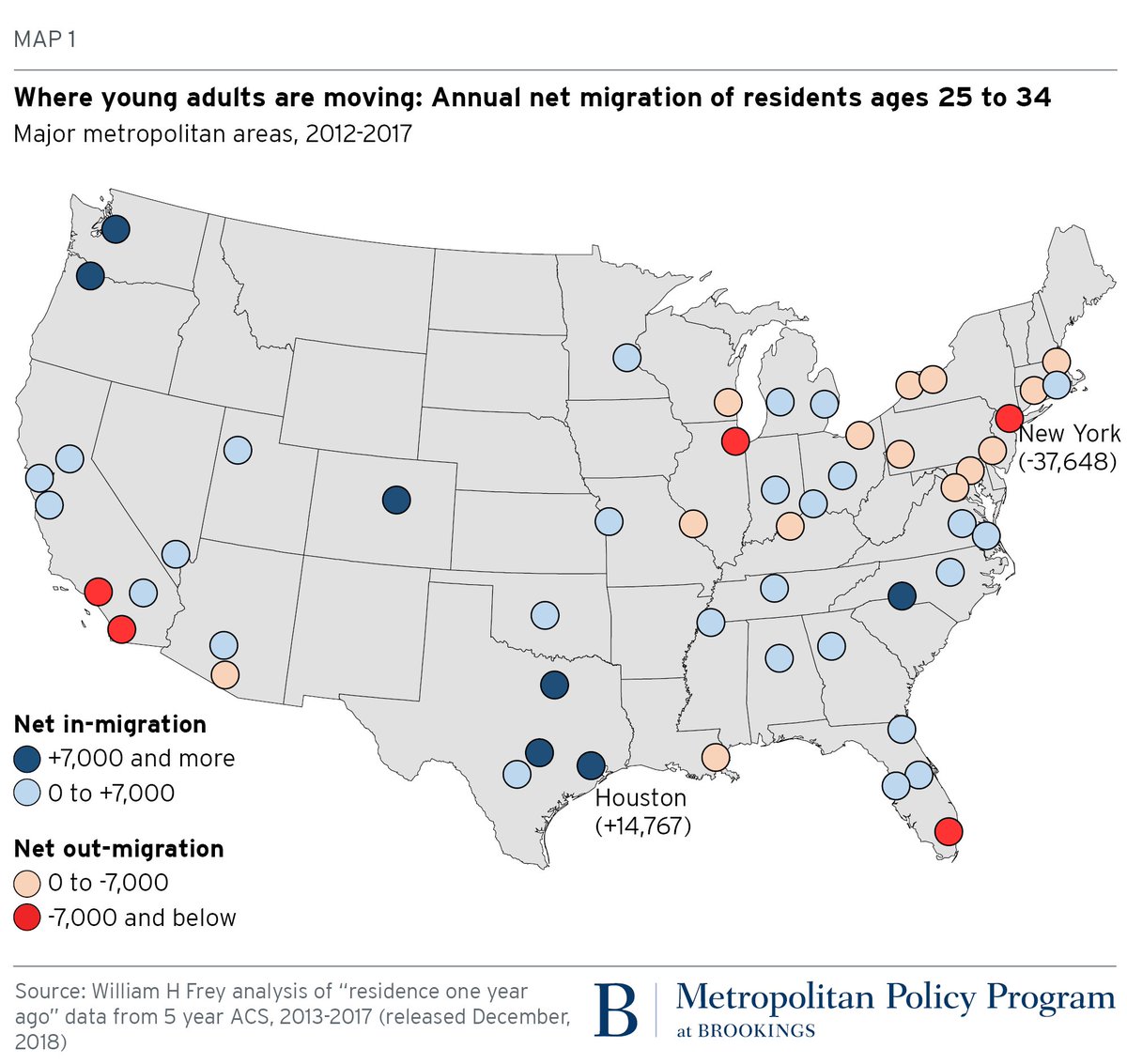
"By contrast, the biggest winner is Houston, a metro area that many planners and urban theorists regard with contempt. The Bayou City gained nearly 15,000 millennials net last year, while other big gainers included Dallas–Fort Worth and Austin, which gained 12,700 and 9,000, respectively. Last year, according to a Texas realtors report, a net 22,000 Californians moved to the Lone Star State."
"I want to call your attention to a new (not yet published) paper on the subject by researchers from Cornell University and McGill University. “A Comprehensive Welfare Impact Analysis for Road Expansion Projects” uses transportation data from the Dallas-Ft. Worth metro area to compare, quantitatively, the effects of four possible highway expansion options (in addition to doing nothing): adding a general purpose (GP) lane, adding a high-occupancy vehicle (HOV) lane, adding a priced ETL (electronic toll lane), or converting all lanes to conventional toll lanes. The priced ETL ranked highest in both regional economic impact and improving system-wide travel time, and was judged to produce the greatest increase in overall social welfare."
WSJ Video: California Home Prices Are Soaring. Here’s Why. The good news for Houston (and most of the rest of Texas) is that we're not afflicted by any of California's problems which are mentioned in the video, therefore housing remains affordable here.
CityLab maps the world's megaregions. I'm not sure how much I buy into the megaregion concept, especially when it crosses state and national borders, but at least we're grouped with the Texas Triangle now (as we should be) instead of separately with New Orleans like we used to be.
A Hypothesis About Airport Connectors. Metro needs to keep any airport connectors we build to affordable BRT. Excerpt on why they're politically popular but don't make economic sense:
"However, what I propose is that the high cost of airport connectors is not because the elite spends money on itself. Rather, it’s because many ordinary middle-class people fly a few times a year and wish for better airport transit, without thinking very hard about the costs and benefits. An airport connector appeals to a very wide section of the population, and may be very cheap if we divide the cost not by the number of daily users but by the number of unique annual users. Hence, it’s easier for politicians to support it, in a way they wouldn’t support an excessively costly subway line connecting a few residential neighborhoods to the city."
"Houston is easily my favorite Texas city, because it combines the best aspects of the other three... I prefer density over sprawl, big over small, new over old, and diversity over monoculture."
And here's the more extensive excerpt:
Houston
"Houston is easily my favorite Texas city, because it combines the best aspects of the other three. The metro area is similar in size to Dallas, and has the same rapid growth, ethnic diversity, and global feel. In fact, Dallas and Houston sit alone together as America’s foremost boomtowns, each growing by more than 144,000 last year throughout the metro area (the third place MSA, Atlanta, grew by a mere 95,000). But, like San Antonio and Austin, Houston has remained more tasteful than Dallas, with numerous interior neighborhoods that are urban, walkable, and separated from the innards of the city.
Not only is Houston Texas’ best city; it is among a handful of emerging ones in the U.S.—including Los Angeles, San Diego, Miami, Denver, Atlanta and Seattle—that will become the dense infill cities of tomorrow, joining the coastal legacy cities. The thing that differentiates Houston from the others, though, is that it doesn’t have the regulatory hurdles to stop this fundamentally market-oriented process. The city has no zoning code, which means a range of densities, uses and architectural styles can go anywhere in the city.
The folk wisdom is that this turned Houston into a sprawling mess like Dallas. But densification is already happening in Clutch City. This year it will lead the nation in multi-family housing construction, with 25,935 units entering the market (Dallas is #2 at 23,159). Much of this is going up rapidly via mid-rises in interior neighborhoods like Midtown, Montrose and Rice Military. Houston has the highest Walk Score of Texas’ big cities. Dallas, meanwhile, may feel more fragmented because of the low-density zoning in its central areas.
Of course, my choice, like anyone’s, is clouded by bias; I prefer density over sprawl, big over small, new over old, and diversity over monoculture."
"After adjusting the two sets of data to make them comparable prior to the time when one group adopted Complete Streets, they found that “Complete Streets policy has no effect on house prices, and therefore we are unable to find a positive amenity value from a municipality-level commitment to Complete Streets.”
"State DOTs should be far more cautious in agreeing to requests from municipalities to convert arterial routes to Complete Streets treatment. Most of the information provided by New Urbanists consists of anecdotes, rather than careful analysis such as Vandegriff and Zandoni have provided."
"After Hurricane Harvey, the city is back on its feet and showing off the everything-is-bigger-in-Texas attitude. Four food halls opened in 2018, including Finn Hall, which features up-and-coming chefs including the James Beard-nominated chef Jianyun Ye with a downtown outpost of his Chinese hot spot Mala Sichuan and a taqueria from the local favorite Goode Company. The five-diamond Post Oak Hotel opened in March 2018 with a two-story Rolls Royce showroom, art by Frank Stella and a 30,000-bottle wine cellar. The Menil Collection, known for its eclectic art ranging from Byzantine antiques to 20th-century Pop Art, underwent a seven-month renovation of its main building and opened the 30,000-square-foot Menil Drawing Institute. The low-slung white steel-and-glass building with a trapezoidal roof is the first addition to the Menil campus in 20 years and the first freestanding museum dedicated to modern drawing in the United States. The city’s museum boom continues with a massive expansion of the Museum of Fine Arts, Houston to be completed in 2020, a newly built location for the Holocaust Museum, which will move in the spring of 2019, and a restoration of the Apollo Mission Center that will open in time for the 50th anniversary of the moon landing in July."
"Transit riders are more sensitive to frequencies than to whether a transit vehicle runs on rubber tires or steel wheels. A bus carries fewer people than a train, but that’s a virtue, not a flaw, because it allows for higher frequencies. If Ft. Worth had used buses rather than rails for this route, it could have run those buses every 10 or 15 minutes (instead of hourly), attracting a lot more riders."
"Houston is a city of immigrants and engineers. Function trumps fashion with this no-nonsense crowd that expects to work hard and earn rewards based on merit. Looking at demographics and migration patterns, people voting with their feet consider the Bayou City the most egalitarian of the Texas metro areas."
Finally, I wanted to end with a longer set of excerpts from an excellent piece by Nolan Gray in CityLab: "How Cities Design Themselves"
"Sometimes when I read the papers of my fellow urban planners, I get the sense that they think cities are Disneyland or Club Med. Cities are labor markets. People go to cities to find a good job. Firms move to cities, which are expensive, because they are more likely to find the staff and specialists that they need. If a city’s attractive, that’s a bonus. But basically, they come to get a job.
...
Urban planning has an important role to play. With the exception of fire and safety regulation, planners should focus much less on what people do on their plot or in their apartment, and much more on the management of the public spaces, like streets and parks.
Insomuch as urban planners deal with land uses and densities, they should closely monitor trends to be aware of what’s happening. For instance, in New York, household size has plummeted over the past 30 years. Urban planners should be aware of that and address rigidities that prevent the city from accommodating those demographic changes.
An area where urban planners should play a much more active role is mobility, mainly by adapting existing systems to emerging trends. Urban mobility is the key to housing affordability. Improved urban transport makes more land available for housing and therefore allows low-income people to live in areas that are both affordable and accessible to most of the city.
..
In my book, I talk a lot about income distribution curves. Every time urban planners do something, they should ask: Who is going to pay?"
"Houston is one of the few regions where transit ridership is still growing. From 2012 to 2017, when San Antonio ridership declined by 23 percent, Houston ridership grew by 7 percent. In the first four months of 2018, when San Antonio ridership fell another 3.2 percent, it grew by 3.5 percent in Houston. (Houston’s market share still declined despite ridership growth because ridership didn’t grow as fast as driving.)
Houston’s success appears to be due to a major reorganization of bus routes. Instead of operating buses on a hub-and-spoke system focused on downtown, Houston rerouted them into a grid system. Since most jobs are no longer located downtown, a grid bus network allows more people to get to work with fewer transfers and out-of-the-way trips.
Houston’s success is not a complete victory. Houston-area transit ridership was much higher before the 2008 recession than it is today. Ridership peaked in 2007 at more than 102 million trips per year; in 2017, it was just 89 million trips per year."
"Houston is casually written off even more often than Los Angeles, which is saying something. Now the fourth largest city in the country in population — and gaining on third-place Chicago — it's an unruly place in terms of its urbanism, a place that (as Los Angeles once did) has room, or makes room, for a wide spectrum of architectural production, from the innovative to the ugly.
...
Roughly one in four residents of Houston's Harris County is foreign-born, a rate nearly as high as those in New York and Los Angeles. Houston's relationship with Dallas, the third biggest city in Texas, is something like L.A.'s with San Francisco; the southern city in each pair is less decorous, less fixed in its civic identity and (at the moment, at least) entirely more vital."
Speaking of LA, an observation that came out of my recent vacation there. It relates to this Cranky Flier post showing the dramatic increase in LAX traffic from 2009 to 2017, growing by more than 50% (!) in those 8 years. Why? My hypothesis: before the smartphone (circa 2007), vacationing in a city like LA was pretty nontrivial, involving a rent car in a large unfamiliar city and a lot of paper maps and planning - unlike New York, DC, San Francisco, London, Paris, Rome, and other older, more concentrated tourist cities with subway transit where you can just show up and figure it out without too much trouble. But now with a smartphone, LA is a whole lot easier to "wing it" on vacation: driving and exploring, finding good restaurants on Yelp or tourist attractions in TripAdvisor and navigating there easily (avoiding traffic!) with Google Maps or Waze. I think people have discovered this and LA has become a significantly more popular tourist destination. Maybe Houston will do the same on a smaller scale??
Interviewed on PBS News Hour about post-Harvey Houston development and recommendations going forward, New Opportunity Boomtown, Big Houston, market urbanism, and more
Before getting to this week's items, PBS News Hour had a 9-minute segment this week on Houston development after Harvey, which includes about a minute interviewing me starting at the 6:50 point. They interviewed me for about a half-hour on the top of my condo midrise in Midtown on Jan 12th, and it was freezing that day, thus the heavy coat. I think they did a fair job with the sound bites and summary of our conversation – I love that they used my “don’t throw the development baby out with the hurricane bathwater” line (which is my mantra/tagline on all things Harvey) - although I wish they had included the stat about Houston land developed since 1992 would have absorbed less than 0.4% of the water that fell.
Eliminate parking requirements (agree to long-term reductions)
Scale back minimum lot sizes (agree)
Get street design right (disagree on being hostile to cars)
I like that he gives a shout-out to the flexibility and adapatability of our lack of zoning, but I'm not as opposed to development on the fringes as he is. I like that we allow both urban and suburban development and let people choose what works for their lives.
From Market Urbanist Scott Beyer: Richard Florida's book hits, then misses, the New Urban crisis: If spatial segregation is the cause of urban America’s problems, then zoning deregulation is the solution. Maybe not a surprise, but I love this and totally agree!
Another great Market Urbanism post on the history and market distortions of zoning, with something originally aimed at preventing nuisances quickly being abused to be exclusionary.
I've got more, but that's already too much for one week!
"...compel employers who provide free parking to offer transit benefits (like a pre-tax bus pass) or a cash payment to workers who find another way to the office. The goal here isn’t to stamp out cars, but to let the non-drivers “cash out” the value of "free" parking. Research suggests this sort of “parking cash-out” works. A series of LA-based case studies by UCLA urban planner Donald Shoup found these programs can decrease the number of drivers who motor alone to work by 17 percent, and increase rates of carpooling, transit riding, biking, and walking."
WSJ: Where High-End Renovations Cost $704,000: "Rising home prices fuel high-end renovations in Houston; homeowners are confident they’ll recoup costs when they sell." Key excerpts:
"Everything’s big in Texas—including home renovations. Houston homeowners, with a median budget of $704,000, outspent remodelers in 74 other U.S. metro markets, according to an analysis of building permits for high-end projects. ... “People are feeling really good about the city, and the amount of money they can put into their houses,” said Stephen McNiel of Creative Property Restoration, a builder in Houston."
Definitely a sign of the high standard of living here (average salaries adjusted for the cost of living) that people can afford to spend so much on home renovations.
"With full recognition that our credibility is suspect, I nonetheless come today to proclaim Houston one of the great eating capitals of America. I mean (and here I mount the mechanical bull) far better than anywhere else in Texas, better than anywhere else in the Southwest, better for that matter than in my current place of residence, Washington, D.C. That the nation’s fourth-largest city is no longer one gigantic steak platter for oil barons should not constitute breaking news. One can go on about the city’s indigenous assets, such as its array of Gulf Coast ingredients and its surprising multiculturalism.
But the main reason for Houston’s culinary ascent is economic. This became clear to me one afternoon last fall while eating at Étoile, a vibrant French restaurant that opened in 2012 near the city’s famed Galleria mall, and whose chef and owner, Philippe Verpiand, hails from Provence. After running a restaurant in San Diego with his wife, Monica, for seven years, Mr. Verpiand decided in 2011 to check out Houston. What he discovered, he told me, was that the Bayou City “is very affordable and full of people who like to go out at night and spend money.” It costs probably one-third less to build and design a restaurant here than in California, he said, adding, “I can afford to pay sous-chefs full time and be able to spend the weekends fishing and duck hunting with my boys.”
Such cost savings are passed on to Houston’s consumers, who can enjoy a first-rate meal here for maybe two-thirds of what such a dinner would come to in New York or San Francisco."
Finally, continuing our series of COU videos on Texas cities, this week's focus city is San Antonio, a city I visited last weekend and really enjoyed despite the 100+ degree heat. The Pearl District is the most impressive industrial re-adaption I've ever seen - Houston needs something similar!
Rodeo tops SXSW+Mardi Gras, #2 zoo!, defending our diversity, traffic better than you think, top rankings, and more
Lots of small items to catch up on this week:
Love this story on how the Houston Zoo has been completely transformed as a public-private partnership over the last 15 years into the second-most visited zoo in the country last year (after San Diego) with 2.55 million visitors! If I were in charge, I'd see about giving them the golf course acreage next door (aren't there plenty of courses around Houston?) and really make a run at dethroning San Diego as the largest and best zoo in the country! Now if they can just get some pandas from China...
Can't say I've seen it, but evidently our traffic got better last year - the only city of the 25 worst where that happened. We fell from 11th 16th worst, and are now behind Austin.
"Also like Houston--which is routinely one of the nation's fastest-growing metros--the rodeo's overall 20-day attendance has spiked recently, going from under 2 million in 2009 to nearly 2.5 million last year. Attendance figures from the first 6 days of this year's rodeo suggests this number will increase yet more in 2017. Compare this with SXSW or Miami's Art Basel, both of which draw under 100,000 annually; or even Mardi Gras, which drew an estimated 1.4 million in 2017."
"Houston: Findings and Implications
The 2017 Metro Monitor’s Inclusive Growth Index shows that the Houston metro area did not make progress on economic inclusion, now ranking 64th overall. Houston dropped from 4th to 5th on overall measures of economic growth (now ranking 5th) but improved on prosperity, now ranking 2nd overall. Additionally, Houston posted the fastest productivity growth from 2010-2015, and posted the second-fastest gross metropolitan product (GMP) growth at over 28 percent, fueled by its energy, wholesale trade, and hospitality sectors as well as significant in-migration. This GMP growth also contributed to one of the largest increases in the average standard of living, but also saw one of the largest increases in relative poverty, as improvements in median wages within the metro area did not appear to extend to workers in the bottom half of the income distribution."
I'll make my point about this again: if coastal cities make themselves unaffordable to the poor and working class - so they move away - they look better on these poverty and median income stats, but did they really do a good thing? I would argue they didn't. Another case of twisted stats.
Finally, the National Review on Houston's multiculturalism, sparked by David Brooks' column quoting me on Houston. He does make some good points (including that the coasts have their ugly as well!), but I’m not sure I’m totally clear on his overall point. Brooks simply said there is an alternative model of conservative Republicanism that is immigrant friendly, and he pointed to Houston and Texas. All this guy’s describing of the nuances in Houston and Texas don’t seem to really counter that point. Yes, other cities can’t replicate our energy economy, but the rest of the Texas triangle cities aren’t the energy capital of the world and they thrive with immigrants as well. And he ignores how well we’re also assimilating Asian cultures, and Texas certainly does not have a long history of that!
An open dialogue on serious strategies for making Houston a better city, as well as a coalition-builder to make them happen. All comments, email, and support welcome.