Tuesday, December 19, 2023

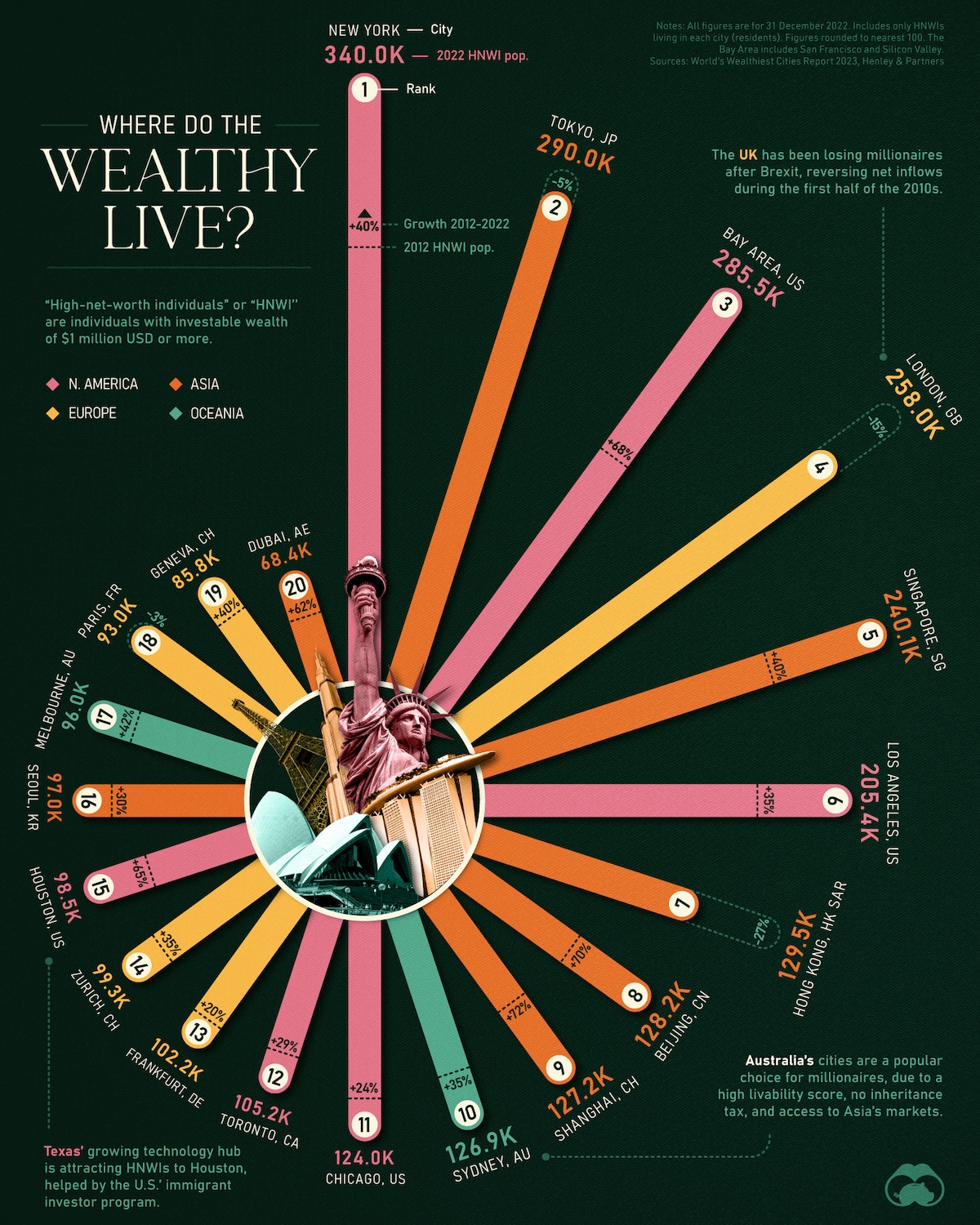
Houston's growing wealth, diversity, investability, tech scene (even over Austin!), food scene, and more

 Continuing to clear out some smaller items before the end of the year...

"Techstars isn’t the only entity scaling back in Austin, either. In November, unicorn Cart announced that it was moving its headquarters back to Houston after relocating to Austin in late 2021. The company, which describes itself as an e-commerce-as-a-service business, reached a $1.2 billion valuation in June after raising a $60 million Series C round of funding. 

Mitch Goulding, director of communications at Cart, told TechCrunch via email that the company had originally relocated its headquarters to Austin “with the explicit goal of attracting more software talent.” But as the company continues to scale (it claims to have seen its revenue climb by 9x since the end of 2021), it decided it needs to “augment other areas of the company,” including HR, finance, accounting and legal.

“We feel the move to Houston will unlock a deeper talent pool in these areas based on its position as a hub for major business,” Goulding said. 

It’s also a matter of cost and convenience. 

“Costs in Austin are high relative to Houston’s affordability, [and] Houston is also more accessible,” Goulding said. “It is typically easier and cheaper for employees flying in. It also tends to be easier for employees who drive in from across the state.”

"In Houston, Black-owned businesses have been thriving, with the city now rivaling Atlanta as a destination for Black families and young people.

“Everyone is coming to Houston,” said Victoria Walsh, 30, who moved from New Orleans for a restaurant job in 2018. “There’s a whole lot of jobs, a whole lot of new concepts, a new pop-up each week.”...

The city of Houston has long had thriving Black communities, but in recent years, the new arrivals have driven a kind of renaissance that is fueled, in large part, by who they are: middle-class Black people from other states with good jobs and business ideas. ...

“When you look at other cities, they’re not as diverse as Houston,” he said. “They don’t have as many opportunities.”

"Now, Houston’s transformation to an international hub for a growing number of multinational corporations — backed by one of the nation’s busiest international airports and global shipping ports — has helped propel the city to the top of the second annual FT-Nikkei Investing in America rankings. ...

That reputation has drawn in businesses both big and small. The Houston area is home to 26 Fortune 500 companies, making it the third-ranking metro area in the country. ...

The transition to green energy is helped by the knowhow that made it a centre for oil and gas. Houston boasts unrivalled technical expertise in energy, including manufacturing, engineering, trading markets, and complex industrial project management. It also has a robust energy infrastructure and the nation’s biggest port by tonnage. ...

“Increasingly, people working in the energy transition space are saying, you know, actually where the action is, is here,” says Tudor. “It’s not really San Francisco. It’s not really Boston. It’s Houston, Texas.”
  • Pros 👍: pleasantly surprised by Houston; plays up affordability, inner loop density, diversity, and the amazing food scene ("strong candidate for best food city in the US")
  • Cons 👎: bike and anti-car snob, toured Houston on bike in wonderful late October - maybe try coming in August sometime and see how bike-over-A/C'd-car you are then?... đŸ„”đŸ™„ I've said it before and I'll say it again: Houston was built around the car because it's the only way to bring an air conditioner with you everywhere you go!


Labels: , , , , , , , , , ,

Wednesday, September 27, 2023

Houston #1 std of living confirmed, #2 F500 HQs, higher speeds = higher incomes, screwy city metrics, and more

 Continuing to work through the summer backlog of smaller items...

"Demographer Wendell Cox’s recent estimates of U.S. housing affordability found unaffordable housing in Dallas, Houston, and other Texas cities that have historically been quite affordable. In a post about housing issues, I noted that Cox’s home price data were based on real estate transactions while the Census Bureau numbers are based on a cross-section of all homes in a region.

Before the pandemic, median real estate transaction prices were only 2 or 3 percent higher than Census Bureau values, indicating that people buying homes represented a good cross-section of America. In 2021, median real estate sale prices were at least 20 percent higher than Census Bureau values. As the recent real estate boom is driven by people who have discovered they can work remotely, which means people of above-average incomes, price-to-income ratios based on real estate transactions overestimate the true value-to-income ratios.

The 2022 data from the Census Bureau confirm this. The data show that the value-to-income ratio was 3.9 for the city of Houston and 3.2 for the Houston urban area. These are a lot lower than the 4.7 in Cox’s paper."
"Houston has the title of second most popular headquarters city for Fortune 500 firms... with 22 of them headquartered in the city... 
What makes Texas, or Houston for that matter, so appealing for corporations? Mostly the low cost of living and lack of taxes on businesses. Even Exxon has tightened its belt in the inflationary age, though, shedding its “God Pod” and consolidating its upper management’s formerly exclusive luxury suite into its preexisting Houston campus."
"faster cities are faster because they have more roads and are lower in density (which they describe as have a “larger land area”); and that those roads produce benefits by allowing faster top speeds more than by reducing congestion...The authors conclude that cities that want to increase speeds (and, by stated implication, worker incomes) should build more roads. While it admits that won’t be possible in Bangladesh, it should be possible in most cities and countries. Even if, as the anti-road people argue, building more roads simply leads to more driving, building roads that are faster leads to higher overall speeds which should produce enormous economic benefits."


Labels: , , , , , , ,

Wednesday, March 22, 2023

Problem, we have a Houston - Houstonians got a free $18k from min lot size reform, METRO 2nd worst for rail crime, The Economist loves Texas, HTX tops std of living, Houston sliding towards zoning? and more

 Lots of good smaller items again this week:

"Most of the nation’s major cities face a daunting future as middle-class taxpayers join an exodus to the suburbs, opting to work remotely as they exit downtowns marred by empty offices, vacant retail space and a deteriorating tax base."

"Firms like to open factories and offices in cities with plenty of skilled workers. When choosing between cities, they typically run an analysis to see how many potential employees live within a reasonable commute of a site. Poor traffic shrinks the radius, and by extension the labor pool, hurting a city’s chances of attracting companies."


Labels: , , , , , , , , , , ,

Wednesday, September 29, 2021

Infrastructure bill problems, Dallas TOD failure, CA vs TX, why transit has trouble competing, and more

I apologize for the sporadic posts over the summer while I was out-of-town with family, but I'm back and looking forward to catching up on a big backlog of smaller items that will probably take several weekly posts to get through.

"In short, TOD is simply a scam. Like Portland’s light-rail mafia, which guided subsidies to favored developers who would build TODs, Dallas light rail and TODs are merely a way of transferring money from taxpayers to developers."

"This page is not calling for abandonment of transit or extolling the virtues of the automobile. It is an attempt to lay out what transit is up against if it is to succeed. Pretending that the economic issues I describe can be made to go away is a guaranteed recipe for failure."
“Right now market forces are telling California, ‘Get your s-- together,’ ” said report co-author Mark Duggan, director of the Stanford Institute for Economic Policy Research. “This exodus thing — I think it’s a risk.” 
"the number of companies relocating their HQs out of CA is running at twice the rate of recent years and is showing no signs of slowing...The winning state is Texas, which for many years has been the most popular destination for CA company relocations" 
"Like many other tech executives, I think Texas is positioned to outpace California due to its proximity to the world's top companies in energy, healthcare, and aerospace, to name a few, and its willingness to innovate with technology in those industries."
  • Painted Into a Corner - It could be time to reconsider land-use laws that contribute to runaway housing costs. Hat tip to George. Really glad to see Houston avoid a lot of these issues. Conclusion:
"The role of cities in the 21st century has not yet been determined. Cities with outdated housing policies may no longer be aspirational. The future of successful cities must begin with enabling a broad set of people to live there, which necessitates affordable housing. Making housing affordable to a large set of people with a range of incomes has its advantages. 

This allows people who have lower-paying, service-industry jobs to live near where they work. It promotes a broader set of cultures within a city. Multiculturalism should be one of the values of large cities. When a city is large enough, it can support such things as museums, art galleries, performing arts and professional sports franchises. The greatest thing that a city can provide is social mobility."
  • WSJ: Mass Spending for Mass Transit - Democrats want the GOP to rescue big-city rail and public unions. This is why I have mixed feelings about the $1T infrastructure bill - a whole heap of the money will be going into a black hole, especially Amtrak.

Labels: , , , , , , , , , , , , ,

Sunday, March 14, 2021

Texas Startup Manifesto 2.0, new top rankings, Houston housing elasticity, remote work reshaping America, and more

 Real backlog of smaller items this week...

"Houston—whose median home values are only 76% of the national average—stands out. Since 2010, it has had America’s 2nd-highest net population growth but is #1 in permits issued. This has made it an affordable city even in core locations; 1-bedroom, 1-bath downtown condo units can be found for under $200,000. 
How does Houston remain so elastic? Less regulation. The city famously lacks a zoning code, and many of its suburbs are also very pro-growth. This means it has fewer legal barriers to more housing than inelastic coastal metros, where proposed zoning changes can trigger lengthy and contentious review processes."

"Similar proposals show that the basic idea of hyperlocal zoning has precedent. Houston has been able to remain a city without zoning laws in part because residents had options in the form of deed restrictions, where neighbors could choose their own rules at the hyperlocal level. In 1998, policymakers were able to reduce the city’s minimum lot sizes by allowing residents on individual streets and blocks to opt out of that change, a move which helped overcome local resistance because residents felt they had control over the risks. The result? Some 25,000 more housing units, including denser townhomes, built close to job centers and transit, many of which Houstonians would not have seen built otherwise."
  • WSJ: How Remote Work Is Reshaping America’s Urban Geography (archive link) - Smaller cities and communities are turning into ‘Zoom towns’ and competing with coastal hubs as workers move to find more space and lower costs.  Basically, Richard Florida articulates Creative Class 2.0, which is the same as 1.0 but for remote workers outside superstar cities. Key excerpts:
Eye-opening stat: "remote workers are often more efficient than their in-office counterparts. They don’t waste hours on mind-numbing commutes, and they aren’t distracted by unnecessary meetings and water-cooler chitchat. The productivity boost to the U.S. economy from remote work could be as high as 2.5%, according to research by Stanford University economist Nick Bloom and colleagues." 
Conclusion: "The remote-work revolution promises to change the way that Americans work and live. It will allow smaller cities, suburbs and rural areas to compete with the superstar cities on the basis of price and amenities. It will shift the main thrust of economic development from paying incentives to big employers to investing and building up a community’s quality of life. As communities attract more remote workers, their tax bases will grow, allowing them to improve schools and public services, benefiting everyone. Eventually, companies will come too. That holds out the possibility of a better, more virtuous circle of economic development."
Finally, a couple items on Houston as a startup hub. First, we rank #4 on this list for annual startup formations and jobs created by startups (#10 for formation rate), behind DFW but - surprisingly - ahead of Austin! Second, the excellent Texas Startup Manifesto 2.0 is out (highly recommended), arguing for treating the Texas Triangle as one giant startup ecosystem (absolutely), with this excerpt on Houston: 
"Houston (East and Gulf Coast) is the fourth largest, and the seventh most diverse city in the US. It’s the energy capital of the world and is home to the Texas Medical Center (TMC), the world’s largest concentration of healthcare delivery and research institutions; to the NASA Johnson Space Center, a hub for cutting-edge human space flight research and astronaut training; to the number one seaport in the nation for waterborne tonnage, for foreign waterborne tonnage, and for vessel transits. Houston is an international city — a seaport, a spaceport, a “health-port”, and an “energy-port.” As a result, Houston has a diverse, high-tech industry ecosystem, and is increasingly an industry destination, serving as the home to 22 Fortune 500 company headquarters (with Hewlett-Packard Enterprise becoming the latest addition)."

Labels: , , , , , , , , , , , , , ,

Sunday, December 20, 2020

Post-pandemic housing reality, charter amendment, alt-cities to CA-NYC, housing boom, and more

 A crazy week with a *ton* of new items I'll only be able to partially get through in this post, including some followups to last week's post about California tech companies moving to Texas:

"In terms of tech hype, Houston isn’t Austin, but it does check an awful lot of boxes for Musk. Also, if he spends much time on Twitter—and we know he does—Musk might be aware that there is a robust argument among Texans on the platform about whether Austin has “jumped the shark” and been supplanted by Houston for the title of coolest city in Texas."
"Affordable suburban living
From the 1980s to the mid-1990s, cities suffered from high crime rates and numerous quality of life issues. New York City, San Francisco, Los Angeles, and some other major cities have recreated the environment of that era, with non-scientific pandemic restrictions that devastated local businesses and a penchant for placing the mentally ill directly in family-oriented, residential neighborhoods. These cities have stopped prosecuting many property and quality of life crimes, inevitably leading to bad quality of life and apathetic enforcement of more serious crimes.

The coronavirus has reset consumer expectations back to suburban living with the mental health benefits of living in greenspace. There has been an exodus from major industry centers to their suburbs and to the alt-cities. The alt-cities of Miami, Austin, and Nashville all offer car-friendly, suburban living, relatively cheap housing, and continual housing construction. With the acceleration of sustainable building materials and clean and cheap energy, the urban planning rationale to pack people into urban cores with mass transportation was already beginning to fray, and the coronavirus has sealed its fate.
...
Low taxes and quality government
People are not moving solely for tax purposes. New York and California’s tax rates are only a few points higher than they were twenty years ago. However, once people decide to move, of course tax rate is a factor in choosing a destination. Florida, Texas, and Tennessee seemingly offer everything that California and New York offer: highways, streets, schools, police departments, fire departments, and such. All the government services one would expect are there, and none of the capital gains taxes that entrepreneurs and venture capitalists typically pay.

As comedian and political commentator Bill Maher recently noted, California is reminiscent of a 1970s Italy, with high taxes and terrible government services. In return for high taxes, one would expect to go to Hunter's Point, East Palo Alto, or East San Jose and see excellent schools and services for disadvantaged people. A hyperloop instead of a failed high-speed train. Fire mitigation and stable power to complement long term climate change goals. A boom in middle-class housing rather than a $700K median house price. California and New York are becoming bad versions of Singapore, with a wealthy technocratic elite, an immigrant servant class, and a collapsed middle class."
"Buyers are paying more, too: The average sale price in Houston jumped by about 15 percent to a historic high of $341,765 in November. And luxury homes—or those going for more than $775,000—saw a staggering 80-percent increase in demand, as well."
  • The Houston Charter Amendment Petition Coalition has a good video arguing for the need to spread power from our mayor to city council by allowing three city council members to put items on the agenda.
  • Unfortunate that Houston is not on this list of top ten cities gaining residents during the pandemic (Austin and Dallas are), but with the severe oil recession, it's not too surprising. I have still seen a ton of out-of-state plates around town, and do think we are getting some significant migration during the pandemic. 
  • Southwest announced new service from Houston Intergalactic to Dallas Love, Chicago Midway, Denver, Nashville, and New Orleans starting April 12th. I expect Dallas Love to be especially popular for The Woodlands and north Houston suburbs since United only goes to less convenient DFW.
Finally, our think tank the Urban Reform Institute - A Center for Opportunity Urbanism held a recent panel on the Post-Pandemic Housing Reality in conjunction with the Bush Center in Dallas.  A lot of good insights here - well worth watching.


Labels: , , , , , , , , , , ,

Sunday, December 13, 2020

Texas +3, California -3: More details on the HPE, Elon Musk, and Oracle moves to TX

The big news this week is all the different tech companies announcing their moves to Texas.

The big one for Houston is the announcement that HP Enterprise is moving its HQ from Silicon Valley to Spring just north of Houston - a long-term legacy benefit of Compaq Computer (which was acquired by HP and kept substantial operations here).

“Houston is also an attractive market for us to recruit and retain talent, and a great place to do business,” Mr. Neri said, adding that as one of the largest and most diverse cities in the country, “Houston provides the opportunity over time to draw more diverse talent into our ranks.”

  • And some more detail from their press release: (hat tip George)  
"Why Houston?
    Houston has long been our largest U.S. employment hub, and construction has been underway since the beginning of the year on a new, state-of-the-art campus in the area. Houston is also an attractive market for us to recruit and retain talent, and a great place to do business. The most diverse city in America and the fourth largest, Houston provides the opportunity over time to draw more diverse talent into our ranks – a key priority for HPE as we work to be unconditionally inclusive.
      We also anticipate long term cost savings associated with this move that we can reinvest in key areas of our business and innovation."
      • And finally a repost from Facebook that digs into what that increased affordability really means for employees:
      "Hewlett-Packard announced its leaving Palo Alto for Houston. 
      $1,100 is the average rent in Houston. 
      $3,350 is the average rent in Palo Alto. 
      Just to give a concept of how much the extra $2,250 a month that saves is. 
      $530 is the average monthly payment on a car. 
      $460 is the monthly individual cost of health insurance. 
      $400 is the average monthly cost of food. 
      $145 is the average monthly spending on gas for a car. 
      $130 is the average monthly cost of car insurance. 
      $1,665 a month total. 
      Those 5 things which are just as essential for people in Palo Alto as Houston and cost about as much in both places cost that much. 
      If an HP employee moved to Houston and cut rent cost down, but chose to save $585 more a month and put it in a 401k paying 5% for 10 years, they’d have $92,700 or 7 years average rent in Houston. 
      Those 5 things are also essential, so let’s just say an HP employee moved to Houston and saved the entire $2,250 a month for 10 years. 
      $27,000 saved a year. 
      $357,000 saved over 10 years
      27 years worth of rent in Houston. 
      9 years worth of rent in Palo Alto. 
      A lot of people have a lot of different reasons for companies leaving, but I think the rent factor and how it’s extremely hard for employees to live is the problem. 
      Hewlett-Packard was the birth of Silicon Valley and it’s leaving. 
      I don’t see it as unlikely a future where Facebook, Uber, Google and more could join."
      Then there are the other stories on Elon Musk's and Oracle's moves to Austin:
      "California, with its steep housing costs, raging wildfires and strict business regulations, has been losing residents to other states, with Texas as the most popular exodus destination. Of more than 653,000 people who left California last year, about 82,000 went to Texas, more than any other state, according to census figures. 
      Or, as The Stanford Review wrote in a nod to the native Texan George Strait, “All of California’s Exes Are Moving to Texas.” (😅) ...
      California and Texas — two economic powerhouses, one led by Democrats and the other by Republicans, with respective populations of 40 million and 29 million — are in many ways natural frenemies. It is a rivalry made up of In-N-Out versus Whataburger, of Disneyland versus the State Fair of Texas, of tacos versus, well, other tacos."
      "Taxes, a more affordable cost of living for employees, a lower cost of doing business, and less competition for talent are among the top drivers for the companies’ moves, though there is also a growing sense that culture is a factor, as well."
      All in all a very good week for Houston and Texas!  Let's hope this is just the beginning of a much larger tech exodus from California to Texas...

      Labels: , , , , , , , ,

      Monday, October 19, 2020

      A new strategy for securing Houston's economic future

      Talk has been growing in recent years about Houston's future in a less carbon-intensive energy world.  Will we still be the world's energy capital in the coming decades, and what does that mean? The Greater Houston Partnership and Center for Houston's Future have taken the lead on this challenge with their Energy 2.0 and energy transition work, and I hope they're getting traction with it (despite pandemic distractions).  We certainly have a lot of expertise here that can work on big problems like carbon capture with the right economic incentives.

      Another strategy is growing our innovation and startup ecosystem to build the companies of tomorrow - especially in energy, space, and biotech - and I think there has been great progress made in recent years, including Rice's building of the Ion in Midtown.  One area that has not been as successful is trying to attract tech companies building new offices.  To be brutally honest, we can't out-Austin Austin.

      The energy transition and innovation ecosystem are both great initiatives to help secure Houston's economic future, but I think there's a third opportunity we're overlooking. It plays perfectly to our strengths:

      • America's most affordable global city (vs. NYC, LA, Chicago, SF, Miami)
      • Being more attractive to global migrants than domestic ones (which seem to be more interested in places like Austin, Denver, and Nashville)
      • Large expat communities from countries all over the world
      • 92 foreign consular offices, the third-largest set in the US after NYC and LA
      • One of the largest ports and industrial bases in the country
      • A friendly and welcoming local culture
      • A huge United hub at IAH with nonstops covering all of the Americas in addition to European, Asian, Middle Eastern, and ANZ connections.

      IAH nonstops on United

      Put all those strengths together and what's the opportunity? To be the location of choice for foreign companies establishing their branch office for the Americas, especially industrial ones.  There are thousands of fast-growing companies around the world that will need to establish a presence in the Americas at some point, and Houston is really the ideal place for them to put it for all the reasons listed above.

      I think we already compete for these to some extent, but there's an opportunity to do it much more aggressively with a formal, well-funded program that cooperates closely with all our foreign consulates to identify their up-and-coming companies and start wooing them as early as possible. Without outside influence, they probably tend to end up in the cities that are more obvious and well-known to them like NYC, LA, and Miami.  But if we intervene early and show them how much better Houston will ultimately be for both their business and their employees, I think we can win over a substantial number of them.  Their expat employees used to small flats and public transport in crowded cities will be blown away by the equivalent home and car they can buy in Houston, Sugar Land, or The Woodlands!

      These foreign branch offices aren't as sexy as green energy, tech, or entrepreneurial startups, but over time they could provide a very strong foundational component to Houston's economy with a whole lot less uncertainty and volatility.  Even better, we won't have that much competition - it's an opportunity ignored by most cities as they chase the hot tech companies and try to cultivate their own startup scenes.  Foreign corporate offices should definitely be the third strategy to secure Houston's economic future in a world increasingly hostile to oil and gas.

      Would love to hear additional thoughts and feedback in the comments...

      UPDATE 4/14/21: Here's one great example - Growing Italian company with U.S. HQ in Houston launches new industrial-scale 3D printing.

      Labels: , , , , , , , , , , ,

      Sunday, June 14, 2020

      HTX most affordable high-growth metro, couple chooses Houston, TX winning vs CA, airport rail fail, modern innovative transit, and more

      I've got a long road trip coming up so posts may get infrequent for a while. This is my attempt to clear out as much of the backlog as possible before leaving:
      1. Houston is home to more than 500 oil and gas exploration and production firms.
      2. Houston houses hundreds of firms that provide supporting activities to the oil and gas industry.
      3. Houston is home to nine refineries that process 2.3 million barrels of crude oil every day (which makes it one of the biggest crude oil producers in the world).
      4. The Energy Corridor, which stretches for 7 miles along Interstate 10, encompasses many businesses engaged in energy operations.
      5. Houston may soon end up with a second energy corridor due to the continuing expansion of local businesses.
      6. Houston houses more than 4,600 energy-related companies.
      7. The city alone employs around 1/3 of the jobs across Texas in gas and oil extraction.
      8. Houston is the center of foreign investment in energy.
      • Governing on TX vs. CA: A Leg Up in the Search for Prosperity: Economic Freedom - Despite their very different attitudes toward the role of government, California and Texas have both found success. But the Lone Star State's small-government/low-tax model gives it an edge. Some excerpts:
      "Texas is best understood as a place where the private sector prevails over the public sector. Among the 50 states, it ranks near the top in economic freedom, a measure of fiscal and regulatory policy, and near the bottom in overall tax burden. It's a state known for building, with Dallas and Houston routinely among the top metros in new home permits and Austin first in the nation for permits per capita since 2004. But state and local government spending per capita is the 11th-lowest of any state, according to data from the Tax Policy Center.  ...
       And it's not just people. Businesses are leaving California too, at an estimated annual clip of over 1,000. For 12 straight years Texas has been the biggest recipient of businesses leaving California. Texas has long sought to capitalize on and accelerate that trend, even running ads in California touting Texas' business friendliness. 
      More than data, though, it's the feeling of what can be accomplished in a state that emphasizes freedom versus one strangled in red tape and high taxes. Houston ended veterans' homelessness in part by cheaply building large supportive housing projects; California cities have spent billions fighting homelessness, but still have tent cities because it costs so much to build affordable housing there. Dallas has, over three decades, built the nation's longest light-rail system, and a private company is planning high-speed rail between there and Houston. California metros have struggled to add capacity to their transit systems, and last year the state's high-speed rail project lost federal funding due to ongoing delay. Perhaps most damning is an annual survey by Chief Executive magazine asking CEOs nationwide to rank state business climates. Texas has been first for 15 straight years, and California in last place for five."
      "Indeed, Houston’s infamous lack of zoning could end up being one of its greatest assets in pursuing climate goals. Without all of the anti-density baggage that comes with zoning — from apartment bans to an onerous approvals process — there is relatively little standing in the way of a rapidly densifying Houston and all of the environmental benefits it brings."
      "The best-performing newer systems in our database, such as Minneapolis, Seattle, and Houston, are all compact, serving urban areas near downtown. By contrast, larger light rail systems that stretch into low-density suburban areas tend to underperform.  ...
      Houston has taken a step in the right direction by abolishing parking minimums in the Downtown, Midtown, and East Midtown neighborhoods, all of which are served by light rail. ...
      In Houston, the cornerstone of a recently approved light rail system is a line to Hobby Airport through industrial and low-density residential areas, estimated to cost $167,000 per daily rider. ...
      Another form of overexpansion comes from the tendency of light rail planners to overvalue airport service. It’s easier to form a broad political coalition for airport service than for run-of-the-mill transit improvements. City power brokers like to impress out-of-town visitors with airports, and suburban residents who do not use transit regularly imagine that a train for their occasional airport trips would be convenient. 
      Airport connectors, however, tend to perform poorly. Airports are usually in remote locations, so light rail to airports requires extensive capital construction; the slow speeds of light rail relative to freeways matter more for long-distance trips from airports to downtown. Moreover, businesses that surround airports, such as industrial suppliers and distribution centers, demand large amounts of land and are difficult to access on foot, making them low-value destinations for transit ridership. Finally, airport noise and pollution make the surrounding areas less desirable for the sort of redevelopment that might improve ridership."
      Finally, I wanted to end with one of my most popular tweets ever about walking through a random neighborhood near Midtown and boom - this awesomeness suddenly appears. Think a zoned city would allow this?! Gotta love Houston!


      Labels: , , , , , , , , , , , , , ,

      Sunday, January 05, 2020

      Three perfect days in HTX, growth forecasts, increasing our density, reducing homelessness, protesting property taxes, and more

      Happy New Year/Decade everyone! Hope you enjoyed your holidays as much as I did (OC/LA w/ family). Lots of backlogged smaller items, but before we get to them, a short word about our sponsor: if one of your new year's resolutions is to save big money on electricity this year, My Best Plan is incredible at absolutely optimizing the lowest-cost electricity plan for you.  I've known David over there for years (fellow Rice MBA), and his optimization algorithm is the best, bar none. And completely unbiased too, which can't be said for some of the other optimizers out there that have been uncovered as fronts for electricity marketing companies.  Send him (or me) your latest electricity bill to get an estimate of your potential savings - it's free, and you have nothing to lose while potentially saving hundreds or even thousands of dollars (as he's saved me over the years).

      On to this week's items:
      Finally, I'd like to end with this United's Hemispheres magazine video on 3 perfect days Houston. Hat tip to George.


      Labels: , , , , , , , , , , , , , , ,

      Monday, December 10, 2018

      Bush and Houston, #1 take-home pay, Europe's rail fail, increasing access to jobs, zoning as crony capitalism, transit's decline, Houston beats Austin and Dallas for affordable housing, and more

      Apologies for the long gap between posts due to travel.  Catching up on many smaller items:
      "So Dallas has decided to legalize the granny flat — subject to enough rules and regulations to ensure that this has approximately zero impact on the housing market. The political mind at work again: Dallas studied Austin’s granny-flat liberalization program, which over the course of several years saw 200 units come onto the market, some of them new construction but mostly the rental of properties that hadn’t been rented before. Austin has almost 1 million people. Dallas copied the Austin model — on purpose, knowing that it would produce negligible results
      Let’s summarize: The city, having prohibited a common form of affordable housing, decided to reverse that prohibition in the hopes of bringing back some of that affordable housing by following the example of another city whose efforts produced basically no affordable housing. Ingenious! 
      Down the road a bit in Houston, they’ve had some success with a radically different approach: building houses."
      "For decades transit planning agencies and public officials (including when I served on the Los Angeles County Transportation Commission) have claimed that new transit rail systems can materially reduce traffic congestion. The development of access metrics should put an end to such misconceptions (Note 3). 
      Regional planning agencies, transportation agencies and public officials should use the access metrics to direct funding to strategies that improve 30 minute access throughout cities. That principally means attention to improving the highway system. It’s time to develop a metric for urban transportation investments to address the fundamental goal of improving access, specifically the cost per new percentage point of job access. Getting people more access is critical to strong economies and reducing poverty, and deserves an assessment based on facts, not wishful thinking or mythology."
      "Five cities—New York, Chicago, Dallas, Houston, San Francisco—accounted for a third of all Fortune 500 headquarters and half of Fortune 500 firms’ profits last year"
      Finally, a moment of remembrance for a great Houstonian, George H.W. Bush, whose statue I was admiring at the airport just hours before his death hit the news.  And a quote I love from the NYT piece talking about his relationship with Houston:
      "Mr. Bush and Houston — both a little quirky, a little square, a little misunderstood — were a natural fit. "

      Labels: , , , , , , , , , , , , ,

      Wednesday, November 14, 2018

      Amazon HQ2 winners vs. Houston

      Today's guest post is from Oscar Slotboom:

      Observations on Amazon's HQ2 Announcement

      Regular blog readers may recall my October 2017 post where I assessed Houston's chances for winning HQ2 and concluded that Houston and Amazon were a poor match, and Houston had no chance of winning. Of course, Houston was not among the finalists, which in my view was a good result since it avoided the expenditure of local time and resources in a futile effort, although the Greater Houston Partnership may have gladly incurred the cost for the "prestige" of being a finalist.

      Tory subsequently added his views (1, 2) on Houston's lack of finalist status
      1. Amazon did not want to compete with the oil industry for talent, since periodic booms make the industry flush with cash for raiding talent
      2. Amazon did not want to be seen squeezing Houston for incentives after Hurricane Harvey
      A Good Business Climate with Low Costs Was Not Amazon's Priority
      Now that we know the winners, it is clear that Houston was totally incompatible with Amazon's HQ2 desires. Houston's strengths are a low cost of living, ample supply of housing, and a good business climate, providing a lower cost of doing business. Finalists Atlanta and Dallas also have these strengths. Amazon chose the cities ranked #1 and #3 for the highest cost of living in the U.S. (chart from Monday's Chronicle). The much smaller operations center in Nashville slated for 5000 workers is a lower cost location, however.


      (click to enlarge)
      On Sunday the Dallas Morning News reported on the higher costs of living in NYC and DC, particularly housing, including these graphics.


      It appears that the deciding factors were public transit and workforce availability in both cities, and enhanced ability to influence the federal government with the Arlington location (as well as being convenient to Jeff Bezos' DC home). New York state is reported to be providing $1.5 billion in incentives plus the potential for tax credits per eligible employee, while Virginia was reported by WSJ to "grant $550 million over 12 years as long as Amazon creates 25,000 jobs with an average wage of over $150,000."

      In a Twitter post after the initial leak of the winners, Tory mentioned that the selection may be designed to attract a certain workforce, mainly recent college graduates and single 20-somethings who want to live in trendy cities, while frightening away 30-something family-oriented employees who won't be able to afford housing (or face super-long commutes) and 40+ workers who won't want to pay the premium to live in a trendy area. The smaller Nashville office, in contrast, may be attractive to everyone.
      "Confirms my suspicions that tech companies strongly prefer cheap young single employees willing to work long hours over older family-centered employees that cost more and work less, so they pick cities as family-unfriendly as possible to drive that turnover."
      Houston's Response
      Of course, Houston's exclusion from the finalist list forced some introspection on our competitive position for attracting tech jobs, and spurred local leadership to strengthen tech-oriented startup activity, as was nicely reported recently by the Dallas Morning News.

      But making Houston attractive to a big tech employer like Amazon will be very difficult and may have negative effects, since a workforce realignment to Amazon-style tech skills may weaken or starve the specialized and disparate STEM skills needed by local industries. But that's another topic.

      Head Scratcher
      While Amazon has massive revenue and a huge market capitalization, it reported good profits for the first time only this year, and is generally a low-margin operation. It seems that Amazon will have to pay higher wages for those 50,000 workers in NYC and DC, maybe much higher, as compared to other finalist cities. The Virginia incentives appear to require an average salary of $150,000 per employee, 50% higher than the $100,000 listed in the original Amazon requirement. Also, the majority of those 50,000 jobs are likely to be routine, run-of-the-mill IT and administrative jobs, not really requiring a premium workforce in an elite location and easily handled by a lower-cost workforce in Chicago, Atlanta, Dallas, or other finalist cities.

      Update 2017-11-21 
      WSJ is reporting that half the jobs at both the NYC and DC  sites will be non-tech positions, and will be "administrative jobs, custodial staff, HR and [other staffers]".

      Biggest Losers
      Chicago and Atlanta, which are both very qualified, have excellent downtown locations available, really wanted to win and were believed to offer substantial incentives. The #3 loser Dallas, which was less qualified due to weaker higher education and no prime downtown site, offered up to $1.1 billion in incentives for the full 50K jobs (or $550 million for 25K jobs). Maryland and Newark offered massive incentive packages but were passed over for other locations in their regions.

      Houston can take solace in the fact that Atlanta and Dallas, which are our closest competitive/peer cities, both were shut out.

      Cities that Win By Losing
      Boston, Austin, and Denver, which all would sustain substantial negatives from the large Amazon presence.

      The other finalist cities were not qualified and had no chance of winning, but did get some good press from being on the finalist list.

      Labels: , , , , ,

      Sunday, June 03, 2018

      The real reasons Amazon didn't shortlist Houston for HQ2, urbanism doesn't reduce transportation costs, your TX right to AirBnB, and more

      I'd like to open my post this week on Houston's hand-wringing over not being shortlisted for the Amazon HQ2. Now while I'm all for improving the city, and am excited about the new developments in the "innovation corridor" that might have been at least partially sparked by the rejection, we need to get some clarity on the real reasons Amazon didn't shortlist us (IMHO), and it's not because we're not good enough:
      1. They don't want to compete with the energy industry for talent, especially when oil might spike to unknown highs at any time.  At the end of the day, Amazon runs a pretty thin-margin business built on tech talent, and if the energy companies poach their talent whenever they're swiming in cash from high oil prices - or make them pay that talent more to keep them - it will destroy those margins. Not an option.
      2. They didn't want to be seen as squeezing Houston for incentives while it's recovering from Harvey. That would definitely look very, very bad from a PR perspective.
      As I've mentioned before, I ultimately think they're angling to end up in the DC area, mainly because there is a plentiful supply of underpaid and demotivated government tech talent there they can easily poach.

      Moving on to this week's items:
      "Perhaps the paper’s significance was best summed up by Smart’s mother, who was apparently unfazed by its somewhat surprising conclusion. “She was like, ‘Of course,’” Smart recalled. “’Everyone loves cars. It doesn’t matter where you live.’”
      "The reason is simple — cars are vastly superior to alternatives for the vast majority of individuals and circumstances.  Automobiles have far greater and more flexible passenger- and cargo-carrying capacities than transit. They allow direct, point-to-point service, unlike transit. They allow self-scheduling rather than requiring advance planning. They save time, especially time spent waiting, which surveys find transit riders find far more onerous. They have far better multi-stop trip capability. They offer a safer, more comfortable, more controllable environment, from the seats to the temperature to the music to the company.
      ...
      The superiority of automobiles doesn’t stop at the obvious, either. They expand workers’ access to jobs and educational opportunities, increase productivity and incomes, improve purchasing choices, lower consumer prices and widen social options. Trying to inconvenience people out of their cars also undermines those major benefits.

      Cars’ allow decreased commuting times if not hamstrung, providing workers access to far more potential jobs and training possibilities. That improves worker-employer matches, with expanded productivity raising workers’ incomes as well as benefiting employers. One study found that 10 percent faster travel raised worker productivity by 3 percent, and increasing from 3 mph walking speed to 30 mph driving is a 900 percent increase. In a similar vein, a Harvard analysis found that for those lacking high-school diplomas, owning a car increased monthly earnings by $1,100.
      ...
      As Randal O’Toole noted: “Anyone who prefers not to drive can find neighborhoods 
 where they can walk to stores that offer a limited selection of high-priced goods, enjoy limited recreation and social opportunities, and take slow public transit vehicles to some but not all regional employment centers, the same as many Americans did in 1920. But the automobile provides people with far more benefits and opportunities than they could ever have without it.”

      Labels: , , , , , ,

      Friday, January 19, 2018

      Why Amazon's HQ2 rejection is good for Houston (plus a winner prediction)

      Ok let's talk about the elephant in the room, Amazon's rejection of Houston for its HQ2 top 20 finalists list, validating Oscar and I's prediction (my key point: nobody wants to compete with energy companies for tech talent when oil might shoot up to unknown highs at any time!)  I don't think it's anything we need to panic about - I'm sure the freak timing of Harvey was the dominant factor. It's also important to remember that economic incentives are driven far more at the state level than the city, and so Amazon wants a wide range of states in the bidding war.  Amazon knows that by including cities like Indy and Columbus, Indiana and Ohio will go all-out on incentives, which they can then leverage over more desirable locations that aren't as likely to play the incentive game (NYC, DC, Boston, LA, Denver, etc.).  It doesn't mean they're more desirable locations than Houston.  Houston was not needed because Texas is already in the game with DFW and Austin, which are honestly better fits for Amazon if they choose Texas.

      I personally think they want it in the DC region if they can get the incentives they want:
      • DC, Northern Virginia, and Maryland all made the final cut - lots of options.
      • Bezos has a home there and owns the Washington Post.
      • Most importantly, it's perfect from a talent perspective: DC is filled with underpaid and disillusioned government workers (including tech) - so it will be easy pickings.  In fact, I think an argument can be made that taxpayers are likely to be screwed twice over: once for the direct incentives, and a second time as the government has to raise salaries to recruit and hold on to tech talent in competition with Amazon.
      There is one great silver lining for Houston, as Aaron Renn points out in his piece:
      "The cities which made this list may also regret it. Putting together an initial bid only required a limited amount of money and civic time and attention. Now the costs start going up for the losers. It may well have been better to be one of the people who got cut early than to keep making through all these rounds only to lose (or potentially even to win)."
      We're saving a lot of resources we don't have to spend on a losing battle, or even risk the "winner's curse" for whoever does win the bidding war.  We'll just keep growing with lots of small under-the-radar wins like we always do.  I'm not saying we don't have work to do as a city to attract more tech talent and companies (something Houston Exponential is directly addressing), but let's not blow this up to be more than it is.  Houston is doing fine - more than fine - and most cities would kill to be growing and thriving like we are.  Amazon was an unnecessary distraction. - let them cause havoc (talent poaching, driving up home prices, increasing traffic, draining tax incentives) somewhere else (Why You Shouldn’t Wish for Amazon’s HQ2 in Your Town).

      Update: This Washington Post analysis includes why Houston didn't make the cut. Note that they give our transit high marks, as opposed to those who bias rail over bus.

      Update 2: My thoughts on Dallas vs. Houston for Amazon HQ2.

      Update 3: Texas Monthly backs us up on our creative "think big" Astrodome Amazon HQ2 idea!

      Labels: ,

      Monday, October 02, 2017

      Assessing Houston’s Chances and Suitability for Amazon HQ2

      This week we have a guest post from Oscar (Erik) Slotboom analyzing Houston's chances for Amazon HQ2.  Chris Tomlinson also weighed in at the Chronicle. And I'll weigh in with my own thoughts at the end, including a silver lining option I think we have a real chance with!

      Assessing Houston’s Chances and Suitability for Amazon HQ2
      Amazon’s request for proposals by October 19 for its planned second headquarters dubbed HQ2 has unleashed a frenzy of interest across the countryThe New York Times has designated Denver as the city to beat, and a leading site candidate in the area is a large tract halfway between Denver and Boulder along highway 36, an office park which curiously was originally developed by Houston’s Phillips 66 to target alternative energy research. Denver’s front-runner status seems justified, since it has the Rocky Mountain high (in more sense than one!) and does not have any fatal flaws which could knock out other likely leading candidates, such as high housing costs and inability to build new housing (Boston, NYC, California), poor business climate and/or government finance (NYC and Chicago), inadequate infrastructure for a 50K workforce (Austin), lack of coolness (Dallas-Fort Worth, Atlanta), and lack of tech workforce in numerous cities, including Houston. There are plenty of rankings and lists of contenders on the web, and not a single one I’ve seen mentions Houston as a candidate (1, 2, 3, 4, 5, 6).

      North Texas has been especially interested and eager, with daily press reports of sites that local interests are promoting, including a detailed proposal for Victory Park by Hillwood (Perot’s firm) and Hines, as well as numerous other sites including the planned Texas Central rail station , Reunion arena site, the Valley View mall redevelopment site in North Dallas, the State Fair site at Exposition ParkPlano, and many more. Local interests are submitting up to 50 sites, which are being filtered for one unified submission.

      The Houston Business Journal reported that Houston will likely submit a bid. But in contrast to North Texas and other cities, there’s been negligible reporting of HQ2 activity in Houston. Which leads to the questions: how extensive is the local effort, does Houston have a chance, and would HQ2 even be a good fit for Houston?

      Amazon’s Requirement
      Amazon’s RFP spells out their wishful wish list, and there is no magical place which meets all their desires. So Amazon’s decision will be based on which criteria are most important, and perhaps only Jeff Bezos knows what will drive the decision. And Bezos may already have preferred location(s) in mind and is using this exercise to maximize the incentives to be offered by increasing the sense of competition.

      Looking at the RFP, here is the number of lines dedicated to each criteria category:

      Lines in RFP on the subject
      Houston’s position
      Site and Buildings
      50
      Probably average or below
      Incentives
      27
      Likely to be less than other big cities
      Workforce
      17
      Below tech hubs
      Overall Logistics
      14
      Good
      Sustainability and Environment (mainly site buildings)
      12
      Depends on the building site
      Business Climate
      10
      Good
      Education
      8
      Average
      Quality of Life
      8
      Average or below
      Highways
      7
      Good (congestion is a factor)
      Culture
      4
      Average or below
      Public transit, bikes and pedestrians
      4
      Below average
      Housing
      2
      Very good

      If Amazon’s decision criteria are in proportion to the RFQ space, then issues like public transit, culture, and quality of life may not be as important as numerous press reports have suggested, which would work in Houston’s favor. The facility site, incentives, workforce, and logistics appear to be most important. On the other hand, business climate and housing, Houston’s strengths, are not among top categories in the RFP. Most cities including Houston are going to struggle to meet the real estate requirement, either with downtown sites or ready-to-build suburban sites with around 100 acres. Cities with suitable sites under single ownership will have an advantage.

      Houston’s Chances
      First things first: will the risk of hurricane disasters and potential major disruption to business operations be a fatal flaw for Houston, especially with Harvey fresh on everyone’s minds? There’s a good chance the answer to that question is yes, especially since Seattle is at risk for a major earthquake, and a near 100% safe location for HQ2 makes sense from the business perspective. But the RFQ makes no mention of operational continuity, so let’s assume we’re still in the running.

      Sites: Amazon is open to anything and everything, but ideally wants 500,000+ sf by 2019 with space to expand to 8,000,000 sf, which is equivalent to eight of Hines’ newly built 48 story 1,050,000 sf office tower at 609 Main.While there is plenty of vacant space in Houston, I can’t think of a location which is an ideal match for Amazon, especially given the 2019 deadline for phase 1 space of 500,000 to 1,000,000 sf.

      This web post suggests three sites in Houston: 800 Bell (former ExxonMobil office), the 150-acre East River site , and the Astrodome.  While 800 Bell is empty and available, it was completed in 1963 and its exterior design screams early 1960s retro, which is probably a negative. Can it be renovated to meet modern standards, everything including LEED standards , trans-gender restrooms and ceiling heights? While the originally planned renovation would have redone the exterior, I’m inclined to think Amazon will want something newer than a 54-year-old building. On the plus side, there are plenty of vacant lots around 800 Bell, and it is downtown, if that’s what Amazon prefers.

      I surveyed the East River site last week and I think it is a nonstarter. Approaching it from interstate 10 on Hirsch, you pass through a disadvantaged neighborhood with pre-WW2 housing and vacant lots – definitely not attractive. The east side of the site is bordered by warehouses, and going east along Clinton you’ll find more warehouses, industrial facilities, and a scrap yard. Buffalo Bayou along the site has a large cliff-like dropoff to the water, as well as bulkheads along the water, and is not much of asset in its current state. The north side of the property along Clinton is modern housing, which is not a vibrant urban scene Amazon may be seeking for a downtown location. In addition, there is no site work in progress yet, and the only office building is the old KBR building. I just can’t see Amazon wanting to bring potential recruits to this site, it won’t impress.

      The Astrodome may have potential. Harris County has already slated $105 million towards its conversion to a parking garage and event center , and that money could be redirected to an office conversion. Once the Dome is reduced to a shell, you could build multiple levels of offices in a ring around the perimeter inside, potentially getting up to 1 million square feet of offices overlooking the field area, creating one of the most distinctive offices anywhere with myriad possibilities for the center field area and maybe catwalks up high. Somewhat like a smaller version of the Apple headquarters inside a dome. There’s plenty of parking, land for additional buildings is available probably for free since it is publicly owned, and it has good transportation access with the freeway and light rail. On negative side – potentially a show-stopper – is the need to coexist with the Houston Livestock Show and Rodeo, which may be possible for a smaller presence but not for a 50,000 person campus.

      The former downtown post office site could be a potential candidate for downtown, but may not be large enough and the developer’s current plan would need to be totally redone. Of course there is plenty office space in the Energy Corridor, such as the 1.4 million sf campus Conoco has recently abandoned , but environmentally-oriented Amazon will probably not want to be anywhere near an oil and gas industry cluster. There could be suburban sites readily available in a suburban area like the Woodlands, but the challenge is to deliver 500,000+ sf by 2019 with sufficient space for massive expansion.

      In summary, Houston does not appear to have ideal candidates for the site, so we don’t have any advantage in this crucial category.

      Incentives: Houston will of course offer something, but most likely it will be much less than others will offer (and rightfully so, since there’s no compelling reason to give away the farm for Amazon, like Wisconsin did for Foxconn).  Incentives are unlikely to be an advantage for Houston.

      Workforce and Education: We’re going to rank behind tech hubs in the important workforce category, and we’ll probably be in middle of the pack in terms of education. Conclusion: there is no advantage for Houston in these categories.

      For education, I can’t help but lament the demise of the proposed University of Texas Data Science Center.  This new campus could have been a big plus in Houston’s bid, as well as being a tremendous asset to the region to prepare our workforce for the future. The University of Texas name would have brought prestige and resources that others can’t match. The cancellation due to narrow-minded political interests was a huge loss to Houston. (Disclosure: I’m a Texas Ex.)

      Other Factors: For the remaining factors Houston will have advantages in business climate, logistics and housing, but lag behind others in public transit, culture and quality of life (or at least outside perceptions of those -Tory). Overall, no net advantage.

      Which brings up a larger, more philosophical issue: are Amazon and Houston a good fit? If Amazon wants to duplicate its Seattle culture, image, and workforce dynamics, probably not. Being in the world’s leading oil and gas center may not be consistent with their values. The high-growth Seattle tech scene is a totally different workforce dynamic with abundant tech workers and high churn. Amazon is notorious for its high turnover rate. Houston’s lack of rival tech employers would provide a more staid, subdued employment scene.

      Wildcards for Houston which could put us in play
      Diversity: Page 5 of the RFQ calls for the “presence and support of a diverse population”. Houston would probably rank #1 among all contenders in this category, both domestically and in terms of immigrants. With the increased scrutiny of workforce diversity and inclusion in the tech industry, Houston would be a much better place to recruit black and Hispanic workers than Denver, Boston, and Austin, and certainly at least as good as any other place.

      Sites and Building: Page 2 states that Amazon has a preference for “communities that think big and creatively when considering locations and real estate options”. As mentioned above, an office in the Astrodome would be highly unique and something that no other city can duplicate, and likely very attractive to millennials due to the coolness factor. But that’s only if the Astrodome is in play for Houston’s proposal.

      Health Care: Does Amazon have any future aspirations of being in the health care industry beyond prescriptions?  If yes, the Texas Medical Center workforce and strong medical education system is among the best in the country.

      The scuttled University of Texas data science center: Can this project be resurrected as part of Houston’s proposal? It seems unlikely in the short time before the Amazon deadline, but if it can be resurrected it would be very helpful in closing the education gap.

      Jeff Bezos Houston connection: He attended elementary school in Houston at River Oaks Elementary from fourth through sixth grade. Does he have fond memories of Houston, or does he prefer to avoid Houston? 

      Downtown Freeway plans: The $4 billion plan to rebuild and expand Houston’s downtown freeways to relieve congestion is expected to move forward in the 2020s. Most or all competing cities except Dallas have nothing in the works even remotely this ambitious for center-city highway infrastructure. Will Amazon view this as a plus?

      Airports (Tory addition): fantastic nonstop air access to all of the Americas, if they want to drive an international expansion across Latin America.

      Verdict
      The chances of Houston being selected seem very unlikely due to our lack of strength in the key categories. And that’s not necessarily a bad thing, since Amazon is probably not a good fit for Houston.

      Just about every city with at least 1 million in population will submit a bid. For most cities (including Houston), this isn’t about winning, but it is about showing what you have to offer, and also that partnerships with Amazon are desired and valued. Amazon will continue to need distribution sites and regional offices, and here’s a chance to show Amazon our strengths, so when they need that next logistics facility, they’ll know we’re a good place to do business. So, assuming that Houston will submit a bid, the Greater Houston Partnership should be sure to highlight our strengths in logistics and transportation.

      Amazon’s RFP says the final site selection and announcement will be in 2018. And North Texas should calm down and not get overexcited. Most likely, they’ll also be on the losing end.

      Tory Commentary
      In general, I pretty much agree with Oscar. I also think there's a more fundamental issue, which is that Amazon doesn't want to compete with the high-paying energy industry for local talent (especially if there's another oil boom!), nor does the energy industry want Amazon poaching their hard-recruited talent, especially technical talent. I just don't think there's much appetite here for Amazon, and the feeling is probably mutual.  

      Also, I think Amazon wants to be the "big fish in a small pond" (or maybe 'modest lake' for sufficient scale) wherever they go, with dominant influence (think Mercedes or Airbus in Alabama or BMW or Boeing in South Carolina), and that just wouldn't be the case in Houston with so many major Fortune 500 corporations here.  They certainly would be in Denver though, and I agree with the NYTimes it's the most likely winner if they put a competitive incentive package together.

      The silver lining: The most interesting wild card from Oscar's analysis is the UT data science center: if somehow those became synergistic campuses (maybe using the Astrodome or old Astroworld land?), it would certainly be a major differentiator vs. other cities.  Even if we didn't win the HQ2, they may circle back for a major secondary office (data science + Americas intl HQ?)... a consolation prize worth shooting for?
      Labels: , , , , ,