Houston Still #1, And Why Bad Planning Hurts (Elsewhere)
Just a few quick items that have crossed the screen recently, reinforcing some long-held Houston Strategies principles:
Houston: Still Drawing a Crowd
First up, no surprise to those of us living here, but Houston has once again topped Penske's list of America's top moving destinations for 2024. CultureMap highlighted the news, noting this is the fourth consecutive year Houston has held the top spot. People are voting with their feet, and they're choosing Houston. Why? The familiar reasons resonate: job opportunities, a reasonable cost of living (especially compared to those "cool" coastal cities), and the ability to find more space. It seems the fundamentals still matter.
The High Price of "Planning" Utopia
Speaking of that reasonable cost of living, particularly in housing, the just-released 2025 Demographia International Housing Affordability report continues to lay bare the consequences of restrictive land-use planning. Year after year, Wendell Cox over at Demographia points out that a major driver of housing unaffordability globally is policies that try to force density and limit the expansion of housing on the urban fringe. These "smart growth" or "urban containment" strategies, while perhaps well-intentioned in some abstract sense, consistently lead to skyrocketing land costs and, consequently, housing prices that push ordinary families out. They create artificial scarcity. Houston is at a house-price-to-income ratio of 4.3, which is one of the most affordable in the country, especially for a high-growth city.
Pure gold excerpt on Planning and Portland
This brings me to a truly pure gold excerpt I saw recently from Randal O'Toole, The Antiplanner, discussing the failures of Portland's Metro 2040 plan. It's a long piece, but this part cuts to the chase (emphasis mine):
"The 1995 Future Vision called for “housing affordable for all,” “accessible employment centers throughout the region,” “equitable economic progress,” “public safety,” and reductions in poverty. By all of these measures, the region is worse today than it was in 1997, and this decline is almost entirely due to Metro’s 2040 plan. ....
The real problem is that planners can’t accurately foresee the future, so instead of planning for the future they plan for the past. Instead of helping people obtain the future they want, planners become so enamored with their plans that they persuade themselves that coercive tools such as restrictions on things that people want and subsidies for things that people don’t want are all good ideas.
This is why I am an Antiplanner. Planners get so caught up in their fantasies that they completely ignore reality when it is staring them in the face. Even when it is clear that their plans have failed — that “growing up not out” hasn’t made housing affordable, that building more light rail hasn’t gotten people out of their cars — they keep on doing the same thing. Metro, for example, continues to subsidize high-density housing projects and is busy planning at least two more light-rail lines."
Read that again. Decades of top-down planning, restricting what people actually want (like single-family homes with a yard, or the ability to drive their own car efficiently) and subsidizing what they don't, has led to the opposite of its stated goals. Housing is less affordable, and mobility can be worse despite billions spent on transit modes few choose to use for most trips.
Houston, for all its imperfections, has largely avoided this kind of ideological, restrictive planning when it comes to land use. Our "plan" has largely been to allow the market to respond to demand. And what do you know? We're a top destination for people seeking opportunity and a better quality of life, with housing that, while not immune to national trends, remains far more attainable than in heavily regulated, "planner-paradise" metros. Coincidence? I think not.
Labels: affordability, home affordability, land-use regulation, migration, planning, rankings, smart growth
Ivy League studies Houston, new left urbanists want to control your life, improving Houston's flood resilience, and more
A whole bunch of backlogged smaller items this week:
"These activists have big dreams. They want local governments to rebuild the urban environment—housing, transit, roads and tolls—to achieve social justice, racial justice and net-zero carbon emissions. They rally around slogans such as “ban all cars,” “raze the suburbs” and “single-family housing is white supremacy”—though they’re generally white and affluent themselves, often employed in public or semipublic roles in urban planning, housing development and social advocacy. They treat public housing, mass transit and bike lanes as a holy trinity, and they want to impose their religion on you.
“The residential is political,” wrote new left urbanists David Madden and Peter Marcuse in 2016. “The shape of the housing system is always the outcome of struggles between different groups and classes.” By dictating how cities build new housing, the logic goes, urbanists can dictate how people live and set right society’s socioeconomic, racial and moral deficiencies.
...
Activists use euphemisms like “transportation alternatives” and “transportation choices,” but at heart their vision is about control."
“It’s too easy to drive in this city,” said Phil Washington, the chief executive of LA Metro. “We want to reach the riders that left and get to the new ones as well. And part of that has to do with actually making driving harder.”
“Sometimes you have to tell people what’s good for them,”
As you would expect, the piece lead all sorts of reactions:
"According to the University of Minnesota Center for Transportation Studies, the average Los Angelean can reach 50 percent more jobs in a 20-minute auto drive than a 60-minute transit ride...
So tell me again, Mr. Washington, how is transit so good for people that it is worth slowing down the 90 percent of them who don’t ride it just to fill a few more bus seats?"
...
"Transit agencies (and reporters) need to recognize that they exist to serve people; people don’t exist to serve transit. If transit is no longer providing the service that people need, then it is time for the agencies to reduce their services, not to increase taxes."
"Yet like the famous Soup Nazi in “Seinfeld,” if you want to drive, own a house and live a middle-class lifestyle in L.A., no soup for you!"
"Houston’s living costs are 5.5 percent below the nationwide average and 22.8 percent below the average of the nation’s 20 most populous metropolitan areas, ranking it third most affordable among its peers (only Tampa and St. Louis are less expensive)."
And I've argued in the past that if you combine our high incomes from the energy and other industries with our low cost of living, we enjoy the highest standard of living of any major metro in the US and probably the world.
"The four strongest large metropolitan areas for job seekers, with nonfarm employment up by at least 3% in the 12 months ending in July are Orlando, Florida; Dallas-Fort Worth, Texas; Seattle, Washington, and; Houston, Texas. The top four large metropolitan areas with more than a million nonfarm workers are in states without an individual income tax.
...
The three Texas metros accounted for 247,300 new jobs over the past 12 months, penciling out to 948 jobs added for every workday in a typical year in the Dallas, Houston and Austin areas. Texas’ big three produced more than 1-in-3 jobs created in the top-15 metro areas."
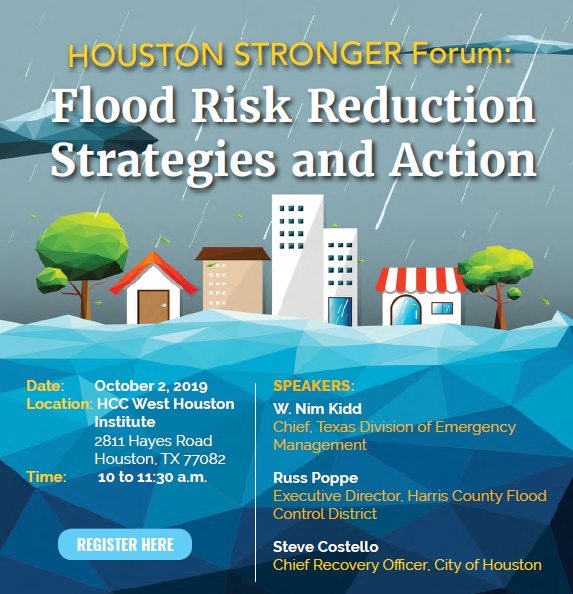
Finally, if this week's rains are making you nervous about flooding, come out to
this Houston Stronger event Oct 2nd to learn more about what's being done to make us more resilient (click the graphic to enlarge).
Labels: affordability, census, economy, education, growth, identity, perspectives, rankings, resilience, smart growth, transit
HTX population crosses 7 million milestone, smart growth is dumb about commuting, BRT beats LRT, and more
Happy Easter! This week's items:
- We're at 7 million people in the Houston metro area folks! Yes, I realize the official number is 6,997,384 on 12/31/18, but it also says we're adding 229 new residents a day, so we crossed 7 million around January 12th of this year. Still 5th-largest metro in the country behind NYC, LA, Chicago, and DFW, but this should also put us ahead of the combined San Jose + San Francisco Bay Area, which is split by the census into two separate metros for some reason, while Dallas and Ft. Worth are combined into one. Makes no sense to me either.
- This Grace Rodriguez interview has some good insights on Houston's entrepreneurship scene - both challenges and opportunities. My favorite excerpt:
"The challenge in Houston is trying to be shiny and polished. And, to me, shiny and polished is Dallas. No one in Houston wants to be Dallas. Let's accept the fact that we are an R&D city. We are a city that researches and develops and experiments new things. Let's lean hard into that and not say we're going to be perfect, and if we do that, then the need to try to appear perfect can go away. Being transparent on the things we are trying makes us become a role model for other cities. I feel like the feeling that we have to be polished and perfect for the rest of the world to be interested in us is the biggest hindrance to our progress. I already know the rest of the world is interested in us."
Here's the specific report excerpt with the broader context:
“US cities generally search for the sweet spot in the demand-to-capacity ratio and try not to provide service frequencies that are so high that their vehicles run empty. Thus, since LRT vehicles are larger, in order to justify providing LRT capacities that are similar to a BRT, LRT tends to operate at lower frequencies. As mentioned above, due to the perceived capacity constraint of BRT there are currently no cases in the US where LRT should be favored over BRT.”
Now we just need MetroNext to go from 70% embracing this principle to 100%...
"Building more market rate housing sets off a chain reaction supply increase that reaches low income neighborhoods. Households moving into new market rate units move out of other, lower cost housing, making it available to other households; the propagation of this effect produces additional housing supply in lower income neighborhoods."
"To achieve higher economic productivity, they recommend fostering speedier rather than slower commuting; more rather than less commuting; and longer rather than shorter commutes.
These policies would expand the opportunity circles of employers and employees, enabling a more productive urban economy. But these are exactly the opposite of the policy prescriptions of smart growth, which generally seek to confine people's economic activity to a small portion of a larger metro area.
...
A less extreme version of smart growth says that we should discourage car travel and shift resources heavily toward transit. People should be encouraged to live in high-density "villages" where they can easily obtain transit service to jobs elsewhere in the metro area. The problem with this vision is the inability of transit to effectively compete with the auto highway system.
Simply put, cars work better for workers. A 2012 Brookings study analyzing data from 371 transit providers in America's largest 100 metro areas found that over three-fourths of all jobs are in neighborhoods with transit service—but only about a quarter of those jobs can be reached by transit within 90 minutes. That's more than three times the national average commute time."
Labels: affordability, census, entrepreneurship, growth, home affordability, Metro, mobility strategies, opportunity urbanism, rail, smart growth, transit, transit-oriented development
The battle for Houston, rapidly arriving autonomous taxis, big success with big sports events, and more
A big backlog of smaller items this week:
"Commuters who use public transit typically use their regular route on the order of 500 times a year. If they also take public transit for non-work trips around the city, the number goes even higher, perhaps 700. In contrast, people who fly only fly a handful of times per year. Frequent business travelers may fly a few tens of times per year, still an order of magnitude less than the number of trips a typical commuter takes on transit."
"Clearly, at $4 per ride, bus-rapid transit is the most cost-effective use of transit dollars. Bus-rapid transit requires minimal new infrastructure, and most of that infrastructure won’t become obsolete if and when driverless ride-hailing replaces transit. Bus-rapid transit also tends to have smaller cost overruns and ridership shortfalls than rail projects.
...
Still, when buses can carry riders for $4 per trip, why are cities planning rail lines that cost $10, $20, or $151 (!!!) per trip? A big part of the answer is the desire to get “free” federal dollars."
"Where the most major neutral-site sports event by city/metropolitan area have been held since the turn of the 21st century or are already booked in the future:
New Orleans (9) – 2002 Super Bowl, 2003 Final Four, 2008 NBA All-Star Game, 2012 Final Four, 2013 Super Bowl, 2014 NBA All-Star Game, 2017 NBA All-Star Game, 2022 Final Four, 2024 Super Bowl.
Houston (8) – 2004 Super Bowl, 2004 Major League All-Star Game, 2006 NBA All-Star Game, 2011 NCAA Final Four, 2013 NBA All-Star Game, 2016 Final Four, 2017 Super Bowl (LI), 2023 Final Four.
Phoenix (7) – 2008 Super Bowl, 2009 NBA All-Star Game, 2011 MLB All-Star Game, 2015 Super Bowl, 2017 Final Four, 2023 Super Bowl, 2024 Final Four.
Indianapolis (7) – 2006 Final Four, 2010 Final Four, 2012 Super Bowl, 2015 Final Four, 2021 Final Four, 2021 NBA All-Star Game, 2026 Final Four"
That's probably more than enough items for one week. More to come next week...
Labels: affordability, autonomous vehicles, home affordability, Metro, mobility strategies, opportunity urbanism, rail, smart growth, sports, transit
Why LA tourism is exploding and might help Houston too, flood overregulation, Houston and transit, and more
Some good items this week:
"Houston is one of the few regions where transit ridership is still growing. From 2012 to 2017, when San Antonio ridership declined by 23 percent, Houston ridership grew by 7 percent. In the first four months of 2018, when San Antonio ridership fell another 3.2 percent, it grew by 3.5 percent in Houston. (Houston’s market share still declined despite ridership growth because ridership didn’t grow as fast as driving.)
Houston’s success appears to be due to a major reorganization of bus routes. Instead of operating buses on a hub-and-spoke system focused on downtown, Houston rerouted them into a grid system. Since most jobs are no longer located downtown, a grid bus network allows more people to get to work with fewer transfers and out-of-the-way trips.
Houston’s success is not a complete victory. Houston-area transit ridership was much higher before the 2008 recession than it is today. Ridership peaked in 2007 at more than 102 million trips per year; in 2017, it was just 89 million trips per year."
"It ain’t the heat here, Bourdain realized, it’s the humanity."
Finally this week, an older item I'm finally getting around to from the LA Times:
Los Angeles, Houston and the appeal of the hard-to-read city:
"Houston is casually written off even more often than Los Angeles, which is saying something. Now the fourth largest city in the country in population — and gaining on third-place Chicago — it's an unruly place in terms of its urbanism, a place that (as Los Angeles once did) has room, or makes room, for a wide spectrum of architectural production, from the innovative to the ugly.
...
Roughly one in four residents of Houston's Harris County is foreign-born, a rate nearly as high as those in New York and Los Angeles. Houston's relationship with Dallas, the third biggest city in Texas, is something like L.A.'s with San Francisco; the southern city in each pair is less decorous, less fixed in its civic identity and (at the moment, at least) entirely more vital."
Speaking of LA, an observation that came out of my recent vacation there. It relates to
this Cranky Flier post showing the dramatic increase in LAX traffic from 2009 to 2017, growing by more than 50% (!) in those 8 years. Why?
My hypothesis: before the smartphone (circa 2007), vacationing in a city like LA was pretty nontrivial, involving a rent car in a large unfamiliar city and a lot of paper maps and planning - unlike New York, DC, San Francisco, London, Paris, Rome, and other older, more concentrated tourist cities with subway transit where you can just show up and figure it out without too much trouble. But now with a smartphone, LA is a whole lot easier to "wing it" on vacation: driving and exploring, finding good restaurants on Yelp or tourist attractions in TripAdvisor and navigating there easily (avoiding traffic!) with Google Maps or Waze. I think people have discovered this and LA has become a significantly more popular tourist destination.
Maybe Houston will do the same on a smaller scale??
Labels: identity, Metro, mobility strategies, opportunity urbanism, resilience, smart growth, tourism, transit
Solving the Corps' reservoir dirt problem, HTX vs. NYC apts, HTX > Chicago, transit's expensive demise, Houston's hilarious "end of the universe", and more
Before jumping into this week's items, an idea: The Army Corps of Engineers wants to dig out Addicks and Barker reservoirs deeper so they can hold more water, but they're not sure what to do with the dirt. How about using it to elevate the new high-speed rail line to Dallas, which has to be grade-separated anyway? Please pass along if you know anyone with the Corps or Texas Central. Idea credit to Patrick.
Moving on to this week's items:
"Fares paid by riders cover only about a quarter of these costs. That means taxpayers who do not ride transit are spending over $50 billion per year to subsidize those who do. In 2017, trips on transit were less than 1% of the total daily trips taken by Americans. That works out to the 99% of Americans that don't use transit paying about $160 per year for the 1% that do. The value to the 1% who ride transit is about $14,000 per year."
...
But it is clear that we are in the midst of a technological revolution in transportation. The most important thing is that we don't spend a lot of money on inflexible infrastructure. I suspect that in the not too distant future, we are going to look back on our light rail experiment in Houston as the City's worst ever white elephant."
- Houston has more people employed in city limits than Chicago! Hat tip and graphics credit to George. Click to enlarge.
 |
| Chicago |
 |
| Houston |
Finally, to end on a little humor: I've actually had this item ready to post for a long time, but
read that Lewis Black was in town last weekend to do some stand-up (
KUHF story link) which reminded me.
Here's his (locally) famous bit about the Starbucks across the street from a Starbucks in River Oaks being the "end of the universe". It's hilarious, and he doesn't even mention the *third* Starbucks next door inside the Barnes and Noble! ;-D
(If the embeded video below fails to play,
go here)
Labels: affordability, autonomous vehicles, economy, high-speed rail, home affordability, infrastructure, market urbanism, mobility strategies, rankings, resilience, smart growth, transit
Forbes on Houston's winning formula for affordability, housing supply, and urban density
This week I'd like to talk about a couple of Scott Beyer's great pieces in Forbes. The first is "
Houston, Dallas & New York City: America's Great 3-Way Housing Supply Race". Conclusion:
"These statistics are glaring, and show that the urban housing affordability crisis, and its solution, is far simpler than many pundits suspect. In their ongoing quest to satisfy their anti-growth biases, they've settled on demand-side responses (read: government subsidies) that ignore or worsen the fundamental problem of under-supply; while they continue to blame various third party boogeymen, including developers, landlords, Airbnb hosts, techies, hipsters, Asian families buying second homes, and migrants in general.
But, again, the Census data sheds light on the actual nature of the issue: some metros in America are building a LOT of housing. Other metros may think they are, but actually are not. And housing prices within given metros are either stabilizing or skyrocketing based on this decision. While it's not clear just how many units metros like San Francisco need to reach market equilibrium, it's obviously more than 10,000 per year, given that the population is growing by 60,000 people annually. Meanwhile, only 3 of these major destination metros are issuing truly significant permit numbers, and only two of them--Dallas and Houston--are doing so without tacking on a bunch of added regulatory costs. Not coincidentally, they're also America's two leading affordability success stories, growing by the largest raw population numbers, yet maintaining some of the cheapest housing."
What's our secret sauce to affordable housing supply and how did it come to be? I suspect a big part of it is state law strictly limiting the land-use powers of counties (from Texas’ historical independent rancher/farmer/cowboy culture of “keep government off my back”), so unincorporated counties outside of cities are pretty unregulated. That, in turn, puts competitive pressure on incorporated cities to not put much regulation on developers, or they will simply drive them outside the city limits – and cities certainly want that increased property tax increment from development. Texas being a sales and property tax state without an income tax is probably also a driver of developer friendliness – it’s how cities and counties increase their revenue. Finally, state law on MUDs (municipal utility districts) makes it easy for a large-scale neighborhood developer to borrow money for greenfield infrastructure in unincorporated counties (water, sewer, drainage, streets) to be paid off by taxes inside that district. I recently met with a New Zealand official visiting Houston to learn about the MUD system to see what he could bring back to NZ to help alleviate their unaffordable housing crisis with new supply, and they're looking very seriously at implementing something similar over there.
Looking at the big picture, I’d say we have a country founded on individual liberty and freedom that somehow created a culturally-accepted loophole that government can put as many restrictions as they like on what you do with your land with no penalty or cost to them. Texas has simply embraced the country’s original principles more fully than most states.
Scott's second Forbes article is "
Houston Or Portland: Which City Is Doing Urban Density Better?" with this great conclusion:
"So which metro area--Houston or Portland--is doing urban density better? In the objective sense, Houston is, by fitting in more people. Subjectively, it depends on one's tastes. Portland's dedication to historic preservation, low-rise, so-called tasteful development, and pedestrian orientation is indeed charming. The core area feels like a slightly bigger version of an antiquated liberal arts college town, where the pace of life is slow and the people are intentionally offbeat. The fact that this sits amid the backdrop of cloudy skies and evergreen-covered hills gives the place an ethereal quality.
Houston, meanwhile, is too busy urbanizing to even try and achieve this pretension. It is building upward, outward, and everything in-between--and is doing so rapidly and unapologetically, with the metro area population increasing since 2010 by 852,054, compared to 208,946 in Portland. This has made Houston, inside and outside of its core, a completely different place than Portland: more grandiose, vertical, diverse, global, monied and in your face. Indeed, there is an extent to which Houston, with its large gleaming skyscrapers and overt street-level multiculturalism, almost makes Portland feel like a cow town.
This is not to say that one is obligated to like--much less live in--either Houston or Portland. But it does make a statement about markets versus planning, in respect to urbanization. If people want cities--as many Americans seem to--they should embrace growth, markets and deregulation; it they want "towns", they should embrace planning, regulation and a collaborative process that allows community interests to navel-gaze about every last land-use decision.
I certainly know what type of place I'd rather live in."
Hear, hear!
Labels: affordability, density, development, growth, home affordability, land-use regulation, smart growth, zoning
Defending urban freeways, smart growth wrong approach to climate change, efficient spending, big TX, and more
Hope you enjoyed
last week's April Fools post.
CultureMap stole the theme of my 2008 April Fools about the Ashby high-rise! But it was a good one worth repeating. Can't believe this Ashby controversy has dragged out over 8+ years - will it never end?
Moving on to lots of small items to catch up on this week:
"The paper shows that there is little potential for meaningful greenhouse gas (GHG) emissions reduction from urban containment policies (smart growth, including anti-suburban housing strategies, transit, etc) and that doing so would be expensive, not only in dollars, but also in economic displacement.
The paper also cites research (McKinsey and others) to the fact that material GHG emissions reductions can be achieved by selecting strategies based on their return cost effectiveness. In other words, urban containment and smart growth is not a necessity to reduce GHG emissions, and is best avoided."
- The Energy Corridor calls for a more flexible park-and-ride systems serving more suburban job centers like theirs, something I've been calling for on this blog for quite a while.
- Houston ranks #5 for efficient public spending, including #1 for parks and recreation, but with room for improvement on education and police spending.
- Watts: Houston, it's time for action on pensions - a topic not included in that last ranking!
- A neat animated map of how Houston has grown using MUDs.
- CityLab: How Much Money U.S. Transit Systems Lose Per Trip, in 1 Chart. Note how well Houston's METRO is doing, including vs. Dallas, although it must be noted this is 2013 data before the new rail lines opened with much lower ridership than our existing Main St. Line.
- Youth magnet: Houston is home to the young and vibrant, new study says
- I was pleasantly surprised and impressed by this Bill Fulton (Director of the Kinder Institute at Rice) piece defending urban freeways, mainly as a stimulant to the urban renaissance allowing people in the core to get to suburban employers. He specifically mentions Midtown in Houston, where he lives (as do I). What are the odds Kinder would be defending urban freeways and I would be calling for tearing them down (even if tongue-in-cheek) in the same week?! ;-D
- An awesome map in The Atlantic: What's closer to Texas than Texas is to itself?
"This map shows (roughly) how large the Lone Star State is. Points in the map’s red section are closer to somewhere in Texas than the opposite sides of Texas are to each other.
That’s right: You can be in Fargo, or Atlanta, or San Diego ... and be closer to Texas than Texas is to itself.
That’s what the map below says. Texas is big."
Labels: affordability, census, environment, governance, home affordability, Metro, mobility strategies, rail, rankings, smart growth, transit
610W express lane flaws, HSR terminal debate, maximizing opportunity circles, TX drains CA, and more
Apologies for not posting last week - the whole world seems to want to pack a month's worth of meetings and work into the first 2.5 weeks of December. On to the big backlog of items:
- I attended TXDoT's public information meeting on the proposed 610W elevated express lanes (details), and as supportive of the idea as I am, I'm concerned about the details of this plan. It would allow express elevated travel along four lanes from just north of I10 to just south of 59, but the problem is that they can only find space for single lane entrances and exits, which essentially cuts the throughput in half. Hopefully someone can come up with some potential alternatives - let's hope so or I have trouble seeing good cost-benefit here.
- Speaking of traffic, here's the simple, universal solution: congestion pricing. And it actually doubles throughput!
"As the paper shows, a freeway lane can typically move up to 2,000 vehicles per hour, but when traffic slows due to congestion, this can fall below 1,000 vehicles per hour. The net result is that road pricing can paradoxically double road capacities, thus giving everyone more options to get where they want to go, not less."
"From the perspective of a transit agency, an express toll lane provides it with an uncongested high-speed guideway at zero capital cost (other than the cost of the buses). And a seamless network of ETLs, as planned in most of these metro areas, provides transit with the infrastructure for region-wide express bus service—again, without the massive infrastructure cost that a rail system of comparable geographic extent would entail—if it could somehow find the umpteen billions of dollars to build such a rail network."
"Much of today's urban transportation planning focuses on transit and "smart growth." According to this set of ideas, suburbanization (aka "sprawl") is bad and should be discouraged, while higher density is good and should be increased, so that "we can get people out of their cars" and do other good things like enabling lots more people to walk or bike to work. But what if this set of policies turned out to be a recipe for urban decline?
...
If their analysis is correct (and I think it is), much of current transportation and land use thinking is mistaken.
...
The main implication of this research is that "the more integrated metropolitan labor markets are, the more productive they are." And therefore transportation policies should promote:
- Speedier rather than slower commuting;
- More rather than less commuting; and,
- Longer rather than shorter commutes.
These policies expand the "opportunity circles" of both employees and job-seekers. But they are the opposite of what those who are promoting "jobs-housing balance" try to achieve: to get people to work closer to where they live, accepting a convenient job rather than the best (most economically productive) job.
...
In order not to undercut metro area economic productivity, transportation and land-use policies should enable people and companies to maximize the size of their opportunity circles, by facilitating faster, longer-distance commuting.
Everyone concerned with transportation and land-use policies should read these important papers."
Finally, a thought I had this week on
the debate about terminating Texas high-speed rail at 290 and I10 vs. bringing it all the way into downtown: if you look at the most likely sources and destinations for HSR business riders, it's likely to be a zone from downtown out west through Uptown to Westchase and the Energy Corridor. The easiest and most central arrival and departure point is 290/10 at 610, not downtown. Forcing everybody to go downtown may actually suppress HSR ridership, especially for those going to/from the west side.
Labels: affordability, commuter rail, congestion pricing, economy, governance, high-speed rail, home affordability, infrastructure, mobility strategies, opportunity urbanism, smart growth, TMC, toll roads
Houston still has the highest standard of living, how smart growth regs hurt the poor, rail fail, and more
This week's items:
"One thing building rail doesn’t do is get many people out of their cars. In 1980, before building any rail, Los Angeles transit carried 5.9 percent of commuters to work. Today, after building six light-rail, one heavy-rail, and seven commuter-rail lines, transit’s share of commuting is all the way up to 6.0 percent–and only 13.5 percent of those transit commuters take the train."
"All of these regulations, write the authors, have been found to increase prices by limiting housing supply. And that disproportionately hurts the poor.
"Most of these studies find that both traditional land use policies and newer policies, such as smart growth and inclusionary zoning, increase the cost of housing. And because housing takes up a larger share of the budgets of lower-income households relative to higher-income households, these policies are regressive."
...
But all these measures kowtow to a group–NIMBYs–who don’t really have a legitimate grievance anyway. Someone who buys a home and pays taxes in a city has a right to good public services. But they shouldn’t be able to micromanage surrounding property that isn’t theirs. The fact that this has become an entitlement shows the distorted nature of modern urban politics. Existing owners have become an interest group demanding undue protectionism, and officials, wishing to stay popular, satisfy them by crafting stronger regulations. Those who suffer are newcomers–especially poor ones–wishing to rent or own in America’s destination cities."
"The growth of Houston has far surpassed the perception about it from outsiders. Thanks to a warm climate, pro-business policies, and a lack of zoning, it is now America’s 4th-largest city, and is creeping up on perpetually-mismanaged Chicago. In the process, it has nurtured a host of amenities that signify its newly-global status, from the world’s largest medical center to one of America’s best restaurant scenes. Add to these several new parks, with more to come, that could tweak the city’s sprawling and auto-centric reputation.
...
"But the most remarkable thing about the park, in an age when government projects constantly exceed cost estimates and drag on for decades, is how much bang this public-private partnership got for its buck. For $58 million, Buffalo Bayou Park now has two new major visitor centers, several pedestrian bridges, added flood control, and acres of amenity-filled parkland. Anne Olson, president of the partnership, credited the project’s privately-funded model for the strong turnaround."
...
When it comes to the factors for attracting this talent, Houston’s parks likely will not surpass its strong business climate. But they should slowly make Houston’s image greener, and assuming everything is completed on time, will become a testament to the city’s pragmatic spirit. In 13 years, the city will have added numerous world class parks, at a cost likely far less than the economic benefits reaped. While other cities have become monuments to bureaucratic inertia, Houston will show what happens when a business-oriented city gets into the business of parks."
Scott is on a 28-month tour of living in 28 American cities leading towards a book on city revitalization, and we're his #2 stop after starting in Miami. I've shown him around town a bit, and I think he's been impressed with what he's seen so far.
Have a great Thanksgiving everyone!
Labels: affordability, home affordability, land-use regulation, mobility strategies, perspectives, quality of place, rail, rankings, smart growth, transit, zoning
Forget the Ike Dike - love will save us from a hurricane
Over the years, I've noticed a phenomena that maybe you've noticed too: some issue becomes the "hot" issue of the moment (terrorism, Ebola, etc.) and then people jump on the bandwagon for that issue by trying to link it to whatever their pet issue is, no matter how tenuous the connection may be. "If you support my pet issue X, it will reduce the problem of hot issue Y." If they can successfully link the issues, maybe public support (or, better yet, taxpayer dollars) will swing behind their pet issue. Sometimes the connection gets stretched so far as to become utterly absurd. And that brings me to Exhibit A:
this op-ed in the Chronicle ("
How to protect our city against storms? First, make it lovable. Dikes and levees are secondary. What they protect matters more.") saying the key to our hurricane resilience is
not something so pragmatic as a dike, but really about making our city more walkable and lovable. Wait... what? Really? Evidently, New Orleans' big failure with Katrina had nothing to do with being a city below sea level with substandard levees, but it wasn't walkable and lovable enough. Uh-huh...
Let me address some of the specific arguments in the piece:
- Levees can fail: Sure, anything can fail, but how many times have levees and dikes successfully protected New Orleans or the Netherlands vs. the number of times they failed? Does one failure mean dozens of other successful protective events don't have value? And the nice thing about Houston over New Orleans is that we are *above* sea level, so if there is a failure, it will just drain right out as the tide recedes, as opposed to stagnating in the big bowl of below-sea-level New Orleans.
- Levees cause stuff to be built where it shouldn't: Sorry Netherlands/New Orleans/Houston, you built stuff where you shouldn't have because once a decade mother nature is going to come at you with wallop. Rather than protecting yourself, you really need to just shut it all down and move somewhere else - nevermind the trillions of invested infrastructure. Wait, you say, it's kinda hard to operate a port without being connected to the ocean. Well, I'm sure you'll figure it out.
- The key is lovability/walkability: I'm pretty sure New Orleans had that in spades, and it doesn't seem to have saved them from Katrina. Nor did it help the quaint walkable sections of Galveston during Ike. And I'm sure the Dutch will be disappointed to learn they could have saved billions on dikes over the years if they had just loved their country more, maybe with just a good handholding and kumbaya singing session every time the North Sea threatened?
- His calling out of my op-ed with Joel Kotkin: "Walkability is not some concept being forced down our throats by elitist planners from the East Coast, as some suggest. (See, for instance, "Economic diversity helps Houstonians live well" by Joel Kotkin and Tory Gattis.)" Actually, if you look at the stated goals of those smart growth planners, they *are* trying to force dense urbanism down our throats, and they specifically call for restricting or eliminating suburban development. We are not opposed to walkability and walkable development like town centers, but we are opposed to forcing it on people by restricting other forms of development which leads to unaffordable housing, widening inequality, reduced opportunity, and a weakened middle class. I totally agree that some people love walkability (including myself), and we need to loosen any regulations that make it hard to develop (agreement with him on this point), but let the market decide how much demand there is and how much and where to build - not central planners.
- "People in Houston currently spend as much on transportation as they do on housing. " Lies, damn lies, and statistics. As I've pointed out here before, when you have affordable housing like we do in Houston (albeit rapidly getting less so), people tend to splurge on very luxurious cars, trucks, and SUVs - but that does not mean that's the cost of transportation here. Everybody can get around Houston quite affordably in a Honda Civic, Toyota Prius, or plenty of other cars - they just choose not to. The 2013 C2ER ACCRA Cost of Living index takes this into account, and rated Houston 95.6 for transportation costs where 100 = the national average, so we're 4.4% below the national average. New York is at 110, Chicago at 124, DC at 106 - so much for dense transit cities reducing transportation costs.
- "Spending less on transportation would mean you could afford more durable construction." While I agree we should have strong construction standards for wind, how does one build more durable construction for a tidal wave surge of water? Should we build everything on stilts? How incredibly expensive and inconvenient would that be, not to mention not very walkable? Maybe we should, um, build a dike so we don't have to worry about the surge in the first place and can build simply at ground level?
- "Walkability means you might see your neighbors more often. Knowing who your neighbors are is a key element of resilience. Social capital is the glue that holds communities together, and places that have it back from catastrophe much faster." Does anybody else remember all the stories in Houston after Ike of people helping each other out and throwing block parties to grill meat before it spoiled in unpowered fridges and freezers? Does anybody remember our amazing response to the Katrina refugees? I think we're doing pretty well on the social capital front. And I'd like to point out that the most dense and walkable city in America, New York, is not exactly known for its friendly "social capital".
- "Many people in New Orleans died because there was nowhere to run in a vast unbroken sea of single-family homes" Actually, the people that were stuck in New Orleans for Katrina where the ones without cars who relied on transit and walking. Just about everyone with a car got out successfully.
To sum up, walkable development is great, and we should certainly enable and encourage more of it, but it is absolutely no substitute for protecting our region from a direct hurricane hit with a strong physical barrier. Let's not mix up our priorities here.
We know what we need to do - we just need the political and financial will to do it (and
here's how to pay for it).
Labels: density, emergency response, hurricanes, land-use regulation, planning, smart growth, walkability