This week I'd like to do a simple re-post from Bob Poole's excellent Surface Transportation Innovations Newsletter at Reason, where Houston has dropped to #9 in the traffic congestion rankings with delay hours far below the worst cities like Chicago, Boston, NYC, Philly, Miami, SF, and LA. Highlights mine.
Traffic Congestion Roars Back, Despite Work from Home
The 2022 INRIX Global Traffic Scorecard was released last month, and it shows a strong resumption of metro area traffic congestion, despite the continued high level of telecommuting. The same pattern appears in major metro areas in Europe, Latin America, and South Africa.
The INRIX global top 25 most-congested metro areas table resembles the 2021 ranking, with London still in first place, Paris in third place, and Toronto moving up from 22nd to 7th place. The 10 most-congested metro areas worldwide had delays ranging from 121 hours per driver to 156 hours per driver in 2022.
For U.S. cities, Chicago moved up to 2nd from 6th place, Boston zoomed from 18th to 4th, and Miami rose to 9th from the previous year’s 32nd place. Other areas rising a lot included Los Angeles, up to 14th from 33rd, San Francisco, from 15th from 34th, and Washington, D.C., which went from 99th to now 20th.
The changes in congestion rank for U.S. metro areas were nowhere near as dramatic as the worldwide changes. Here are the key 2022 INRIX figures for the top 10 metros.
2022 Rank (2021)
Metro Area
Avg. Delay (hrs)
Cost/driver
Cost per Metro
1 (2)
Chicago
155
$2,618
$9.5B
2 (4)
Boston
134
$2,270
$4.3B
3 (1)
New York
117
$1,976
$10.2B
4 (3)
Philadelphia
114
$1,925
$4.5B
5 (5)
Miami
105
$1,773
$4.5B
6 (6)
Los Angeles
95
$1,601
$8.6B
7 (7)
San Francisco
97
$1,642
$2.6B
8 (13)
Washington
83
$1.398
$3.5B
9 (8)
Houston
74
$1,257
$3.7B
10 (10)
Atlanta
74
$1,257
$3.1B
Source: INRIX
Many factors are responsible for these traffic congestion results, but let me suggest a few that might be relevant. First, despite much rhetoric arguing that traffic congestion is a byproduct of low-density sprawl land-use patterns and that higher density and mass transit are the answer, the top four U.S. metro areas are all characterized by high-density and high-transit mode-share, in comparison with lower-density, low-transit Miami, Los Angeles, San Francisco, and Atlanta.
Second, which of these areas have added express toll lanes to portions of their freeway systems? Miami, Los Angeles, San Francisco, the Virginia suburbs of Washington, DC, Houston, and Atlanta.
One other point about density and transit as the long-term solution: urban agglomeration benefits. Extensive research shows that large metro areas are generally more economically productive than smaller ones because a lot more positive-sum transactions can take place in the former—assuming there is fast and reliable transportation from any origin to any destination (since both residences and jobs are spread out all over the landscape). (See Alain Bartaud’s excellent book, Order Without Design, MIT Press, 2018)
Less-congested freeways, due to variably-priced express lanes, contribute to employers having a wider choice of qualified prospective hires and workers having many more good employment options. The same is true, in theory, of a large transit network. Yet, a series of “access to destinations” studies by University of Minnesota researchers have shown that in most large metro areas one can get to nearly all the potential jobs in 30-45 minutes by car, but to very few via transit.
What the Katy Managed Lanes tell us about the NHHIP 45N expansion project
This week we have a great guest post on the effectiveness of managed lanes and why they're so critical to the 45N expansion plan from Oscar Slotboom, author of Houston Freeways. (highlights mine)
---
Managed lanes are one of the more controversial features in the North Houston Highway Improvement Project. The current HOV lane uses 25 feet of width in the center of the existing freeway where there are no interior shoulders, and 41 feet of width where there are interior shoulders. In the NHHIP design, the managed lanes require 82 feet and the interior shoulders (with pylons) require 25 feet, for a total of 107 feet. So the extra width required for the managed lanes is 66 to 82 feet, which is about 37% of the needed new right-of-way north of Loop 610. The rest of the needed right-of-way is for buffers outside the frontage roads (27 feet on each side), wider frontage roads including a 15-foot-wide shared lane, more space between the main lanes and frontage roads, and auxiliary (merging) lanes for the main lanes.
The City of Houston proposal, which is endorsed by Harris County, would remove the managed lanes entirely and also remove the existing reversible HOV lane. Other opposition groups want more public transit emphasis and no right-of-way acquisition which would eliminate the managed lanes.
Of course, we already have a managed lane facility in Houston, the Katy Managed Lanes. Let's take a closer look at its performance, before and after Covid. Data sources: Metro and HCTRA.
Attention NNHIP Opposition: Managed lanes have demonstrated substantial transit ridership
In 2019, prior to Covid, Metro's bus routes using the Katy Managed Lanes served 9,105 weekday public transit trips, more than the $756 million Red Line north extension and the Green or Purple Lines, which together cost $1.4 billion. The original Red Line, which has strong ridership, had 42,385 weekday trips.
HOV and Ridesharing provide even more SOV reduction
Metro bus service is only part of the reduction in single-occupant vehicles provided by managed lanes. The main purpose of the Katy Managed Lanes, which require only 2 persons per vehicle for free use, is to promote carpooling and ridesharing. In contrast, most managed lanes facilities outside Houston require 3+ occupancy for free use, and privately owned managed lanes are operated to maximimize toll revenue. While there is no readily-available data for HOV traffic count, Metro's 2018 Highlights publication (p.28) states the following
"METRO provided 7.7 million Park & Ride commuter bus rides in 2017"
For all HOV/HOT lanes except the Katy Freeway managed lanes (which is operated by HCTRA), Metro reports
"An additional 25.4 million people used HOV/HOT lanes operated by Metro in 2017."
Even excluding the heavily-used Katy managed lanes, the ratio of HOV/HOT users to bus riders is 3.3 to 1. There's no information on the number of HOV vs. HOT vehicles, but the pre-covid Katy Managed Lanes bus ridership of 9,105 trips per day probably translates to HOV trips of at least 20,000 per weekday, which (assuming 2-person HOV) was taking at least 10,000 SOVs off the road.
Managed lanes serve vanpools, and Metro reports (for all its HOV lanes)
"METRO facilitated 2 million vanpool rides and more than 700 active vanpools in 2017."
The 2018 report also states
"HOV/HOT lanes maximize the utility and value of existing freeway lanes by allowing riders and vehicles to move faster and bypass heavy traffic."
That statement should put a smile on Tory's face, since his brand name for managed lanes is MaX lanes. (editor's note: It does! :-)
Impact of Covid
Metro's overall ridership dropped by around 55% for most months since April 2020. Park & ride customers are not transit dependent, so they could switch to their cars for safety, and they are mostly professional so many or most could work from home. Consequently, park & ride service was hit much worse, with Katy corridor ridership down around 88%.
Metro's downtown routes (221, 222, 228, 229) were down 95% in the year after Covid hit (excluding the uptick in recent months). However, ridership on Metro route 298, which provides service to the Texas Medical Center, was down only 53%, which is consistent with the overall loss in Metro ridership. Assuming route 298 riders don't have the option to work from home, this suggests that (95-53)/95 = 44% of the downtown route ridership loss was due to working from home. Of course, folks working from home will no longer be Metro customers in the future. Recovering these riders will depend on how many continue to work from home.
Revenue Generation
In 2019, the Katy Managed lanes generated $20.7 million in toll revenue, below its 2018 peak of $22.5 million. We can expect a rebound from the 2020 value of $8.9 million, but it may take years to get back to $20 million.
Managed lane toll revenue is low by HCTRA toll road standards, as HCTRA collected $855 million in toll revenue in 2019. The adjacent section of the Sam Houston Tollway to the south (to the Southwest Freeway) generated $116 million and the section to the north (to the Northwest Freeway) generated $98 million.
However, $21 million is substantial in the context of Metro's systemwide total farebox revenue, which was flat between 2013 and 2019 in the range of $72 million to $76 million, and was $75 million in 2019. Farebox collections for FY 2020, which ended in September with only 6 months affected by Covid, dropped to $43 million. Just completed FY 2021 (no data available yet) was fully affected by covid and will be much lower.
Metro's park & ride bus service also generates substantial farebox revenue due to its high fares. In the 15 months prior to Covid, the Grand Parkway endpoint was the most-used park & ride lot in the Metro system, averaging 2,977 daily trips. The fare for Grand Parkway service is $4.50, compared to $1.25 for regular service, which is diluted by discounts. Using an average fare of $4.25 for Metro park & ride service using the Katy Managed Lanes, we can estimate those routes generated 9105*52*5*4.25= $10.0 million in fares, which is 13% of 2019 Metro systemwide total farebox revenue. Adding together the toll and farebox revenue is $30.7 million, which is 41% of Metro's systemwide total farebox revenue.
dollar values in millions
2019
Toll Revenue
$20.7
Bus Fares (estimated)
$10.0
Katy Managed Lanes Total
$30.7
Metro 2019 systemwide farebox revenue
$75.3
Katy Managed Lanes revenue, percent of Metro systemwide farebox total
41%
Managed Lanes: more services provided = less risk of obsolescence
Suppose rail transit had been built instead of the managed lanes along the Katy Corridor. Rail would serve only commuters using public transit, and demand for that service was down 88%. Of course there will be a recovery, and there has been an uptick in recent months, but it remains to be seen how much of the lost ridership can be recovered. Due to work from home, demand for commuter transit will likely be suppressed indefinitely.
In today's money, rail infrastructure for the 19 miles from the Northwest Transit center at Loop 610 to the Grand Parkway would cost at least $1 billion for commuter-style trains, and at least $2 billion for light-rail style service. (Of course, the trains would have terminated at the Northwest transit center and required a transfer, which would lower ridership.)
With the dramatic drop in commuter ridership, rail infrastructure would now be a very expensive and very underutilized asset.
Managed lanes provide multiple services, including ridersharing, vanpools, and express toll service. This lowers the risk of the investment. While these services were also down (toll revenue was down 57%), these services continued to be served, with toll users at a much higher level than commuter bus.
This underscores another major benefit of flexible, adaptable, and less expensive managed lanes. If consumer preferences shift, the lanes can easily adapt and won't become a costly "white elephant".
Managed Lanes: a crucial feature of NHHIP
To summarize
Pre-covid, the Katy Managed Lanes demonstrated strong transit ridership, higher than much more expensive recent light rail expansions.
Pre-covid, the Katy Managed Lanes demonstrated strong revenue generation, both tolls and bus farebox.
With the onset of covid and the collapse of demand for commuter transit service, the Katy Managed Lanes continued to provide multiple services, underscoring its adaptability to shifting needs.
Managed lanes are the most important feature of NHHIP north of downtown, providing an adaptable transportation asset that will serve Houston's future needs, whatever they may be: bus rapid transit, commuter bus, HOV, vanpool, technologies of the future such as automated vehicles and potentially toll service. (Current plans don't include tolls, but would optimize the lanes for transit and ridesharing.)
Strong performance, low cost, and adaptability are reasons why Tory and I support the NHHIP managed lanes and are advocates of a managed lane network for Houston, as described in the MaX lanes report and as proposed in the TxDOT REAL plan.
Houston's blob is about to eat even more of East Texas... and we should embrace it
I recently submitted this op-ed to the Houston Chronicle:
The Chronicle’s recent article debating the sustainability of Houston’s traditional “build more” approach to growth (“Houston became 'the blob that ate East Texas' by building big. Is it time for that to change?” August 27) frames the debate as if Houston can dictate whether people drive cars in the suburbs or ride transit in the densifying core, when in reality people make their own choices which we can accommodate and thrive or ignore and decline.
The debate completely misses the reality of our post-pandemic world. Remote work is now a permanent part of our economy, and it is creating a tidal wave of suburban and exurban growth as people realize they’ll no longer need to commute into the city on a daily basis. Houston can’t stop it, even if it wanted to. All we can do is try to accommodate it while keeping the core healthy and accessible to attract their dollars for discretionary shopping, restaurants, entertainment, events, health care, philanthropy, office visits, and more. And if we don’t maintain that accessibility - including prudent transportation investments - not only are they unlikely to visit, their employers are likely to leave as well along with their much-needed local property and sales tax contributions.
Houston’s great strength has always been embracing growth - suburban, urban, and the freeways to connect it all together. That formula has kept us the most affordable major metro in the country and always near the top in growth rankings. In other words, we’ve made ourselves extremely attractive to newcomers, especially diverse people of color and immigrants looking for affordable opportunity. We’ve got a product people want. Why would we want to radically change that? Especially to models like California with urban growth boundaries, constrained development, astronomical housing costs, traffic gridlock, and wasteful transit spending (LA has spent upwards of $20 billion only to lose 21% of its ridership pre-pandemic) resulting in a mass exodus of both people and businesses.
What Houston’s formula needs is tweaking, not throwing out the baby with the bathwater. For example, with growing concerns about flooding, the answer is not banning new development, but tightening runoff regulations on new suburban developments so they don’t flood us downstream. Every new development should have enough detention that the land releases even less water during a hard rain than it did undeveloped - then every new development would actually reduce flooding!
And when it comes to transportation investments, yes, many freeways are reaching realistic width limits, but that doesn’t mean we should give up growth for perpetual congestion or old, slow transit. We’ve proposed - and TXDoT is planning - an innovative next-generation mobility strategy: a network of MaX Lanes (Managed eXpress Lanes) 'moving the maximum number of people at maximum speed' by allowing direct point-to-point single-seat high-speed trips by transit buses and other shared-ride vehicles today, and even higher-speed zero-emission autonomous vehicles in the future. The network would enable Houston’s seven core job centers to scale from 626,000 jobs today to over one million jobs in the future while drawing employees from all across our ever-expanding region with a reasonable commute (even if they’re doing that commute less often in a remote work world). This is the type of climate-friendly innovative mobility solution that could attract substantial federal funding while also embracing suburban and exurban trends rather than hopelessly fighting them.
Finally, Houston’s unzoned urban core can continue to naturally densify as it has been doing successfully for at least two decades now - not because we’re trying to force it to, but because people - especially diverse young people - choose it. They choose it because we allow the free market to build and cater to that demand, including townhomes, apartments, residential towers, and walkable mixed-use complexes.
Which brings us full circle to Houston’s secret sauce: building what people want rather than what academic urban planners deem the ‘right’ way to live and get around. That strategy will always be a winner.
Tory Gattis is a Founding Senior Fellow with the Urban Reform Institute - A Center for Opportunity Urbanism, and the Editor of the Houston Strategies blog.
$7 billion: yes, it is expensive, but he fails to mention that this is *state money* that will go somewhere else in the state if we don't use it. Houstonians are being essentially offered $7 billion in free transportation infrastructure - are we really going to turn that down??
Lost businesses and jobs: these businesses, jobs, and economic activity don't evaporate, they just move.
Our lack of competitiveness: then why are we consistently at the top of the metro rankings for population and economic growth? Why are people choosing with their feet to move here? And why are the top cities he lists - SF, NY, Chicago - all out-migrating?
Freeways don't benefit downtown: if we tore down all the freeways going into downtown, I'd be willing to bet a *whole* lot more companies would be moving out than new residents would be moving in. Those freeways are the lifeblood of those major downtown employers bringing their employees in from the suburbs that offer the quality of life (and schools) they want for their families. If those freeways are gone, those employers will be moving out to them (like Exxon did), not vice-versa.
Induced demand: this is exactly what we should want! It means the government built transportation infrastructure that is in high demand, and that's exactly what taxpayers should want! Would you rather they built transportation infrastructure noone wants to use? (like a lot of rail lines built in the US these days...) My favorite example that makes this clear: if an airport built a runway, and no new flights used it, that makes it a boondoggle waste. But if it fills up with new flights, that's the definition of success!
The Katy expansion was a mistake: ask just about anyone that used to drive on the old 6-lane Katy freeway, and they'll all agree it's *way* better now. Nobody wants to go back to what it was before. And it has enabled nothing less than a boom out there, including the Energy Corridor. Here's the most-liked online comment that points out the flaws in his numbers:
"What a truly garbage article, even though I agree with the premise that the I-45 expansion isn't being done correctly. All I had to do was look into the claim that "the PM commute on the Katy was up 55% since before construction". That's not true. Opening the link, that 55% rise was since 2011 - freeway construction was complete in 2008. There was no analysis of the commute times before the construction.
Making fraudulent claims like that, Mr. Speck, completely undermines your argument. And you really think getting rid of the sections of 45 where you're speeding along at 70 MPH inches away from a concrete wall will somehow decrease safety? You really don't understand that per vehicle PM emissions are higher when the vehicle is idling in traffic (and thus has its engine on) longer? No discussion on the population and economic growth in West Houston since the expanded Katy opened?
This is exactly why I got out of urban planning - unbelievable hypocrisy and ignoring of facts that don't fit your agenda. No the 45 expansion is not perfect, but leaving the freeway configured the way it is now in perpetuity is unacceptable. Go away please."
Safety: in addition to the comment above, he ignores the fact that when freeways are congested, people cut through local streets, and that is *way* more dangerous than keeping that same car on a freeway.
Air pollution: see comment above. What causes more pollution than cars zipping down a freeway? Cars stuck in congestion on a freeway, or continuously idling on surface streets.
Future vision: he pretends like these are mutually exclusive, but they are completely compatible and both are doable and actually happening. The project includes removing the Pierce between downtown and midtown and sinking it in Eado and the Museum District, which enhances rather than detracts from his walkable vision!
"If I-45 is widened, it will be remembered that, in the decade prior, Houston enjoyed a brief glimpse of a better future. Downtown and Midtown have been reborn, lifted on a demographic shift that favors urban living. Regional bike trails grace the Bayou Greenways, and a brilliant Beyond the Bayous plan lays out an ambitious path for sustainable growth. Transit ridership is up, thanks to investment in light rail and a redesigned bus network. The mayor, members of city council, and county commissioners all sing the praises of a more walkable Houston. Sadly, all these trends will be reversed if Houston doubles down on its nation-leading commitment to fossil-fuel infrastructure."
I'll also point out what I've said before: personal and commercial vehicles are never going away. They may run on fossil fuels or electricity or fuel cells or whatever, but the basic vehicle is now a foundational element in our society. These freeways will accommodate plenty of non-fossil-fuel vehicles in the future.
Congestion-based pricing: finally, one good idea in here! And good news: the 4 new MaX Lanes down the middle of 45N will almost certainly have it (as well as supporting huge transit improvements in MetroNext!). But unfortunately, congestion pricing the whole thing is not politically feasible (nor federal or state-allowed, I believe).
I'll conclude by saying I applaud TXDoT's extensive efforts to respond to community input and mitigate impacts (and hope they continue to do so), but I also wish they would commission a regional poll on support for the project, which I'm sure would show overwhelming support and quash this illusion that the public is opposed to it. Then we can get past this "do it/don't do it" debate and just focus on the "how do we make it better?" debate.
"Why does the Chronicle print this garbage and give it the prime location in the Sunday op-ed? It would take a very long post refute all the nonsense in the Speck op-ed, but here are a few points.
Most new lanes on I-45 are managed lanes, which will be a critical part of future public transit options
Downtown will be greatly improved by removing the Pierce Elevated, sinking around 2 miles of I-69 below ground, and reducing the number of freeway structures on the west side of downtown
The expansion and improved single-occupant vehicle mobility will be most beneficial to people in blue-collar and mid-skill jobs, since those jobs are outside of downtown (warehouses, industrial sites, construction, medical, etc) and the only way to get to those jobs is to drive
The idea that the growth and revitalization of downtown will be reversed by this project is absurd. Downtown Houston interests help design this project and are highly supportive. When construction of the project starts, we'll see new development as developers anticipate the improvements.
Speck's solution, congestion pricing, will disproportionately impact the lower-income population. It's ridiculous to compare Houston to NYC. NYC has extensive public transit (mostly built 100+ years ago) and people can switch to transit. That's not an option in Houston, or just about any city outside of NYC."
"To be clear, the funding allocated to delivering the I-45 improvements cannot be made available for transit expenditures. If Houston decides they don't want the highway improvements, the funding will ultimately be re-allocated to highway improvements in other areas of our region or the state. Imagine where that would leave Houston in addressing congestion in the nation's fourth-largest city. "
On the whole and on balance, I'm a supporter of the project (although it can always be tweaked to be better, of course). It's probably the last realistic opportunity Houston will ever have to fix this freeway. But it is mighty expensive and I greatly fear what a decade of disruptive construction will do to downtown, including a potentially major exodus by employers as their leases expire and they decide to head out to the suburbs for an easier life like Exxon did. There's also the issue of tremendous land loss/takings in EaDo and no funding for the imaginary deck parks over the newly sunken freeways. And I'm personally not a fan of losing the Pierce Elevated's six lanes of capacity, which really reduces the impact of new capacity on the north and east sides around downtown.
If someone made me all-powerful dictator-in-charge, here's what I'd consider doing instead with $7 billion of TXDoT's money:
Take the $1-2B already allocated in the short-term budget to start work on the 59-288 piece (which everyone agrees is a major bottleneck) as well as 45N north of the loop (with all needed mitigations for Independence Heights). That lets us use all the existing filings/process/EIS as-is and not lose that money.
Keep the downtown tangle pretty much as it is today, including the Pierce Elevated. Downtown will always need surface parking lots - put them under the elevateds. Give the surface streets under the elevateds some nice treatments so they're more inviting for pedestrians to cross under to EaDo and Midtown. Lighting, paint, noise insulation, whatever. There are good examples all over the world on how to do this. And if we want more park space downtown, put it cheaply where it belongs along the bayou or on existing land rather than on an extremely expensive deck park over a sunken freeway.
To solve the capacity problem, build a single set of 4 new MaX Lanes down the center of 45N inside the loop (as planned), but when they get downtown wrap them around the north and east sides of downtown elevated on their own single pylons - not disrupting any of the existing freeways nor taking much land from EaDo (like over Chartres St). In addition to exits downtown, connect them into MaX Lanes on 45S, 288, and 59.
Take the billions saved from doing it this way to build out the rest of the interconnected MaX Lane network across the city. This will do far, far more to improve long-term mobility across the region.
I know I'm really oversimplifying things here vs. real, detailed plans, but I think it conveys the broad alternative concept. In my mind, this is the 80/20 solution: 80% of the benefits for 20% of the cost and disruption (at least for the downtown portion).
An alternative variant of this Michael Skelly has proposed would bring the Hardy toll road downtown (as planned), but congestion price it like MaX Lanes so TXDoT won't need them on 45N. This would be even less expensive and disruptive, but requires cooperation from HCTRA and Metro (moving their planned IAH BRT). And I believe they would still need to continue to wrap around the east side of downtown in addition to offering downtown exits, so they can connect up with MaX Lanes on the south side of town.
That's my proposal for what it's worth. I'd love to hear your thoughts in the comments. And if an all-powerful dictator-in-charge position opens up, I'm happy to offer my services... ;-)
A few interrelated items this week leading to a new opportunity for MetroNext 2040.
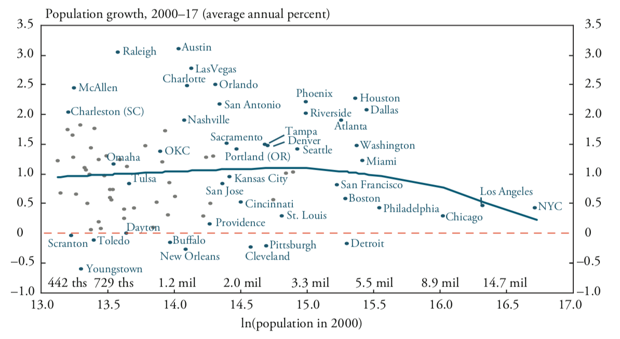
First, this CityLab article implying that Houston is reaching a size (7m metro) where it is in significant danger of tipping into much lower or even negative growth like the NYC, LA, and Chicago (see the graphs).
"For large, dense places, the key is to deal with the diseconomies brought on by density by alleviating traffic congestion through investments in mass transit or congestion pricing; or by reducing housing prices by eliminating land use restrictions, building more housing, and providing more affordable housing."
“Los Angeles imagines transforming itself from a carpocalypse into a transitopia, with free public transit gliding past traffic in dedicated bus lanes.”
This fits with an aspirational goal I've been pitching to Metro, where its organizational mission would be to offer half-hour or less express trip times from every park-and-ride and transit center to every major job center and both airports using a network of MaX Lanes in collaboration with TXDoT and HCTRA (with vehicle size and frequency tailored to demand). It's a very big goal - Metro's Moonshot, if you will.
What's exciting now is that at the last MetroNext board workshop (which I was able to partially attend), Metro showed a new alternative Hobby airport light rail plan that consolidates two lines into one and saves about $400 million which would be available for new investments. That money could go a very long way towards reducing fares to attract new riders from their cars - especially to the P&R commuter buses - and reducing congestion (I'd propose either free or $1 rides systemwide). That money could also be used to ramp up the service to meet the increased demand and work towards the Moonshot goal.
It's my sincere hope that Metro seizes this amazing opportunity to think big and outside the box to pursue this bold moonshot with the newly available resources. It's not exaggerating to say that Houston's future depends on it.
"What’s frustrating is that the last 25 years have shown—in Los Angeles and other cities— that expanding bus service increases transit ridership while expanding rail service decreases transit ridership. Further, bus is almost always cheaper than rail. Even premium express bus and bus rapid transit services cost one-third to one-ninth as much as the most cost-efficient light rail lines. Yet L.A. leaders, who should know better, continue to push for rail.
Unfortunately, this is true in many places across the country. When Houston built a multi-billion-dollar light-rail network, total transit ridership (including bus) declined. A few years ago, Houston redesigned its bus network for a minimal additional cost, which led to an increase in bus ridership. The redesign, which included adding service on weekends, helped transit-dependent riders reach jobs they could not previously access on weekends. Yet Houston politicians have responded by calling for more rail funding."
"Congestion pricing is premised instead on the notion that public roads are a valuable and scarce resource. And we should pay in some places to use it not primarily to gin up revenue, but to help manage access for everyone.
...
In reality, the government is a monopoly provider of road space, and the government has largely chosen to give it away. It’s no surprise, then, that the vast majority of American commuters drive to work alone, or that all those lonely commuters (plus taxis, Ubers, buses and delivery trucks) cause congestion.
When the government holds down the price of something people value, Mr. Manville said, we get shortages. And congestion is effectively a shortage of road — one that occurs at the peak times when people want to use it most.
If we had that problem with other kinds of infrastructure or commodities, we’d charge people more for them. If airline tickets were particularly in demand, their prices would go up. If there were a run on avocados, grocers wouldn’t respond by keeping them as cheap as possible."
"Meyers Research, which studies housing markets, asked Millennials where they wanted to move to. Their top five choices were Denver, Portland, Seattle, Washington, DC, and New York City
Then Meyers asked where should Millennials want to live, based on the factors millennials said were most important: job opportunities, affordability, and lifestyle. The answers were Dallas, Houston, Austin, Phoenix, and Orlando. Although Denver and Seattle were both in the top ten, neither of the top-five lists had any cities in common.
Perhaps a more pertinent question is: where are Millennials actually moving? According to a Brookings Institution analysis of American Community Survey data, the top seven destinations for millennials have been Houston, Denver, Dallas, Seattle, Austin, Charlotte, and Portland — which is more-or-less a combination of Meyers’ two lists.
...
Brookings also found that Millennials are leaving New York, Los Angeles, Chicago, San Diego, and Miami. That pretty much kills the myth that Millennials prefer density, as those urban areas all have much higher than average densities (4,000 people per square mile and above). Numbers six and seven are Boston and Philadelphia, which also have very dense cores although their overall urban areas are less dense."
"By contrast, the biggest winner is Houston, a metro area that many planners and urban theorists regard with contempt. The Bayou City gained nearly 15,000 millennials net last year, while other big gainers included Dallas–Fort Worth and Austin, which gained 12,700 and 9,000, respectively. Last year, according to a Texas realtors report, a net 22,000 Californians moved to the Lone Star State."
"I want to call your attention to a new (not yet published) paper on the subject by researchers from Cornell University and McGill University. “A Comprehensive Welfare Impact Analysis for Road Expansion Projects” uses transportation data from the Dallas-Ft. Worth metro area to compare, quantitatively, the effects of four possible highway expansion options (in addition to doing nothing): adding a general purpose (GP) lane, adding a high-occupancy vehicle (HOV) lane, adding a priced ETL (electronic toll lane), or converting all lanes to conventional toll lanes. The priced ETL ranked highest in both regional economic impact and improving system-wide travel time, and was judged to produce the greatest increase in overall social welfare."
WSJ Video: California Home Prices Are Soaring. Here’s Why. The good news for Houston (and most of the rest of Texas) is that we're not afflicted by any of California's problems which are mentioned in the video, therefore housing remains affordable here.
CityLab maps the world's megaregions. I'm not sure how much I buy into the megaregion concept, especially when it crosses state and national borders, but at least we're grouped with the Texas Triangle now (as we should be) instead of separately with New Orleans like we used to be.
The paradox of liberal coastal cities and the real reason for growing inequality, Austin embraces BRT, the freeway of the future is congestion-priced, and our growing density
"And last month, [Senator Kirk Watson] gave a big signal that he’s ready to get involved in bringing a full-fledged mass transit system to the area.
And that it probably won’t be light rail.
[Capital Metro's CEO has been promoting] a regional system of autonomous, electric-powered buses moving in platoons along dedicated transit rights of way on or next to Central Texas streets."
"In 2017, there were 168,600 households in buildings with 50 or more units — more than double the number in 2013. They are moving to recent large-scale residential additions to the city such as Camden McGowen Station and the Pearl in Midtown."
Excellent post on the power of congestion-priced toll lanes (i.e. MaX Lanes). Turns out the optimum speed for maximum throughput is only 50mph, which was a bit lower than I expected. I hope autonomous vehicles will be able to go much faster much closer together to move that speed up substantially.
"The real problem here is that housing is never just a question of “build” or “don’t build.” It’s “build here” or “build somewhere else.”And if you live in a coastal U.S. city, somewhere else is usually way worse for the environment. People don’t disappear just because they can’t move to our cities; they move to the suburbs of Texas, where housing continues to be produced in abundance and, as a result, costs have stayed reasonably low.
...
Some of you may remember the hub-bub in 2014 over Thomas Piketty’s book, “Capital in the Twenty-First Century,” which examined wealth inequality in Europe and the U.S. over the past few centuries. It was an absolute blockbuster (for an economics book), showing that the share of income coming from returns on capital was increasing over time, which was bad news for those of us who don’t earn most of our money on stocks, property, or other capital investments (i.e., most of us). It was a rallying cry for liberals around the developed world.
What you may not have heard about was the critique of Piketty’s work by a 26-year-old MIT graduate student named Matthew Rognlie, who basically said that the issue isn’t so much capital in a general sense, but housing in particular. In other words, the growing value of housing relative to other assets (as well as labor income) is responsible for almost 100 percent of increasing wealth inequality in the Western world.
... By doing essentially nothing but letting things happen, conservative America is kicking our ass at providing opportunities for low income and working classes to build wealth and get ahead. Cities like Dallas, Phoenix, and Atlanta have managed to stay affordable by simply allowing housing to continue to be built as their populations grow, and the result is that people keep moving there.
...
So, this is the paradise we’ve built across the liberal cities of the United States. Are we proud? I’m not. We’ve walled off our cities to those of lesser and greater means, making pathetic, often subtly racist or classist arguments about “character” and “culture.” We’ve destroyed any possible opportunity for low income and working class households to build wealth in the same way as their affluent neighbors, or displaced the poor households so that they’re no longer neighbors at all."
"This is the genius of Houston’s unique system: Let those with strong preferences for tight restrictions have them and the city as a whole can go on operating under a largely liberal land-use regime. There is a valuable lesson here for other cities: when attempting to liberalize land-use regulations, consider strengthening the private (subdivision deed restrictions) and public (stricter local rules subject to local consensus) mechanisms whereby the most powerful opponents of liberalization can simply opt out. Houston figured this out in 1965 and again deployed this strategy to great effect in the 1998 subdivision regulation overhaul. In relationships as in city planning, sometimes you have to give a little to get a little."
"In the meantime think about this. What could we have done instead with the $2.2 billion that was spent on light rail? The answer is lots. Like solving most of our flooding problem or resurfacing virtually every street in the street in the City or repairing our dilapidated wastewater system or putting more police officers on the streets or demolishing some of the thousands of dangerous buildings in the City or any one of dozens of other critical priorities facing the City.
The question is not whether light rail is a good thing or not. The question is whether it was the best use of $2.2 billion of taxpayer money. The answer to that question is pretty clearly, “No.”
"According to the American Public Transportation Association, the average speed of rapid rail (a.k.a. heavy rail) is just 20 mph, while the average speed of rapid bus is less than 11 mph.
According to the 2016 National Transit Database, the nation’s fastest heavy-rail line is BART, which averages 35 mph. Atlanta’s is 31 and Washington’s is 27, while New York City subways average just 18 mph. Considering that most transit riders also have to take time getting to and from transit stations, none of these can compete effectively with door-to-door driving, which in San Antonio averages 33 mph."
"For decades, cities have overseen transit monopolies that use heavy infrastructure, fixed routes and set schedules, under the premise that these will spur surrounding growth. And in many cities, they have. But thanks to the rise of the gig economy, workers often find themselves making multiple trips in a given day, and public transit has proven inflexible — unable to get them from point A to point B in a timely manner, or at all. As a result, even densifying cities have seen declining ridership.
Contrast that with private transit, which has grown in success by pursuing “microtransit.” This model stresses malleable routes, on-demand service, smaller vehicles and minimal brick-and-mortar infrastructure. Companies include the bus services Via and Chariot; the ride-hailing services Uber and Lyft; and the bike-share services Zagster and LimeBike. Their flexibility lets them locate where demand exists, rather than counting on populations to come to them.
... Indeed, these new microtransit companies could increase the flexibility of transit, creating systems that are complicated yet smart, not orderly but dumb."
Finally, building on last week's post, it turns out that not only does Houston employ more people inside its city limits than larger city Chicago, it even employs more than much larger Los Angeles! Reasons: I'd guess good annexation and multiple major job centers. Again hat tip and graphics credit to George. Click to enlarge.
As both H-GAC and Metro prepare new long-term transit plans, Houston is facing a critical decision point between two paths that will determine our transportation future for decades to come – and whether we continue to thrive and grow as a global city or we become another gridlocked, unaffordable LA.
The first path - sometimes called for by local officials - is the traditional approach of adding rail as cities grow beyond a certain size, with New York, Washington DC, Chicago, and San Francisco being the largest examples. This is not only extremely expensive to build – New York is spending $2.7 billion per mile on the Second Avenue Subway – but expensive to maintain, with massive maintenance backlogs causing well-publicized chronic service problems in New York, Washington DC, and San Francisco. Even worse, it turns out adding rail to sprawling Sunbelt cities built in the automobile age has been a costly failure almost everywhere, including recent bad press on Dallas DART’s high costs and low ridership, Denver’s $4.7 billion FasTracks, and LA’s $9 billion rail investment leading to overall transit ridership declines. If LA - with twice our density, far worse traffic congestion, and perfect walking/waiting weather - can’t make massive rail investments pay off, what chance does Houston have?
Beyond these issues, traditional transit is facing the same technological disruption as many other industries with the imminent arrival of autonomous vehicles. Shared ride services like Uber and Lyft are already causing broad transit ridership declines across the country, and estimates are that their prices could drop even further to $0.35/mile once they go autonomous in the 2020s. Despite the high risk of building obsolete and costly white elephants with taxpayer dollars, some cities continue to plunge obliviously into this technological buzz saw with obscenely expensive old-school rail plans like $54 billion in Seattle, $5.2 billion in Nashville, and $10+ billion in Honolulu ($10,500 per Oahu resident!). And we’re not immune to the insanity: some of the rail plans under consideration for Houston could easily run into several tens of billions of dollars.
So what’s a second path that rides this disruptive technological wave rather than drowns under it? There are hints of it in the Chronicle’s recent coverage of Metro’s commuter bus expansions and the Downtown Management District’s ‘Metro MAX’ proposal of two-way HOV-lane bus service connecting more than a dozen major job centers. Houston is a dispersed city with many major job centers besides Downtown – like Uptown, the Texas Medical Center, Greenway, Energy Corridor, Westchase, Memorial City, etc. - needing commuter services that would be poorly served by a downtown-centric rail network feeding less than 7% of the area’s jobs.
Taking it to the next level would be our proposal of an expanded network of two-way Managed eXpress (MaX) freeway lanes connecting every job center to every neighborhood. These lanes would be explicitly managed to move the maximum number of people at maximum speed, including converting to autonomous-only when the technology becomes available. At that point, vehicles can run safely at much higher speeds while platooning more closely together to increase capacity. These lanes are far more cost-effective and flexible than rail, and we estimate that such a network could support a million commuters to a million jobs Houston’s core job centers – more core jobs than any other city in the country outside of Manhattan.
But what’s the experience like for the actual commuter? With rail, it’s infrequent service (big capacity = longer waits to fill) with many intermediate stops, averaging 25-35 mph dropping you far from your workplace and requiring time-consuming walks or transfers in all sorts of weather. With MaX Lanes you may be in a comfortable public or private Park-and-Ride bus or a smaller shared commuter vehicle that picks you up along with others in your neighborhood going to the same job center (such custom vehicles may even have private compartments). As they enter the MaX Lanes, they go into autonomous “auto-pilot” mode (if they’re not already) and accelerate to high speeds – possibly as high as 100+mph! (can you imagine the global publicity for Houston and our image if we’re the first city on the planet to offer affordable 100+mph daily commuter services?!) They then go nonstop to your job center wherever it may be, where they exit and circulate to get you right to your building – no transfers and no risk of walking or waiting in summer heat or downpours. A faster, better experience at a far lower cost – it’s no contest.
Historically, Houston has always been comfortable ignoring the conventional wisdom and going our own pragmatic way - like being the largest city in the country without zoning and building an extensive HOV/HOT bus lane network instead of costly, inflexible, and slow commuter rail. We should continue that iconoclastic tradition and publicly embrace the next generation of transit instead of chasing flashy, over-priced, ineffective rail projects like other cities (and put the savings towards flood control!).
Two paths forward – one looking to the past and one looking to the future. The choice is ours.
Out of that work came some preliminary recommendations/ideas that aren't in the paper, but I'm interested in hearing feedback on in the comments. I'll be the first to admit that these are very high level, and that people far more qualified than I are looking into many of these at a much deeper level.
FEMA should accelerate programs to buyout homes that flood repeatedly. 7,000 homes could be removed for roughly $2 billion.
Jumpstart the Trump infrastructure plan with a FEMA infrastructure investment bank, since FEMA is best positioned to see the costs and benefits of flood mitigation infrastructure projects.
Review detention regulations, especially the 10,000 sq.ft minimum rule. Also consider increasing the detention standard so runoff is actually reduced by development vs. land left undeveloped.
Instead of an outright ban on floodplain development - which risks government takings lawsuits or very high costs of buyouts – enforce high elevation and detention requirements on such developments. Houston should be confident that every new outlying development is actually reducing the flow of water into downstream bayous.
Review reservoirs for upgrades and improvements. Evaluate the potential for additional new reservoirs and detention parks.
Consider cross-connecting reservoirs and bayous using high-voltage power-line rights-of-way so areas at risk for overflowing can have alternate drainage channels. One possibility would be to connect the Addicks and Barker reservoirs to White Oak and Braes Bayous to reduce stress and flooding on Buffalo Bayou (see power-line RoW map here and note the dotted lines on the west side near the reservoirs connecting to both bayous). If such channels had existed during Harvey, thousands of homes near the reservoirs would not have needed to flood during reservoir releases (as Dallas News exposed in this story about a never-implemented 1996 plan under I10).
Use Harvey as a new modeling benchmark for flooding. Projects can be evaluated on a cost-benefit basis for property value that would have been removed from Harvey flooding.
Reinstate ReBuild Houston, including a new ballot this fall if necessary. Popular support seems assured after Harvey.
Consider relaxing minimum parking regulations in favor of additional stormwater retention. Allow new developments or re-developments to tradeoff parking for additional stormwater retention.
Consider special purpose/TIRZ districts in specific watersheds for mitigation projects in those watersheds. These projects would be paid for by the tax-increment value increase of properties removed from the floodplains.
When adding new taxes or fees for drainage funding, consider market-based incentives that give property owners credits to reduce their tax with water retention improvements like green roofs, cisterns, water barrels, permeable pavers, and detention ponds.
Don’t let Harvey’s rainfall make us lose sight of Houston’s high storm-surge risk (especially in the industrial Ship Channel) and the continuing need for the Ike Dike or mid-bay solutions. Evaluate potential financing of these projects with the savings from resulting flood insurance rate reductions. Eric Berger also pointed out that we've grown complacent about the risks from very high winds, since nothing higher than a Cat 2 hurricane has hit us since the early 60s. Construction standards should be revisited.
Harvey exposed the need for elevated roads to help evacuations and first responders get around the city during flood events. As Houston further develops its network of Managed eXpress (MaX) Lanes (see below), consider elevating them to provide this network. This is the quote that made me think of it: "It seems like there would be a way to create an elevated road that helps people get out all the time [rather than rely solely on low-lying, water-conveying roads]." -Wesley Highfield, professor of marine sciences at Texas A&M University at Galveston who specializes in flood resilience in an interview here.
One thing Houston is really good at is engineering, and this is really just a large cost-benefit engineering optimization problem that should be manageable: calculating what $X investment will yield in $Y benefits in terms of property protected from future flooding. Figuring out the right answers should be complex but relatively straightforward. But I acknowledge the politics will be trickier. Fingers crossed our representatives are up to the challenge, even if it involves a few tax increases.
Answering Mayor Turner's call to re-imagine Houston's transportation future
Last week the Chronicle published a piece of mine on addressing Houston's mobility challenges with the future in mind, including the rise of self-driving cars. I'd like to re-post it here for posterity and to catch any of my readers that might have missed it over there.
How to fix Houston
traffic? Let's talk MaX Lanes.
Connected, beefed-up HOV
lanes would move the most people, the fastest
By Tory Gattis, for the
Houston Chronicle, February 16, 2016
Houston's new mayor, Sylvester
Turner, recently called for the Texas Transportation Commission to re-think its approach to mobility in large cities like
Houston, saying – in essence – that it's time to shift focus from vehicles
carrying only one person to other ways of getting around. Freeway widenings are
reaching their limits and congestion is still increasing. Wisely, he left open
to discussion what exactly that new approach might look like. How can Houston
be similarly thoughtful in its approach going forward?
The first step is learning from what
has and hasn't worked for other cities. Rail investments in other
decentralized, Sunbelt cities, such as Los Angeles, Dallas, Denver, and
Atlanta, have been disappointing. Los Angeles in particular is a cautionary case. With $9 billion spent on new rail lines
in a city with twice the density of Houston and perfect walking weather
year-round (unlike our summers!), they have seen overall declines in transit
ridership and worsening traffic congestion. Rail is incredibly expensive —
typically over $100 million per mile — and just not well suited for
spread-out Sunbelt cities built around the automobile in the post-WWII era.
The second step is understanding the
ramifications of coming new technologies — specifically self-driving cars. While the general vehicle fleet will
take decades to turn over as people slowly replace their cars, we can expect
extremely rapid adoption among taxi services as soon as these vehicles are
available in the early 2020s. The economics are simply too compelling: Almost 80 percent of the cost of a
ride is the driver. One estimate has the typical ride dropping to $3.25, with
shared rides going for $2.43 or even as low as $1 with SUVs carrying up to six
passengers at once along a shared route.
Customized SUVs could be made with
private individual compartments, so that passengers traveling in generally the
same direction could share a ride without interacting. When vehicle pulls up,
an indicator could tell you which door to enter for your compartment, then
alert you again when it's time for you to get out based on the destination you
put into your smart phone. A private ride combined with shared prices and
efficiency: the best of both worlds.
The impact on traffic congestion
could be dramatic, as fewer vehicles carry more riders. Analysis by MIT,
Stanford, and others estimate that shared rides could reduce the number of
vehicles needed to carry the same number of trips by 70 to 90 percent. Quite
the silver bullet to reduce traffic congestion! Then there's the icing on the
cake: Automated drivers are expected to dramatically reduce crash injuries and
space required for parking, which will free up a tremendous amount of
much-needed land in our cities.
All indications are that these
super-cheap, point-to-point autonomous taxi services will essentially replace
most bus and rail transit: Most trips would be much faster and more direct at
nearly the same cost. In fact, transit agencies like METRO may switch
their fleets to such vehicles, providing better service to their customers.
Helsinki's transit agency is already a pioneer of this transition, offering
on-demand mini-vans available via smart phone app.
In this new era, rail will only make
sense in the very densest cities in the world, like New York and Tokyo. And
cities investing billions in rail projects now may find themselves with
substantial white elephants on their hands in the near future — a fate
Houston should definitely try to avoid.
So if freeways are reaching their
limits, and traditional rail and bus transit face obsolescence, what's the
right answer for Houston right now?
Consider Managed eXpress Lanes — MaX
Lanes, for short — which aim to move the maximum number of people at maximum
speed (a phrase recently adopted by TxDOT's Houston office). These lanes are
the next generation of METRO's very successful HOV lanes: lanes that are
restricted to high-occupancy vehicles, such as buses, carpool vans and cars
carrying more than one person. HOV lanes are much less crowded than regular
lanes, so — as Houston commuters know well — their traffic usually moves
far faster.
If we create a comprehensive,
connected, two-way network of these freeway lanes across the metro area —
including our loop freeways, like 610 and Beltway 8 — then multi-occupant vehicles
(self-driving or not) can offer fast, nonstop, point-to-point service between
any neighborhood and any job center.
The lanes will transition naturally
to self-driving vehicles. When the technology is mature, these lanes can be
reserved exclusively for auto-piloted vehicles, instantly increasing the lanes'
capacity two to four times as the cars flow more smoothly, closer together and
with less braking.
MaX Lanes are also perfect for
serving a spread-out city of multiple job centers (fewer than than seven
percent of Houston's jobs are downtown). If the mayor is serious about shifting
trips with more than one occupant in the vehicle — aiming to go from 3
percent to 15 percent and beyond — MaX Lanes are best strategy to reach that
goal.
In his address to the Transportation
Commission, Turner also called for greater inter-agency cooperation. MaX Lanes
are the perfect application of such cooperation, with a single vision bringing
the city together with TxDOT, HCTRA, and METRO. The lanes give the mayor an opportunity
to be the leader who sets the stage for the next era of Houston's growth.
An open dialogue on serious strategies for making Houston a better city, as well as a coalition-builder to make them happen. All comments, email, and support welcome.