Interviewed on PBS News Hour about post-Harvey Houston development and recommendations going forward, New Opportunity Boomtown, Big Houston, market urbanism, and more
Before getting to this week's items, PBS News Hour had a 9-minute segment this week on Houston development after Harvey, which includes about a minute interviewing me starting at the 6:50 point. They interviewed me for about a half-hour on the top of my condo midrise in Midtown on Jan 12th, and it was freezing that day, thus the heavy coat. I think they did a fair job with the sound bites and summary of our conversation – I love that they used my “don’t throw the development baby out with the hurricane bathwater” line (which is my mantra/tagline on all things Harvey) - although I wish they had included the stat about Houston land developed since 1992 would have absorbed less than 0.4% of the water that fell.
Eliminate parking requirements (agree to long-term reductions)
Scale back minimum lot sizes (agree)
Get street design right (disagree on being hostile to cars)
I like that he gives a shout-out to the flexibility and adapatability of our lack of zoning, but I'm not as opposed to development on the fringes as he is. I like that we allow both urban and suburban development and let people choose what works for their lives.
From Market Urbanist Scott Beyer: Richard Florida's book hits, then misses, the New Urban crisis: If spatial segregation is the cause of urban America’s problems, then zoning deregulation is the solution. Maybe not a surprise, but I love this and totally agree!
Another great Market Urbanism post on the history and market distortions of zoning, with something originally aimed at preventing nuisances quickly being abused to be exclusionary.
I've got more, but that's already too much for one week!
"Thus, my conclusion on Texas Central Railway is about the same as on All Aboard Florida. Both are private sector projects, to be done via project finance that must be paid back from the project's own revenues. There is little or no risk to taxpayers, federal or state, in either project."
ULI makes the economic case for increased walkability in Houston. While I do support overall efforts to increase walkability, I suspect they have their cause-and-effect a little muddled here when they claim walkability adds so much value. Walkability is a proxy for density which is a proxy for an in-demand neighborhood, so of course rents are higher, but walkability isn't necessarily the primary driver (although I'm sure it helps). That doesn't mean a developer can move a strip center up against the sidewalk and put apartments on top of it in the far suburbs along 1960 and instantly add value to it - in fact he might kill the retail with the inconvenient parking. Same reason suburban developers don't build large subdivisions of tightly packed mixed-use and townhomes up against the sidewalk. A comparable analogy would be noting that cars with a top speed over 150mph (i.e. luxury and sports cars) can charge, on average, much higher prices, so all cars should be designed to go that fast - the logic doesn't quite hold.
Aaron Renn (The Urbanophile) has an excellent piece in the City Journal: "Libertarians of Convenience: Urban progressives favor deregulation—but only for things they like or want to do." At least the urban left is starting to realize the significant negatives of urban overregulation, but let's hope they broaden that freedom over time to things that aren't part of their orthodoxy. I love the concluding paragraphs that give a nice shout-out to Houston:
"In Texas’s cities, by contrast, progressives often share, to some degree, the state’s pro-freedom, pro-market ethos. That’s why Houston, though hardly without restrictions on building, has no zoning per se and a pro-market Democrat, Annise Parker, for mayor. Unsurprisingly, it remains an affordable place to live, as do other low-regulation cities, such as Indianapolis.
At least some on the left appreciate the principle of liberty when it comes to things like free speech: they understand that odious opinions have to be tolerated, or everyone’s liberty is at risk; and that selective free expression isn’t really free. But they fail to see that selective economic freedom brings its own injustices and inequities. Progressives should embrace a broader principle of economic liberty for American cities—not only for the sake of their own pet causes but also because it’s the right thing to do."
"Forty-four of North America's largest airports have "international" in their title. Only one has the word "intercontinental." No word yet on whether Houston's proposed space port will be named "intergalactic."
Fifteen of the world's 20 busiest airlines serve Houston. They are Delta Air (1), United (2), Emirates (3), American (4), Southwest (5), Lufthansa (6), Air France (7), British Airways (8), Air China (12) Singapore Airlines (14), Turkish Airlines (16), Air Canada (17), KLM (18), and Qatar Airways (19).
When Air New Zealand starts service later this year, IAH will be the only airport in North America that serves all six inhabited continents. There are only four other airports in the world that can claim the same--Dubai, Doha, Abu Dhabi, and Johannesburg.
...
When the Houston's Hobby International Terminal opens this fall, Houston will be one of only six markets with dual international hubs"
Mayor gets it right on planning, thoughts on the new Houston Area Survey, petition to save the Astrodome, and more
First, let me express my support for Mayor Parker and her approach to a general plan for Houston. She is right to focus it on coordinated planning and infrastructure rather than land-use or zoning, and also right to be skeptical of New Urbanism and Smart Growth, which have some laudable ideals, but always seem to end up on a slippery slope to "we need a government bureaucracy to tell every land owner in the city what they can and can't build." Incremental reforms are absolutely the right way to go. Houston's growth model is working better than anywhere in the country - it just needs continuous refinements, not an overhaul. A most definite case of "if it ain't broke, don't fix it." And it's always worth remembering that everything is a tradeoff - you can't plan or regulate your way to utopia.
I'm sure everyone also saw the new Rice Kinder Institute Houston Area Survey results last week (also here). I'm certainly happy to see the increase in tolerance, but also want to point out that wording definitely affects responses, and people’s stated preferences on simple choice surveys are often very different from what they actually do when there are real world tradeoffs, especially when it comes to things like housing choice and transit usage. When people say they support transit vs. freeways, what they're usually really saying is either (a) "if there was a great direct route from where I live to where I work that's cheaper and faster and on the exact schedule I need, I'll take it" (very rarely the case) or, (b) "yes, please get everybody else riding transit so my driving commute will be faster." The answer to the highest-priority traffic concern, as I always tout here, is a more complete network of HOT lanes with express bus services from every neighborhood to every major job center (Houston has at least a half-dozen big enough to support such service). It is far less expensive than rail, faster (65mph w/o stops), and can circulate within a job center to get people closer to their building and keep them out of Houston's nasty weather (heat or rain). The urban planning community is touting inner core densification as the answer, and Houston is actually doing more of it than anybody else out there. The apartment, condo tower, and townhouse boom is absolutely incredible inside the loop. No other city comes close to our inner core building permit numbers, so I think we're effectively addressing that part of the puzzle. Now we just need the multi-centric express bus lane network...
Last week I attended the GHP State of METRO luncheon and was pleasantly surprised. The running theme is "Back to Basics" which I heartily applaud. They are aggressively focusing on improving the core bus network and reversing the massive bus ridership losses of the last few years (from 90m in 1999 to 60m/year today). Ridership is back on the upswing, and they're working a very promising new initiative to re-imagine the entire bus network. They've completed a great initiative to convert the HOV lanes to HOT lanes, and they're expanding the P&R network.
Of course, rail is still the big issue. The 3 new lines have consumed billions, and readers of this blog know I'm skeptical of their value. To pay off they'll need to lead to a massive redevelopment and revitalization of the north, east, and southeast side neighborhoods they cross. There is excitement about the Uptown BRT plan, although it won't be connected to the rest of the network until the University Line gets built, which is an open question. Gilbert Garcia stated that they're studying doing a first phase shortened version of the U-Line "to Greenway Plaza", although it's unclear to me where that would start. It seems obvious to me that if they're going to do a shortened University Line in the short-term it should connect the new Uptown BRT to the Main St. line - and they can circle back and add the Hillcroft transit center and UH later (UH is already on the SE line, so it would just require some transfers).
One really good idea I heard from an attendee that METRO needs to strongly consider: making the new protected Uptown BRT lanes open to vehicles from the I-10 and 59 HOV/HOT lanes, so a bus could exit directly into those lanes and get their passengers right to their buildings instead of requiring a transfer. Brilliant. I'm guessing the mixing of those buses with the BRT could be a little tricky, but I don't see why it would be impossible.
But what I really want to do here is back up and look at the big picture future for transit. I don't think people truly appreciate how much self-driving vehicles will change things 10 and 20 years from now. Not only will the capacity of the freeways vastly increase (automatic vehicles can travel much closer together and at higher speeds), but imagine this: waves of automated, driverless, small shuttle buses and taxis wandering the city all the time. You tell your smartphone where you want to go, and the network automatically sends the right shuttle your way to pick you up and take you nearly directly to your destination, with the potential for a few stops along the way to pick-up or disembark other passengers. Now imagine the capacity of the freeways if they not only have more vehicles much closer together at higher speeds, but they're also carrying multiple passengers each in this manner. And congestion priced lanes to keep them free-flowing. Rail can't compete with that, either on a travel time or overall cost basis. Investments we make in rail over the coming years may look particularly foolish a decade or two from now as these automated vehicles become more ubiquitous. I'm not sure any transit agency today is really thinking about this in their planning. Houston should be the first.
Ironically, what destroys the viability of rail may actually stimulate higher-density mixed-use/TOD-type development. What really impedes street-level retail is the lack of easy parking. But that's not a problem if you can just step out of your vehicle and it can putter off on its own to remote parking. Later, you just call it up on your phone and have it come right over to pick you up. This could also reinvigorate retail in downtowns, including Houston, which has been trying desperately for years to do so.
There is growing consensus that this technology is coming. We need to start integrating it into our planning instead of wasting money on the next wave of rail assets that will soon be obsolete.
Randal O’Toole of the Cato Institute, a free-market think-tank, says Oregonians are shooting themselves in the feet. By his calculation, housing costs nearly twice as much relative to local incomes in the states with the strictest planning regimes compared with those with the most permissive. Thus a city like Houston, which has very little land-use regulation, is expanding by 120,000 people a year as migrants rush to live in its big, cheap houses. Portland, by contrast, is deterring migrants and thus subduing economic growth.
NIMBYs make the world less equal An increasing amount of academic evidence backs up that claim. In a paper published in 2007, Raven Saks, an economist at the Federal Reserve, found that much demand for labour went unmet in cities with strict planning rules. Last year two academics at Harvard University, Peter Ganong and Daniel Shoag, found not only that land-use restrictions were impeding migration to wealthier parts of the country, but that those impediments accounted for roughly a tenth of the increase in inequality in wages since 1980.
Finally, "Tory, you blog about urban issues in Houston, but what would you know about living in a walkable urban neighborhood?" That's a good question - I'm glad you asked. How's this for a credential? The City's new Urban Houston Framework case study (executive summary) was recently released with a cover picture of one of the most urban and walkable corners in the city - Bagby at Gray. The window to my loft is actually visible in the picture of this corner! Random but kinda cool.
Paying for Ike Dike and rail, aspirational cities, Metro's new GMP, and more
Before I get to some more misc items, a reader recently asked me my opinion on the new Metro GMP referendum. Bottom line: Nothing's perfect, but overall I like it. I wish Houston was getting more of its fair share vs. the other entities. But I like the slow, very modest GMP reductions, and that the extra is required to go to critical Metro needs like increasing ridership via buses and reducing debt.
On to the smaller items:
The Chronicle on the stalled Ike Dike plan from the lack of funding. It should reduce home insurance rates dramatically, so why not just tax those insurance plans equal to the savings to pay off the dike and come out ahead? Nobody pays any more than they already are, and we go ahead and skip all the death and destruction. If you agree and know any of the decision makers, please pass it along. Would love to see this get done.
A Chronicle op-ed calling for more light rail to support pedestrian districts. It's worth noting that these touted pedestrian districts in The Woodlands and Sugar Land are doing great without any light rail. Houston also has plenty of these areas, starting with the big daddy, The Galleria. (A/C to boot!) Then there's downtown, parts of Midtown, Uptown Park, City Centre, and the West U Village. And new ones are being built near River Oaks and Uptown, including that new project east of the Galleria I forgot the name of. When you look at all those, we're absolutely smoking The Woodlands and Sugar Land.
The benefits of cities come from size, not density, meaning it's ok if Houston sprawls rather than densifies (or does both, as it is doing). And, as I've mentioned before on this blog, it means it's important for Houston to continue supporting growth, even with the growing pains.
"Specifically, West, a theoretical physicist, and his team show that measures such as gross domestic product per capita and income per capita rise, on average, 15 percent with each doubling of city population....For example, the Seattle and Houston urban areas have population densities much lower than those of Paris, London, Hong Kong and even Los Angeles – yet they still rank higher among the most productive metropolitan areas in the world, according to the Brookings Institution Global Metropolitan Monitor 2011."
The Urbanophile on "aspirational cities", meaning cities people aspire to live in without any direct connection to it. Houston qualifies on 2 of the 3 possibilities: if you want to work in the energy industry, or if you want to live in a growing economically vibrant city. Lifestyle - like Austin or Portland - not so much, although I think if more people really understood the lifestyle advantages of Houston, we might qualify in that category too.
Atlanta, Houston and Dallas each have added 300,000 college grads in the past decade. This is far more than Boston’s increase of 240,000 or San Francisco’s 211,000. Once considered backwaters, these Sunbelt cities now all enjoy a critical mass of educated people.
Houston boasts a percentage of college grads over 25 somewhat above the national average. Dallas-Fort Worth is just about at the national average. The total Houston increase in college grads over the past decade amounts to three times that of the capital of Silicon Valley, San Jose, Calif., twice that of San Diego and more than Philadelphia. Since hipness is not a well-known Houston trait (though it did place first this year on Forbes’ list of America’s Coolest Cities), and climate can hardly be seen as a positive, one has to imagine this growth has something to do with a job machine that has created over 100,000 new positions between 2006 and 2011.
The addition of college grads leads to changes on the ground that tend to make cities even more attractive to future graduates. In the case of Houston, there’s been a proliferation of more sophisticated restaurants, clubs and bars in growing inner-city districts like Houston Heights, Montrose and Midtown.
In the past, executives often turned up their noses at the prospect of relocating to the Gulf Coast metropolis, says Chris Schoettelkotte, founder of the Houston-based recruiting firm Manhattan Resources. Now, particularly given the weak national economy, Houston is increasingly competitive in the race to recruit skilled, educated labor, he says. This is particularly true with people at the beginning of their career. “I don’t get the pushback I used to get,” Schoettelkotte says. The message to recruits: “ You try to find a city with a better economy and better job prospects than us.”
That's probably enough items for this week. Be sure to check out this new site, "Houston Has Heart". I love it! And this brand. "Houston Has Heart" might even beat out "Houspitality" ;-) Check out my item near the top of the Most Loved tab ("American Dream"). Vote for it if you like it, and/or add your own. And their logo is pretty cool too:
My friend Neal and I were in a tall building recently looking out over the city, and noted that there is an interesting phenomenon in Houston. There are now enough tall buildings to almost outline a new zone. If you go from the Medical Center up to Downtown, west along Allen Parkway/Memorial, south along 610/Post Oak, back east to Greenway Plaza, and then southeast to return to the Medical Center (here's a satellite map of the area - sorry I'm not skilled enough to overlay an outline; UPDATE: a rough outline map by a HAIFer) there is an almost continuous - well not continuous - but a substantial line of skyscrapers. And it's pretty green within that zone, as least from an elevated viewpoint. And we named it "The Walled Garden". Somewhat similar aesthetically to New York's Central Park or Chicago's Millennium Park, but much larger and, of course, not a public park. It does, in my stretched definition, contain the key parks of central Houston: Hermann, Discovery Green, Eleanor Tinsley/Buffalo Bayou, and Memorial (my concept, my boundaries ;). It also contains such key areas as the Galleria, Highland Village, River Oaks, Upper Kirby, Montrose/Neartown, Midtown, the Museum District, Rice University and the Rice Village.
"Inside the Loop" is a very common phrase you'll hear in Houston. I'd like to think "The Walled Garden" could be a similar such phrase describing a narrower zone where young singles want to live (as evidenced by the explosion in apartment construction within it) vs. more family-oriented areas like West U, Bellaire, The Heights, or the various neighborhoods of the east side. It could also be used for branding and attracting young talent to Houston, like the way people talk about the Near North Side/Lincoln Park in Chicago or Santa Monica in LA or Manhattan in NYC. By having a unifying label over the area, it's easier to promote it. And I think "Houston's Walled Garden" has a pretty appealing ring to it.
Aaron Renn/The Urbanophile on the high-speed rail boondoggle in this country, especially California, which looks to do for rail infrastructure investments what Vietnam did for military adventures.
290 rail, IAH A380, city GDP, H-town Hackerspace, K12's future, and more
OK, the smaller miscellaneous items just keep stacking up:
Check out TX/RX Labs, Houston's Hackerspace. I just think it's awesome that Houston has something like this. Very cool and expanding fast.
Peter Wang writes about a nightmare traffic experience at CityCentre for a holiday party, noting that New Urbanist/"Livable Center" developments in Houston will still need to accommodate large volumes of cars at peak periods since we just don't move that many people by foot, bike, or transit (like classic "old urbanist" cities would).
IAH is getting Airbus A380 service, and is just the sixth U.S. city to do so! (on Lufthansa from their Frankfurt hub) I remember meeting an airport official a few years back that was skeptical about IAH getting A380 service (or, more importantly, needing to pay big $ to upgrade the airport to accommodate it), but I think the global energy boom is changing the equation.
"But even taking the report's ridership projections at face value, the real stumbling block to this project is the cost. Without the link to downtown, the start-up capital costs are estimated to be $290 million, with an annual operating cost of more than $6 million. This equals a capital cost of $96,000 per rider and an annual operating cost of more than $2,000 per rider, a level that is clearly not viable.
If one assumes that somehow the inevitable neighborhood opposition to an extension through the Heights could be overcome, and a link to downtown completed, the report projects the total capital costs would be $544 million with annual operating costs of $21 million. This would still be about $50,000 in capital costs and more than $2,000 in annual operating costs per rider."
"Metro service today has 5-minute intervals between buses and goes nonstop to downtown. The proposed commuter rail line would have 20-minute intervals and stop at 10 stations, then require a transfer to a bus to get downtown."
A WSJ profile of the world's most fabulous airport in Singapore, including rooftop pool, butterfly garden, and tons of other amenities. IAH, take notes if you want to be the hub of choice for international travelers...
Houston is the country's #5 metro in terms of GDP at $379B, behind NYC, LA, Chicago, and DC, but ahead of SF, Dallas, Boston, Philly and Atlanta. That makes *just our city* the 31st-largest economy in the world and larger than Austria, Argentina, or South Africa.
Forbes “Best State for Business” pegs Texas at No. 6, but No. 1 in the economic climate category.
If you want to understand the high-tech future of K-12 education, read this book. Short, quick, easy read, but one that will amaze you with the potential revolution. It even has a book jacket endorsement from HISD superintendent Terry Grier (but don't let that stop you if you're not a fan of his). I plan on doing a future post with a more detailed book review, but wanted to get it out there now in case anybody's looking for a little holiday reading material for when you're traveling or stuck at the in-laws'... ;-)
Sorry for the post delay this week - got back midweek from California and ran right into a giant pile of work. Back in June I had the opportunity to speak at TEDx Houston on the UH campus. It was a fantastic (and yet nerve-wracking) experience I really enjoyed. Well, the professionally edited video of my talk is finally available: "What is Social Systems Architecture and why does it matter?" It covers kind of a wide range of topics over 20 minutes (the first 14 mins are all Houston):
The Opportunity Urbanism philosophy of cities and how Houston is an exemplar of that model
Branding Houston
A transportation/transit solution for Houston and other decentralized cities
And yes, if you're wondering, I broke all the TED talk rules by packing way too much into my 20 minutes (and apologies in advance for the frequent throat clearing; lesson learned: no ice water before speaking). But I got some very positive feedback from the audience, so at least some people appreciated the difference from the usual TED talk model. The video does a decent job of capturing the slides too (use the bottom right-side arrows to make it full screen), but you can also download a pdf of the slides here. I know 20 minutes is a lot of commitment in the web/blog world, but it really does capture a lot of the key themes from this blog, so if you're a loyal reader, it's probably worth your time (Facebook will still be there for you tomorrow, right? ;-)
Enjoy. As always, thoughts and feedback are welcome in the comments.
Lessons for Houston from the global urban revolution
Thanks to a generous invitation from the World Affairs Council of Houston, I was able to attend a recent talk by Jeb Brugmann, author of "Welcome to the Urban Revolution: How Cities are Changing the World", on "Cities of the Future: Ideas for Houston from Cities of the World." Most of his talk focused on the benefits and risks of the rapid urbanization of our planet, especially in the developing world (with a focus on India). He articulated four primary benefits that are driving the global rural-to-city migration:
Concentration: making markets with proximity economies of scale. Our own example is the concentration of flower shops along Fannin north of the Medical Center, not to mention various farmers' markets.
Density: the most efficient possible cost structure. His developing world examples were similar to what you'd see in the NYC immigrant tenements 100+ years ago. While I agree that, in a world of walking and transit mobility, maximizing density is important, I don't think it's necessarily the optimal answer when societies become wealthy enough that other mobility technologies start to dominate, like the personal vehicle. It is all about maximizing connections to other people, and that is a combination of density and mobility, or what I refer to as opportunity zones.
Association economies
Extension of urban infrastructure and connections
As for urbanization risks, he mentioned several: crime (inc. organized crime), populism from income disparities, disease spread and mutation, and the financial/housing crisis. I did not know that the Pearl River delta in China, home to hundreds of exotic live animal markets, is a major source of mutating animal diseases that jump to humans (like SARS a few years back).
The most interesting part of his talk was on Curitiba, the Brazilian city famous for its BRT transit system. Some of his points on their system offer good lessons for Houston:
The transit system is profitable, which is unheard of.
100 private bus companies compete
Not master planned (more organic)
Dedicated bus corridors
Different optimally-sized buses by route
Boarding tubes/shelters like the subway, to speed payments and boarding
385 routes
40-second headways (not sure on how many of the routes)
45% of daily trips are profitably served by BRT
They have the most autos per capita of any Brazilian city, but the least gas usage per capita
This amazing high-service, low-cost system could easily be achieved in Houston if we were less obsessed with pouring billions into rail.
He ended abruptly by saying the new urbanist, mixed-use densification of San Jose, CA represented the future, and Houston should emulate it. He said they wanted to move away from the private corporate campus model of the tech companies. I don't buy it. Can you imagine Google or Apple maintaining their security if their buildings were part of a mixed-use campus open to the public? And San Jose's transit system is one of the larger disasters in America. A key excerpt:
...VTA has “the worst operating statistics of any American transit operator.” The reason for this, he says, is that San Jose — being built mostly after World War II — is one of the most spread-out urban areas in the country. Not only are people spread out, but jobs are spread out, with no job concentrations anywhere.
This makes large buses particularly unsuitable for transit because there is no place where large numbers of people want to go. So what was VTA’s solution when its bus numbers were low relative to other transit agencies? Build light rail — in other words, use an expensive technology that requires even more job concentrations.
Now it has one of the, if not the, poorest-patronized light-rail systems in America. So what is its solution? Build heavy rail, a technology that requires even more job concentrations.
The initial analysis for building BART to San Jose, Rubin notes, projected that it would cost more than $100 to get one person out of their car for one trip on BART (!!!). (By comparison, most bus improvements cost $2 to $6 per new ride, while light rail usually costs around $10 to $30 per new ride.) To make the numbers look better, VTA assumed that downtown San Jose would grow to be 80 percent the size of downtown San Francisco, which Rubin considers unlikely in the extreme. Even if it builds this BART line, VTA admits it doesn’t have the money to operate it.
VTA is now so heavily in debt that when the dot-com bust hit Silicon Valley, it was forced to cut transit service by nearly 20 percent. The in turn contributed to a 33 percent loss in transit riders. This makes San Jose’s light rail a true planning disaster and suggests that BART to San Jose, if it ever gets built, will be an even bigger disaster.
The fact that VTA is willing to sacrifice its transit riders in order to persue a dream of ever-more-expensive rail transit leads Rubin to conclude that, while he doesn’t know for sure if VTA is the worst-managed agency, “if there is a worse one out there, I hope I never find it.”
Does any of this sound ominously similar to Houston's direction?
I think there will be many more mixed-use, new urbanist projects, and they will be popular, but they will not be fundamentally transforming either San Jose or Houston. We will change the propulsion technology of cars before we make any mass, fundamental shift to density and transit.
On the other hand, he did make one point that I wholeheartedly agree with: it is extremely important to have a vibrant local developer community to do customized local development for a particular city's situation. Customize the urbanism, transit, and transportation to the city. Curitiba went against convention with BRT over heavy rail like NYC, London, and Tokyo. Houston should do the same.
AP gave IAH some nice coverage of their karaoke machines:
"There's no better thing I've seen in any airport, and I've been everywhere," said Flood, 48. "In this economy, there is nothing better than seeing smiles like this. It shouldn't just be for Christmas."
A new blog advocating bike racks on Metro's light rail cars. The trade-off is less space for passengers. Maybe they could drop down in the wheelchair area when that area's not being used? Hat tip to Peter.
"Rather than dictating uses for neighbourhoods, as almost all American cities do—apartments here, light industry over there—Mesa’s planners will determine the appearance of buildings. They want to encourage a mixture of uses in one street, and allow for change (so a warehouse might eventually be converted into apartments). They hope that, by putting many of the essentials of life in a small area, people will walk around. Mesa’s scorching summers might be a problem here."
Joel Kotkin has a good op-ed in the Washington Post on making sure we make the right kind of infrastructure stimulus. In essence, he argues for investments in the much-neglected basics that drive the real economy rather than the flashy, low-substance spending of the recent past like stadiums, convention centers (and their subsidized hotels), and many boondoggle rail transit investments. He does make an exception of our popular Main St. light rail line though:
"Spending on upkeep of transit systems in older centralized cities such as New York, Washington and Chicago also seems logical. But with few exceptions -- the heavily traveled corridor between downtown Houston and the Texas Medical Center, for instance -- ridership on most new rail systems outside the traditional cities has remained paltry, accounting for barely 1 or 2 percent of all commuters. Such projects are almost absurdly expensive on a per-capita basis."
A big part of the problem, IMHO, is that politicians can't cut ribbons and get big PR for basic maintenance.
Texas did well in a recent ranking of The Best State Business Climates:
"While it has been a tough year for state economies across the US, that hasn’t changed the positive views of corporate site selectors when it comes to doing business in North Carolina. The state took the top slot for the fourth straight year in Site Selection magazine’s 2008 Top State Business Climate rankings. North Carolina’s strong education system has been the real difference maker, but other important factors include the state’s aggressive economic development programs and lower cost of living. Other top performers in the rankings include (in rank order): Tennessee, Alabama, Texas and Indiana. A separate poll of business executives produced a slightly different list of the most “business friendly” states with Texas topping that poll, followed by North Carolina and Georgia. When asked to identify the key factors in a favorable business climate, the top three, according to corporate real estate executives, were ease of permitting and licensing, transportation infrastructure, and workforce skills.
Access the article, “Pedal to the Medal,” by Mark Arend (also appears in the November 2008 issue of Site Selection).
Hat tip to Peter.
Not sure how much blogging I'll get done over the holidays. Hope you and yours enjoy them.
Doing Urban Corridors the right way, the Houston way
Had a conversation this week with Josh at HRG about the Urban Corridors initiative moving forward at the Houston Planning Commission, which involves encouraging dense development near Metro rail stops. There are debates about the right standards, but the real issue is mandatory vs. incentives. Another big issue is who will pay for needed infrastructure upgrades, like wider sidewalks, landscaping, utility moves (and burials), public space, and street parking (ideally diagonal).
Here's an interesting compromise solution we came up with:
The Planning Commission describes their "ideal" development standard around rail stops.
Landowners near each stop have the option to voluntarily join together to put deed restrictions on their property meeting something close to this standard (although it does not have to be exact, if there are certain "ideals" that don't make sense for their specific case).
If the Planning Commission signs off on the voluntary group deed restrictions (i.e. they're close enough to the ideal), a partial TIRZ gets created around that stop where some (but not all) of the tax increment gets reinvested into infrastructure upgrades around that stop. This is a strong incentive for the landowners to come to a voluntary deed restriction agreement: their value goes up, and that tax increment goes directly into improving the public assets around their land.
This is a win for everybody involved:
Property rights are respected and everything stays voluntary.
No "one size fits all" standard is forced on everyone. The landowners around each stop have the flexibility to craft specific standards that work in their context.
Landowners get improved land values, rents, and adjacent public infrastructure investments.
Development gets maximized because no onerous regulations drive developers away (i.e. no "dead zones" near rail stops), which is also raises the city tax base.
It creates money for the needed infrastructure investments.
The city gets some dense, new urbanist neighborhoods attractive to a certain young creative class demographic that is more likely to ride the light rail rather than add to traffic woes.
The citzens and taxpayers get maximum benefit from their expensive rail investments by increasing density and ridership near the stops. (aside: this is not an argument for rail - I'm just taking it as a given and asking how we can get the most out of it)
One issue that would have to be worked out is the percent sign-off by landowners to create enforceable deed restrictions. Does it have to be 100%? Can it be a super-majority like 70-80%? By land area or value? I'm not saying everybody within a quarter-mile of each stop has to buy-in - probably just the commercial land (non-single-family-home) nearest the stop. I'm sure acceptable details could be worked out.
I'd love to hear your feedback in the comments.
UPDATE: This was passed along to me today. Hat tip to David.
NEW NORTH TEXAS TIF DISTRICT APPROVED
DALLAS (Prescott Realty Group) – The city recently approved its first TIF district focused on multistation transit-oriented development.
The new TIF includes 559 acres in addition to public rights-of-way. It stretches from the Lovers Lane and Mockingbird area along the DART rail line to the Lancaster and VA Medical Center region.
The district will have a 30-year life, during which real property values are predicted to grow from $320 million in 2008 to $3.52 billion by 2038. About $328 million in incremental tax revenue is expected to accrue in the district during the life of the TIF.
"The primary focus of this effort is to encourage high-density, mixed-use, pedestrian-friendly developments around existing DART Rail stations," said Dallas City Manager Mary Suhm. "The TIF provides an effective development tool to encourage the redevelopment of important, centralized areas of the city, as well as new development."
Quite a while back, someone sent me a link to an interesting white paper from New Zealand's Center for Resource Management Studies titled "The Rise of Urban Romanticism (or The New Road to Serfdom)". I finally got a chance to read it, and I think it has a really interesting perspective. He talks about the fundamental conflict over the last few centuries between the Scientific Enlightenment and Emotional Romanticism, and how socialism, fascism, and communism were all 20th-century "dark sides" of these fundamental movements. Modern Emotional Romanticism movements include anti-globalization, radical environmentalism, and, you guessed it, urban romanticism - i.e. the smart growth movement of density and transit. Romantic movements always revolve around an extremely passionate mission to "fix" some aspect of humankind based on an elite aesthetic vision, whether society wants to be "fixed" or not and pretty much regardless of any collateral damage to the people involved.
He defines an older generation of urban planners schooled in the scientific enlightenment tradition of reason and engineering what the people wanted. Then he gets into the newer generation of planners who have moved to the romantic side based on aesthetics and environmentalism - more architect than engineer. You can guess which side he comes down on. Excerpts:
In his seminal work, The Road to Serfdom, Hayek makes the point that the problem with central planning is that it attempts to form a universal view on matters on which there can be no universal agreement. Therefore any such plan necessarily coerces more people than those who willingly go along with it. Smart Growth is a classic example of this failing. It forces the majority to live where they would not choose to live if given the choice. All those people must be coerced into making second-best choices – they lose their property rights and their liberty. ... Sometimes we are asked to choose from three or four of these different “visions” – overlooking the fact that the future contains an infinite number of possibilities. We should ask what happened to all the others. The few alternative visions presented have one thing in common. They all transfer power from the people to the Urban Romantics who will then use those powers to impose their “vision” on the canvas of the region. The rest of us have to do as we are told, and suffer the costs, which are enormous. The Urban Romantics don’t care – they have power and have no concern for the consequences. When did you last hear a “Smart Growth” planner express real concern for, or even refer to, housing affordability. ... The other fatal flaw in these “visioning” exercises is that they survey the wrong population. The need to develop the “vision” is always justified by a perceived need to manage the “problem of growth”. Hence the exercise begins with some scary claim that the population of city X will grow by Y thousands or millions over the next Z years.
The Urban Romantic visionary then asks the existing population (or a small and carefully chosen sample of the existing population) where these hordes of newcomers should live. We know that existing people have quite strong preferences about where newcomers should go, but these are usually remarkably different from where the newcomers themselves want to go. Certainly in New Zealand newcomers show little enthusiasm for land around railway stations or other “transport nodes”. Unsurprisingly they prefer the beaches, the mountains, the countryside, or the nearest “Hobbit-like” village.
While he starts out mentioning some dark sides of the scientific enlightenment (like socialism and social engineering), later in the paper he seems to categorically divide the world into good science/reason vs. bad romanticism. I don't think it's that simple. Romanticism has produced a lot of good things (like civil rights), and clearly has a place as the balancing yin to the science's yang. But his overall insight is a good one well worth considering.
Harvard prof on Houston (again) and transport energy
I'm back in town, but I have a major project due Friday, so I'll just be passing along some smaller misc items split across this post and another later in the week:
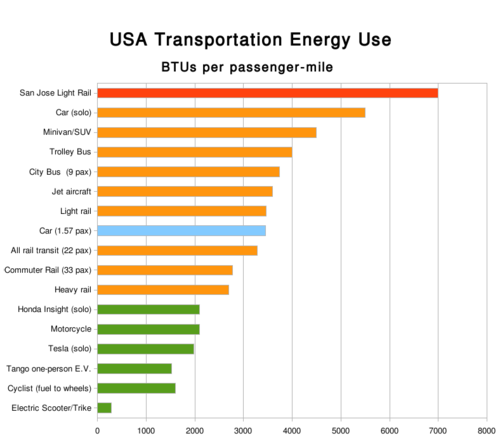
An interesting graph and discussion of energy use by different modes of transport, including various transit and personal vehicle options. You might be surprised how competitive cars can be. Hat tip to Raymond.
Harvard urban economist Edward Glaeser had an interview in the Wall Street Journal recently with these quotes mentioning Houston (in addition to this piece in July).
"I think the relatively laissez-faire approach of Houston may be workable when you've got ungodly amounts of land you can use, but the more you squeeze in an area, the more policies you need -- and the great hope is those policies don't limit growth." ...
WSJ:What about looking to European cities, where more people walk and rely on mass transit, as a model for the U.S.?
MR. GLAESER: There's been a segment of urban developers who have been enthusiastic about the model in Europe for quite some time [because] it's much more environmentally sensitive. But there are bad aspects as well.
While there certainly seem to be some smart things done in Europe, it's a mistake to think they've got it right and we've got it wrong. There are many good things that came out of giving Americans the opportunity to live in big houses on the edge of urban areas.
If you think about the lifestyle of ordinary Americans living on the fringe of Houston or Dallas, for example, compared to what their lifestyle would be in an older European city -- living in a walk-up apartment there compared to a 2,500-square-foot house here they bought for $130,000 with a 24-minute commute -- it's extraordinary in the low-cost areas of this country what a $60,000 family income gets you.
There's a reason Atlanta, Dallas, Houston and Phoenix are our four fastest-growing areas. They offer an astonishingly high standard of living for ordinary Americans.
New York City is a great place to be really rich and not a terrible place to be really poor, but it's a pretty hard place to live on $60,000 a year. You don't experience anywhere near the basic standard of living you would in Houston on the same income."
Finally, I'd like to end with a random thought of the day: My sympathies to people all over the world who have to learn English as a second language, where subtleties like "tastes awful" and "awfully tasty" mean two completely different things...
I'm staying at the Chautauqua Institution lakefront resort in western NY state this week, and thought I'd pass on some personal observations about living in a new urbanist community. Well, to be technical, it's old urbanism - it started in 1874 - but it absolutely fits many new urbanist ideals: beautiful, large (2-4 story), dense Victorian houses on very small plots of land (almost no yards), built right up against each other, with very narrow streets and almost no parking (pictures, maps). It's incredibly walkable and bikeable - in fact that's pretty much the only way to get around. Cars are only allowed in for loading and unloading, and then have to park in a giant parking lot outside the community across the highway. It's a pretty good-sized place - filling up with about 7,500 people every summer - so the streets have a lot of pedestrian vibrancy. It even has a classic town square in the center everybody can walk to with a fountain, library, bookstore, restaurants, convenience store and other retail.
While it is an idyllic place, what I can't figure out is how much this works just as a summer resort vs. "real life" applicability. It's only open during the summer and shuts down the other 8-9 months of the year during the brutal NY state winters. Each house is jammed with people. I'd say our 3-story Victorian is hosting 12+ couples in small bedrooms packed on the floors with shared bathrooms - far, far more people than if it were occupied by a normal family household (draining the needed pedestrian vibrancy and density to support shops and services). Lectures, classes, and other events happen around campus all day long, drawing people out to walk around more than they might normally. People are here on vacation, meaning they're not doing daily work commutes or running the errands of daily life - where the trek to the car in the far lot would be intolerable. And the weather is perfect up here in the summer, making the pedestrian experience wonderful. I imagine it would not be so wonderful the rest of the year.
All that said, it might work in the "real world" with narrower townhomes for smaller households set on top of garages, although the steady car traffic that would create would make the narrow streets much less pleasant for pedestrians or bikers. There's a danger issue too: with sightlines so limited by close-in houses up against the street, it's easy for a pedestrian or biker to come out of nowhere. Combine that with the steep hills and winter ice, and it's a dangerous mix. My father already ran his bike into a tree pretty hard, dodging a surprise pedestrian while coasting a downhill curve. Yes, in theory the narrow streets and sightlines should make everybody be more careful and go slower, but people are human, and safety is not always top-of-mind (especially with kids).
All this drives home for me why new urbanist projects that aren't apartments stacked on top of a town center mall are so difficult and so rare: there are just too many hard tradeoffs in a modern society built around the car. All this nostalgia we have is for old urban places built before cars were common - when walking and biking and transit were the only ways to get around. Any modern household today - even living in a TOD where they walk, bike, and use transit for some trips - will still own a car and use it often, and that's really hard to reconcile with the ideal new urbanist environment.
An open dialogue on serious strategies for making Houston a better city, as well as a coalition-builder to make them happen. All comments, email, and support welcome.


 ", on "