The concept of induced demand is frequently invoked
in transportation debates as an argument against expanding highway capacity.
While induced demand is a well-established and uncontroversial economic
phenomenon, its application in transportation is often oversimplified and
argued as if additional travel is inherently frivolous or socially
undesirable.
This characterization misrepresents both the nature
of induced travel and its welfare implications. Induced travel reflects the
release of suppressed demand for access to activities such as employment,
education, healthcare, and social participation. The policy debate should
therefore shift from questioning the value of induced demand to explicitly
weighing the benefits of improved access against the associated externalities.
Induced demand arises when an increase in capacity
reduces the generalized cost of consumption, leading to an increase in quantity
demanded. For roads, added capacity lowers travel time, improves reliability,
and reduces scheduling penalties. The resulting increase in travel is an
entirely predictable behavioral response, analogous to increased use of health
care following the expansion of hospital capacity or increased data consumption
following broadband upgrades.The
mechanism itself is value-neutral; it simply describes how
users respond to lower costs.
Importantly, the existence of induced demand is not
evidence of inefficiency or failure. On the contrary, it is often a necessary
condition for realizing the benefits of infrastructure investment. If
demand did not respond to improved conditions, the social value of capacity
expansion would be limited, or nil.
In transportation debates, induced travel is
frequently portrayed as discretionary or frivolous; implicitly likened to
joyriding or unnecessary consumption. This framing is unsupported by empirical
evidence. Induced travel typically comprises:
Access
to jobs, education, healthcare and services previously foregone due to
excessive travel costs;
Shifts
from inferior routes, times or modes to more efficient ones;
Expanded
labor and consumer catchment areas for businesses; and,
Long-term
land-use and location decisions that improve household welfare.
These behaviors represent revealed preferences for
activities whose benefits now exceed their costs. To dismiss such trips as
inherently low-value is to ignore the foundational welfare principle that
individuals are generally best placed to assess their own benefits, absent
significant distortions.
A central logical flaw in simplistic induced-demand
arguments is the implicit assumption that demand suppressed under constrained
conditions must be socially undesirable. In reality, suppressed demand
generally reflects binding constraints rather than low valuation. Congestion,
unreliability, and excessive travel times exclude individuals from
opportunities, imposing welfare losses that are largely invisible in ex post analysis.
A key issue is the fact that the visibility of
congestion contrasts with the invisibility of
foregone trips, unrealized employment opportunities, and unmade
investments. This asymmetry biases policy narratives toward treating
post-expansion traffic as a problem while neglecting the welfare costs of
pre-expansion exclusion.
No comparable stigma attaches to induced demand in
other infrastructure sectors. New hospitals are not criticized for inducing
health care utilization; new schools are not faulted for inducing education;
new bus services are not denounced for inducing transit usage, and digital
infrastructure is not condemned for inducing data use. In these sectors,
increased utilization is interpreted as a success—the successful revelation of
unmet need.
The distinctive treatment of roads reflects not
economic logic but the conflation of induced demand with broader concerns about
emissions, urban form, and car dependence. These concerns are legitimate policy
objectives, but they are external to the induced-demand mechanism itself and
should be addressed directly rather than embedded implicitly within economic
arguments.
Acknowledging the value of induced travel does not
imply that all road expansion is optimal. Additional travel can increase
congestion, emissions, and other externalities. However, this does not negate
the benefits of improved access; it merely necessitates complementary policies.
Pricing, demand management, vehicle technology, and land-use planning are
appropriate tools for managing external costs without denying the underlying
welfare gains from enhanced access.
The appropriate question is therefore not whether
induced demand exists, but whether the net social benefits of capacity
expansion—accounting for both access gains and external costs—are positive
relative to alternatives.
Induced demand is best understood as a descriptive
account of how infrastructure enables access and economic activity. Its
frequent portrayal as evidence of waste or futility in road investment relies
on an implicit yet unexamined assumption that newly generated travel is of low
social value. This assumption is fundamentally inconsistent with welfare
economics and with the treatment of induced demand in other sectors.
A more rigorous and transparent policy debate would
recognize induced travel as a source of genuine benefit, while explicitly
addressing the distributional and environmental trade-offs that accompany it.
Rob
Bain is Senior Partner with CSRB Group, a UK/Canada transportation consulting
firm.
The Antiplanner has an excellent post that deserves its own dedicated post over here because it gets at what's wrong with one of the most pernicious fallacies regarding highway congestion relief. Key excerpts (bold highlights mine):
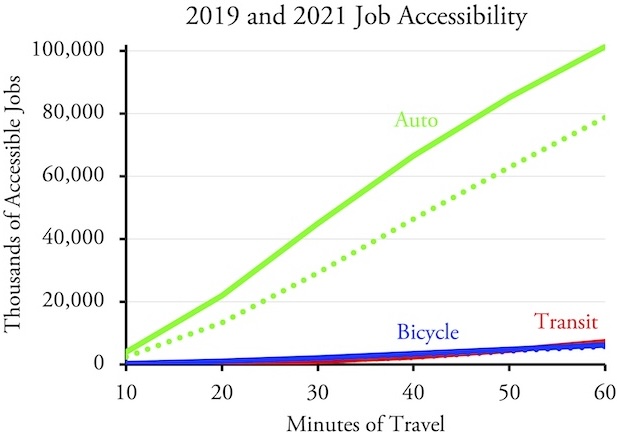
"Data published by the University of Minnesota Accessibility Observatory a few months ago reveals some of the benefits of congestion relief that resulted from the COVID pandemic. I’ve used 2019 data in the past to show that residents of U.S. urban areas can reach far more jobs in a 20-minute auto drive than a 60-minute transit trip. The latest data for 2021 reveal that the number of jobs reachable by transit or bicycle was about 9 percent greater in 2021 than 2019, but the number reachable by a 20-minute auto drive was 66 percent greater.
On average, over 50 urban areas and for trips of 10 to 60 minutes, auto users were able to reach 48 percent more jobs in 2021 than in 2019. Solid lines show 2021 and dotted lines show 2019.
The Texas Transportation Institute documents that congestion in U.S. urban areas dramatically rose between 1982 and 2019. The average number of hours of delay imposed on individual commuters grew by nine times. This growth was because many cities had made a deliberate decision not to try to relieve congestion under the argument that increased capacity simply leads to more driving.
The response to this should have been: So what? Very little driving is frivolous. Instead, most of it is people trying to get to work, school, shopping, health care, friends and relatives, or recreation activities. Then there are trucks moving freight, bringing construction materials and services to work sites, and so forth. Anything that results in more such travel is a good thing because it means more economic activity, more income for people, and more access to better housing, lower-cost consumer goods, and other benefits. The sign of failure is if the new road capacity isn’t used, not if it is.
...
Since 1992, the earliest year data are available, U.S. transportation agencies spent more than $320 billion ($420 billion in today’s dollars) constructing and reconstructing rail transit
On the other hand, if cities had spent even a quarter of the hundreds of billions of dollars spent on rail transit projects since 1992 on highway improvements instead, the congestion relief those improvements would have provided would have allowed far more economic activity, giving low-income people access to better jobs and everyone access to more affordable housing and other benefits. Like most wars, the war on the automobile has done far more economic harm than the negligible benefits it provided."
I've wanted to write for a while about "induced demand", the specious argument that expanded roads just fill up with new traffic so why should we bother?
Two articles below debunk the induced demand argument in their own ways, but here's my own TL;DR summary: Which type of infrastructure should government invest in: transit almost nobody will use, or lanes everybody will use? Induced demand is a false argument. Nobody says "don't build a new airport terminal or runway - it will just fill up with new flights" or “don’t build a new port terminal – it will just fill up with ships” (🙄 eye roll)
In other words, I think the idea of induced demand is just somewhat less paradoxical than people make it out to be.
Consider the traffic impact of a mass transit project rather than highway widening. In the aforementioned Los Angeles, a project is currently underway to extend the little stump of a purple line in the map below and extend it west to Beverly Hills, then down Wilshire Boulevard into Santa Monica and to the Pacific Ocean. This may never happen due to the usual litigation and delays, and it’s conceivable that once completed the project will be a low-ridership white elephant. But let’s stipulate that it gets built and that lots of people take advantage of this transit option.
Well, what happens next?
•Some of the people riding the new Wilshire Metro will be making trips they wouldn’t otherwise have made, taking advantage of new opportunities and making their life better.
•Some of the people riding the new Wilshire Metro will be making trips they otherwise would have made by car, reducing traffic.
•But now that there’s less traffic, some people throughout Los Angeles will make trips they otherwise would not have made due to fear of traffic jams, bringing the system back to congested equilibrium.
In other words, “Ambitious Mass Transit Projects Don’t Fix Traffic. So Why Do We Keep Doing Them?” ...
But “inducing” extra demand would be part of the point — the only thing worse than a new highway project that only causes people to drive more would be a new highway project that didn’t cause people to drive more and wasted a bunch of money."
The second is from Planetizen: Induced Travel Demand Induces Media Attention - Induced demand is a popular concept among urbanists, but does its pervasiveness obscure the true costs of mobility? Key excerpts:
Most new demand on expanded roads comes from new population, new employment and economic activity (some or all of which may have been attracted by enhanced transportation infrastructure), traffic rerouted from neighborhood streets or congested roads, or travel that has shifted in time to the benefit of the traveling public now that more capacity is available to undertake activities during desired travel times.
...
Since approximately 2005, U.S. vehicle travel per person has not grown and the amount of travel on roads with newly increased capacity attributable to additional or longer induced trips is likely modest. The National Household Travel Survey documents declining trip rates as telework, e-commerce, and other communications substitution opportunities further dampen travel demand growth pressures, particularly for urban households. If travel expanded to fill all capacity, we would not have any low-volume highways.
More importantly, characterizing induced travel as bad or wasted is a misrepresentation of the value that people derive from engaging in travel. It’s not just wealthy folks making superfluous trips. Residents having access to better jobs or businesses with better selection and lower prices isn’t bad. Businesses having access to a bigger labor pool and potential customer and supplier bases because people can travel farther in a tolerable amount of time isn’t bad. Making supply chains work better isn’t bad. Getting emergency vehicles where they need to go faster isn’t bad. Pulling cut-through traffic out of neighborhoods to travel on a safer highway facility isn’t bad. Having more direct and less congested—and thus environmentally greener—trips isn’t bad. Enabling parents to get home and share a meal with the family isn’t bad. Using transportation infrastructure to shape development or improve economic competitiveness isn’t bad. Being able to engage in social interactions and recreational activities isn’t bad, and contributes positively to physical and mental health.
...
Overplaying induced demand arguments as a pretext for discouraging roadway expansion or presuming travel demand can be accommodated by investing in alternative modes can be disingenuous and ill-informed. The presumption that directing resources to transit, bike, or pedestrian options can meet the mobility needs of all people and goods seldom works out as a real solution that is financially sustainable, environmentally superior, or offers comparable mobility, accessibility, or other benefits.
That yellow highlight is my favorite, crisply articulating all the benefits of expanded highways. Keep it in mind next time you hear silly "induced demand" arguments being thrown against new projects.
This week I'd like to do a simple re-post from Bob Poole's excellent Surface Transportation Innovations Newsletter at Reason, where Houston has dropped to #9 in the traffic congestion rankings with delay hours far below the worst cities like Chicago, Boston, NYC, Philly, Miami, SF, and LA. Highlights mine.
Traffic Congestion Roars Back, Despite Work from Home
The 2022 INRIX Global Traffic Scorecard was released last month, and it shows a strong resumption of metro area traffic congestion, despite the continued high level of telecommuting. The same pattern appears in major metro areas in Europe, Latin America, and South Africa.
The INRIX global top 25 most-congested metro areas table resembles the 2021 ranking, with London still in first place, Paris in third place, and Toronto moving up from 22nd to 7th place. The 10 most-congested metro areas worldwide had delays ranging from 121 hours per driver to 156 hours per driver in 2022.
For U.S. cities, Chicago moved up to 2nd from 6th place, Boston zoomed from 18th to 4th, and Miami rose to 9th from the previous year’s 32nd place. Other areas rising a lot included Los Angeles, up to 14th from 33rd, San Francisco, from 15th from 34th, and Washington, D.C., which went from 99th to now 20th.
The changes in congestion rank for U.S. metro areas were nowhere near as dramatic as the worldwide changes. Here are the key 2022 INRIX figures for the top 10 metros.
2022 Rank (2021)
Metro Area
Avg. Delay (hrs)
Cost/driver
Cost per Metro
1 (2)
Chicago
155
$2,618
$9.5B
2 (4)
Boston
134
$2,270
$4.3B
3 (1)
New York
117
$1,976
$10.2B
4 (3)
Philadelphia
114
$1,925
$4.5B
5 (5)
Miami
105
$1,773
$4.5B
6 (6)
Los Angeles
95
$1,601
$8.6B
7 (7)
San Francisco
97
$1,642
$2.6B
8 (13)
Washington
83
$1.398
$3.5B
9 (8)
Houston
74
$1,257
$3.7B
10 (10)
Atlanta
74
$1,257
$3.1B
Source: INRIX
Many factors are responsible for these traffic congestion results, but let me suggest a few that might be relevant. First, despite much rhetoric arguing that traffic congestion is a byproduct of low-density sprawl land-use patterns and that higher density and mass transit are the answer, the top four U.S. metro areas are all characterized by high-density and high-transit mode-share, in comparison with lower-density, low-transit Miami, Los Angeles, San Francisco, and Atlanta.
Second, which of these areas have added express toll lanes to portions of their freeway systems? Miami, Los Angeles, San Francisco, the Virginia suburbs of Washington, DC, Houston, and Atlanta.
One other point about density and transit as the long-term solution: urban agglomeration benefits. Extensive research shows that large metro areas are generally more economically productive than smaller ones because a lot more positive-sum transactions can take place in the former—assuming there is fast and reliable transportation from any origin to any destination (since both residences and jobs are spread out all over the landscape). (See Alain Bartaud’s excellent book, Order Without Design, MIT Press, 2018)
Less-congested freeways, due to variably-priced express lanes, contribute to employers having a wider choice of qualified prospective hires and workers having many more good employment options. The same is true, in theory, of a large transit network. Yet, a series of “access to destinations” studies by University of Minnesota researchers have shown that in most large metro areas one can get to nearly all the potential jobs in 30-45 minutes by car, but to very few via transit.
NYC passes LA for worst traffic as people drive instead of riding trains during the pandemic. Houston still a pretty bad #3. We just keep growing, have been less locked down than California, and so many of our jobs require being in-person (industrial, mfg, port, health care).
If you’re trying to buy a home, then you’re probably a grown-up. You deserve a grown-up city—the city of Houston.
"Austin is a fun place, no doubt. Texans from across the state love to hop in the car and spend a long weekend paddle-boarding on Lady Bird Lake, swimming at Barton Springs, partying on Sixth Street, and reliving college memories at Kerbey Lane—as if the city were their personal playground. But playgrounds are for children. If you’re trying to buy a home, then you’re probably a grown-up. You deserve a grown-up city—the city of Houston.
Don’t get me wrong; Austin has some great attributes. The Capitol is a beautiful and historic building. Houston should aspire to have a campus of the caliber of the University of Texas. And Austin summers are somewhat more of a dry heat. But those great Austin amenities that people swear they could never do without—the live music! The outdoors! The progressive attitude!—exist in every other major city in one form or another. And I would argue that Houston’s offerings are better, and more sophisticated, than Austin’s.
...the fact that the city’s leadership can’t find a way to make housing affordable should be an indictment of anything related to self-proclaimed progressiveness. Politics is about power, and if Austin politicians can’t use their power to improve the fundamental living conditions of not only the most vulnerable but also a reasonably privileged middle class, then they should just admit the city is becoming a resort town for celebrities and a techno-oligarchy and spend their time arguing about plastic straws. Say what you will about Houston’s relationship with the oil and gas industry; at least pollution here has abated. Austin still hasn’t figured out how to mitigate the collateral consequences of tech wealth and Hollywood tourism.
...
No doubt Houston isn’t as affordable as it used to be, especially for renters already struggling. But somehow it remains tenable for those upwardly mobile geriatric millennials taking their first steps into homeownership. In the past few months alone, I’ve seen four friends buy their first places: a new townhouse in Oak Forest, a classic eighties townhouse in Montrose, a bungalow north of downtown, and a cottage in the Second Ward. These homes aren’t in far-flung suburbs; they’re in Houston’s inner core, within walking and biking distance to the breweries, restaurants, arts venues, and other hallmarks of a livable, enjoyable city. Some of these are dense housing allowed by Houston’s lax land-use rules. Others are older homes still left standing—and reasonably priced—as new construction soaks up capital like a sponge, saving older neighborhoods from the deluge of wealth that has made Austin so unaffordable. I also know people who moved to the Woodlands.
...
In contrast, Houston, a place without pretension or zoning, will gleefully tear down its past if that makes the present more appealing—anything to give you the freedom to grow. You won’t be restrained by outdated notions of what the city should be. You’ll be empowered by hopes of what the city can be. We’re improving our parks, adding more bike lanes, and expanding the mass transit system. And we don’t listen to NIMBYs who want to block affordable housing. Forty years of the Houston Area Survey show that we’re a city perpetually, even irrationally, optimistic about our future. Houston thinks there are better days ahead, while Austin worries it is past its prime.
The choice is clear: You can rage against the dying of the light in Austin and spend 50 percent of your income on housing, or you can be reborn a sweaty, home-owning phoenix in Houston."
NYT: Smarter Traffic Lights, Calmer Commuters. Holy crap Houston needs this! I think Uptown and TMC would be really good test cases. The AI could learn optimal traffic light timings based on time-of-day as well as make dynamic adjustments for unexpected surges.
Cities Spending the Most on Eating Out in 2020. We found that Houston, Texas ranks #11 for spending their annual income at restaurants. Houston residents spend an average of $357 each month on eating out and 5.7% of their annual income at restaurants. Houstonians spend about the same amount eating out vs. in. We eat out a lot, but at low prices. We eat out a lot more than Dallas residents, which surprised me a bit until you think about how hyper-competitive Houston's restaurant scene is from the lack of zoning. That hyper-competition applies to grocery stores as well, which shows up in how much less we're able to spend on food than most of the cities in their graph. Houstonians spend $300 less per year on groceries than the average American, but $1,000/year more on eating out due to the high incomes and great affordable restaurants here.
City Journal: End of the Road for Parking Requirements - They serve as a tax on housing. Houston has been expanding its "market-driven parking" zone beyond downtown to Midtown and EaDo, and hopefully to additional areas in the future. Let developers decide how much parking they need, not arbitrary formulas. Hat tip to Jay.
This makes me nauseous. Planners actually like tight zoning regulations like high minimum parking requirements so they can extort more out of the developer to relax them!
Since I'm traveling this week, I'm just going to pass along this excellent section from a recent Surface Transporation Innovations newsletter from Robert Poole at Reason: (highlights mine)
Is Traffic Congestion a Con?
Last month, INRIX issued a new report on urban traffic congestion worldwide, with new rankings for U.S. metro areas. Based on a revised method of assessing commuter traffic (counting trips to more than just the central business district of each metro area—finally) it identified Boston, Chicago, and Philadelphia as having the highest amount of delay hours per driver, worse than Washington, DC, Los Angeles, and San Francisco. Due to their much greater size, the New York, Los Angeles, and Chicago metro areas are ranked as first, second, and third in the total cost of congestion, which is quite plausible.
These numbers are based on 2019 INRIX traffic data, whereas the well-known data in the most recent 2019 Urban Mobility Report (UMR) from the Texas A&M Transportation Institute are from 2017. Despite INRIX having worked with TTI on that report, its delay and cost numbers are very different, with INRIX now reporting an average delay per driver nationwide of 99 hours per year compared with 54 hours per year in the 2019 UMR. Even more startling, the UMR estimated total U.S. congestion cost as $179 billion a year, while the new INRIX report’s number is a mere $88 billion. Due to TTI’s more sophisticated methodology, I’m inclined to accept their congestion numbers.
Meanwhile, about the same time as the INRIX report reached my inbox, Transportation for America (T4A) released a new report called “The Congestion Con.” Its thesis is that our main national strategy for dealing with congestion is expanding freeway capacity—and that this has utterly failed. The report uses data from the 2019 Urban Mobility Report together with Federal Highway Administration (FHWA) highway statistics and census bureau data in an attempt to demonstrate its case—and utterly fails. An excellent rebuttal, well informed with data and reasoning, is Randal O’Toole’s response, “The Induced-Demand Con.”
The T4A authors use some odd measurements to make their case. First, they compare the percentage growth in freeway lane-miles with the percentage growth in population between 1993 and 2017, finding that the lane-mile increase was generally higher than the population increase. O’Toole points out a major problem with this. FHWA highway statistics reveal that large amounts of exurban freeway mileage that already existed in 1993 were outside the 1993 definition of urbanized areas, but are included in their 2017 boundaries. He plausibly estimates that “well over a third of the 30,511 [lane-miles] that T4A implies were built in that time period already existed in 1993.”
A second problem is that the percentage increase in congestion is a poor basis for comparing metro areas. O’Toole notes that low-congestion metro areas (like Bakersfield, CA) still have low 2017 congestion but may have had a high percentage increase since 1993. By contrast, a highly congested area like Los Angeles typically has relatively small percentage increases in its already enormous traffic congestion. He suggests a better metric would be to compare freeway vehicle miles of travel (VMT) per lane-mile over time. That metric allows us to discern differences among metro areas that did and didn’t add a lot of freeway lane-miles. For example, neither Portland nor Seattle added many lane-miles between 1993 and 2018, but their freeways got increasingly clogged: VMT/ln-mi. up 84 percent in Portland and 44 percent in San Francisco. By contrast, the increases in metro areas that added a lot of capacity are much lower: VMT/ln-mi. up only 21 percent in Houston and 14 percent in Phoenix.
T4A’s assertion that adding capacity has failed to reduce congestion is also falsified by data that used to be included in TTI’s Urban Mobility Reports but has been omitted since their 2012 report. With TTI’s permission, I reproduced a graph from that report in my book, Rethinking America’s Highways (page 258). It shows that 17 metro areas that had capacity growth within 10 percent of traffic growth actually had a declining trend in congestion increases between 1998 and 2010, compared with strong and ongoing congestion increases from 1982 through 2010 for 84 metro areas that added far less capacity.
Another major problem is that T4A continues to put forth the “induced-demand” thesis: that it is futile to add freeway capacity because new lanes will simply fill up, and congestion will soon get back to what it was before. If that were literally true, as O’Toole and others have pointed out, every freeway would have high levels of congestion, yet, for example, Los Angeles freeways are overloaded with 23,000 VMT per lane-mile per day, while Pittsburgh freeways (for example) breeze along with just 9,000. In my book, I devoted several pages to a critique of the most-cited source on induced demand, the 2011 paper in American Economic Review titled “The Fundamental Law of Road Congestion: Evidence from U.S. Cities.” If you don’t have my book, you can read a condensed version of this sidebar here.
The bottom line of T4A’s report is that America should stop expanding freeways and radically reform land-use policy to discourage or prohibit outward expansion of metro areas (which they deride as “sprawl”). National policy, they urge, should reorient the federal surface transportation program away from reducing delay to encouraging better “access.” By that, they mean the densification of urban areas, on the premise that people could, therefore, walk, bike, or use transit to get to “jobs” and other destinations. The fallacy in all of that “access” research is that it treats jobs as generic—as long as you can get to some kind of a job, problem solved. But as researchers like Alain Bertaud of NYU (Order Without Design, MIT Press) and others have shown, this is a recipe for reducing the productivity of urban areas. Urban agglomeration effects only come about when people and companies are able to find each other and engage in positive-sum transactions—individuals finding the best jobs and companies finding the best people. This is what happens in urban areas that enable fast commutes over long distances—exactly the opposite of what “smart-growthers” like T4A recommend. A growing body of research finds that metro areas with fast, region-wide transportation infrastructure have significantly higher economic productivity.
P.S: I will give T4A credit for two good points in their 2020 policy agenda (and included in this new report). I agree that federal and state political considerations have led to a serious underfunding of highway maintenance. Also, I agree that road pricing is underused, and could make a real difference as part of reducing traffic congestion. But a lot of that requires new construction, such as adding priced managed lanes to congested freeways, which T4America does not support.
A recent post discussed that Texas was ranked near the top for residents that feel their state is the best place to live. I would go so far as to say Houston is one of the best cities to live in, but there is one thing holding Houston back from taking the top slot as the best city: effective public transit. The Houston readers can commiserate with the feeling of boredom and frustration when stuck in stand-still traffic during rush hour. We Houstonians have to make sacrifices due to limited public transit options including:
10 days wasted per year in the car
thousands of dollars spent each year on gas and vehicle maintenance
thousands of kilograms of carbon dioxide emitted annually
With the upcoming Metro Next Plan vote, there has been much discussion about future transit systems in Houston, but one key transit possibility has been absent from the discussion: autonomous vehicles (AVs).
Autonomous vehicles are advantageous for the following reasons:
Transform system from small number of large vehicles to large number of small vehicles
Switch from fixed-route, fixed-timetable to demand-responsive system
Address the first/last mile problem
Point A to point B system
Because autonomous vehicles do not require a driver (or a driver’s salary), Houston would be able to better afford a larger fleet size of smaller vehicles. This means that there would be frequent services that reduce commute times and increase convenience. In addition, autonomous connected vehicles can communicate with each other and the passengers to create demand-responsive routes which would be more convenient for riders and would lead to higher vehicle load factors. To increase connectivity, autonomous vehicles can be applied to the first mile/ last mile problem of public transit that excludes some populations from using a transit system. Many opt-out of using public transit due to limited connectivity between their initial location and the transit pick-up or between the transit drop-off and their intended destination. AVs can fill in the gaps of existing transit, helping to create a fully integrated and accessible system that can get a user from point A to point B. The advantage of private cars is that one can hop in a car and get wherever they want whenever they want. If a public transportation system is comprehensive so that commuters can get from anywhere to anywhere with short wait times, it can challenge the dominance of cars and thus change the face of Houston transit.
I recently finished a Masters course at the University of Cambridge in which I wrote a dissertation (alternate link) postulating the use of autonomous vehicles as a means of delivering a public transport service in Houston. The results from the dissertation suggest that autonomous transport systems have great potential in Houston with regards to social, financial, and environmental performance. Houston needs a forward-thinking solution when planning transit that will be in place for the upcoming decades. Autonomous vehicles are that solution and Houston can be the leader in pioneering autonomous systems for public transit.
TX beats CA, bike lanes backlash, tops for middle class and startups, clever flood protection for homes, TXDoT drop, place-based visas
I'm finally back from vacation with lots of items to catch-up on:
The Economist did a special section comparing California and Texas, and Texas came out on top. I finally had a chance to read the entire special section on my flight back. They definitely get into the pros and cons of both models, but summarize by saying Texas is pragmatic and best positioned to build on its strengths and address its weaknesses (like education and support services for the poor), while California has strongly entrenched interests that make it hard to change, especially unions and pension obligations (not to mention the cost of housing!).
"Many struggling American communities are, among other things, losing people. Meanwhile, many millions more people would like to move to the United States of America than the country is prepared to allow in.
Three economists have called for leveraging the latter into a solution for the former, allowing both communities and immigrants to opt into a special program that would allow communities experiencing population loss to issue temporary visas to skilled foreigners that would allow them to live and work in places that want more workers."
"Texas continues to rank ahead of other states that have multiple large metro areas, like California and Florida.
In safety and performance categories, Texas ranks 1st in structurally deficient bridges, but is 33rd in urban Interstate pavement condition, 37th in overall fatality rate, and 43rd in traffic congestion. On spending, Texas ranks 27th in total spending per mile.
“Texas has the largest highway system in the country and could do the most to improve its overall rankings by reducing traffic congestion on urban highways, improving the pavement conditions on those urban Interstates, and lowering fatality rates on rural and urban highways. Compared to nearby states, the report finds Texas’ overall highway performance is still better than Louisiana (ranks 34th) and Oklahoma (ranks 41st), but just behind New Mexico (ranks 21st),” said Baruch Feigenbaum, lead author of the Annual Highway Report and assistant director of transportation at Reason Foundation. “Texas is doing better than comparable highly-populated states like California (ranks 43rd) and Florida (40th).”
Texas’ best rankings are structurally deficient bridges (1st) and rural arterial pavement condition (13th). Texas’ worst rankings are in traffic congestion (43rd) and rural fatality rate (38th).
Texas’ state-controlled highway mileage makes it the largest highway system in the country."
Finally, a very clever tech solution for home flooding protection. Check out the cool video. What I don't quite get from the video though is how it keeps water from seeping underneath it. More on the company here.
Aaron Renn recently wrote an excellent piece in the City Journal describing the challenges facing Atlanta, and it holds some cautionary lessons for Houston.
First, here are his excerpts related to Houston:
"Though still growing rapidly, Atlanta’s fortunes have taken a hit in the new century. From 1980 to 2000, metro Atlanta grew in population by an astonishing 82.3 percent, outdistancing Dallas–Fort Worth and Houston. But in the 18 years since 2000, its population growth rate was only 39.6 percent, which trails its Texas peers. Since 2000, the population gap between Houston and Atlanta more than doubled, rising from less than 500,000 to more than 1 million. And growth has continued to slow. From 2000 to 2010, Atlanta’s average annual population growth reached only 2.13 percent, and that has fallen to 1.45 percent since 2010.
... Migration to Atlanta has significantly slowed. The city welcomed fewer domestic migrants than much smaller Charlotte and Austin did last year, and it’s drawing far fewer immigrants than Dallas, Houston, and even Philadelphia.
... Atlanta also has huge transportation challenges. Its freeways are among the nation’s widest but also the most congested. Atlanta failed to rearchitect its freeway network as it grew, retaining its sixties-era beltway-and-spoke system. By contrast, Houston is working on its third beltway. The net result: Atlanta outside its I-285 perimeter is by far the most developed urban area in the world without non-radial freeways, according to demographer Wendell Cox. The metro area has the nation’s third-lowest share of jobs accessible to the average commuter in 30 minutes or less.
The highway problems may be unfixable. Regional planners have been pushing transit expansion into the suburbs, but in the highly dispersed Atlanta region, transit has no chance of making a dent in mobility needs."
I’ve been warning Houston for years about the risk of underinvestment in transportation infrastructure leading to employers leaving the core for the affluent suburbs like Exxon did. Now I can point to an actual example of that happening in Atlanta (especially a lack of loop freeways), based both his piece as well as the comments there and at his blog. There people discuss the jobs boom in the suburbs - not the core - because of congestion. Employers will move to where their employees want to live if they can't reach them within a reasonable commute time.
When a metro region gets too hard to get around – like LA and Atlanta – it fragments into an archipelago of isolated, zero-sum winner and loser “islands” rather than being a single cohesive labor market. Houston faces the same risk if we don't invest in projects like the 45N expansion and connecting up a regionwide MaX Lanes network.
MetroNext kudos and tensions, HTX traffic is better than you'd expect, road diets kill businesses, the aging affordable housing pipeline, and more
Before getting to this week's items, some thoughts on last week's MetroNext board workshop I attended (presentation slides here). First off, kudos to Metro (and Chair Carrin Patman) for sticking to its guns on the value of BRT over LRT. They can build three miles of BRT for the cost of one mile of LRT, getting more service to more areas more quickly and cost-effectively. People keep asking for fantasyland LRT service everywhere without understanding the economic tradeoffs, and it's good to see Metro have the backbone to say no.
As Dug's Chronicle story mentioned, there was tension on the Hobby line routing between the board and Houston City Councilmember Gallegos. He doesn't want it to come down 75th Street even though that's the most efficient routing with the best service, including bringing people to a renovated Mason Park (he's worried about right-of-way loss, which Metro thinks would be absolutely minimal if any). He's insisting on a longer routing that hits the new botanic gardens but misses shopping and restaurants of Gulfgate, which I guarantee generates 100x the trips the botanic garden does. How often do you eat or shop vs. go to tourist attractions? (probably in about the same proportion as you go to work vs. go to the airport!) Metro's plan includes an autonomous shuttle that would run from a stop near Reveille and Telephone along Sims Bayou to offer connectivity to the botanic gardens at Glenbrook Park, which I think could be an attraction in itself. It makes total sense.
Moving on to this week's items:
Houston #2 best city in Texas behind Flower Mound, and the only major city among the top five. Actually, neither Dallas nor Austin are in the top 100!
Houston is very good at this process of keeping up a steady supply of new housing that eventually becomes affordable older housing: Market Urbanism Report - Why the used housing market should be like the used car market - "As with the car market, the creation of new housing means used housing can filter down, to be bought or rented by lower income groups."
"There’s room for a new politics that recognizes that the path to actual social justice lies primarily in expanding opportunities for a broad range of jobs and housing options. But this can only be done by confronting the current approach to social justice that results in conditions demonstrably unjust."
"The new TomTom Traffic Index puts Houston at No. 204 globally and No. 18 nationally for traffic congestion, as well as No. 2 in Texas.
In Houston, drivers spent an average of 23 percent extra travel time stuck in traffic last year, according to TomTom. The worst day in 2018 for traffic congestion in Houston: October 31 (44 percent). The best: Christmas Day (1 percent)."
Houston Carbon Council, free transit reduces congestion, HTX #2 for STEM jobs, and more
Last week I attended the fantastic Houston Low-Carbon Energy Summit put on by the Center for Houston's Future and KPMG (story). Speaker after speaker said Houston has the assets and skills to really make difference in reducing carbon, from carbon capture and sequestration to methane reduction to biofuels to hydrogen manufacturing (a key one for anything requiring high energy densities like aviation). That extends to the energy trading world too, where carbon offsets are a natural market for us. There is a lot of pragmatic room in the middle between "nothing to worry about here" and "pure green renewables are the only answer" (lots of obstacles there that will take decades). My proposal: we need to form a Houston Carbon Council (maybe through the GHP?) to set pragmatic economic and technical goals and coordinate efforts, while also publicizing carbon-reduction efforts and improving Houston's brand as a can-do city doing its best to mitigate climate change as we transition towards a long-term low-carbon future. It could provide more realistic alternatives to the fantasyland green new deals of the world, including cost-effective solutions governments could really implement.
"The Dallas-Fort Worth and Houston metros respectively garnered the #1 and #2 overall rankings for best STEM metros. This was due to each scoring in the top 10 on all three metrics – total STEM employment, total employment growth and relative affordability for first time buyers (FTBs). ...
#2: Houston earned the number 2 spot among the 30 largest STEM employment centers by also having top ten ranking on all three metrics:
- STEM employment of 207,000 earned a 10th place ranking, just below Seattle.
- Overall employment growth of 70% since 1990 earned a 6th place ranking, more than double the national average of 33%.
- A FTB median home price to median income affordability ratio of 2.7 landed a 6th place finish.
A vibrant new home construction sector helps Houston maintain both a high rate of employment growth and FTB affordability. New construction sales accounted for 25.5% of all home sales in the 4th quarter of 2018, well above the national rate of 11.2%. For the entry-level home segment, the new construction share was 16.1%, also well above the 6.2% rate for the national entry-level home segment. In the move-up home segment, Houston’s share was 42.3%, again well above the 19.6% rate for the national move-up home segment."
A new big-name urban planning book advocating the Houston model
I've been wanting to discuss this new contrarian urban planning book "Order without Design: How Markets Shape Cities" by Alain Bertaud (former urban planner at the World Bank) for quite a while, since it's a ringing endorsement for Houston's model as well as my own concept of opportunity zones. We are essentially the poster child for the policies advocated in this book.
Apologies in advance for the long post, but I promise you it is a great nutshell summary of a very long 432-page book you're being saved from reading! (unless you're an actual practicing urban planner, in which case the whole book is required reading)
"Bertaud’s new book, Order without Design, reflects a lifetime of growing skepticism about urban planning dogma. Planners, says Bertaud, based their ideas on rules of thumb that were developed by people who often know nothing about the people they are regulating or planning for.
For example, Bertaud shows that big cities are more productive because they have bigger labor markets, meaning employers and employees are more likely to find a match that needs their needs and skills. He also shows that the size of a labor market depends on commute times: only people located within an hour of a job center should be considered a part of the labor market.
Urban planners who try to slow down commute speeds — either by getting people out of their cars and onto transit or by deliberately allowing congestion to grow to reducing driving — end up fracturing major urban areas into multiple smaller labor markets. Planners seek to turn urban areas into “urban villages” in which people both live and work, but such villages, says Bertaud, don’t exist: even though many suburbs have a jobs-housing balance, most people don’t work in the suburbs in which they live. All of these things reduce urban productivity.
While there are no cities without planners, Bertaud points out that the world-wide range of cities goes from Houston, where there is almost no government intrusion into land markets, to some capital cities such as Brasilia, which were almost completely centrally planned. The comparative experiences within this range has persuaded Bertaud that cities that rely more on markets and less on planning to determine land uses are more affordable, more mobile, and more productive. This is an essential book in the Antiplanner’s library."
"...one of Bertaud’s central insights: a metro area’s productivity “depends on its ability to maintain mobility as its built-up area grows.” In other words, the urban agglomeration benefits that increase the region’s productivity will continue “only if the transportation network is able to connect workers with firms and providers of goods and services with consumers.” The failure to manage the transportation network to maintain high mobility results in congestion.
The bottom-line point of this discussion is that “the effective size of the labor market depends on travel time and the spatial distribution of jobs.” Bertaud cites empirical research on urban-area productivity and travel time in Europe, Korea, and the United States. In particular, citing two key research papers, he concludes that “workers’ mobility—their ability to reach a large number of potential jobs in as short a travel time as possible—is a key factor in increasing the productivity of large cities and the welfare of their workers. Large agglomerations of workers do not ensure high productivity in the absence of mobility.” Bertaud concludes that “the main objective of planning should be to increase the speed of transport as a city’s size increases.”
These insights are expanded upon in much greater detail in the book’s longest chapter, on mobility (Chapter 5). I don’t have the space to summarize that, but a couple of key points are worthy of mention. First is that a poly-centric or widely dispersed pattern of job locations is more conducive to transportation that efficiently links workers to jobs than the 19th-century monocentric pattern, with a transport network focused on a “central business district.” Second, he explains that the trendy idea of “urban villages”—where people can live and work within walking or bicycling distance—is a recipe for stagnation. Yes, people might find “a” job in that village, but it is highly unlikely to be a high-productivity job. This planning policy would reduce, rather than increase, a metro area’s economic productivity."
"Bertaud sees the restrictive land use planning regulations that have proliferated around the world as a major problem. He has particular criticism for urban containment policy, which outlaws or significantly restricts new housing on the urban fringe. He cites the extensive economic evidence associating urban containment with higher house prices.
...
His prescription for what planners should do is very simple: 'The main objective of the planner should be to maintain mobility and housing affordability as a city’s population increases and it diversifies its activities'
...
Bertaud notes that 'The objective of an urban transport strategy should be to minimize the time required to reach the largest possible number of people, jobs, and amenities.'"
"Though considered obvious among urban economists, the idea of cities as labor markets has enormous implications for the work of city planners. Take urban form: current city planners aspire to nudge residents into self-contained urban villages. But if we recognize productivity, and its resulting wealth, as a function of access to large labor markets, we’ll know that people will always travel well outside their local neighborhoods for work. Once city planners acknowledge this basic reality, they can get on with the work of supporting, rather than resisting, natural urban patterns—Bertaud wants planners to respect the natural choices of city dwellers.
... Order without Design is a work with a clear vision for urban policy—a magnum opus from one of the twenty-first century’s great city planners. Similar to Jane Jacobs’s The Death and Life of the Great American City, Bertaud’s book manages to weave together theory and practice in a way that will be eye-opening to the curious urbanite and enriching to the practicing professional. If city planning has a future, its contours can almost certainly be found here."
Let's hope the book is read and adopted widely in the urban planning community and that they start seeing Houston as a model to emulate rather than avoid!
HTX tops for millennials, startups, and middle-class home affordability; Houspitality support, highway vs. rail cost-benefit
So a sad week here at Houston Strategies: I have a draft post where I keep ideas for future posts. It had gotten quite long over the last 14 years, with tons of good thoughts and links whenever I had time to get to them. Well, that all came to a crashing end last week when I discovered a Blogger quirk: if you open a post, paste in some content, realize it's not formatted right and accidentally hit Undo twice, it *wipes out the entire post* then auto-saves the blank version (and unlike Google Docs, Blogger does not keep a version history of posts). Then I unwisely compounded the error trying to close the browser tab before the auto-save instead of just hitting the redo button. Regardless, it's all gone now - 14 years of potential post ideas... 😳😢
Moving on to this week's items... lots of kudos for Houston this week!
"The region also has a reputation for welcoming newcomers, whether they’re from New York or New Zealand...a global city, with 90 consulates, two international airports, the second busiest seaport in the nation, and nearly 1,000 foreign-owned companies with HTX ops"
"Houston ranked among the top three cities in several specific areas, including diversity, ease of meeting new people, fair income taxes, everyday expenses, salary potential and amenities for children."
More details here, including some cool comparative graphs (hat tip to George). Houston is a pretty dominant #1, notably ahead of #2 Atlanta and #3 Dallas in the overall value graph (also notably ahead of #5 Austin!).
"In 2004, Denver-area voters approved a sale tax increase to pay for “FasTracks,” a plan to build 119 miles of rail transit lines in the metropolitan area. In 2008, California voters approved the sale of bonds to pay for the construction of a 520-mile high-speed rail line between Los Angeles/Anaheim and San Francisco/San Jose. FasTracks is within a metropolitan area and high-speed rail is supposed to connect several metropolitan areas, yet there are a lot of similarities between these two projects.
Both rely on technologies that were rendered obsolete years before they received voter approval. The agencies sponsoring both projects ignored early warning signals that the projects were not cost effective. Both had large cost overruns. Advocates of both lied to voters about the benefits and costs of the projects. Due to poor planning, both projects remain incomplete. Despite the failure of the projects to date, both have adherents who hope to complete them."
"By contrast, the biggest winner is Houston, a metro area that many planners and urban theorists regard with contempt. The Bayou City gained nearly 15,000 millennials net last year, while other big gainers included Dallas–Fort Worth and Austin, which gained 12,700 and 9,000, respectively. Last year, according to a Texas realtors report, a net 22,000 Californians moved to the Lone Star State."
"I want to call your attention to a new (not yet published) paper on the subject by researchers from Cornell University and McGill University. “A Comprehensive Welfare Impact Analysis for Road Expansion Projects” uses transportation data from the Dallas-Ft. Worth metro area to compare, quantitatively, the effects of four possible highway expansion options (in addition to doing nothing): adding a general purpose (GP) lane, adding a high-occupancy vehicle (HOV) lane, adding a priced ETL (electronic toll lane), or converting all lanes to conventional toll lanes. The priced ETL ranked highest in both regional economic impact and improving system-wide travel time, and was judged to produce the greatest increase in overall social welfare."
WSJ Video: California Home Prices Are Soaring. Here’s Why. The good news for Houston (and most of the rest of Texas) is that we're not afflicted by any of California's problems which are mentioned in the video, therefore housing remains affordable here.
CityLab maps the world's megaregions. I'm not sure how much I buy into the megaregion concept, especially when it crosses state and national borders, but at least we're grouped with the Texas Triangle now (as we should be) instead of separately with New Orleans like we used to be.
Congestion improvements, global superstar city, biggest homes in America, up vs out debate, Vision Zero flaws, CA vs. TX, and more
Ok, first an apology for such a *long* gap between posts. I have been nearly continuously traveling since early Sept (multiple trips mixing work and fun), including presenting MaX Lanes at the Strong Cities 2030 sustainable mobility symposium in Essen, Germany and debating up vs. out urban development policies at the Breakthrough Institute Ecomodernism 2018 conference in DC. Both events went really well and I got very positive feedback. As you might expect with such a long gap, a lot of smaller items have gotten backlogged:
"The other point that leaps out of the table is the change in rank of Dallas and Houston, both of which moved significantly lower in the league table of most-congested metro areas. Both have a growing fraction of their expressways that are tollways, and both have expanding networks of variably priced managed lanes. Also striking is that Portland, with just one-third the population of Dallas, has nearly the same average congested hours per commuter and has nearly double the percentage of peak period hours that are congested."
"Vision Zero is a failed policy from a paternalistic government that takes millions of dollars to implement and never reaches its goal of zero deaths, in part because its goal is completely unrealistic. But Vision Zero does make life harder for commuters and those delivering freight. Yet this is the policy that many U.S. cities want to implement."
Joel Kotkin in City Journal on "One Nation, Two Economies - More than gender, race, or other hot-button media issues, a deep socioeconomic divide will shape the midterm elections."
"The 50 cities account for 8 percent of global population, 21 percent of world GDP, 37 percent of urban high-income households, and 45 percent of headquarters of firms with more than $1 billion in annual revenue. The average GDP per capita in these cities is 45 percent higher than that of peers in the same region and income group, and the gap has grown over the past decade."
Guardian on Houston after Harvey, tech to Houston? Market Urbanist transit, #1 city for young people, top migration, and more
Happy New Year! Let's dive right into this week's items:
The Guardian did an in-depth piece on Houston after Harvey which has some extensive quotes from me: ‘The bayou's alive’: ignoring it could kill Houston - America’s fourth largest city is built on an ancient river network that flooded catastrophically after Hurricane Harvey. With 400,000 homes in the watershed, achieving resilience is the Texan boom town’s greatest challenge
Next time you dismiss Houston's cost-of-living advantage: A report from the University of Southern California and the Los Angeles Business Council published earlier this year found that exorbitant housing costs in Los Angeles were inhibiting employers from attracting "high performers" or top talent to their companies.
"About 60% of the employers surveyed said Los Angeles' high cost of living affects employee retention, with 75% naming housing costs as a specific concern. And nearly all said they viewed high housing costs as a barrier to hiring new mid- and upper-level employees."
Finally, Scott Beyer posted this great piece to his Market Urbanism Facebook group describing key transit ideology I agree with here at Houston Strategies:
Let’s talk transit – and ideology.
Many conservatives/libertarians dislike transit, because they think it's solely a subsidized public utility. But there's a small subset of this bunch called Market Urbanists, who not only like transit, but think transit use would increase significantly if free-market policies were used in cities. Because that would mean the following 4 things:
1) Banning restrictive zoning, so that housing would get denser, creating the critical mass of people needed for transit
2) Enforcing congestion charging, so that road use is priced based on driver demand. This would incentivize people to locate closer to their jobs, or commute in using different modes besides solo driving.
3) Liberalizing private transit from pointless bans and regulations. This would cause the industry to grow, namely through “micro transit” options like rideshare, bikeshare, carpool, ebikes, shuttles, dollar vans, etc.
4) Reforming public transit. Many Market Urbanists aren’t against public transit, per se, but think that transit agencies must improve their management and services as a condition to get more funding. And if they are unable or unwilling to do this, cities should seek privatization, by signing short-term, performance-based contracts with outside companies.
All 4 of these market-based policy ideas are politically unlikely. But if any or all of them were applied, there's no doubt in my mind that many cities would have higher transit usage...because transit would be way better.
"For the life of me, I can’t figure out why so many Republicans prefer a dying white America to a place like, say, Houston.
Houston has very light zoning regulations, and as a result it has affordable housing and a culture that welcomes immigrants. This has made it incredibly diverse, with 145 languages spoken in the city’s homes, and incredibly dynamic — the fastest-growing big city in America recently. (Personally, I wish it would do a bit more zoning — it’s pretty ugly.)
The large immigrant population has paradoxically given the city a very strong, very patriotic and cohesive culture, built around being welcoming to newcomers and embracing the future. As the Houston urban analyst Tory Gattis points out, the Houston Rodeo has so many volunteers it has recently limited their special privileges. In 2015 it had the healthiest philanthropic sector in the nation. The city is coming together to solve its pension problems better than just about any other big place.
Cotton and Perdue are the second coming of those static mind-set/slow-growth/zero-sum liberals one used to meet in the 1970s. They’ll dry up the river. I wish they had a little more faith in freedom, dynamism and human ingenuity."
Hear, hear! For the record, I'm not a fan of the ugly comment either, but you can't win 'em all. Still some great recognition for our city.
"Houston is a city (metropolitan area) of superlatives. The most recent Brookings Institution data shows that Houston has the seventh strongest per capita economy (gross domestic product) in the world (Figure 1). This places Houston above New York and more surprisingly, perhaps, other cities perceived to have strong economies are far below Houston and outside of the top 10, such as London, Tokyo and Chicago."
Decentralized employment which is not rail-transit friendly - see Figure 6:
"The central business district (downtown) ranks eighth in total employment in the nation and also experienced growth. The Texas Medical Center is the largest life sciences center in the world. The center is located south downtown and rivals some of the nation’s largest central business districts, larger than Minneapolis and nearly as large as Denver ,, with more than 100,000 employees (see photograph above). There are other large centers, such as the Port of Houston, the Galleria (Uptown) and the Energy Corridor. Houston is one of the best examples of a decentralized city, with major employment centers throughout."
"Houston is often characterized as a “sprawling” urban area. In fact, however, Houston has a higher than average urban density for the United States (by eight percent) and an urban density approximately 75 percent higher than Atlanta and Charlotte and denser than Philadelphia and Boston. "
"Since 2010 Houston has led the 53 metropolitan areas with more than 1,000,000 population in net domestic migration. "
"There are at least two important keys to Houston’s attractiveness. Obviously, its strong job-creating economy has opened career opportunities for people from other parts of the country. In addition, Houston’s favorable housing affordability has been an important factor. Seminal recent academic research has pointed to the importance of housing affordability in attracting domestic migrants "
"Houston has been more successful in controlling traffic congestion than many other cities. In 2015, Houston tied with Boston for the 11th worst traffic congestion in the United States, according to the TomTom Traffic Index (Figure 10). This is a far better rating than in the middle 1980s, when the Texas Transportation Institute ranked Houston as having the worst traffic congestion in the nation.
Since that time, Houston has managed to have spectacular population growth, yet has kept up with it by expanding its freeway and arterial systems, along with traffic management improvements. Los Angeles, San Francisco, Seattle, San Jose, New York, Honolulu, Miami, Portland, Washington, and Chicago have seen their traffic congestion become worse than in Houston over the same period. Houston is larger in population than all but three of these nine metropolitan areas (New York, Los Angeles, and Chicago), more than twice the size of San Jose and Portland and nearly seven times that of Honolulu. Further, exhibiting the association between greater traffic congestion and higher population density, all cities ranked worse than Houston have higher urban densities."
Another interesting tidbit to note is the remarkable parity between the City of Houston, the rest of Harris County, and the outer burbs of the metro area in figures 3 and 4.
After the Oscars last night, I should probably mention that all of the above is true about Houston as an actual winner, and not a mixup of mistaken identity with Dallas... ;-D
An open dialogue on serious strategies for making Houston a better city, as well as a coalition-builder to make them happen. All comments, email, and support welcome.