Houston has less kludge and more opportunity, the value of mobility, and more
A few misc items this week:
Every planner should prominently post this quote in their office: “You can’t overestimate the value that mobility has on people’s quality of life and their ability to achieve their full economic potential.”
NYT: American Cities Have a Conversion Problem, and It’s Not Just Offices - Piles of regulations, or “kludge,” and a culture of “no” are limiting the ability to turn building blocks into something new. Houston's greatest advantage is that we have far less kludge than other cities - let's not squander it. Hat tip to George for the no-paywall link.
WSJ: ‘We Hold Our Breath’ Review: On the Banks of Buffalo Bayou - A brief account by a Houston native of the Texas city’s history, uncontrolled sprawl—and, above all, susceptibility to flooding. Hat tip to Tom. This one is less interesting for the book review itself than the comments on Houston:
"It is a great oasis of opportunity, especially for the immigrants, legal and otherwise, who end up there, stay, and prosper. There is a sizeable and successful Vietnamese population, Chinese too. The Hispanic community continues to grow and advance. A construction friend of mine once said, the new arrivals take any job because they can't speak English. Five years later they do and are foremen. In 10 they have their own company. Houston has a wealthy elite that gives unstintingly to its educational and cultural institutions and a great deal to its non-governmental help agencies. One I got to know helped released prisoners transition into work and careers with astonishing success statistics. Denominational schools like Corpus Christi and Strake Jesuit Strake do great work prepping minorities for college. The list goes on. And, Houston is resilient. It always rebuild, usually better."
"We are now retired in Austin (family ties) but despite its airs of superiority, Houston is better. It has what more of what I term real people not pretenders. The attractions there are better, museums, restaurants, entertainment, etc. Along with the real people, the sort of people I grew up and worked with."
“The answer for Houston, as in so many urban places imperiled by inadequate planning and a changing climate, seems to amount sadly to this: We hold our breath, and hope for the best.”
"For such a an awful place, it sure is curious how the Houston metropolitan area continues to be one of the fastest growing in the nation. Hmm. The real canard here is the foolish, unfounded belief that urban planning would make any difference when natural disasters occur. Urban planners are low rent civil servants whose livelihoods are dependent upon the largess of the politicians to whom they answer. The politicians, in turn, serve the greed of the rich and powerful, or respond to the ever changing whims of an ignorant populace. Who is to say which is worse? So, don’t pretend, for even an instant, that urban planning is a solution. Like central planning everywhere and every when, urban planning merely guarantees misallocation of capital and resources."
"Ah, the mystery of why people want to live in a city that is prospering, even though it hasn’t been adequately planned by experts in planning and is now susceptible to natural disasters like real hurricanes—unlike, say, New York City, where American zoning was invented but which, nevertheless, had to struggle through a “superstorm”."
"I look forward to reading the book; the review hits on many of the negatives of the city, it's hot, wet, sprawling, mosquitoes, snakes, etc... I'm a life long Houstonian, born and raised in the Bayou City, all those negative qualities do exist but people keep moving to the city. Why? The primary reason is opportunity. All of these opportunity seekers have a hard working, can do, personality, which gives Houston it's magic."
"Lived in Houston 30 years. Loved it! The Texas Medical Center is a treasure. The variety of restaurants and cross section of people from across the world is unequaled. No one cares where you came from, what school you attended who your parents were…just can you do the job. Houston is about “doing bidness”."
Access to Jobs: New Research on Driving and Transit
Readers of this newsletter may recall prior articles reporting on “access to jobs” studies carried out by researchers at the University of Minnesota. The broad conclusion of the series of studies is that in the 50 largest U.S. metro areas, a commuter can reach vastly more jobs in a given number of minutes via driving than by using transit. That is generally due to the dispersed locations of residences and employers. There is also a growing body of international research on the impact of journey-to-work time (or travel speed) on the economic productivity of metro areas.
I’m therefore pleased to report on a new working paper from the National Bureau of Economic Research that provides new findings on this subject. “More Roads or Public Transit: Insights from Measuring City-Center Accessibility,” by Lucas J. Conwell, Fabian Eckert, and Ahmed Mushfiq Mobarak was published in Jan. 2023 as NBER Working Paper 30877.
The authors’ innovation is to define “accessibility zones” surrounding the central business districts of the 109 largest U.S. and European cities. For each city, the study defined a set of car accessibility zones and transit accessibility zones. In keeping with established research on a metro area’s economic productivity, a premise of the study is that larger accessibility zones are associated with greater productivity. One broad finding is that compared with European cities, on average U.S. cities are twice as accessible by car as European cities, but are half as accessible by transit. This is obviously due to the much greater density of European metro areas compared with largely suburbanized America, and the corresponding differences in roadway networks and transit systems between the United States and Europe.
To simplify the modeling, the researchers divided commuting times into four groups: 0-to-15 minutes,16-to-30 minutes, 31-to-45 minutes, and 46-to-60 minutes. They defined the central business district (CBD) as the area with the highest economic productivity in the metro area and drew a 1-kilometer radius circle around the defined center. The median U.S. central business district accounted for 28% of all the employment within a 20-kilometer radius. They used Google Maps to construct the accessibility zones, using it to find the car or transit travel time to the CBD from any point in each land parcel. All the land parcels that enable a trip to the CBD in 15 minutes or less make up the 15-minute accessibility zone, and so on up to 60 minutes.
One of the most interesting results is that although Europe’s transit accessibility zones are all larger than those of the U.S., “car travel offers larger overall accessibility across all time distances in both Europe and the U.S.” And that means that “U.S. cities enjoy greater accessibility overall because they have a comparative advantage in car-based commutes.” One reason for this is that, especially for longer-distance commutes, transit provides only “patchy” access. By contrast, car commuters can use a comprehensive roadway network that directly connects every point A to every point B. But that does offer an advantage to bus transit over rail transit.
Although the authors mention in their introduction that larger accessibility (via more possible trips within a given time frame) leads to greater economic productivity, their paper does not attempt to quantify the potential economic benefits of U.S. cities’ much greater accessibility. They do briefly discuss the limited impact that could be expected from “densification” policies. And of course, they discuss how “US cities’ car orientation comes at the cost of less green space, more congestion, and worse health and pollution externalities.” Assuming vehicle electrification continues, the health and pollution impacts should decrease in the coming decades. Also, with greater use of road pricing, urban traffic congestion can be reduced.
While this study would be even more impressive with quantified economic productivity estimates, it should help transportation planners think through trade-offs between highways and transit in the coming decades.
One of the common mistakes I make with this blog happens when I come across a really good, important, long article that I want to discuss more in-depth than my usual bullet points, because I usually set it aside to get back to later when I have more time, and sometimes later ends up being a year and a half, as is the case this week (apologies). It's a City Journal piece by Ed Glaeser titled "How to Fix American Capitalism - End insider privileges by renewing the freedoms to build, to work, to sell, and to learn." His opening:
"February 2019 Harris poll found that roughly half of younger Americans would “prefer living in a socialist country.” Millennials may not fully grasp the consequences of the government owning the means of production, but they certainly don’t like how American capitalism is working for them. They have a point. Over the past 40 years, insiders have increasingly captured the American economy—from homeowners opposed to new housing construction near them to incumbent firms that benefit from the overregulation of employment to interest groups that have transformed the federal government into the equivalent of a pension system with a nuclear arsenal. The young are usually outsiders; the bill for the insiders’ triumph has been laid in their laps. ...
What many young people today don’t realize is that socialism is a machine for empowering insiders. Few insiders have ever been rewarded more assiduously than the nomenklatura of the Soviet Union. Few governments have been as gray—in every sense of the word—as the Brezhnev regime. A vast expansion of the American government, as imagined by today’s Democratic Socialists, would create its own privileged elite.
From its inception, by contrast, capitalism was designed for outsiders. Its original apostles, such as Adam Smith, argued that entrepreneurs needed freedom from the royal regulations that limited trade and the formation of new enterprises. When the government controls decisions to work or to start a business, political pull becomes a prerequisite for success. The whole point of economic freedom is that all people—not just the connected—can use their talents to help themselves and, potentially, to change the world.
These days, capitalism’s advocates often focus more on defending the status quo than on promoting outsider opportunity. If capitalism is to win over the young, that must change—and a new freedom agenda can help make that happen. In January 1941, Franklin Roosevelt announced his four freedoms (of speech and worship, from want and fear) that helped frame his objectives for World War II, which the nation would enter before the end of that year. Our contemporary outsiders would benefit from a renewal of four key freedoms: to build, to work, to sell, and to learn. The young need fewer land-use restrictions that make it tough to provide affordable housing in productive areas. They need fewer employment rules that limit their ability to find work, as well as fewer business regulations that suppress entrepreneurial energies. And—even before these other important things—they need new educational options that liberate them from underperforming educational monopolies.
In 1981, the social scientist Mancur Olson published his magisterial The Rise and Decline of Nations: Economic Growth, Stagflation, and Social Rigidities... His thesis: nations lost dynamism when insiders managed to stack the rules against disruptive outsiders."
His classic example is how well Germany and Japan have done since their society went through a complete reset after WW2, while Great Britain has been much more stagnant. Glaeser then proceeds to focus on onerous land-use regulation wielded by NIMBYs, often with the cover story of environmentalism or historical preservation:
"As Olson suggested, collective action takes time and skill, and better-educated suburbs have proved particularly effective at blocking development. To succeed, though, antidevelopment groups need rallying cries that go beyond self-interest, and green causes have frequently provided them....
Because areas like lower Manhattan and Berkeley have enjoyed enormous economic growth, limiting construction there means that fewer people can benefit from that growth. In the past, Americans could move to booming places because it was easy, for instance, to put up cheap balloon-frame houses on the frontier or erect tenements on the Lower East Side of Manhattan. Today, starter homes in Silicon Valley go for more than $1 million, while townhouses in Greenwich Village, a neighborhood that preservationists fought to keep pristine, now routinely sell for $5 million and up."
Next, he gets into how onerous local licensing laws restrict small business and entrepreneurship.
"One of the most egregious ways that government favors insiders is occupational licensing, typically presented as a way to protect consumers. Economists Morris Kleiner and Alan Krueger documented that, in the late 1950s, less than 5 percent of American workers needed some form of occupational license. Licensing in fields with a real public-health impact—pharmacy, say—may protect some consumers, but it’s hard to see why the person selling you flowers or your eyeglass frames needs certification.
Licensing can deter someone from starting a new job or experimenting with new occupations. If you think that you might like to be a florist, you could just try it out, in a free environment. If floristry requires a long process of certification, though, you’re more likely to stick with your current job. Occupational licensing also makes it harder to move across states to seek work, since licensing requirements vary."
His next biggie is employee unions, especially public ones, as well as public entitlements that resist reform:
"Private-sector unions have weakened, but public-sector unions remain strong—and they protect older and established insiders....
Twenty-four percent of the national budget now goes toward Social Security, and another 8 percent funds benefits for retired public workers, including veterans. Another 15 percent is spent on Medicare. Altogether, spending on the elderly now makes up 47 percent of the federal budget.
Some form of old-age pension system is a matter of basic decency, and no one wants to see the elderly on the streets without decent health care. But the political might of older voters—who live disproportionately in the crucial swing state of Florida—has been strikingly effective at blocking sensible reforms that could reduce the cost of the system for younger voters. When Social Security began in 1935, American life expectancy was 61, and only 7.8 million Americans were over 65. Today, life expectancy is 79, and 49.2 million Americans are over 65. Raising the retirement age would obviously make retirement benefits more financially sustainable. Yet older voters’ power has made such a change almost impossible....
Younger Americans see the massive flow of public spending toward the old, and they understand the difficulties facing reform. They thus find themselves attracted to politicians, like Bernie Sanders, who promise more spending on them. Visions of Medicare for All seem far more plausible to young voters than proposals to cut benefits already enjoyed by the elderly. But America needs policies that will empower the young, not make them a new generation on the dole."
And the final biggie at the foundation of it all and my personal reform passion, education:
"Insiders’ power to block change has been a steady feature of the education-reform wars over the last 20 years. "
And finally, his solutions:
"An effective alternative to the status quo and social democracy must, I believe, focus on empowering outsiders... To build a political agenda around the four freedoms of learning, working, selling, and building, four specific policies would provide a good start.
Start with the right to learn, which precedes the other freedoms. Insider control over traditional K–12 education is, at present, too strong to achieve any radical reform within existing schools. Charter schools sadly remain a niche product, so pushing for their expansion—and for greater school-choice options more broadly—is necessary. Another alternative that could open up new education opportunities would be vocational training that bypasses the school system entirely. Washington could pay for programs inculcating marketable skills—from plumbing to computer programming. These programs could be competitively sourced, meaning that labor unions and community colleges and for-profit entrepreneurs could compete to offer them. But providers would get paid only if students learned real skills. Access to vocational vouchers could go not only to teenagers but also to displaced workers, or to anyone without a solid job.
Second, we should establish a stronger right to work. All employment regulations should undergo rigorous cost-benefit analysis and have automatic sunset provisions. The Social Security system should also be made friendlier to the young. The payroll taxes that fund Social Security could be eliminated for those under 30 and phased in later in life. Younger workers and their employers would initially pay nothing into the system. That shift would eliminate a large tax-related barrier to hiring the young and make it more financially attractive for young people to work. That reform would reduce revenues, true; but raising the age of retirement could offset the lost funds.
Third, Americans need greater freedom to sell and to launch new businesses, especially of the non-digital kind. The Internet’s platforms may make it easy to sell goods these days, but services and experiences are provided live and thus are often highly regulated. The next generation’s entrepreneurs should be able to create abundant opportunities outside of eBay—above all, in poorer areas. The path to liberating physical entrepreneurialism is clearer in cities, since more customers are clustered together for creative local service providers. But starting a business should be easier everywhere.
The need to ease business regulations is particularly acute as America attempts to recover from the economic dislocation caused by Covid-19...
As with employment regulations, a top-to-bottom review of business regulations, subjecting them to ruthless cost-benefit analysis, would be welcome, but that could take years. A speedier approach might be to experiment with entrepreneurship districts. They could combine one-stop permitting with shared maker spaces and targeted training programs. The permitter could be made accountable for the speed of the process.
Fourth, we need more freedom to build. Since the Clinton administration, I have regularly interacted with officials at the Department of Housing and Urban Development, and they’ve always wanted to reduce the local barriers to building that push up prices. Their wishes have had almost no influence, largely because land-use decisions at the local level are not easy to control from Washington—and the notion that HUD would preside over local building permits is a little scary, anyway. State legislatures are the natural intermediate institutions that can push localities to build more. In many cases already, state governments have reduced the power of local land-use controls. The best federal approach in this area would be to deploy financial incentives to encourage state legislatures to do the right thing. Federal transportation spending is partially meant to build the infrastructure needed by new construction. If a state isn’t allowing any construction in high-demand areas, shouldn’t the federal government reduce its infrastructure support? Use money to nudge states—and let states nudge communities.
Today, capitalism seems unattractive to the young because it is stacked against them. America’s current outsiders will have far better lives in a free system, however, than in any new socialism, which would invariably privilege connected apparatchiks (among the other failings it would bring). The cause of freedom will need to present itself as a radical break with the status quo to win the hearts and minds of a new generation.
Even with these extensive excerpts, I'm not really doing the piece justice - I really recommend taking the time to read the whole thing. I can't think of a more important agenda for America.
Preventing big infrastructure failures, mass migration to Texas, the Ion, costs spiral with Austin growth, and more
Lots of backlogged smaller items to clear out this week, especially from my Twitter feed (which you may want to follow if you're a Twitter user).
NYT: Years of Delays, Billions in Overruns: The Dismal History of Big Infrastructure - The nation’s most ambitious engineering projects are mired in postponements and skyrocketing costs. Delivering $1.2 trillion in new infrastructure will be tough. America can't do big infrastructure. Cost estimates are “systematically and significantly deceptive.” The solution is to require private insurance to sign off on budgets and cover cost+schedule overruns. When private contractors and insurance take the risk, these things will get done right, or - more likely - not done at all when they don't make sense! Alternatively, maybe we need a neutral agency similar to the Congressional budget office that would score projects and compare them to the actuals on other similar projects and then come back with a real estimate of cost and time BEFORE it goes through the approval process. Data points and excerpts:
Honolulu light rail from $4B to $11.4B
CA HSR from $33B to $100B
NYC East Side Access extension for LIRR from $2.2B to $11.1B
"Honolulu’s tribulations are far from a lone cautionary tale. To the contrary, they signal the kind of cost overruns, engineering challenges and political obstacles that have made it all but impossible to complete a major, multibillion-dollar infrastructure project in the United States on budget and on schedule over the past decade. ...
Bent Flyvbjerg, a professor at the University of Oxford who has studied scores of projects around the world, found that 92 percent of them overran their original cost and schedule estimates, often by large margins — in part, he said, because cost estimates are “systematically and significantly deceptive.” ...
In a candid admission of how the political world operates, Willie Brown, the former mayor of San Francisco, once dismissed cost overruns on a transportation hub intended for the bullet train.
“In the world of civic projects, the first budget is really just a down payment,” he wrote in a guest newspaper column in 2013. “If people knew the real cost from the start, nothing would ever be approved. The idea is to get going. Start digging a hole and make it so big there’s no alternative to coming up with the money to fill it in.”"
“People say over and over again, ‘Oh, the millennials are going to stay in the cities.’ They are not,” said Doug Shepherd, a real-estate broker based in the city of Riverside. …
“California is changing because of a desire of many millions of people to have something that looks like the conventional, traditional California Dream: a house on a lot in a neighborhood of similar houses on lots,” Mr. Waldie said. …
Last year, a half-dozen families left Eastvale for Montgomery County, Texas, a suburb of Houston near lakes and resorts.
Michele Nissen, a former city manager of Eastvale, was among them. She sold her house in June for $910,000, 3½ times what she paid for it in 2001.
Now, she and her husband own a 3,500-square-foot, four-bedroom home surrounded by dozens of trees and down the street from Lake Conroe. They paid $532,500."
"Texas, now, feels a bit like California did when I first moved here in the late 1980s — a thriving, dynamic place where it doesn’t take a lot to establish a good life. For many people, that’s more than enough."
NYT: How Austin Became One of the Least Affordable Cities in America - The capital of Texas has long been an attractive place to call home. But with an average of 180 new residents a day arriving, its popularity has created a brewing housing crisis that is reshaping the city.
"The Austin metropolitan area is on track to become by year’s end the least affordable major metro region for homebuyers outside of California. It has already surpassed hot markets in Boston, Miami and New York City."
WSJ: Samsung to Choose Taylor, Texas, for $17 Billion Chip-Making Factory. Toll Road 130 is becoming the new tech corridor of east Austin with Samsung and Tesla. I35 and Mopac are too congested, so companies go east. Easy straight shot to the airport, which I'm sure will be shipping a lot of these new chips.
"In 1999, Houston enacted new land-use regs that set in motion two decades of the city’s expansion. Developers prioritized multifamily townhouses and encouraged migration from other states and countries. These changes led to a 21% increase in developed land."
Niche 2021 Best Cities to Live in America. The Woodlands ranked the #1 Best City to Live in America. Houston gets an A-, not bad for a major metro, pulled down by crime. Hat tip to George.
"Seven decades later, I'm amazed to hear that some still think of Houston as part of "flyover country" when it has become one of the world's great art cities. What would it take to wake people up to all that diverse, sophisticated Houston has to offer?"
“Messrs. Glaeser and Cutler see nothing less than “the rapid-fire deurbanization of our world.”
“Uncontrolled pandemic,” the authors write, poses “an existential threat” to the urban world. Nor is the coronavirus the only problem that cities face. “A Pandora’s Box of urban woes has emerged,” they continue, “including overly expensive housing, violent conflict over gentrification, persistently low levels of upward mobility, and outrage over brutal and racially targeted policing and long prison sentences for minor drug crimes.” These are not disparate problems. Rather, they “all stem from a common root: our cities protect insiders and leave outsiders to suffer.”
In Messrs. Glaeser and Cutler’s view, something has gone deeply wrong with how policy is set in many American cities. Insiders have captured control of how cities operate—and used that control to enrich themselves while providing limited opportunities for newer, younger residents."
I think Houston is better than most cities on these problems, but I'd be curious to hear what you think in the comments...
"Silicon Valley is a perfect example of the long-term problem. According to the Bureau of Economic Analysis, four counties in northern California—Marin, San Francisco, San Mateo and Santa Clara—have per capita incomes over $100,000. Given that extraordinary prosperity, you might think that people would be flooding into the region, as they did after gold was discovered at Sutter’s Mill in 1848. Yet they are not. Taken together, those counties’ population grew by only 6.5% between 2010 and 2020, below the average growth rate for large counties. For comparison, Harris County, Texas, where Houston is located, has 35% less land than the four California counties, but in the 2010s its population grew 175% faster.
The reason for this is not hard to find. House prices in Silicon Valley make living there prohibitive for all but the very wealthy. Data from the National Association of Realtors show that in the second quarter of 2021, the median sales price for a new home was $1.7 million in San Jose and $1.4 million in San Francisco. In Houston, the median sales price was $307,000. Given the ease of building in greater Houston, house prices there may actually decline once we get through the pandemic. There is little chance that prices will fall in Silicon Valley.
Harris County is growing so rapidly because it is a place where housing and entrepreneurship are still largely unfettered. In contrast, coastal California is the capital of insider privilege. In 1982, the economist Mancur Olson published “The Rise and Decline of Nations,” in which he argued that in every society, cliques and special interest groups pass laws that limit competition and prevent change."
Infrastructure bill problems, Dallas TOD failure, CA vs TX, why transit has trouble competing, and more
I apologize for the sporadic posts over the summer while I was out-of-town with family, but I'm back and looking forward to catching up on a big backlog of smaller items that will probably take several weekly posts to get through.
"In short, TOD is simply a scam. Like Portland’s light-rail mafia, which guided subsidies to favored developers who would build TODs, Dallas light rail and TODs are merely a way of transferring money from taxpayers to developers."
"This page is not calling for abandonment of transit or extolling the virtues of the automobile. It is an attempt to lay out what transit is up against if it is to succeed. Pretending that the economic issues I describe can be made to go away is a guaranteed recipe for failure."
“Right now market forces are telling California, ‘Get your s-- together,’ ” said report co-author Mark Duggan, director of the Stanford Institute for Economic Policy Research. “This exodus thing — I think it’s a risk.”
"the number of companies relocating their HQs out of CA is running at twice the rate of recent years and is showing no signs of slowing...The winning state is Texas, which for many years has been the most popular destination for CA company relocations"
"Like many other tech executives, I think Texas is positioned to outpace California due to its proximity to the world's top companies in energy, healthcare, and aerospace, to name a few, and its willingness to innovate with technology in those industries."
Painted Into a Corner - It could be time to reconsider land-use laws that contribute to runaway housing costs. Hat tip to George. Really glad to see Houston avoid a lot of these issues. Conclusion:
"The role of cities in the 21st century has not yet been determined. Cities with outdated housing policies may no longer be aspirational. The future of successful cities must begin with enabling a broad set of people to live there, which necessitates affordable housing. Making housing affordable to a large set of people with a range of incomes has its advantages.
This allows people who have lower-paying, service-industry jobs to live near where they work. It promotes a broader set of cultures within a city. Multiculturalism should be one of the values of large cities. When a city is large enough, it can support such things as museums, art galleries, performing arts and professional sports franchises. The greatest thing that a city can provide is social mobility."
WSJ: Mass Spending for Mass Transit - Democrats want the GOP to rescue big-city rail and public unions. This is why I have mixed feelings about the $1T infrastructure bill - a whole heap of the money will be going into a black hole, especially Amtrak.
MaX lanes network moves forward, 45N turmoil, Houston Story movie, immigrant magnet, downtown woes, zoning tax, and more
Apologies for the long delay between posts while on extended travels with the family. The featured item this week is TXDoT's new video promoting a managed lane network for Houston similar to what Oscar and I proposed in 2017. Can't say I'm a fan of the Regional Express Access Lanes (REAL) branding vs. Managed Express (MaX) Lanes Network, but great to see TXDoT pushing the concept forward! It would enable a high-speed nonstop ride from every part of the region to every major job center and be a major asset for the city.
City Journal: California Fleeing - Some deny the Golden State’s demographic decline, but data make it hard to ignore.
"California may be a great state in many ways, but it also is clearly breaking bad. Since 2000, 2.6 million net domestic migrants, a population larger than the cities of San Francisco, San Diego, and Anaheim combined, have moved from California to other parts of the United States."
Finally, ending on a little humor, hat tip to Barry for finding this little gem: The Houston Story movie from the 1950s. How have I never heard of it before?! Trailer, background, and even the full movie if you're so inclined. Wow.
"A new study from the fDi Intelligence division of the Financial Times places Houston at No. 7 among the top major cities of the future for 2021-22 across North, South, and Central America. Among major cities in the Americas, Houston appears at No. 3 for business friendliness and No. 4 for connectivity."
Market Urbanist Scott Beyer at Catalyst: Is Texas the U.S. Capital of Logistics?Free trade, a business-friendly climate, and urban agglomeration allows freight to thrive in Texas.
"America's political class seems to believe that, due to automation, we will enter an era of secular stagnation and need welfare schemes like UBI to support people.
Texas, as the U.S. leader in trade & logistics, is a giant rebuttal to that.
Texas shows how through low taxes, loose land/housing regs, natural resource extraction, and open trade, a state can foster blue-collar jobs and upward mobility."
More from Scott Beyer: Will Texas Get a Fifth Large Metro?Texas’ “Big 4” metro areas—Dallas, Houston, Austin and San Antonio—have all exploded with growth. Will a 5th sleeper one emerge? His conclusion? If it will be anywhere, it will be in the I-35 corridor between Austin and San Antonio at the edge of the Hill Country. Not so much a fifth metro as the gradual merger of two of them. Eventually Austin-San Antonio may be right up there with Dallas-Ft. Worth and Houston in size. I agree with his assessment. The most compelling value proposition for most people moving to Texas is the suburb of an existing Triangle metro, where they'll have access to all that metro's jobs and amenities (including a major airport). Check out the cool maps he has of the largest Texas metros and their relative growth rates.
Joel Kotkin: The Next Entrepreneurial Revolution - The pandemic’s economic destruction has also created new winners. One of his profiles is based in Houston:
"Out of the wreckage, some restaurant entrepreneurs are finding new ways to survive—and even thrive—by using the kinds of technology Jaffe sells. But what’s mattered most, suggested Chris Williams, owner of Houston’s famed Lucille’s soul food house, has been finding ways to stay in touch with customers through the pandemic. Faced with closures, Williams, unlike many of his counterparts, decided to keep all his staff. Instead of cutting personnel costs, he innovated, changing the menu to make it friendlier to online delivery, instituting a delivered Easter brunch, making extensive use of the yard adjacent to the restaurant, and having his employees make the deliveries, rather than rely on expensive services like Uber Eats. He also made a very public effort to feed thousands of hungry people in Houston, which was also hit hard by a cratering in oil prices.
“The lesson of 2020,” Williams said, “is you do best to invest in your employees and your company. The community is your business. People see what we are doing and order from us. The community work turned out to be a dual-purpose dollar.”
Transit tips from Harvard and Japan, shrinking office space, HTX life science, foreign offices for economic growth, MUD videos, and more
Lots of small items to catch up on this week:
"40 years of Harvard transportation research can be summed up in 4 words: BUS GOOD, RAIL BAD." -Ed Glaser, Harvard economics professor, The Bush Center Leadership Forum April 15, 2021
A bit dated but still incredible: "As can be seen on the following chart, during the period from January 2011 to March 2014, there have been slightly more single-family housing starts in Houston (95,037) than in California for the entire state (94,993)." That's a metro of 7 million building more housing than a state of 40 million - crazy!
The next big entrepreneurial opportunity: help companies locked into long-term office leases convert their excess space for coworking (including their own employees a couple days a week). NYT: After Pandemic, Shrinking Need for Office Space Could Crush Landlords - Some big employers are giving up square footage as they juggle remote work. That could devastate building owners and cities.
“The cities with the lowest [office] return rates are on the coasts like New York, San Francisco, and Washington, Kastle said, where long commutes, often on dysfunctional transit systems, are common.”
"In fact, tuck-under townhouses are probably the most successful middle housing type around. In lightly-regulated Houston, builders small and large have been building townhouses, sometimes on courtyards perpendicular to the road. Parking is tucked. Townhouses are usually three stories tall (bad!), sometimes four. A few are even five stories. Their courtyards are driveways (also bad!)."
Finally, some fun, short animated videos on MUDs and property taxes in Texas you might enjoy exploring, courtesy of Triton and hat tip to David. That video on shutting off water to your home would have been real handy for a lot of people during the February winter storm...
"Houston—whose median home values are only 76% of the national average—stands out. Since 2010, it has had America’s 2nd-highest net population growth but is #1 in permits issued. This has made it an affordable city even in core locations; 1-bedroom, 1-bath downtown condo units can be found for under $200,000.
How does Houston remain so elastic? Less regulation. The city famously lacks a zoning code, and many of its suburbs are also very pro-growth. This means it has fewer legal barriers to more housing than inelastic coastal metros, where proposed zoning changes can trigger lengthy and contentious review processes."
"Similar proposals show that the basic idea of hyperlocal zoning has precedent. Houston has been able to remain a city without zoning laws in part because residents had options in the form of deed restrictions, where neighbors could choose their own rules at the hyperlocal level. In 1998, policymakers were able to reduce the city’s minimum lot sizes by allowing residents on individual streets and blocks to opt out of that change, a move which helped overcome local resistance because residents felt they had control over the risks. The result? Some 25,000 more housing units, including denser townhomes, built close to job centers and transit, many of which Houstonians would not have seen built otherwise."
WSJ: How Remote Work Is Reshaping America’s Urban Geography (archive link) - Smaller cities and communities are turning into ‘Zoom towns’ and competing with coastal hubs as workers move to find more space and lower costs. Basically, Richard Florida articulates Creative Class 2.0, which is the same as 1.0 but for remote workers outside superstar cities. Key excerpts:
Eye-opening stat: "remote workers are often more efficient than their in-office counterparts. They don’t waste hours on mind-numbing commutes, and they aren’t distracted by unnecessary meetings and water-cooler chitchat. The productivity boost to the U.S. economy from remote work could be as high as 2.5%, according to research by Stanford University economist Nick Bloom and colleagues."
Conclusion: "The remote-work revolution promises to change the way that Americans work and live. It will allow smaller cities, suburbs and rural areas to compete with the superstar cities on the basis of price and amenities. It will shift the main thrust of economic development from paying incentives to big employers to investing and building up a community’s quality of life. As communities attract more remote workers, their tax bases will grow, allowing them to improve schools and public services, benefiting everyone. Eventually, companies will come too. That holds out the possibility of a better, more virtuous circle of economic development."
Finally, a couple items on Houston as a startup hub. First, we rank #4 on this list for annual startup formations and jobs created by startups (#10 for formation rate), behind DFW but - surprisingly - ahead of Austin! Second, the excellent Texas Startup Manifesto 2.0 is out (highly recommended), arguing for treating the Texas Triangle as one giant startup ecosystem (absolutely), with this excerpt on Houston:
"Houston (East and Gulf Coast) is the fourth largest, and the seventh most diverse city in the US. It’s the energy capital of the world and is home to the Texas Medical Center (TMC), the world’s largest concentration of healthcare delivery and research institutions; to the NASA Johnson Space Center, a hub for cutting-edge human space flight research and astronaut training; to the number one seaport in the nation for waterborne tonnage, for foreign waterborne tonnage, and for vessel transits. Houston is an international city — a seaport, a spaceport, a “health-port”, and an “energy-port.” As a result, Houston has a diverse, high-tech industry ecosystem, and is increasingly an industry destination, serving as the home to 22 Fortune 500 company headquarters (with Hewlett-Packard Enterprise becoming the latest addition)."
Honestly, I think the second one is the more realistic option right now, and could be very popular. The simple pitch for the second one is the world’s largest climate-controlled park. People love going to parks, but not during Houston’s extreme weather, especially summers and thunderstorms. Having an activated park full of activities and festivals on weekends that is always protected from heat and rain would be a very popular spot for Houstonians, especially families desperate to find affordable activities every weekend. And it could easily start very modestly and then expand over time with philanthropy (like has been happening with the zoo, MFAH, and HMNS) as well as parking charges to cover operations.
Live and Lets Fly blog on 7 must-try restaurants in Houston. As a local, I’ll say this list is pretty solid, but really barely scratches the surface of the incredible depth of Houston's restaurant scene, honed from being where cultures mix – originally South + West + Mexico, but later from everywhere including Asian – plus the lack of zoning allowing absolute hypercompetition: good won’t cut it here, a restaurant better be great if it wants to survive. That Darwinian evolution has honed the scene over decades to where it’s finally getting the acknowledgment it deserves, like from GQ.
"But there’s another factor I hadn’t considered, one that so far appears to be the single largest driver of pandemic-era migration: family."
Bloomberg: Silicon Valley Won't Last Forever, and Texas Knows It - The birthplace of Dell and TI has been quietly building its tech industry since the 1930s. Now it has the chance to move into the spotlight (hat tip to George for archive link). Includes a nice excerpt on my alma mater:
"Part of the reason for this trajectory had to do with another institution that continues to play a key role in driving technological innovation in the state: Houston’s Rice University, which played a role comparable to Stanford's vis-à-vis Silicon Valley. In fact, many of the early players in Silicon Valley actually moved to California after graduating from Rice, constituting what is sometimes called the “Rice Mafia.”
How appropriate, then, that Rice would play a key role in the next step in the rise of Texas. In 1961, the university donated more than a thousand acres of land for the construction of what became known as the Johnson Space Center, flooding a once-provincial city with literal rocket scientists. Like Silicon Valley, where government contracts and connections proved essential in getting the region off the ground, Houston’s leadership in the space race kick-started a host of related industries."
"If California is a vision of the sort of future the Biden administration wants for Americans, expect Americans to demur."
The Atlantic: Superstar Cities Are in Trouble - The past year has offered a glimpse of the nowhere-everywhere future of work, and it isn’t optimistic for big cities. It includes four predictions and a conclusion I would never have expected to see in a magazine like The Atlantic!
The rise of the supercommuter
The decline of the coastal superstar cities
The rise of the rest
The next Silicon Valley is nowhere
"As an urban resident of Washington, D.C., writing from my dining-room table, my claim is not that I believe the internet could or should replace the riotous physical-world collision of urban work, culture, art, and life. My humbler assertion is that 2020 has punctured my confidence that the internet cannot encroach on the benefits of urban density and proximity. Going forward, many fledgling companies may agree, as they find that the city in the cloud essentially acts as a more accessible version of the city on the Earth, eerily reproducing its forces of agglomeration, specialization, and convenience. The past 12 months have offered a glimpse of the nowhere-everywhere future of work."
“It’s an amazing time to be a Houstonian because it doesn’t matter where you’re from. Once you’re here, you’re welcomed—and welcome to make a great life for yourself.”
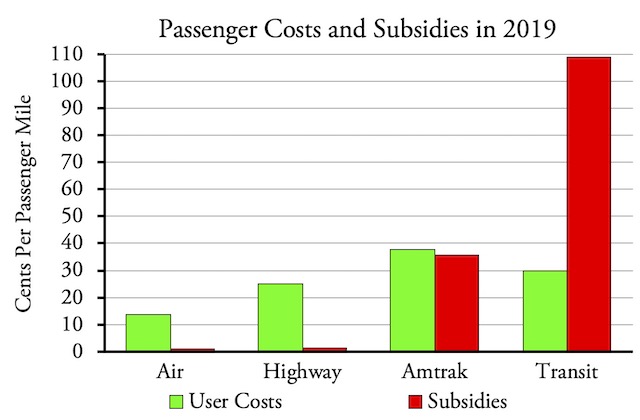
Next time someone argues planes and highways are subsidized like transit, you can tell them just how wrong they are...
The City Planner’s Guide To Tragedies And Trade-Offs - A new book is full of ideas on housing that progressives and conservatives can both like. A lot of good ideas in here I mostly agree with, with the same caveats as the reviewer. And Houston is already doing a lot of these, like (effectively) upzoning (via no-zoning), eliminating density limits, low impact fees, and having by-right development. Hat tip to Judah.
A better alternative to channelizing Buffalo Bayou, VC leaving CA for TX, top life science and entrepreneurship rankings, big solar, and more
My lead item this week is my proposed alternative to channelizing Buffalo Bayou or an expensive tunnel to better drain the westside reservoirs and avoid a future Harvey flooding tragedy: a 27-mile drainage trench or pipeline(s) using power-line right-of-way, satellite mapped here. I got inspired after reading Jim Blackburn's Chronicle interview about how bad the Army Corps of Engineers study was. And if a trench is problematic for some reason, maybe giant pipelines like these could work for a small fraction of the cost of a bored tunnel? Or the trench could be covered? Would genuinely love to hear feedback in the comments on the feasibility of this from people more knowledgeable than I...
"Houston is on track to be a top market for life sciences. The report factored in size and growth of life-sciences employment, venture capital and National Institutes of Health funding, and more."
WSJ: California, Love It and Leave It - Bad policy has made the state unlivable, so I moved my family and my venture-capital firm to Texas.
"California’s restrictive zoning laws make it nearly impossible for many essential low- and middle-income workers to live anywhere near major cities. In Texas, permissive zoning allows every member of our staff to live close to work and spend time with friends and family instead of enduring grueling commutes."
"I think oil and gas is going to be with us a long time. And Houston has a comparative advantage against every other city in the world.
If you get beyond the rhetoric about the energy transition and projections, what is it really about? It’s about infrastructure. It’s about an investment. It’s about technology. And it’s about scale. And those are all things that the energy industry is good at doing. So I think that Houston and the oil and gas companies here will be very much at the center of that. We’re starting from a point where 84 percent of the world’s energy comes from fossil fuels today. So you’re talking about a huge infrastructure of investment and embedded activity that just doesn’t change overnight. If you’re going to power what is an $87 trillion economy that’s going to be a $100 trillion global economy, you’re going to need a lot of engineering and a lot of technology and a lot of equipment. And that’s what Houston and energy companies bring to the table." ...
"...if you did have big restrictions on our domestic oil industry, it would simply mean that we would import more oil. That’s because there’s still 280 million cars in the United States, almost all of which run on petroleum."
Yet another reason to support an OPEC tariff over a fracking ban!
"Americans generally don’t give much thought to energy policy, except when they stop at the local gas station for a fill-up. But if state and federal leaders who want to ban fracking and “transition” away from oil prevail, that complacency will change quickly.
You may not think about energy policy, but it thinks about you. Energy is the foundation of society. Everything—food, clothing, shelter, your iPhone, you name it—requires energy to produce. When it costs more to supply that energy, the cost of everything else increases. The OPEC oil embargoes in the 1970s, for example, ushered in an era of double-digit inflation."
“...the most dynamic cities have been like Tokyo in the post-war decades, in a state of restless metamorphosis.” He later adds that “messiness is something to be embraced, especially for a fast-growing city: it is a dynamic feature of urban development.”
Remote work will increase migration in the U.S. Between 14 and 23 million Americans are planning to relocate as a result of businesses’ increasing acceptance of remote work. As a result, near-term migration rates could be three to four times what they normally are.
Major cities will see the biggest out-migration. 20.6 percent of those planning to move are in a major city.
People are seeking less-expensive housing. More than half (52.5 percent) of those planning to move are seeking a house significantly more affordable than their current home.
People are moving beyond regular commute distances. 54.7 percent of planned moves are to locations more than two hours away from their current location, which is beyond most people’s tolerance for daily commuting.
The highest-priced housing markets are taking the biggest hits. Rental data from apartments.com shows that the top 10 percent most-expensive markets are losing tenants at a much greater rate than markets in the bottom 10 percent.
A new strategy for securing Houston's economic future
Talk has been growing in recent years about Houston's future in a less carbon-intensive energy world. Will we still be the world's energy capital in the coming decades, and what does that mean? The Greater Houston Partnership and Center for Houston's Future have taken the lead on this challenge with their Energy 2.0 and energy transition work, and I hope they're getting traction with it (despite pandemic distractions). We certainly have a lot of expertise here that can work on big problems like carbon capture with the right economic incentives.
Another strategy is growing our innovation and startup ecosystem to build the companies of tomorrow - especially in energy, space, and biotech - and I think there has been great progress made in recent years, including Rice's building of the Ion in Midtown. One area that has not been as successful is trying to attract tech companies building new offices. To be brutally honest, we can't out-Austin Austin.
The energy transition and innovation ecosystem are both great initiatives to help secure Houston's economic future, but I think there's a third opportunity we're overlooking. It plays perfectly to our strengths:
America's most affordable global city (vs. NYC, LA, Chicago, SF, Miami)
Being more attractive to global migrants than domestic ones (which seem to be more interested in places like Austin, Denver, and Nashville)
Large expat communities from countries all over the world
92 foreign consular offices, the third-largest set in the US after NYC and LA
One of the largest ports and industrial bases in the country
A huge United hub at IAH with nonstops covering all of the Americas in addition to European, Asian, Middle Eastern, and ANZ connections.
Put all those strengths together and what's the opportunity? To be the location of choice for foreign companies establishing their branch office for the Americas, especially industrial ones. There are thousands of fast-growing companies around the world that will need to establish a presence in the Americas at some point, and Houston is really the ideal place for them to put it for all the reasons listed above.
I think we already compete for these to some extent, but there's an opportunity to do it much more aggressively with a formal, well-funded program that cooperates closely with all our foreign consulates to identify their up-and-coming companies and start wooing them as early as possible. Without outside influence, they probably tend to end up in the cities that are more obvious and well-known to them like NYC, LA, and Miami. But if we intervene early and show them how much better Houston will ultimately be for both their business and their employees, I think we can win over a substantial number of them. Their expat employees used to small flats and public transport in crowded cities will be blown away by the equivalent home and car they can buy in Houston, Sugar Land, or The Woodlands!
These foreign branch offices aren't as sexy as green energy, tech, or entrepreneurial startups, but over time they could provide a very strong foundational component to Houston's economy with a whole lot less uncertainty and volatility. Even better, we won't have that much competition - it's an opportunity ignored by most cities as they chase the hot tech companies and try to cultivate their own startup scenes. Foreign corporate offices should definitely be the third strategy to secure Houston's economic future in a world increasingly hostile to oil and gas.
Would love to hear additional thoughts and feedback in the comments...
"Houston comes third in the overall ranking. The Texan city is a reputable talent hub and, according to the 2019 Academic Ranking of World Universities, is home to five of the global top 500 universities, as well as over 30 international baccalaureate schools. This contributed to its achieving third place in the Human Capital and Lifestyle category.
Houston also placed sixth in the Business Friendliness category. The city’s welcoming business environment is clearly a hit with investors, as it recorded 53 expansion or co-location projects between May 2015 and April 2020, representing more than a quarter of its total inward FDI and the second highest out of all locations analysed."
Save America’s Dying Cities. Hat tip to Judah. Summary recommendations, where I think Houston does ok but definitely has room for improvement:
"Yet, under any circumstances, I believe that the state of our understanding is at least sufficient to provide some basic principles for guiding efforts to improve the prospects of dying cities. First, officials of cities hoping to be successful must be seen as dedicated to managing their municipal enterprise in more honest, efficient, and business-friendly ways. Too many cities have experiences similar to Baltimore’s, whose last two mayors and a recent police chief have gone to prison for corruption. One reason, as I’ve argued, is that many big city mayors no longer have business backgrounds. As a result, few know how to manage complex municipal organizations, including the challenge of minimizing opportunities for graft. Corruption-free cities where mayors and city councils are experienced in working the intersection of business and citizen interests, which are most often coincident, experience faster growth rates...
Second, mayors and other urban leaders must focus on developing productive entrepreneurship that will make cities more competitive in the future. My research shows that after two decades of betting on entrepreneurs to generate new economies, few cities appear to have benefited from their investment. Mayors should rethink their expectations of local entrepreneurs and the resources they provide to the town’s efforts to encourage new firms. Emphasis should be focused instead on building partnerships with local engineering schools and firms. My research also shows that persons with engineering educations and experience are responsible for starting the majority of new firms that survive and create demand for new jobs.
Third, cities also need to create incentives for residents, especially racial and ethnic minorities, to become owners of local business."
Finally, another great episode of Pop Culture Urbanism with really good insights on how tight zoning regulation forced development to be synonymous with evil gentrification and displacement, instead of a good thing of providing more housing for more people. Highly recommended.
Solving the anti-vaxer problem, Houston's dynamic culture, TX #1 food state but needs VC, city govt vision vs. competence, and CA ineptness
Before this week's items, my idea of the week: I'm probably treading on dangerous ground here with the growing coronavirus pandemic, but I've been thinking about the child vaccination problem (anti-vaxers) and new laws in some states requiring the vaccines to enroll kids in public schools, which is really causing a lot of turmoil with many families. Now I'm a science guy all in favor of vaccinations (annual flu shot every Sept-Oct), but I also believe in more freedom and less government coercion (there are also some valid arguments on specific required vaccines and their timing). My solution is this: ~95% of a population needs a vaccine to protect the whole population. Instead of requiring 100% of students to be vaccinated, auction off up to 5% exemptions at whatever price that clears the market. The parents that really care the most about not vaccinating (vs. the more unsure/on-the-fence/going-with-the-herd ones) will pay that price for an exemption slot. They may not be happy about it, but it's a better option than not enrolling their kids in school.
Moving on to just a few small items this week:
Great piece from Alain Bertaud in the MIT Press Reader: Do We Really Want Our Mayors to Have a Vision?Mayors and their municipal staff should not be considered visionaries, but a coordinated team of managers and janitors. Key excerpts:
"An unfortunate trend has developed over the past quarter-century: Many municipalities have begun describing their development plans as a “vision,” a word once reserved for spiritual gurus and artists. Calling a simple municipal action and investment program — such as collecting tolls on bridges — a “vision” is symptomatic of the grandiose misunderstanding that municipalities have concerning their role. A city, after all, is entirely created by its citizens’ initiatives. These citizens are required to act within a set of “good neighbor” rules, and to be supported in their endeavors by a network of physical and social infrastructure managed by a mayor and a city council. Mayors and their municipal staff, including urban planners and economists, should be considered not visionaries or rulers, then, but a well-coordinated team (one hopes) of competent managers and janitors.
...
Visionary leadership implies a top-down approach, in other words, but a city is mostly created from the bottom up. A visionary mayor may feel compelled to impose her unique insights on the life of her Philistine citizens.
...
To be sure, a top-down approach is required to design infrastructure and services, but only as they are needed to support citizens’ activities. The support role involved in this top-down design is not trivial and requires good data and outstanding technical and financial skills, but a personal vision is not a requirement. It might rather be a hindrance.
... They did not need vision, but something much less romantic: extreme competence."
Great new report from Aaron Renn at AEI on Culture and Dynamism in Cities. I've always felt Houston has done pretty well on most of these, although education is certainly an ongoing weak spot.
"It’s a look at the role of the culture of cities in economic dynamism and resiliency. I examine a few case studies, and from these try to draw out some cultural traits that seem to be relevant to success, notably an open social structure, invested leadership and institution building by civic elites, and a high value placed on education."
Interested to hear your thoughts in the comments on how Houston does on those indicators?...
"Austin is one of the fastest-growing cities in America, and the city of Austin and Austin’s transit agency, Capital Metro, have a plan for dealing with all of the traffic that will be generated by that growth: assume that a third of the people who now drive alone to work will switch to transit, bicycling, walking, or telecommuting by 2039. That’s right up there with planning for dinner by assuming that food will magically appear on the table the same way it does in Hogwarts.
...
Planners have developed two main approaches to transportation. One is to estimate how people will travel and then provide and maintain the infrastructure to allow them to do so as efficiently and safely as possible. The other is to imagine how you wish people would travel and then provide the infrastructure assuming that to happen. The latter method is likely to lead to misallocation of capital resources, increased congestion, and increased costs to travelers.
Austin’s plan is firmly based on this second approach. The city’s targets of reducing driving alone by a third, maintaining carpooling at an already too-high number, and increasing transit by 394 percent are completely unrealistic. No American city has achieved similar results in the past two decades and none are likely to come close in the next two decades."
Animated graph of Where Americans are Leaving: Net Domestic Migration Out Of Metro Areas 2010-2018. Mostly the big 3 of NYC, LA, and Chicago, but Houston does appear at the bottom near the end. Harvey losses I assume. Excerpt:
"People vote with their feet. Sunbelt states overall offer stronger economies, more job opportunities, better weather, and lower taxes. These trends may have political implications, as “blue state” residents move to “red” states, perhaps making them more “purple.”"
Finally, while we're all disappointed in how the World Series turned out (how the heck did the home team lose *every* game?!), there is a small silver lining in the ad Nationals fans put in the Chronicle, which I think is an excellent example of Houspitality!
An open dialogue on serious strategies for making Houston a better city, as well as a coalition-builder to make them happen. All comments, email, and support welcome.