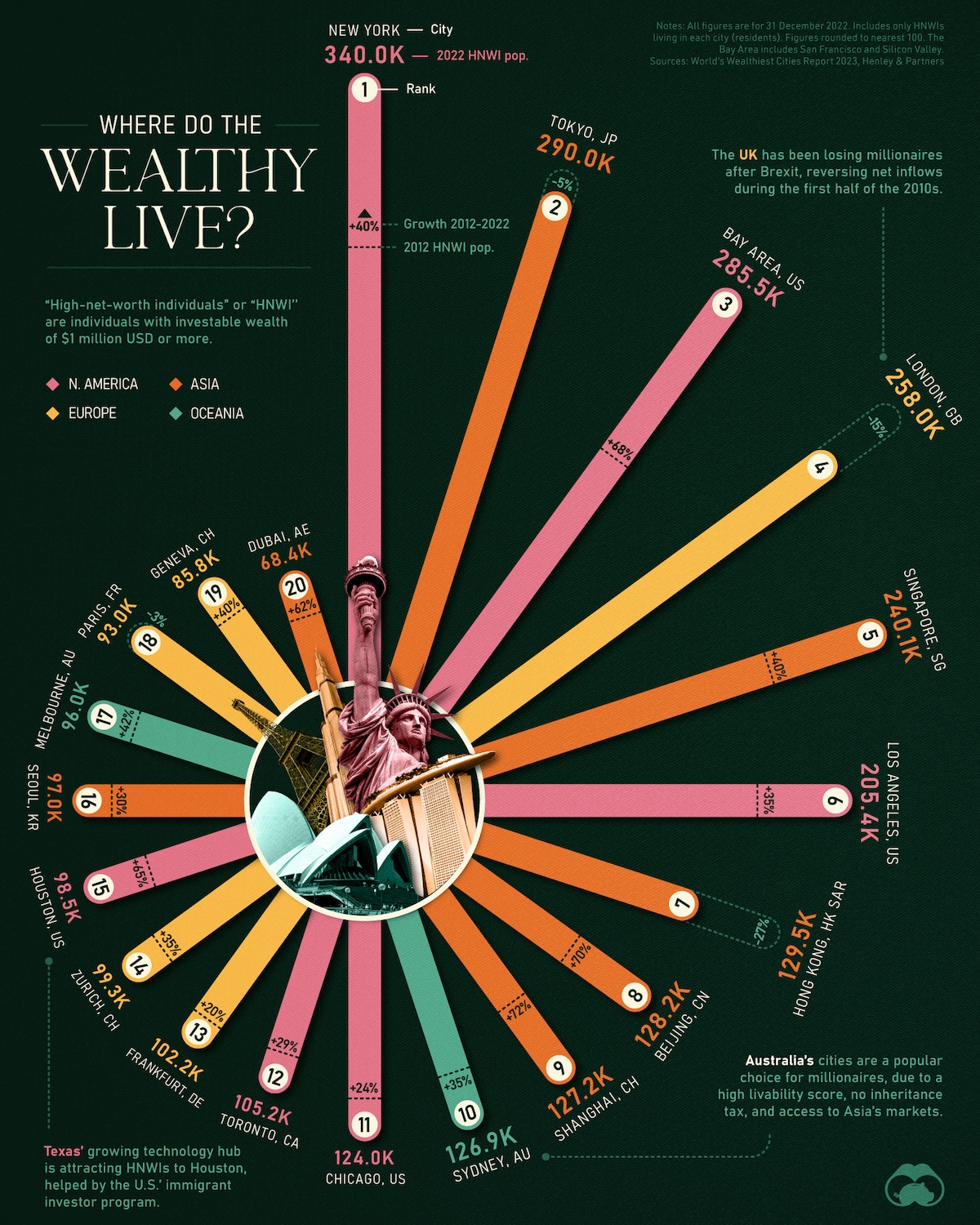
"Techstars isn’t the only entity scaling back in Austin, either. In November, unicorn Cart announced that it was moving its headquarters back to Houston after relocating to Austin in late 2021. The company, which describes itself as an e-commerce-as-a-service business, reached a $1.2 billion valuation in June after raising a $60 million Series C round of funding.
Mitch Goulding, director of communications at Cart, told TechCrunch via email that the company had originally relocated its headquarters to Austin “with the explicit goal of attracting more software talent.” But as the company continues to scale (it claims to have seen its revenue climb by 9x since the end of 2021), it decided it needs to “augment other areas of the company,” including HR, finance, accounting and legal.
“We feel the move to Houston will unlock a deeper talent pool in these areas based on its position as a hub for major business,” Goulding said.
It’s also a matter of cost and convenience.
“Costs in Austin are high relative to Houston’s affordability, [and] Houston is also more accessible,” Goulding said. “It is typically easier and cheaper for employees flying in. It also tends to be easier for employees who drive in from across the state.”
"In Houston, Black-owned businesses have been thriving, with the city now rivaling Atlanta as a destination for Black families and young people.
“Everyone is coming to Houston,” said Victoria Walsh, 30, who moved from New Orleans for a restaurant job in 2018. “There’s a whole lot of jobs, a whole lot of new concepts, a new pop-up each week.”...
The city of Houston has long had thriving Black communities, but in recent years, the new arrivals have driven a kind of renaissance that is fueled, in large part, by who they are: middle-class Black people from other states with good jobs and business ideas. ...
“When you look at other cities, they’re not as diverse as Houston,” he said. “They don’t have as many opportunities.”
"Now, Houston’s transformation to an international hub for a growing number of multinational corporations — backed by one of the nation’s busiest international airports and global shipping ports — has helped propel the city to the top of the second annual FT-Nikkei Investing in America rankings. ...
That reputation has drawn in businesses both big and small. The Houston area is home to 26 Fortune 500 companies, making it the third-ranking metro area in the country. ...
The transition to green energy is helped by the knowhow that made it a centre for oil and gas. Houston boasts unrivalled technical expertise in energy, including manufacturing, engineering, trading markets, and complex industrial project management. It also has a robust energy infrastructure and the nation’s biggest port by tonnage. ...
“Increasingly, people working in the energy transition space are saying, you know, actually where the action is, is here,” says Tudor. “It’s not really San Francisco. It’s not really Boston. It’s Houston, Texas.”
Pros 👍: pleasantly surprised by Houston; plays up affordability, inner loop density, diversity, and the amazing food scene ("strong candidate for best food city in the US")
Cons 👎: bike and anti-car snob, toured Houston on bike in wonderful late October - maybe try coming in August sometime and see how bike-over-A/C'd-car you are then?... 🥵🙄 I've said it before and I'll say it again: Houston was built around the car because it's the only way to bring an air conditioner with you everywhere you go!
2045 RTP survey, #1 permitting, POST HTX diversity, housing costs hurt education, planning tool vs NIMBYs and their mentality
Took my visiting cousin to POST Houston Saturday night and it had the most Houston diversity I've seen in one place in 40 years here, both in food and people. Just incredible. These photos don't do it justice. Every ethnicity in the city was represented! Very cool place worth visiting if you're ever near downtown.
“Enrico Moretti (2013) estimates that 25% of the increase in the college wage premium between 1980 and 2000 was absorbed by higher housing costs. Moreover, since the big increases in housing costs have come after 2000, it’s very likely that an even larger share of the college wage premium today is being eaten by housing. High housing costs don’t simply redistribute wealth from workers to landowners. High housing costs reduce the return to education, reducing the incentive to invest in education. Thus higher housing costs have reduced human capital and the number of skilled workers with potentially significant effects on growth.”
Very cool tool that I'm also very glad Houston doesn't need because we don't need the public's approval over what gets built where: Fast Company - This ingenious tool helps cities avoid rabid NIMBY arguments over housing - Balancing Act helps calm the contentious process of deciding where housing should get built.
NYT: Twilight of the NIMBY - Suburban homeowners like Susan Kirsch are often blamed for worsening the nation’s housing crisis. That doesn’t mean she’s giving up her two-decade fight against 20 condos.
"How does a place (CA) that prides itself on progressive politics have so many policies that exacerbate inequality? How do homeowners whose window signs say they welcome every oppressed group rationalize a housing system that has caused their own children to flee?"
Market Urbanism Report: "Our latest data dive shows a clear correlation between permit rates fm 2004-2021, and current median home prices, in America's 20 "superstar" metros. Houston remains America's best metro for combining strong population/job growth with low prices. It's also had the most net permits (945,068) over this period. Not a coincidence." Hear hear! Click to enlarge the graph:
Finally, be sure you fill out the H-GAC 2045 Regional Transportation Plan survey before the end of June. They also have a Comment Map where you can add comments to very specific locations. Here was my public comment submission after attending their virtual public meeting:
"Very excited about the REAL network of managed/MaX Lanes! By far the most effective, cost-efficient, flexible, adaptable (to autonomous vehicle technology), and realistic transportation solution for a metro like Houston. Bike lanes and transit are nice amenities but will never be able to address more than a tiny slice of trips in Houston. Houston's future vibrancy and economic success is absolutely critically tied to expanding convenient, fast transportation used by the vast majority of people (cars), and if we ignore that and pretend we don't need to make any more traditional transportation expansions to accommodate growth (like freeways) we will stagnate into gridlock like LA, which has invested tens of billions into transit expansion while overall ridership *dropped*."
“ A paper published this week by two California economists calculated that the mass shift to remote work accounted for 15.1 percentage points of the 24% increase in U.S. home prices between November 2019 and 2021.”
“There are lots of places in America with jobs and lower climate risks or jobs and racial diversity, but if you want all three, Texas will take care of you best,” The NYTimes noted in 2021.
“Many of us move to big cities and spend little time in nature — also not a path to happiness. A study by the economists Ed Glaeser and Josh Gottlieb ranked the happiness of every American metropolitan area. They found that New York City was just about the least happy. Boston, Los Angeles and San Francisco also scored low. The happiest places include Flagstaff, Ariz.; Naples, Fla., and pretty much all of Hawaii. And when people move out of unhappy cities to happy places, they report increased happiness.”
And a little humor, lol: "The data-driven answer to life is as follows: Be with your love, on an 80-degree and sunny day, overlooking a beautiful body of water, having sex."
And here are the academic paper details behind that excerpt: Unhappy Cities. People are the least happy in some of America's largest cities like NYC, LA, SF, Boston, and Chicago. Oddly, Dallas and Houston are not included, although Galveston scores surprisingly high (#16).
"Abstract: There are persistent differences in self-reported subjective well-being across U.S. metropolitan areas, and residents of declining cities appear less happy than other Americans. Newer residents of these cities appear to be as unhappy as longer term residents, and yet some people continue to move to these areas. While the historical data on happiness are limited, the available facts suggest that cities that are now declining were also unhappy in their more prosperous past. One interpretation of these facts is that individuals do not aim to maximize self-reported well-being, or happiness, as measured in surveys, and they willingly endure less happiness in exchange for higher incomes or lower housing costs. In this view, subjective well-being is better viewed as one of many arguments of the utility function, rather than the utility function itself, and individuals make trade-offs among competing objectives, including but not limited to happiness."
"Some organisations even sent staff to Houston to watch the system at work, and a pilot of it effectively took place in Auckland with Fulton Hogan and its Milldale project.
What came out of all this broad political consensus was a new piece of legislation: the Infrastructure Funding and Financing (IFF) Act, which allows councils to set up Texas-style Special Purpose Vehicles (SPVs). It passed in 2020 with the support of every political party in Parliament, showing just how broad the surrounding consensus had grown.
Megan Woods says she is expecting three special project vehicle initiatives to come across her desk this year.
In the Houston Business Journal, Urban Reform Institute fellow Tory Gattis said: “if all goes well, there should be a tremendous increase in New Zealand housing supply in coming years which will help to ease prices.”
“Texans and Houstonians should be proud to serve as a model to the world for market-based approaches to affordable homeownership.”
Banner week for getting quoted: yours truly gets quoted at the very end of this Reason Surface Transportation Innovations newsletter on the silliness of the induced demand anti-freeway-expansion argument. As taxpayers we *want* government to invest in infrastructure where there is demand! (as opposed to so many new rail lines these days)
“We want government to invest in infrastructure that gets a high utilization (as opposed to roads to nowhere). If they built a new airport runway and it filled up with flights, people would sing the praises of such a great investment. Yet if we invest in additional freeway capacity and it fills up, it was wasted money? How does that make sense? It means the government built mobility infrastructure exactly where people needed it—where there was unmet demand—and isn’t that exactly what we want them to do as taxpayers?”
Unherd: Texas is the Future: "Texan metros, notably Houston and Austin, also are among the nation’s leading destinations for minorities and immigrants, the drivers of America’s demographic future."
Colorado Public Radio has a new four-part podcast that examines how Denver's Rail system has overpromised and under-delivered. The system is deeply in debt and is realizing that they could have a similar level of service with BRT bus lanes rather than expensive trains, a lesson Houston also learned the hard way.
"RTD took on a lot of debt during its rail-building push. Now, the fiscally-struggling agency is paring back planned rail expansion, while looking toward less costly projects that benefit core riders: bus-only lanes and bus system reorganization."
Political guide for moving to Texas (America's Future), Houston no-zoning video, TX HSR re-route? population growth and building permits, airport wins
Continuing from last week on catch-up items...
From Twitter: My oversimplified political guide for moving to Texas: progressives to Austin, conservatives to DFW, and pragmatic centrists and independents to Houston.
"But if you’re really looking for a bellwether state that offers a glimpse into the country’s economic future and engines of growth as well as its political fault lines in the long run, it’s not California. It’s Texas."
"For every new white resident that Texas welcomed over the past decade, there have been three Black residents, three Asians, three people with multiracial backgrounds and 11 Hispanics. Dallas-Fort Worth, Austin and Houston also have large L.G.B.T.Q. populations."
City Beautiful covers the details of Houston's lack of zoning in this 10 min video. Mostly pretty good, but I think he misses some of the densification and affordability benefits. He talks about affordability, but only on a metro level, ignoring how we're able to increase access and affordability for the most desirable core neighborhoods through new townhomes, apartments, and residential towers.
Passing this great graph along from Scott Beyer at the Market Urbanism Report: "A decade after the recession, and peak permits are still down in almost every major metro except in one state. Any mystery why this state remains affordable even as millions of people move there?" I'm impressed to see we're holding steady vs. our crazy-high peak building during a previous oil boom.
"Data from the 2020 Census released August 12 shows Houston at No. 5 (20.3 percent) among the country's 50 largest metro areas in the biggest jump in population from 2010 to 2020.
Houston maintains its position at No. 5 (7,122,240 residents), the Census data notes. For some perspective, Houston was No. 8 (4,944,332) in the 2010 Census.
The Bayou City is also one of the three U.S. metro areas to gain at least 1.2 million residents over the decade. (Dallas-Fort Worth and New York are the others.)"
My Land Use without Zoning event, TX #1 for small biz, HTX #1 for diversity, urban transit after covid, sinking I69 in Midtown, and the Be Someone sign is back!
"Zoning and land use policy regulations present the greatest barriers to affordable housing and increased urban density.
Understanding how to navigate and remove these barriers allows for a dynamic housing market and paves the way for successful community development efforts.
The study of the impact of land use and zoning policy began with Bernard Siegan in his pioneering 1972 study, "Land Use Without Zoning." In his book, Siegan first set out what has today emerged as a common-sense perspective: Zoning not only fails to achieve its stated ends of ordering urban growth and separating incompatible uses, but it also drives housing costs up and competition down.
Drawing on the unique example of Houston—America’s fourth-largest city, and its lone dissenter on zoning—Siegan explored the impact of a different approach to land use policy and demonstrated how land use will naturally regulate itself in a non-zoned environment and yield a greater availability of multifamily housing.
While we have gained a greater understanding of the issues created by overly burdensome land use restrictions, these policies still remain in place, restricting the growth of communities and keeping housing costs high. Join us for a discussion of how land use reform battles have evolved over time, how community groups are working to remove these barriers and increase urban density, and how barriers to development can be challenged in court."
Big piece of good news buried in this one - let the sinking and debottlenecking begin!
"Though TxDOT has halted development of many segments, the portion along I-69 from Spur 527 to Texas 288 — which includes Wheeler — remains on pace for construction to start next year."
Reason: Urban Transit after Covid explores what remote work may do to transit. Current ridership is so low cars are actually more fuel-efficient and environmentally friendly! Excerpt and conclusion:
"As of December 2020, the most fuel-efficient means of commuting was the car, followed by light trucks—but only because occupancy embedded in the transit calculations was so drastically low. ...
A major premise of the Biden administration’s transportation agenda is to greatly increase federal spending on transit, compared with only modest, constrained increases for highways (with very little scope for adding highway capacity). This approach poses major risks of putting billions of taxpayer dollars into projects that will have costs far greater than their benefits (e.g., light rail systems for medium-sized cities, megaproject expansions of heavy rail and commuter rail systems, etc.).
At the very least, it is premature at this juncture to commit funding for major new rail transit projects before we have some idea of the extent of transit ridership in the first several years after nationwide vaccinations."
Finally, I'd like to end with a small celebration for whoever repainted the iconic Be Someone bridge - love it!
One more lead item so the blog lives up to its name this week ;-) Assuming the River Oaks Theater won't be taken over by a live theater group (really the best option), my suggested best realistic option in a streaming world: since Weingarten wants another high-rise there, preserve and repurpose it as a cool public lobby and coffee bar, marquee and all. Sure it's sad to lose the actual movie theater, but does that have any chance when you can stream pretty much any independent film at home any time?
Moving on to lots of backlogged items to catch up on this week:
Dallas insanity: $1.7 billion for 2.4 miles of mostly subway. That's $708 million per mile! Glad Houston METRO is being a lot more pragmatic and prudent with their resources than this. Hat tip to Oscar.
Antiplanner on Reinventing the Jetliner (i.e. high speed rail) with some compelling opening paragraphs:
"Suppose I told you that I have reinvented the jet airliners that carried Americans more than 750 billion passenger miles–about 10 percent of all passenger travel–in 2019. My reinvented jet will go less than half as fast as existing jets. It will cost six times as much to operate, per passenger mile, as existing jets. Unlike existing jets, which can go anywhere there is air, the reinvented jet will only be able to go on a limited number of fixed routes.
This wondrous invention will become a reality if the federal government spends a mere one, two, or possibly three or four trillion dollars. Does that sound like a good deal? No? Yet that is exactly what high-speed rail advocates are proposing. Some proposals, such as the Green New Deal, even call for almost completely replacing low-cost, fast jet airliners with high-cost, relatively slow trains."
Now on an opportunity cost basis, just imagine if those trillions went directly into carbon reduction instead of white elephant high-speed rail lines??
"Less than 50 percent of people who worked in Manhattan offices in 2019 will be working from those offices in the coming years, according to a recent survey by the Partnership for New York City."
"One thing I always admired about Houston is how confidently immigrants claim public space for themselves—how working families picnic in Hermann Park or elated quinceañeras roam the Galleria with their brightly attired entourages and pose for portraits before the Waterwall."
Which relates to this good news for Houston: "Among his clients, more than half now cite diversity as a top criterion when choosing new locations"
I keep reading how Houston is losing its affordability and median home prices have gone up 34% since 2010, but isn't that just 3% per year (compounded), slightly above inflation?
Joel Kotkin: The death of the American city - Rising crime and a pandemic-inspired exodus are powering urban decay. Great quote:
"Cities do not thrive by having more cutting-edge coffee shops, trendy restaurants and edgy boutiques; they need safe streets, decent schools and jobs for middle and working-class families."
"Houston—whose median home values are only 76% of the national average—stands out. Since 2010, it has had America’s 2nd-highest net population growth but is #1 in permits issued. This has made it an affordable city even in core locations; 1-bedroom, 1-bath downtown condo units can be found for under $200,000.
How does Houston remain so elastic? Less regulation. The city famously lacks a zoning code, and many of its suburbs are also very pro-growth. This means it has fewer legal barriers to more housing than inelastic coastal metros, where proposed zoning changes can trigger lengthy and contentious review processes."
"Similar proposals show that the basic idea of hyperlocal zoning has precedent. Houston has been able to remain a city without zoning laws in part because residents had options in the form of deed restrictions, where neighbors could choose their own rules at the hyperlocal level. In 1998, policymakers were able to reduce the city’s minimum lot sizes by allowing residents on individual streets and blocks to opt out of that change, a move which helped overcome local resistance because residents felt they had control over the risks. The result? Some 25,000 more housing units, including denser townhomes, built close to job centers and transit, many of which Houstonians would not have seen built otherwise."
WSJ: How Remote Work Is Reshaping America’s Urban Geography (archive link) - Smaller cities and communities are turning into ‘Zoom towns’ and competing with coastal hubs as workers move to find more space and lower costs. Basically, Richard Florida articulates Creative Class 2.0, which is the same as 1.0 but for remote workers outside superstar cities. Key excerpts:
Eye-opening stat: "remote workers are often more efficient than their in-office counterparts. They don’t waste hours on mind-numbing commutes, and they aren’t distracted by unnecessary meetings and water-cooler chitchat. The productivity boost to the U.S. economy from remote work could be as high as 2.5%, according to research by Stanford University economist Nick Bloom and colleagues."
Conclusion: "The remote-work revolution promises to change the way that Americans work and live. It will allow smaller cities, suburbs and rural areas to compete with the superstar cities on the basis of price and amenities. It will shift the main thrust of economic development from paying incentives to big employers to investing and building up a community’s quality of life. As communities attract more remote workers, their tax bases will grow, allowing them to improve schools and public services, benefiting everyone. Eventually, companies will come too. That holds out the possibility of a better, more virtuous circle of economic development."
Finally, a couple items on Houston as a startup hub. First, we rank #4 on this list for annual startup formations and jobs created by startups (#10 for formation rate), behind DFW but - surprisingly - ahead of Austin! Second, the excellent Texas Startup Manifesto 2.0 is out (highly recommended), arguing for treating the Texas Triangle as one giant startup ecosystem (absolutely), with this excerpt on Houston:
"Houston (East and Gulf Coast) is the fourth largest, and the seventh most diverse city in the US. It’s the energy capital of the world and is home to the Texas Medical Center (TMC), the world’s largest concentration of healthcare delivery and research institutions; to the NASA Johnson Space Center, a hub for cutting-edge human space flight research and astronaut training; to the number one seaport in the nation for waterborne tonnage, for foreign waterborne tonnage, and for vessel transits. Houston is an international city — a seaport, a spaceport, a “health-port”, and an “energy-port.” As a result, Houston has a diverse, high-tech industry ecosystem, and is increasingly an industry destination, serving as the home to 22 Fortune 500 company headquarters (with Hewlett-Packard Enterprise becoming the latest addition)."
Bloomberg's Case for Moving to Houston (but not a city for the soft), URI-COU 2020 year in review video, HTX youth, TX #1 growth, and more
Happy new year everyone. Hope you enjoyed the holidays and the recent amazing weather (while staying safe). A lot of you probably had out-of-town family and/or friends visiting. Next time nonlocal friends or family say Houston is too hot, floods too often, or gets too many hurricanes, here's my recommended reaction: politely agree with them that Houston is not a city for the soft or irresilient - they should probably choose somewhere like California. Texas welcomes the tough.
"Consider Phyllis Njoroge, who grew up in Massachusetts. After graduating from Tufts University in 2019 with a degree in cognitive and brain science, she started making spreadsheets of places in the U.S. that had a warm climate, were diverse, and had a reasonable cost of living.Houston won out, and she moved there in March"
...
Having more remote workers means “wages in Texas are going up,” he says. So are housing prices. “You can’t have a $2 million, 2,000-square-foot house in San Francisco and a $200,000 house in Dallas that are basically the same for very long when there are airplanes and internet connections and Zoom.”
"I simply say, “no, please don’t be sorry. I love living in Houston. It’s a great place to live and I have a great life there. It’s actually not that place that you might imagine it to be. In fact, it’s one of the country’s most ethnically diverse and progressive cities. My children go to school with kids from all over the world. And the wine and food scene there is great, too.”
Hobby rail critique, livable city ranking flaws, Houston tops Dallas for homeless reduction, and more
This week's items:
I've come around to accepting light rail to Hobby in the MetroNext plan as a less-than-optimal compromise among many different constituencies, but this Urban Reform blog post by Connor Harris of the Manhattan Institute makes a pretty strong case about the cost-inefficiency of such a line at $167,000 per new daily rider. His alternative:
"For improving service to Hobby Airport, Houston Metro has a much faster and cheaper option: express buses.
Currently, bus route 40, the only direct bus line from the airport to downtown, takes a scheduled 55 minutes to cover a distance that is less than 9 miles as the crow flies. An express bus alongside Interstate 45, however, could easily make the trip in 20 to 30 minutes—substantially faster than light rail, which currently averages only about 15 miles per hour. Buses could make the trip this fast even during rush hour: Interstate 45 has a separate HOV lane all the way from the airport to downtown, and adding an entrance at Airport Boulevard for express airport buses would just require repainting a few lane markings. Special-purpose express buses could also be fitted with luggage racks, which would compete with rush-hour commuters for space on light rail trains."
"Issues such as housing affordability are taken into account, for example, but have to balance against more rarified qualities such as access to opera, high-end restaurants, and other amenities. This isn’t all bad—for those who can afford them, opera and restaurants are wonderful things. The result is still that rankings often end up assessing cities in terms of a small band of citizens for whom almost all of such metrics are relevant. They assess, broadly, how much potential a city possesses when seen from a privileged point of view: that of a straight, affluent, mobile, and probably white couple who works in something akin to upper management and has children. Remove even one of those characteristics from the equation and the results often seem way off the mark. City rankings are thus a window onto the projected tastes of a highly specific elite."
This month’s edition of the Greater Houston Partnership's Houston: The Economy at a Glance analyzes recent population estimates and discusses how the region's population has grown since '10, provides an employment update, and summarizes the Partnership's recent publication, Global Houston.
A simple reasonable home elevation standard, Houston's coolest map, amazing Harvey graphics, DFW+CA rail fails, algorithmic zoning insanity, and more
Before getting to this week's smaller items, two more important items:
First, a random idea on the city's proposed and controversial 500yr + 2ft housing elevation standard, which may raise housing costs substantially in those areas while also devaluing existing housing stock and make neighborhoods look like Galveston beach houses on stilts, even if they've never flooded: why not just make Harvey the standard, since it is a multi-thousand year storm? Don't build anything that would have flooded during Harvey, or any of our other major flood events. Show that your development wouldn't have flooded, and you're good to go. Keeps elevations reasonable, especially in areas that didn't flood. Simple standard, simply enforced.
Second, a bit of a yellow flag from a recent High Capacity Transit task force meeting. Check out the 17:30 point in the Service concepts video where they aim for an 8-fold increase (from 87 million to 758 million) in transit usage by 2045, with a transit market share increase from 2 to 20% (!). Pretty darn ambitious. I have to wonder where that's realistically coming from, since Dallas, LA and others are losing overall ridership, and that decline may accelerate with coming autonomous ride share technology. I'm skeptical (especially if the assumption is rail), but looking forward to learning more over time and understanding the model. Maybe this is the potential of MaX Lanes?! If it's based on solid assumptions, it would certainly be amazing, and something no other American city is doing. Hat tip to Oscar.
"California: The Golden State has some big problems. Its taxes keep soaring, home prices are stratospheric, regulations are proliferating, and the quality of life continues to diminish. Now add what might be its most serious problem: People are leaving the state by the thousands." This stat boggles my mind: "About 155,000 taxpayers out of 15.7 million pay half of all the state's income taxes." Hat tip to Jay
Port of Houston Moving Landscape study to do interesting things transforming port land. I can't find the full report online, but here's an overview and a video.
WSJ: Chicago entices companies to return downtown. I think this might be less about generational preferences and more about how much average work tenure at a company has shortened, especially in the age of LinkedIn and aggressive headhunters. People used to think they might move to Peoria or a suburb and spend many years – if not a career – with one company. But now they know they’re likely to switch in 2-3 years, and they want to have lots of switching options without having to move. That’s big cities. In Chicago’s case, the loop freeways are so weak that employers feel they have to be downtown to draw from employees across the metro (as well as the millennials in the core of the city).
Chronicle: Planners stress need to balance growth, affordability downtown. I really don't understand the obsession with attracting families to live downtown? Why? It's a perfect place for singles and couples - why does it need families? Do you ever hear about big suburban subdivisions worrying about attracting more singles? Singles/couples and families are looking for different amenities (like bars and nightclubs being a positive vs. a negative). Downtown should embrace being a specialized neighborhood for singles and couples, and let the suburbs handle families like they always have. And as far as arguing that downtown needs more affordable housing, downtown is the *least* in need of affordable housing with direct rail to 3 affordable neighborhoods!
"In some cases, the decline in bus ridership more than made up for increases in rail ridership. Phoenix light-rail ridership grew by 10.6 percent, but for every light-rail rider gained, Phoenix transit lost nearly four bus riders. Los Angeles light-rail ridership grew by 8.7 percent, but for every light-rail rider gained, Los Angeles lost nearly six bus riders. Ridership on Nashville’s Music City Star grew by 2.6 percent, but the city lost more than 30 bus riders for every new rail rider. Denver opened a new rail line to the airport but lost more than 1-1/2 bus riders for every rail rider gained. Charlotte lost more than 15 bus riders per new rail rider, while Portland lost nearly 2 bus riders per new light-rail rider.
Other major rail systems couldn’t even record gains. Washington’s Metrorail fell by 10.4 percent; Atlanta fell by 4.7 percent; and the biggest shock of all, New York City subways fell by 0.8 percent. Heavy-rail ridership also feel in in Baltimore (-13.2%), Chicago (-1.3%), Miami (-3.8%), and Philadelphia (-4.5%), among other places.
...
Light-rail ridership declined in, among other places, Buffalo (-6.1%), Cleveland (-4.7%), Dallas (-1.7%), Minneapolis (-0.2%), Philadelphia (-6.0%), Pittsburgh (-4.3%), St. Louis (-4.6%), and Sacramento (-3.5%). Commuter-rail ridership fell in Albuquerque (-7.7%), Austin (-3.5%), Dallas-Ft. Worth (-6.1%), Los Angeles (-4.3%), Maryland (-1.9%), Miami (-1.6%), Orlando (-8.5%), and Philadelphia (-5.9%), among other places.
Salt Lake City has been getting more federal transit funding per capita than any other urban area, but the region seems to be losing its bet on light rail and commuter rail. Except for paratransit, every mode of transit in the region declined. The same thing happened in Dallas-Ft. Worth, which has built more light rail than any region in the country. Transit in San Jose, home of one of the nation’s worst-managed transit agencies, took a real nosedive, losing 10.0 percent of light-rail riders and 8.5 percent of bus riders."
Rodeo tops SXSW+Mardi Gras, #2 zoo!, defending our diversity, traffic better than you think, top rankings, and more
Lots of small items to catch up on this week:
Love this story on how the Houston Zoo has been completely transformed as a public-private partnership over the last 15 years into the second-most visited zoo in the country last year (after San Diego) with 2.55 million visitors! If I were in charge, I'd see about giving them the golf course acreage next door (aren't there plenty of courses around Houston?) and really make a run at dethroning San Diego as the largest and best zoo in the country! Now if they can just get some pandas from China...
Can't say I've seen it, but evidently our traffic got better last year - the only city of the 25 worst where that happened. We fell from 11th 16th worst, and are now behind Austin.
"Also like Houston--which is routinely one of the nation's fastest-growing metros--the rodeo's overall 20-day attendance has spiked recently, going from under 2 million in 2009 to nearly 2.5 million last year. Attendance figures from the first 6 days of this year's rodeo suggests this number will increase yet more in 2017. Compare this with SXSW or Miami's Art Basel, both of which draw under 100,000 annually; or even Mardi Gras, which drew an estimated 1.4 million in 2017."
"Houston: Findings and Implications
The 2017 Metro Monitor’s Inclusive Growth Index shows that the Houston metro area did not make progress on economic inclusion, now ranking 64th overall. Houston dropped from 4th to 5th on overall measures of economic growth (now ranking 5th) but improved on prosperity, now ranking 2nd overall. Additionally, Houston posted the fastest productivity growth from 2010-2015, and posted the second-fastest gross metropolitan product (GMP) growth at over 28 percent, fueled by its energy, wholesale trade, and hospitality sectors as well as significant in-migration. This GMP growth also contributed to one of the largest increases in the average standard of living, but also saw one of the largest increases in relative poverty, as improvements in median wages within the metro area did not appear to extend to workers in the bottom half of the income distribution."
I'll make my point about this again: if coastal cities make themselves unaffordable to the poor and working class - so they move away - they look better on these poverty and median income stats, but did they really do a good thing? I would argue they didn't. Another case of twisted stats.
Finally, the National Review on Houston's multiculturalism, sparked by David Brooks' column quoting me on Houston. He does make some good points (including that the coasts have their ugly as well!), but I’m not sure I’m totally clear on his overall point. Brooks simply said there is an alternative model of conservative Republicanism that is immigrant friendly, and he pointed to Houston and Texas. All this guy’s describing of the nuances in Houston and Texas don’t seem to really counter that point. Yes, other cities can’t replicate our energy economy, but the rest of the Texas triangle cities aren’t the energy capital of the world and they thrive with immigrants as well. And he ignores how well we’re also assimilating Asian cultures, and Texas certainly does not have a long history of that!
"In sum, less government regulation means lower housing costs."
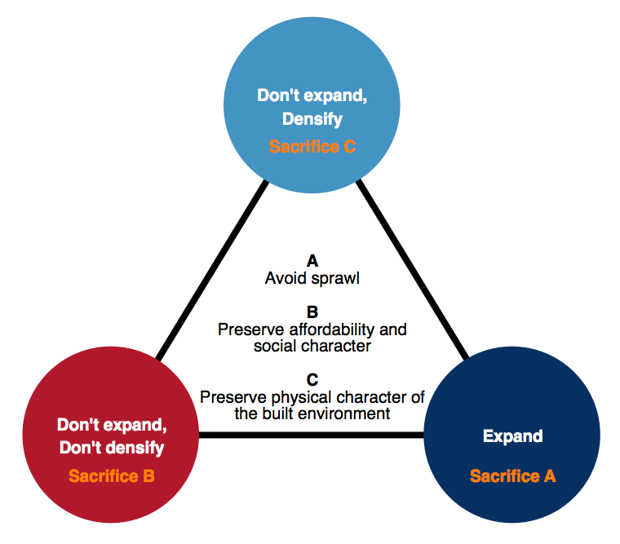
Richard Florida on the difficulties of density - which peaked in America in the 1950s - and the land-use trilemma (below). No matter what you do, there are tradeoffs. And we need to recognize the reality that, as society gets wealthier, people want more personal space.
Atlantic CityLab talks about Houston's Cistern, which I visited on Saturday. Just amazing. Highly recommend the tour, especially as this may be your only chance to see them "raw" - next year they'll start hosting art exhibitions. The 17-second echo is a pretty incredible experience, and the water is such a perfectly still mirror you'll swear there's another walking ledge down below...
"Clothing can protect you from rain, wind, and cold while biking – it cannot protect you from extremes of heat and humidity that Denmark does not face. Nobody has yet invented the air conditioned jacket. Houston should certainly improve its biking infrastructure where it can, but let’s not harbor any illusions about significantly reducing cars and their very critical air conditioning in this city…"
Best Cities for Minorities, Global Houston, good moves by METRO, and more
Sorry for not posting last week - I was visiting family in California and missing the flooding drama here (same way I missed Allison - you guys should be fearful when I leave town ;-). Speaking of California, we found your lost rain here in Texas - feel free to come and pick it up anytime.
"We found, for all three major minority groups, that the best places were neither the most liberal in their attitudes nor had the most generous welfare programs. Instead they were located primarily in regions that have experienced broad-based economic growth, have low housing costs, and limited regulation.
...
There are other policy implications. Blue state progressives are often the most vocal about expanding opportunities for minority homeownership but generally support land use and regulatory policies, notably in California, that tend to raise prices far above the ability of newcomers -- immigrants, minorities, young people -- to pay. Similarly blue state support for such things as strict climate change regulation tends to discourage the growth of industries such as manufacturing, logistics and home construction that have long been gateways for minority success.
Given the persistence of racial tensions, this data begins to give us a clearer understanding of what actually works for America’s emerging non-white majority. Denunciations of racism, police brutality and xenophobia may be all well and good for one’s sense of justice. But if you want actually to improve the lives of minorities, we might consider focusing instead on policies that promote economic opportunity, keep living costs down, and allow for all Americans to enjoy fully the bounty of this country."
I'm excited about the METRO-Culberson agreement, mainly this part: $300 million in federal funds over three years for buses, Park-and-Ride expansion and HOV improvements. That's the right strategy for improving commuter transit, and great use of federal dollars. An MIT urban planning professor tells me that he has seen the future of urban mobility and it is autonomous self-driving vehicles - taxis, transit and personal vehicles. As I've said before, we need to be including this in our planning, and certainly not sinking billions more into light rail. Bravo and congrats to both sides for getting the deal done. Chronicle story here.
If this isn't crass, I don't know what is: unions fight for higher minimum wages, then give themselves an exception in the law so they can force employers to accept unions to lower their wage bill below minimum wage. Workers actually end up *worse off* with the union, but the unions grow their membership and rake in the dues. Wow.
GHP has released their Global Houston report. I especially like how it measures Houston against some criteria for a global city (pages 2 and 3). "The report goes beyond the well-known facts about Houston's position as a global leader and focuses on export demand, trends in foreign direct investment, real estate acquisitions and corporate business ties. The report also includes Trade Profiles highlighting Houston’s top 20 trading partners."
#1 in college grads and real estate, the new class conflict, in praise of boring suburban cities, and more
A week for clearing out the rapidly growing backlog of smaller items:
Houston is #1 in growth of college grads with a 50% increase since 2000, at least according to the graph in the NYT story here, although you wouldn't know it from the article, which doesn't even mention us. More here, which also points out how much Dallas is lagging in Texas.
The WSJ on the backlash against toll roads in Texas, especially around DFW. I'm a big proponent of toll roads, as they remind people what it really costs to live far out and commute in (as opposed to the illusion of free highways), but I'd also like to see the gas tax indexed for inflation. Texas is falling dangerously behind in infrastructure investment.
Houston and Austin ranked first and second, respectively, topping San Francisco. In similar examples, Charlotte, N.C., ranked higher than Seattle and Boston, while Nashville topped Manhattan. Dallas/Fort Worth ranked No. 5.
“Investors are looking closely at opportunities beyond the core markets,” ULI global CEO Patrick Phillips, said in a statement. “These cities are positioning themselves as highly competitive, in terms of livability, employment offerings, and recreational and cultural amenities.”
GHP's October report has some good notes on our economy, including noting that we've hit a half-trillion dollars in metro area GDP, #4 in the nation, and some new census data.
“Soulless” and “boring” are to some extent judgmental code words for “stuff I don’t like.” Sophisticated urbanites tend to look down on much of suburban life. But I suspect many suburbanites find downtown obsessions – contemporary art, say, or elaborate ways of preparing coffee – equally tedious. Why isn’t their thumbs-down verdict on urban pretentiousness just as valid? …. Those of us who love urban areas’ walkability, variety and novelty often have a tendency to universalise – not to say sacralise – our values and tastes. But in an ever more diverse world, different people are going to have different ideas about the good life. We need to be more tolerant of those who make different choices. (In Arlington you can’t even argue that the car culture is killing the environment, since as Adler notes they’ve focused much more on transit and density than your average place). Some people like stability, predictability, rootedness and a lot of what suburbs have to offer. There’s nothing wrong with that. We frequently fail to recognise that our own personal preferences are in most cases just that. And too often in urbanist discussions, that means white hipster preferences.
“Urban enthusiasts live in a bubble. I don’t care where they are. The reality is that the VAST majority of people like getting in a private air conditioned car, driving to an island of shopping or whatever and finding a parking space closest to where they are going without being bothered by street people. Urban enthusiasts are under the delusion that most people want to walk around in sticky moist air and sit at their desk stinking all day from sweat in order to pretend they live in a city that was built before cars were invented so they can live like the people they envy on t.v. A dense urban environment in the inner city would be a novelty and I’m all for it. Choices are great. Downtown and Midtown are shaping up nicely. The center of Midtown is going to have a very cool buzz going on with all the new infill. The Match, Superblock, Mid-Main development, etc. East side Downtown is going to be a beast and so will Market Square. But as cool as it may be to have a tiny, tiny, microscopic sliver of New York in the center of this city, it is totally unnecessary. Our booms have proven that. The VAST majority don’t have a problem with strip malls, blue glass or driving cars to get where they want to go.The VAST majority stay in Houston because they WANT to live in a suburban environment. Jobs? There are jobs in other cities. No one stays in Houston long if they really hate it. You can’t argue with success. Builders keep building things the way they do in Houston because it works. ‘Quality’ is subjective. Some people think Miley Cyrus is quality. But you can’t argue with ‘quantity.’ Houston is fascinating to people (even the haters) because whatever it is, unlike many of those true centers of urbanity on the east and west coast, Houston IS NOT stagnant. Even in slower economic times, things happen in Houston and it is fun watching it grow.”
"Indeed, the Houston model of development might be described as “opportunity urbanism.”"
"Houston now has among the highest, if not the highest, standard of living of any large city in the U.S. The average cost-of-living-adjusted salary in Houston is about $75,000, compared with around $50,000 in New York and $46,000 in Los Angeles."
"An even bigger component of Houston’s growth, however, may be its planning regime, which allows development to follow the market instead of top-down government directives. The city and its unincorporated areas have no formal zoning, so land use is flexible and can readily meet demand. Getting building permits is simple and quick, with no arbitrary approval boards making development an interminable process. Neighborhoods can protect themselves with voluntary, opt-in deed restrictions or minimum lot sizes. Architect and developer Tim Cisneros credits the flexible planning system for the city’s burgeoning apartment and town-home development. “There are a lot of people who come here for jobs but don’t want to live, at least not yet, in the Woodlands,” he notes. “We can respond to this demand fast because there’s no zoning, and approvals don’t take forever. You could not do this so fast in virtually any city in America. The lack of zoning allows us not only to do neat things—but do them quickly and for less money.”"
"The flexible planning regime is also partly responsible for keeping Houston's housing prices relatively low. On a square-foot basis, according to Knight Frank, a London-based real-estate consultancy, the same amount of money buys almost seven times as much space in Houston as it does in San Francisco and more than four times as much as in New York. Houston has built a new kind of "self-organizing" urban model, notes architect and author Lars Lerup, one that he calls "a creature of the market.""
"Houston is neither the libertarian paradise imagined by many conservatives nor the antigovernment Wild West town conjured by liberals. The city is better understood as relentlessly pragmatic and pro-growth. Bob Lanier, the legendary three-time Democratic mayor who steered the city’s recovery from the 1980s oil bust, when the metro region bled more than 220,000 jobs in just five years, epitomized this can-do spirit. Lanier was more interested in building infrastructure and promoting growth than in regulation and redistribution. That focus remains strong today. “Houston is getting very comfortable with itself and what it is,” says retired Harris County judge Robert Eckels. “We are a place that has a big idea—supporting and growing through private industry, and that’s something everyone pretty much accepts.”"
I may be biased here, but there is far too much worth excerpting, so I strongly encourage you to read the whole thing. I'll end with the concluding paragraph of the City Journal piece:
For now, though, most Houstonians see the city as a place that works—for minorities and immigrants, for suburbanites and city dwellers—and few want to fix what isn’t broken. “The key to Houston’s future is to keep thinking about how to be a greater city,” notes David Wolff as he passes a new set of towers off the Grand Parkway. “This road, it wouldn’t be built in many places. People might talk about these things, but in most places, they don’t get done. In Houston, we don’t just talk about the future—we’re building it.”
Looking forward to your thoughts in the comments...
"...Sugar Land, the largest city in Fort Bend County, which Stephen Klineberg, a sociology professor at Rice University, calls the most ethnically diverse county in America. By that, he means that this county southwest of Houston comes closer than any other county in the United States to having an equal division among the nation’s four major ethnic communities — Asian, black, Latino and white residents."
Forbes makes the case for Philly competing with Houston as an energy hub (hat tip to HAIF). From what I'm reading there, it sounds like it could be an energy hub, but it would be a *regional* one, not a national and certainly not a global one like Houston. A big chunk of the U.S. population lives in the northeast, and it probably needs a local energy infrastructure hub. Philly is probably not a bad place for that with a port, affordable land, and a central location in the DC-Boston corridor. Houston is a regional energy infrastructure hub too, but we're also the global hub for headquarters and professionals - and Philly is a far cry from that.
"As economist Tyler Cowen points out in Time magazine, when you adjust incomes for tax rates and cost of living, Texas comes out ahead of California and New York and ranks behind only Virginia and Washington state.
Critics charge that Texas’s growth depends on the oil and gas industries and is weighted toward low-wage jobs. In fact, Texas’s low-tax, light-regulation policies have produced a highly diversified economy that from 2002 to 2011 created nearly a third of the nation’s highest-paying jobs. In those years, its number of upper- and middle-income jobs grew 24 percent.
Liberals like Noah often decry income inequality. But the states with the most unequal incomes and highest poverty levels these days are California and New York. That’s what happens when high taxes and housing costs squeeze out the middle class."
Finally, I'd like to end with a pretty mind-bogglingly impressive time lapse video of Chicago at night. Watch it in full-screen HD for the full effect. Still waiting on someone to step up and do this for Houston...
An open dialogue on serious strategies for making Houston a better city, as well as a coalition-builder to make them happen. All comments, email, and support welcome.