A better alternative to channelizing Buffalo Bayou, VC leaving CA for TX, top life science and entrepreneurship rankings, big solar, and more
My lead item this week is my proposed alternative to channelizing Buffalo Bayou or an expensive tunnel to better drain the westside reservoirs and avoid a future Harvey flooding tragedy: a 27-mile drainage trench or pipeline(s) using power-line right-of-way, satellite mapped here. I got inspired after reading Jim Blackburn's Chronicle interview about how bad the Army Corps of Engineers study was. And if a trench is problematic for some reason, maybe giant pipelines like these could work for a small fraction of the cost of a bored tunnel? Or the trench could be covered? Would genuinely love to hear feedback in the comments on the feasibility of this from people more knowledgeable than I...
On to this week's smaller items:
"Houston is on track to be a top market for life sciences. The report factored in size and growth of life-sciences employment, venture capital and National Institutes of Health funding, and more."
"California’s restrictive zoning laws make it nearly impossible for many essential low- and middle-income workers to live anywhere near major cities. In Texas, permissive zoning allows every member of our staff to live close to work and spend time with friends and family instead of enduring grueling commutes."
Labels: economic strategy, energy, entrepreneurship, home affordability, infrastructure, land-use regulation, rankings, resilience, TMC, tunneling
HTX top five global city in America, big SWA increase at Hobby, Dilbert vs. city red tape, big growth, and more
Lots of interesting items this week:
But mainly I expect everything to (eventually) get more affordable under covid (see previous item). It will certainly free up a lot of workers from service industries for construction, which has been a major issue for builders. And people being free from commutes reduces price premium of close-in properties and opens up exurban ones.
#12. Houston-The Woodlands-Sugar Land, TX
3-year population growth (percent): 5.11%
3-year population growth (total): 340,438
Cost of living (compared to national average): +1.8%
Median home price: $221,426
Average 2-bedroom rent: $1,096 per month
 |
Click to enlarge
|
Labels: affordability, aviation, corruption, development, growth, home affordability, land-use regulation, TMC, world city
Discouraging panhandling, airport wag brigade, 6-figure incomes, Grand Parkway size, TAMU TMC growth, and more
Big Idea of the Week before getting to our smaller items: I think the City needs to hang signs over major panhandler intersections saying:
"Please give to charity, not panhandling."
I think this could make a major positive improvement in the city over time, both at the intersections and among the panhandling population which would have to go to charities with real comprehensive services rather than just unsafely collecting dollars in the middle of busy roadways from intimidated motorists and doing who-knows-what with it.
One key: making sure to hang them high up near the traffic lights. If they're down low, the panhandlers will either tear them down or deface them.
Moving on to this week's items:
- Houston has the 9th-most six-figure jobs in the country, 8th if you combine San Francisco and San Jose. We're the 5th-largest metro, so we're punching a little below our weight, with Boston, Seattle, SF+SJ, and DC pushing us down. On the plus side, we still edge out DFW even though they're a bigger metro than us.
- Super cool: Texas A&M to Build $550 Million Project at TMC
- New Geography: The limits of being "near transit" for low-income workers
- This is pretty freaking cool: See how big the Grand Parkway is compared to other land formations. "Grand" is an appropriate label. Almost all of London, Paris, Chicago, DFW, Mexico City, Rhode Island, DC-Baltimore, or the SF Bay Area - among others - would fit inside! Towards the end, they compare Texas to other landmasses. Spoiler alert: it's big.
- Man, I hope these babies are cruising Houston streets soon: GM and Honda unveil self-driving car with no steering wheel or pedals. Cool video.
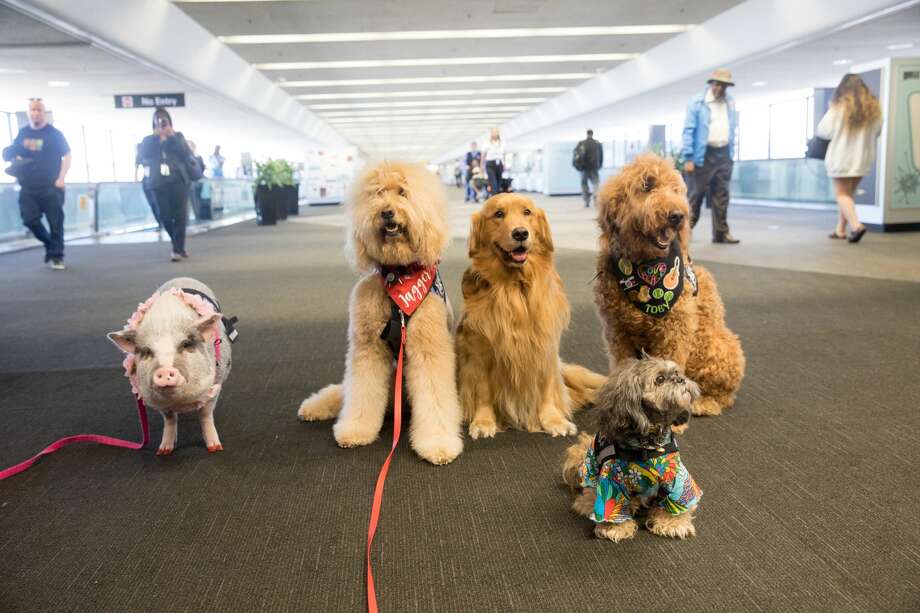
Finally, can we *please* get
a wag brigade at Houston airports?! Get a small army of these cuties wandering the terminals and it will give Houston a PR buzz that money can't buy. It would also encourage more people to connect on flights through Houston as well, which would stimulate United and Southwest to add more service.
Labels: affordable proximity, autonomous vehicles, aviation, economy, homelessness, quality of place, rankings, TMC, transit
Building to the Grand Finale - An updated analysis of the 45N rebuild
Happy Independence Day! (
a bit of that theme in the post) I'm finally back from my travels. This week we have a guest post by
Houston Freeways author Oscar Slotboom on plans for the 45N project, which was recently
featured in the Chronicle where I was quoted.
-----
In May TxDOT posted updated schematics for the inner loop section of the
North Houston Highway Improvement Project on the official project site. This is the second update after
the seriously flawed original design released in April 2015 and the first update in September 2015.
The good news is that TxDOT and their engineering consultant HNTB continue their steady progress of improving the design, and
my updated analysis now contains only four serious design concerns, down from sixteen in the original release and seven in the September 2015 update. See the
September 2015 issue status list for the improvements in the latest version.
For the latest project design:
- Three of the four remaining concerns are related to access to the northbound MaX (managed express) lanes from downtown, including the poorly situated proposed slip ramp, the lack of access to the MaX lanes inside the loop, and reducing northbound IH 45 to three main lanes at the Loop. TxDOT has agreed that the design in the area can be improved and is currently studying options.
- TxDOT made a huge improvement in the latest design by restoring the on-ramp to northbound IH-69 from San Jacinto, which currently exists but was removed in the first two versions of the plan. But the new design does not restore the currently-existing southbound exit to Fannin, and still requires vehicles to exit to Almeda and then proceed west through Midtown, where the streets are not designed east-west traffic. So half of this problem is solved, and I propose possible designs to fix the other half.
Overall we’re very close to getting a plan which will be just about the best it can be within the already established framework and constraints. Let’s continue the ongoing refinement to get a plan worthy of a fireworks grand finale, with no remaining serious design concerns.
The MaX Lane North-South connectivity issue
TxDOT and HNTB say that their traffic model indicates that traffic will move through downtown much better, an average of 24 miles per hour faster, and touts the huge benefits for IH-69. But we all know that future traffic often exceeds projections as economic and population growth push volumes higher, and latent demand also consumes newly added capacity. In the larger perspective, north-south travel has become one of the most serious travel challenges at rush hour, with downtown, the West Loop and West Sam Houston Tollway all typically heavily congested.
With the IH-45 MaX lanes in this plan, construction soon to begin on the SH 288 managed lanes, existing HOV lanes on the Southwest, Gulf and Eastex freeways, the planned Hardy Toll Road extension into downtown, and possible future MaX lanes inside the loop on the Katy and Southwest Freeways, there will be a huge number of managed lanes converging into downtown with no dedicated path for managed lane traffic to get through downtown.
Ideally, this plan should have included a MaX lane connection through downtown on a north-south axis, both for transit and to give an option to motorists. The biggest beneficiary of the connection would be the Texas Medical Center, since downtown congestion limits their access to the workforce on the north side of the city.
While it may be too late to include a north-south connection in this plan, it is important that future options are not precluded by the project design. Within 6-9 months, it should be possible to do the following:
- Launch a short-term technical study to identify future volumes of demand for MaX lanes in all directions around and through downtown, based on current and potential future MaX corridors. Also identify possible future long-term connection corridors, which could be tunnels.
- On the section of IH 69 between Spur 527 and SH 288, consider a right-of-way set-aside for one or two managed lanes. Even if a north-south MaX lane connection is determined to be infeasible, this connection could serve as an extension of the SH 288 managed lanes to connect to the Southwest Freeway.
- Based on the study results, adjust the design so as not to preclude potential future MaX lane connections. This could mean preserving space for an additional lane on the downtown spur (on the west side of downtown), or preserving space for connections between existing HOV lanes and lanes going through downtown, for example, allowing the Eastex Freeway HOV lane to connect into the IH-69 main lanes near IH-10 to allow passage through downtown to the medical center.
Very Nice, but Expensive
The most recent cost estimate places the overall plan cost at $7 billion, with the downtown improvements costing $4 billion.
TxDOT has fully accommodated the wishes and desires of downtown and north side interests, leading to a very ambitious downtown design which is very expensive. To put things in perspective:
- The 35-mile-long US 290 project currently in progress from 2013 to 2017 has a total cost of $2.4 billion and a construction cost of $1.3 billion.
- The 25-mile-long Katy Freeway expansion built from 2003 to 2008 cost around $2.7 billion, which would probably be in the range of $3.2 to 3.5 billion in today’s money.
- At current funding levels, this project will consume virtually all funds for new construction for a period of around 10 years, or the construction could drag on for a very long time, 15 years or more
What does this mean?
- There will probably need to be an increase in funding at the federal and/or state levels to complete this entire project in a reasonable amount of time, which I would say is seven years or less after construction begins since we don’t want downtown to be a construction zone any longer than necessary.
- Looking at the benefit/cost ratio of separate independent sections will be necessary if funding is short, rather than plunging straight into the entire costly downtown rebuild.
- Independent sections which could offer the most benefit to relieve bottlenecks include the section of IH 69 between Spur 527 and SH 288, IH 69 on the east side of downtown, and the IH 45/Loop 610 interchange and adjacent sections.
Looking Ahead
While the funding issue can be worked out in the next few years, getting the federal “record of decision” (ROD) is the top priority, since nothing can move forward until the ROD is received.
Houston is a can-do city, and by getting this project done we’ll have perhaps the best, most urban-friendly downtown freeway complex in the United States.
- Make the final needed refinements to the design as soon as possible, including adjustments to ensure any future north-south MaX lane connections are not precluded.
- Get the record of decision by 2018, which is TxDOT’s stated goal
- Start work on sections with the most benefit as soon as 2020.
Labels: infrastructure, MaX Lanes, mobility strategies, TMC, transit, transportation plan
America's Housing Crisis, new hurricane surge maps, techies escaping Silicon Valley for Houston, affordable housing, and more
Before getting to the big backlog of items this week, I should mention that our
Center for Opportunity Urbanism recently held a very successful and well-attended
luncheon event to release
our newest report on America's Housing Crisis.
Chronicle coverage here, and coincidentally it got reinforced by
this story at NPR about millennials moving to the suburbs. The report is packed with interesting stuff -
definitely worth at least a skim.
Moving on to this week's items:
"When trains start running on 11 new miles of Gold Line tracks this weekend stretching eastward to Azusa, will they carry any passengers? Ridership on Metro's buses and trains has been not just stagnant, but shrinking for nearly two years. At the start of 2014, there were on average 1.45 million bus and rail boardings on weekdays. A year later, it was 1.38 million. By January 2016, weekday boardings had further slipped to 1.27 million.
Even given transfers and round-trips, it would appear that upward of 130,000 Angeleno commuters have abandoned mass transit."
Labels: affordability, economy, home affordability, hurricanes, land-use regulation, mobility strategies, opportunity urbanism, planning, quality of place, rankings, TMC, transit
METRO improvements, MaX Lines, UT vs. UH, Houston > Toronto, regulation trying to solve over-regulation
This week I got to attend a blogger lunch meeting at METRO (
pic here) to get an update on things over there, which are definitely on a strong upswing (note to the new Turner administration: please be careful not to screw it up with bad board changes). The good news:
- Ridership is already up 10% since the redesigned bus network started a few months ago. Transit agencies all over the country are asking how they can do it too. Nice to see Houston a real innovative leader here rather than a follower.
- Low-demand neighborhoods like the new "flex routes" once they get used to them.
- They are continuing to tweak routes to improve service, including a new set of changes this week.
- They're simplifying transfers with unlimited transfers in any direction for 3 hours, which will even allow people to do short errands round trip with one ticket.
- They now offer a Park-and-Ride lot at Space Center Houston as I suggested long ago, allowing tourists downtown (or connecting from elsewhere) to use transit to visit our most popular tourist attraction.
- Better technology options, including texting for next-bus timing, service alerts, and a better phone app. Ticketing on your mobile phone is coming soon.
The not-so-good news:
- They still struggle with inter-agency coordination, especially road construction/closures (although improving) and getting popular transit destinations like new health, education, and government facilities located along major arterial routes instead of far back on side streets.
- The ongoing "squeaky wheel" problem where a vocal few push the board to make changes that are better for them but make service worse for the majority across the broader transit network. This "death by a thousand cuts" is part of how the old bus network got so out of whack.
I also had a good conversation with Christof Spieler of the METRO board about a vision for expanding a more comprehensive MaX (Managed eXpress) lane network across region in collaboration with TXDoT, HCTRA, and H-GAC, and then unifying the branding for different commuter services (like METRO's P&R express buses, Woodlands Express, etc.) under something like "MaX Lines" with unified ticketing, service maps, coordination, etc. I think it would be a huge asset and benefit for the region to have such MaX service connecting all parts of our metro area to our multiple job centers. If you know someone with any of those agencies, please pass it along...
A few smaller items I'd like to respond to this week:
- UT closes on 100 acres in Houston, plans to buy 200 more. UH is definitely not happy - HAIF debate here. I think the simple answer from a Houston perspective is that more is better. That's certainly the case with the Texas Medical Center - why not other higher ed institutions? UT is going to deploy the resources from that $25 billion endowment somewhere in the state - why not try to maximize the amount coming to Houston? UH should negotiate Big 12 entry and a no-faculty-poaching agreement (which should actually be policy between all Texas public schools - it just raises faculty costs for taxpayers with no added benefit to the state) and get back to focusing on their own improving trajectory rather than worrying about any potential competition.
- This Chronicle op-ed calling for more prescriptive urban planning in Houston to be like Toronto. Ugh. Long-term readers know my feelings on this. First, the million-dollar lifetime savings estimate for using transit is a joke once you consider how much more expensive housing is under such a regime (it also ignores the costs of actually riding the transit). Second, there's nothing stopping anybody in Houston from living within easy walking or transit distance of any of our job centers - it's just that people are making value trade-offs and choosing not to. The value equation in the suburbs (housing, neighborhoods, schools, crime) is just too compelling for most. Third, our downtown is growing and developing just fine - why would we want to mess with success?
WSJ: Turning the Twin Cities Into Sim City (hat tip to George) As much as I sympathize with opportunity and the problems of zoning, I can see all sorts of ways this federal and regional regulatory hammer can go very, very wrong (like it already has in Portland and California).
More regulation isn't going to solve over-regulation. It's sort of like a car that isn't going anywhere because you've got your foot on the brake plus the parking brake engaged, and thinking the answer is just to push down harder on the accelerator until the car moves, when a lot better answer is to just release the brakes - i.e. reduce regulations and let free choice and free markets solve the problem.
Labels: downtown, education, land-use regulation, MaX Lanes, Metro, mobility strategies, planning, TMC, tourism, transit, transit-oriented development
610W express lane flaws, HSR terminal debate, maximizing opportunity circles, TX drains CA, and more
Apologies for not posting last week - the whole world seems to want to pack a month's worth of meetings and work into the first 2.5 weeks of December. On to the big backlog of items:
- I attended TXDoT's public information meeting on the proposed 610W elevated express lanes (details), and as supportive of the idea as I am, I'm concerned about the details of this plan. It would allow express elevated travel along four lanes from just north of I10 to just south of 59, but the problem is that they can only find space for single lane entrances and exits, which essentially cuts the throughput in half. Hopefully someone can come up with some potential alternatives - let's hope so or I have trouble seeing good cost-benefit here.
- Speaking of traffic, here's the simple, universal solution: congestion pricing. And it actually doubles throughput!
"As the paper shows, a freeway lane can typically move up to 2,000 vehicles per hour, but when traffic slows due to congestion, this can fall below 1,000 vehicles per hour. The net result is that road pricing can paradoxically double road capacities, thus giving everyone more options to get where they want to go, not less."
"From the perspective of a transit agency, an express toll lane provides it with an uncongested high-speed guideway at zero capital cost (other than the cost of the buses). And a seamless network of ETLs, as planned in most of these metro areas, provides transit with the infrastructure for region-wide express bus service—again, without the massive infrastructure cost that a rail system of comparable geographic extent would entail—if it could somehow find the umpteen billions of dollars to build such a rail network."
"Much of today's urban transportation planning focuses on transit and "smart growth." According to this set of ideas, suburbanization (aka "sprawl") is bad and should be discouraged, while higher density is good and should be increased, so that "we can get people out of their cars" and do other good things like enabling lots more people to walk or bike to work. But what if this set of policies turned out to be a recipe for urban decline?
...
If their analysis is correct (and I think it is), much of current transportation and land use thinking is mistaken.
...
The main implication of this research is that "the more integrated metropolitan labor markets are, the more productive they are." And therefore transportation policies should promote:
- Speedier rather than slower commuting;
- More rather than less commuting; and,
- Longer rather than shorter commutes.
These policies expand the "opportunity circles" of both employees and job-seekers. But they are the opposite of what those who are promoting "jobs-housing balance" try to achieve: to get people to work closer to where they live, accepting a convenient job rather than the best (most economically productive) job.
...
In order not to undercut metro area economic productivity, transportation and land-use policies should enable people and companies to maximize the size of their opportunity circles, by facilitating faster, longer-distance commuting.
Everyone concerned with transportation and land-use policies should read these important papers."
Finally, a thought I had this week on
the debate about terminating Texas high-speed rail at 290 and I10 vs. bringing it all the way into downtown: if you look at the most likely sources and destinations for HSR business riders, it's likely to be a zone from downtown out west through Uptown to Westchase and the Energy Corridor. The easiest and most central arrival and departure point is 290/10 at 610, not downtown. Forcing everybody to go downtown may actually suppress HSR ridership, especially for those going to/from the west side.
Labels: affordability, commuter rail, congestion pricing, economy, governance, high-speed rail, home affordability, infrastructure, mobility strategies, opportunity urbanism, smart growth, TMC, toll roads
Houston dominates America's growth corridors and makes the case for the world's highest standard of living
The Manhattan Institute has just released
a new report by Joel Kotkin on "
America's Growth Corridors", which outlines four key corridors that are still growing strongly in an otherwise anemic U.S. economy: the great plains, the Gulf coast, the inter-mountain west, and the manufacturing belt of the southeast. Houston figures into the report quite prominently as the largest city among the four growth corridors. If you don't want to read
the whole pdf, I recommend searching on "Houston" to find the key elements. Here are some of my favorite Houston excerpts:
In Houston, for example, the massive Texas Medical Center is now the largest concentration of medical facilities in the world. [It] now ranks as the country’s 12th-largest business district in terms of square feet, ahead of downtown Los Angeles, with plans to expand so that it will rival Philadelphia’s (the seventh-largest) in size by 2014.
Houston, the clear center of the Third Coast economy, has emerged as one of the country’s megacities. Over the past decade, Houston has had one of the largest increases in employment of any major metropolitan area—up 15 percent between 2000 and 2011.
...
Houston, Dallas, Baton Rouge, and Tampa have seen stronger rates of growth in the numbers of educated people moving into their areas, more so than such cities as New York, Los Angeles, Chicago, and San Francisco.
...
Houston and Dallas already have a higher rate of international immigration than such traditional magnets as Chicago, Washington, and Philadelphia. A recent Rice University study found that Houston now surpassed New York as the country’s most racially and ethnically diverse area.
Today, Third Coast ports Brownsville, Tampa, and Houston have some of the highest rates of foreign immigration in the nation. Traditionally, this migration has come largely from Mexico and Latin America, but newcomers are increasingly arriving from Asia as well. Over the past decade, Houston’s Asian population has expanded by 160,000, or 70 percent, and the city is now home to the eighth-largest Asian population in the nation. Houston’s Asian migration is growing 50 percent faster than migration flows to such established Asian hubs as New York, San Francisco, Los Angeles, and Seattle.
...
When adjusted for cost of living, wage earners in Houston, Dallas, and Austin, as well as most corridor cities, earn much more than residents of New York or Los Angeles.
...
This is particularly notable in Houston, which has had one of the strongest increases in manufacturing over the past decade of any major city
...
The region is now home to several of the country’s leading ports, led by Houston and New Orleans, which also boast the first- and second-fastest growth in custom district traffic among the top five districts, outpacing New York, Los Angeles, and Detroit.
...
In the future, many Third Coast ports will likely increase trade with Asia. The scheduled 2014 opening of an expanded Panama Canal, with double its current capacity, will likely shift some Asian trade from America’s West Coast ports to its Third Coast. Houston will likely benefit most; the city expects a 15 percent jump in Asian trade after the canal expansion project is complete. In contrast to ports in the Northeast and California, virtually all the Third Coast ports—and many on the southeast littoral as well—are in the process of large-scale expansions.
But, by far, the most important and interesting tidbit in the report is
the chart at the bottom of page 15:
As you can see, Houston simply dominates it at #1 with $75k (!!). DFW and Austin are a distant second and third at $63k, and they fall from there. This is reinforced by a similar statistic in a recent
City Journal article on the Texas Growth Machine (hat tip to Jessie), which notes:
"Adjusted for cost of living, Texas’s per-capita income is higher than California’s and nearly as high as New York’s. Factor in state and local taxes, and Texas pulls ahead of New York."
This further backs
my argument that Houston has the highest standard of living in the U.S. (and likely the world) among major metros.
Of course the dominant factor in cost of living is housing, so this strongly validates Texas' free market approach allowing supply to meet demand (if avoiding the housing crash didn't already prove that point). And Houston's very substantial $12k advantage over even other Texas cities points to the incredible value of no-zoning in keeping housing and other costs of living low (including commercial office and retail costs). For more on how that works, check out
my Opportunity Urbanism op-ed here. And that leads me to end with
this awesome graphic that I just love (hat tip to Josh).
UPDATE: I'm often sharing the linklove with
CultureMap, but
they're not sharing back :-(
Labels: affordability, demographics, economic strategy, economy, growth, home affordability, identity, land-use regulation, opportunity urbanism, port, rankings, TMC, world city, zoning
The Ultimate Houston Strategy
Today is the 7th anniversary of Houston Strategies. After 947 posts (cream of the crop here), almost half a million visitors, and thousands of comments in an epic dialogue about Houston, I thought this would be a good time stand back, look at the big picture, and ask "What should be next for Houston?" while linking back to some of the gems from that archive.
First, let's look at where we are currently. Our foundation is in great shape. Houston has started the 21st-century with a set of rankings and amenities 99% of the planet’s cities would kill for: a vibrant core with several hundred thousand jobs; a profitable and growing set of major industry clusters (Energy, the Texas Medical Center, the Port); the second-most Fortune 500 headquarters in the country; top-notch museums, festivals, theater, arts and cultural organizations; major league sports and stadiums; a revitalized downtown; astonishing affordability (especially housing); a culture of openness, friendliness, opportunity, and charity (reinforced by Katrina); the most diverse major city in America; a young and growing population (fastest in the country); progressiveness; entrepreneurial energy and optimism; efficient and business-friendly local government; regional unity; a smorgasbord of tasty and inexpensive international restaurants; and tremendous mobility infrastructure (including the freeway and transit networks, railroads, the port, and a set of truly world-class hub airports).
To those I'd add:
With all that, it's really easy to get complacent. In fact, in some ways I think we might be coasting a bit now. But coasting is definitely not how we got here. Big initiatives are a proud tradition here: dredging the original port, founding the Texas Medical Center, establishing the Johnson Space Center, and being the first in the world to build a gigantic, futuristic, multi-purpose domed stadium - just to name a few examples. But what should be next? Where should the world's Energy Capital put its energy, so to speak?
I was recently inspired by the Urbanophile's post on Indianapolis' 40-year economic development and tourism strategy built around sports. Starting with nothing but the Indy 500 they've built a string of wins all the way up to hosting one of the most successful Super Bowls ever last month. We need that same sort of sustained, long-term strategy that goes beyond specific projects to a theme we can weave into everything we do over the decades ahead. We need to take the energy boom we're currently enjoying and invest it to secure our long-term prosperity no matter how technology shifts in the future (most especially energy technology).
In an unpredictable world, the only safe bet is a talent base that can adapt. With the Texas Medical Center, we concentrated health care talent in a district that has grown and adapted into the largest medical concentration in the world with an array of world class facilities. We've done the same on an even larger scale with energy and engineering talent. The next step is to take that strategy and generalize it to focus on being the global capital of applied STEM (Science/Technology/Engineering/Math) talent. We need to mobilize the city around a common purpose of building this human infrastructure. We need to embed it into our education, tourism, cultural and economic development strategies. It's just a perfect fit for Houston on so many levels:
In particular, I think we should focus on applied STEM - systems-based problem solving (engineering) over pure knowledge (where we are at a competitive disadvantage with many university clusters around the country). Facilitating man's progress through innovative problem solving.
Part of this strategy includes tourism, articulated in more detail here. We need the big tourism experience of other world class cities, and STEM is a unique niche we can build around, with a primary focus on families, schools, and STEM-related conferences. We already have some of the assets in place - JSC and Space Center Houston, the Natural Science Museum, the Health Museum, the Children's Museum, Moody Gardens - and others with more potential, like the Texas Medical Center. But we need that signature attraction: the world's largest institute/museum of technology. Not just a history-focused museum, but an institute actively involved in the community with a strong focus on the future. Local kids should spend frequent school days and summer camps there on fun and inspiring STEM activities. It could provide educational STEM experiences both online and on-site, helping to attract talented global youth to Houston for amazing experiences that draw them back later for college or after graduation. It should have the world's largest hackerspace. It should be an inspiring space that attracts global academic and professional STEM-related conferences (building on the OTC) - groups trying to solve big problems and contribute to humanity's progress (imagine a Davos or G8 of STEM...). Each conference could leave behind a new exhibit on its subject area, building the collections over time. And since it has the event space, we might as well open it up to festivals to expose more of our community to that same inspiration.
Name? Maybe "The National Museum of Technology and Innovation"? We could even get it officially certified by the Smithsonian, which is now allowing national museums outside of DC.
The natural place for such an institute is clearly the Astrodome, our historic icon looking for a second life. We should embrace the Astrodome as Houston's architectural icon like Paris does the Eiffel Tower, New York does the Statue of Liberty or Empire State Building, Rome does the Vatican or Coliseum, and San Francisco does the Golden Gate bridge. It can find a second life as our inspiring cathedral to man's technological progress (along with some fun mixed in - Robot Rodeo anyone?). Most importantly, it has around a million square feet of space. Here's how it compares to other top museums:

But unlike every other museum in the world where exhibits are carved up into a series of halls, almost all of them could be visible in a giant 360-degree panorama while standing on the floor of the Astrodome. How amazing would that space be?
And consider this: at every single Texans home game (and the 2017 Super Bowl!), the national media would be pointing their cameras at the Astrodome STEM museum and talking about Houston's STEM innovation focus and strength. They would have aerial blimp shots talking about it and even doing interior shots of exhibits for their cutaway footage (you know, the short local background videos when they return from commercials). Our national and global identity would get tied to technology and innovation (in addition to the existing identity around energy), and that would help draw talent and jobs.
It would be a *huge* reputation and brand builder for the city.
The cost, you ask? Easily in the hundreds of millions. But if LA can come up with $1.2 billion to build the Getty Museum, I have no doubt that Houston can muster the needed resources. It's a tiny fraction of the wealth of Houston's 14 philanthropic billionaires, much less the broader base of wealth in this booming city. We can come together to make this happen before the Astrodome's 50th birthday in 2015, and it can put us on a path to greatness for our bicentennial in 2036 that Houston's and Texas' founding fathers could never have imagined.
We, the citizens of Houston, aren't the types to get complacent and rest on our laurels. That's not the legacy previous generations left us. It's time to step forward and tackle our next great challenge. Are you in?
UPDATE 4/24/22: this could also be integrated with the annual high school FIRST robotic championships which are held every year in Houston and bring thousands of top STEM students here!
Labels: Astrodome, economic strategy, education, highlights, identity, infrastructure, NASA, TMC, tourism, world city
Next great global health hub, TX vs. Midwest, luxury buses vs. trains, and more
Another stack of smaller misc items this week:
- Very unfortunately, Metro's future is almost certainly going to be the same as Denver and most other transit agencies in America: Build Trains = Raise Fares + Cut Bus Service. It's the clearest case of "the emperor has no clothes" that I've ever seen. Everybody can clearly see the long-term financial train wreck Metro is embarking on, but they all just shrug their shoulders and nobody tries to stop it. So frustrating and sad. So many better things could be done for the city with that money. Any brave officials out there to rally the cause of Houston's long-term transportation future?
UPDATE 8/25: Bill King's excellent Chronicle op-ed today - "Metro federal rail funding is resting on shaky ground" and BlogHouston recap.
Nope. Those places are major global health hubs for sure. But the emerging story is further south. In Houston, Texas to be precise.
Houston is well-known for the Texas Medical Center (TMC), which is comprised of 49 institutions and describes itself as the largest medical center in the world. The Baylor International Pediatric AIDS Initiative is highly regarded for its leading role in the global fight against HIV/AIDS. Beyond HIV/AIDS however, Houston hasn’t really featured prominently on the global health community’s radar.
That is about to change.
- Joel Kotkin defends Texas against the detractors that have come out of the woodwork since Rick Perry announced for President. He's not as big a fan of Rick, but he makes a strong case for the state's very successful model.
- The Wall Street Journal also has an interesting op-ed on how the Texas model beat the Midwest model:
To understand the political economy of the Midwest, it helps to put it in historic perspective. Originally the Midwest's economy was built on its farms, then later on its factories. The long farm-to-factory migration lasted from roughly 1890 to 1970. At the end of that period, when I was working on the first edition of "The Almanac of American Politics," it seemed there were two models for the U.S. future. One was the Michigan model, which prevailed in the industrial Midwest and the factory towns of the Great Plains. The other was the Texas model, which prevailed in most of the South and Southwest.
The Michigan model was based on the Progressive/New Deal assumption that, after the transition from farm to factory, the best way to secure growth was through big companies and big labor unions.
...
The idea that the wave of the future is an ever-larger public sector financed by a more or less stagnant private sector looks increasingly absurd. The Midwest's public sector has, as Margaret Thatcher put it, run on "other people's money." Meanwhile, Mr. Obama's trip to the Midwest has been preceded by Texas Gov. Rick Perry's foray into Waterloo, Iowa. Mr. Perry points out that his state, with low taxes and light regulation, has been producing nearly half of America's new jobs. The Texas model may be sweeping the Midwest, not vice versa.
- HGAC has put together a video on the regionally coordinated transportation plan here. It's the most exciting, amazing video you will ever watch. Or maybe not. In fact, quite possibly the opposite. But they do deserve kudos for reaching out beyond the typical public information meeting.
- Reason's Surface Transportation Innovations newsletter surveys some strong data on how inter-city buses continue to challenge Amtrak - and make high-speed rail plans expensive boondoggles. What I can't figure out is why none of them have set up in the Texas Triangle yet?
- The Urbanophile also touts how awesome the Megabus inter-city model is, and why the arguments against it are bogus. Did I mention I can't wait for the Texas Triangle to get it?...
Finally,
a gorgeous video of the lights of LA.
Watch it full size if you can. Somebody should definitely do something similar for Houston. Any ambitious aspiring videographers out there?...
LA Light from
Colin Rich on
Vimeo.
Labels: economic strategy, economy, high-speed rail, Metro, mobility strategies, rail, TMC, transit
Dropping JV crime, new flights, Metro press, nanomedicine, and more
A few smaller and mid-sized items:
- A story on the dramatic one-third drop in juvenile crime since 1997. My theory: the rise and now ubiquity of the internet, cell phones, and video game consoles have got to be a big factor here. Youth don't get bored and cause mischief as much anymore - there's always something entertaining to do close at hand. Or with texting, IM and social networking, they're always informed of the latest social events to go join. While I don't think a continuous stream of novelty/entertainment/socializing is the ideal way to grow up, it's better than some of the darker alternatives like drugs and crime.
- A YouTube video visualization of planned improvements to the 290-610-10 interchange. They can't happen soon enough. Hat tip to Gonzalo. And here's a video on the plans for BW8 and 290, along with the new Hempstead Tollway.
- Some of my long-time readers probably know I'm also a bit of an aviation nerd, so I got pretty excited by the Continental announcements of new 787 service from IAH to both New Zealand and Nigeria in the fall of 2011 (once they get the planes). Nigeria is all about the oil industry, but New Zealand is all about the feed to and from Star Alliance partner hubs at each end: Air New Zealand to points all over NZ and Australia, and Continental to the eastern US, Latin America, and even Europe. The only other US service to Australia or New Zealand is from California, but Houston can offer a lot more connections than LA or SF can. I was a little disappointed Continental is not offering thru-service from IAH to Sydney with a stop in Auckland, but evidently it's a crew-rest issue (you'll be able to easily connect on Air New Zealand). I also understand that the schedules allow them to use just three 787s to provide a circulation of flights covering both destinations (usually it would require four, since each leg is over 12 hours). Anyway, all in all it's pretty cool and a nice feather-in-the-cap for Houston (take that, DFW!), as is this designation from the press release:
"With the addition of flights to Africa, Houston will become one of just four cities in the world - and the only city in the Western Hemisphere - to have nonstop service to every inhabited continent on the globe."
Well, that's if you assume New Zealand is part of the Australian continent, which is debatable, but I'll buy it. For the curious, the other three cities with similar service are Doha, Dubai, and Johannesburg.
"I can see in Houston the nanomedicine industry developing like Silicon Valley," said Mauro Ferrari, chairman of the Department of Nanomedicine and Biomedical Engineering at the University of Texas Medical School at Houston. "I think it’s a big opportunity for the city and the state, and it’s developing at a good pace."
In the 3½ years Ferrari has been conducting research in Houston, his lab has brought in close to $70 million in funding.
"By the summer, my department will have brought in over $100 million," he said. "Those are unprecedented numbers. That speaks to the growth of nanomedicine and that Houston has excellence in research in nanomedicine and excellence on the clinical side."
"If you put together the numbers for my department, plus these 170 faculty in the alliance, you have by far the largest collection in the world of nanomedicine expertise, and literally hundreds of millions of dollars in funding coming in," Ferrari said. "Nanomedicine is an area that has an unbelievable economic impact, and to be leaders in this high-growth field has a huge impact on Houston and on Texas."
Houston’s position as a hub for nanomedical research has also spawned a number of startup spinoffs in the private sector, including Leonardo Biosystems, with which Ferrari is affiliated. The company is developing a technique to deliver drugs that would fight refractory breast cancer.
The Texas Medical Center continues to grow and provide great high-tech diversification from energy, space, and the port for the Houston economy.
Finally, I've mentioned before that I also have a companion blog at the Chronicle called
Opportunity Urbanist. Some of you may be interested in a new series I've started running over there on Friday afternoons where I re-post (and occasionally update)
highlight posts from the archives at Houston Strategies. I've started at the beginning in mid-2005, and am moving forward from there. You'd be amazed how many readers front page placement on Chron.com can bring in...
Labels: aviation, crime reduction, economy, Metro, TMC, transportation plan
Toll plans, TMC problems, empty nesters, Ashby regs
Yet again I've let the backlog of smaller items get too large, so I'm going to have to break them up into a couple of posts.
...demographers and economists have predicted that many aging baby boomers would opt for smaller, easier-to-manage dwellings once their children left home. Those predictions helped spur a surge in loft and condominium developments in many U.S. cities, as well as efforts to develop so-called walkable communities. So far, the bet hasn't paid off. "The developers that anticipated a big increase in condominium living in center cities are sorely disappointed," says Gary Engelhardt, a professor at Syracuse University who's studied the influence of boomers on the housing market. The housing bust has led many people who might have sold their suburban homes to stay put. But even when the market recovers, Mr. Engelhardt says, "I don't foresee a massive movement back in center cities for older individuals."
Why not? From what I've heard, it's what you'd expect: not only do empty-nesters have deep ties to their current suburban community (church, friends, etc.), but they also want a home big enough to welcome their children and grandchildren for frequent visits.
UPDATE: Evidently the Fairmont Parkway has been taken off the current version of that map.
Details here. It implies they may do it non-tolled. I hope they definitely keep the RoW here for a future freeway at some point. Tolled or not, it will be needed, if only to take some of the load off of overcrowded 45S. And the population out there is exploding. It's a great alternative to the waterfront and one of the Port terminals. Hat tip to Eric for the update.
The rest next week.
Labels: demographics, land-use regulation, TMC, toll roads