"Techstars isn’t the only entity scaling back in Austin, either. In November, unicorn Cart announced that it was moving its headquarters back to Houston after relocating to Austin in late 2021. The company, which describes itself as an e-commerce-as-a-service business, reached a $1.2 billion valuation in June after raising a $60 million Series C round of funding.
Mitch Goulding, director of communications at Cart, told TechCrunch via email that the company had originally relocated its headquarters to Austin “with the explicit goal of attracting more software talent.” But as the company continues to scale (it claims to have seen its revenue climb by 9x since the end of 2021), it decided it needs to “augment other areas of the company,” including HR, finance, accounting and legal.
“We feel the move to Houston will unlock a deeper talent pool in these areas based on its position as a hub for major business,” Goulding said.
It’s also a matter of cost and convenience.
“Costs in Austin are high relative to Houston’s affordability, [and] Houston is also more accessible,” Goulding said. “It is typically easier and cheaper for employees flying in. It also tends to be easier for employees who drive in from across the state.”
"In Houston, Black-owned businesses have been thriving, with the city now rivaling Atlanta as a destination for Black families and young people.
“Everyone is coming to Houston,” said Victoria Walsh, 30, who moved from New Orleans for a restaurant job in 2018. “There’s a whole lot of jobs, a whole lot of new concepts, a new pop-up each week.”...
The city of Houston has long had thriving Black communities, but in recent years, the new arrivals have driven a kind of renaissance that is fueled, in large part, by who they are: middle-class Black people from other states with good jobs and business ideas. ...
“When you look at other cities, they’re not as diverse as Houston,” he said. “They don’t have as many opportunities.”
"Now, Houston’s transformation to an international hub for a growing number of multinational corporations — backed by one of the nation’s busiest international airports and global shipping ports — has helped propel the city to the top of the second annual FT-Nikkei Investing in America rankings. ...
That reputation has drawn in businesses both big and small. The Houston area is home to 26 Fortune 500 companies, making it the third-ranking metro area in the country. ...
The transition to green energy is helped by the knowhow that made it a centre for oil and gas. Houston boasts unrivalled technical expertise in energy, including manufacturing, engineering, trading markets, and complex industrial project management. It also has a robust energy infrastructure and the nation’s biggest port by tonnage. ...
“Increasingly, people working in the energy transition space are saying, you know, actually where the action is, is here,” says Tudor. “It’s not really San Francisco. It’s not really Boston. It’s Houston, Texas.”
Pros 👍: pleasantly surprised by Houston; plays up affordability, inner loop density, diversity, and the amazing food scene ("strong candidate for best food city in the US")
Cons 👎: bike and anti-car snob, toured Houston on bike in wonderful late October - maybe try coming in August sometime and see how bike-over-A/C'd-car you are then?... 🥵🙄 I've said it before and I'll say it again: Houston was built around the car because it's the only way to bring an air conditioner with you everywhere you go!
The future of remote work and what it means for Houston
This week I want to focus on a single CSM story, because it's the most insightful I've seen on what post-pandemic work might look like: Remote work is here to stay – and it’s changing our lives. There are so many great nuggets, insights, and excerpts in it, which I'll follow with what I think it all means for Houston:
An IBM poll found that 54% wanted to keep working from home post-pandemic, and 75% wanted the option of working from home occasionally.
“What the pandemic made blazingly obvious,” says a Manhattan entertainment lawyer, “is that there is no need for a physical office.” Only a complete lack of imagination, he says, kept the realization from dawning sooner. “Before the pandemic, we wouldn’t have taken the question [of going virtual] seriously. It wouldn’t have seemed possible.” ...
It’s hard to find a management expert who doesn’t judge the work-from-home experiment a resounding – and somewhat unexpected – success. A survey by the recruiting firm Robert Walters found that 77% of professionals believe they’ve been equally or more effective when remote, and that 86% of employers plan to continue remote work “in some form” after the pandemic ends. A January survey by the consulting firm PwC revealed that employer satisfaction had risen even as the year dragged on, with 83% now assessing remote work successful for their company, up from 73% last June.
Wrote one top manager in an email posted by economist Tyler Cowen: “Speaking from personal experience as a white-collar Exec, the productivity gains for our highest value workers has been immense. The typical time-sucks and distractions of in-office work have been eliminated.... Mental focus on productive efforts is near constant. Perhaps most importantly, work travel is not happening.” ...
Among venture capitalists and venture-backed entrepreneurs, 74% now expect their companies to be majority or fully remote. ...
“Even before the pandemic,” he says, “big cities like New York, Los Angeles, and Chicago were losing population to suburbs, lower-cost metro areas, and less expensive states in what Zillow called ‘a great reshuffling.’”
The trend has accelerated, Mr. Kotkin says. “In just the past six months, New York City lost almost as many residents as it gained since 1950.” He notes that a recent report by Upwork, a freelancing platform, suggests that 14 million to 23 million Americans are seeking to move to a less expensive and less crowded place. Welcome to the “Zoom towns.” ...
The market research firm Forrester predicts a 60-30-10 split among organizations: post-pandemic, 60% will be hybrid, 30% will be all-in-the-office, and 10% will be all-remote. ...
Experts can point to only one other work style “experiment” like the one caused by COVID-19, though its sample size in comparison was minuscule. When a 2011 earthquake demolished Christchurch, New Zealand, the entire community turned immediately to telework. Then the city rebuilt, renewing its stock of office space. Yet years later a study revealed that Christchurch’s workers continued to operate remotely, away from their freshly available workplaces. “When [the crisis] was over,” said a researcher, “they didn’t go back.”
If the expert consensus proves right, Americans won’t go back, either.
“As remote working has boomed during COVID-19,” summarizes a study by the University of Utah, “the rise in the number of people working from home has prompted many to reconsider where they wish to live.” Which means, as the survey data already indicate, that as many as 40% of office workers could scatter outward from the name-brand cities to places more spacious and affordable. ...
“As life at work [when remote] will be less social, people will have to get more of their socializing from elsewhere. So people will choose where they live more based on family, friends, leisure activities, and non-work social connections. Churches, clubs, and shared interest socializing will increase in importance. People will also pick where to live more based on climate, price, and views. Beach towns will boom, and the largest cities will lose.”
So workers will be more dispersed, and more of their working hours will be spent where they live instead of elsewhere in an office. The question is: Could all this lead to a “reset” of the locus of community in America?
Might the center of gravity shift at least somewhat from the office to the neighborhood – back, in a sense, to something closer to a pre-industrial model? What might it mean for our culture if the human contact that offices used to provide is replaced by closer-to-home human connections? And how might that affect the health of local communities and even levels of societal trust? ...
Here Mr. Kotkin quotes Lenin: “There are decades when nothing happens; and there are weeks when decades happen.”
So what does it mean for Houston?...
Working against us:
Not a classic lifestyle-destination city (think Austin, Denver, Miami) - no mountains or beaches
Big city problems, including traffic and crime
Climate: flooding, hurricanes, heat and humidity
Working in our favor:
Lots of Houston ex-pats that can come home to be closer to friends and family
Industries that are less amenable to remote work: manufacturing, refineries, port, health care, NASA, even energy to a significant extent
The most affordable global city in America - big-city amenities at an affordable price
Strong community culture for such a large, diverse city
High pull among immigrant networks
Overall I'd say we're likely to come out fairly well - not as good as the popular lifestyle cities, but much better than the unaffordable superstar cities like SF and NYC. Would love to hear your own thoughts in the comments...
Texas +3, California -3: More details on the HPE, Elon Musk, and Oracle moves to TX
The big news this week is all the different tech companies announcing their moves to Texas.
The big one for Houston is the announcement that HP Enterprise is moving its HQ from Silicon Valley to Spring just north of Houston - a long-term legacy benefit of Compaq Computer (which was acquired by HP and kept substantial operations here).
“Houston is also an attractive market for us to recruit and retain talent, and a great place to do business,” Mr. Neri said, adding that as one of the largest and most diverse cities in the country, “Houston provides the opportunity over time to draw more diverse talent into our ranks.”
And some more detail from their press release: (hat tip George)
"Why Houston?
Houston has long been our largest U.S. employment hub, and construction has been underway since the beginning of the year on a new, state-of-the-art campus in the area. Houston is also an attractive market for us to recruit and retain talent, and a great place to do business. The most diverse city in America and the fourth largest, Houston provides the opportunity over time to draw more diverse talent into our ranks – a key priority for HPE as we work to be unconditionally inclusive.
We also anticipate long term cost savings associated with this move that we can reinvest in key areas of our business and innovation."
And finally a repost from Facebook that digs into what that increased affordability really means for employees:
"Hewlett-Packard announced its leaving Palo Alto for Houston.
$1,100 is the average rent in Houston.
$3,350 is the average rent in Palo Alto.
Just to give a concept of how much the extra $2,250 a month that saves is.
$530 is the average monthly payment on a car.
$460 is the monthly individual cost of health insurance.
$400 is the average monthly cost of food.
$145 is the average monthly spending on gas for a car.
$130 is the average monthly cost of car insurance.
$1,665 a month total.
Those 5 things which are just as essential for people in Palo Alto as Houston and cost about as much in both places cost that much.
If an HP employee moved to Houston and cut rent cost down, but chose to save $585 more a month and put it in a 401k paying 5% for 10 years, they’d have $92,700 or 7 years average rent in Houston.
Those 5 things are also essential, so let’s just say an HP employee moved to Houston and saved the entire $2,250 a month for 10 years.
$27,000 saved a year.
$357,000 saved over 10 years.
27 years worth of rent in Houston.
9 years worth of rent in Palo Alto.
A lot of people have a lot of different reasons for companies leaving, but I think the rent factor and how it’s extremely hard for employees to live is the problem.
Hewlett-Packard was the birth of Silicon Valley and it’s leaving.
I don’t see it as unlikely a future where Facebook, Uber, Google and more could join."
Then there are the other stories on Elon Musk's and Oracle's moves to Austin:
"California, with its steep housing costs, raging wildfires and strict business regulations, has been losing residents to other states, with Texas as the most popular exodus destination. Of more than 653,000 people who left California last year, about 82,000 went to Texas, more than any other state, according to census figures.
Or, as The Stanford Review wrote in a nod to the native Texan George Strait, “All of California’s Exes Are Moving to Texas.” (😅) ...
California and Texas — two economic powerhouses, one led by Democrats and the other by Republicans, with respective populations of 40 million and 29 million — are in many ways natural frenemies. It is a rivalry made up of In-N-Out versus Whataburger, of Disneyland versus the State Fair of Texas, of tacos versus, well, other tacos."
"Taxes, a more affordable cost of living for employees, a lower cost of doing business, and less competition for talent are among the top drivers for the companies’ moves, though there is also a growing sense that culture is a factor, as well."
HTX tops for millennials, startups, and middle-class home affordability; Houspitality support, highway vs. rail cost-benefit
So a sad week here at Houston Strategies: I have a draft post where I keep ideas for future posts. It had gotten quite long over the last 14 years, with tons of good thoughts and links whenever I had time to get to them. Well, that all came to a crashing end last week when I discovered a Blogger quirk: if you open a post, paste in some content, realize it's not formatted right and accidentally hit Undo twice, it *wipes out the entire post* then auto-saves the blank version (and unlike Google Docs, Blogger does not keep a version history of posts). Then I unwisely compounded the error trying to close the browser tab before the auto-save instead of just hitting the redo button. Regardless, it's all gone now - 14 years of potential post ideas... 😳😢
Moving on to this week's items... lots of kudos for Houston this week!
"The region also has a reputation for welcoming newcomers, whether they’re from New York or New Zealand...a global city, with 90 consulates, two international airports, the second busiest seaport in the nation, and nearly 1,000 foreign-owned companies with HTX ops"
"Houston ranked among the top three cities in several specific areas, including diversity, ease of meeting new people, fair income taxes, everyday expenses, salary potential and amenities for children."
More details here, including some cool comparative graphs (hat tip to George). Houston is a pretty dominant #1, notably ahead of #2 Atlanta and #3 Dallas in the overall value graph (also notably ahead of #5 Austin!).
"In 2004, Denver-area voters approved a sale tax increase to pay for “FasTracks,” a plan to build 119 miles of rail transit lines in the metropolitan area. In 2008, California voters approved the sale of bonds to pay for the construction of a 520-mile high-speed rail line between Los Angeles/Anaheim and San Francisco/San Jose. FasTracks is within a metropolitan area and high-speed rail is supposed to connect several metropolitan areas, yet there are a lot of similarities between these two projects.
Both rely on technologies that were rendered obsolete years before they received voter approval. The agencies sponsoring both projects ignored early warning signals that the projects were not cost effective. Both had large cost overruns. Advocates of both lied to voters about the benefits and costs of the projects. Due to poor planning, both projects remain incomplete. Despite the failure of the projects to date, both have adherents who hope to complete them."
Today's guest post is from Oscar Slotboom: Observations on Amazon's HQ2 Announcement
Regular blog readers may recall my October 2017 post where I assessed Houston's chances for winning HQ2 and concluded that Houston and Amazon were a poor match, and Houston had no chance of winning. Of course, Houston was not among the finalists, which in my view was a good result since it avoided the expenditure of local time and resources in a futile effort, although the Greater Houston Partnership may have gladly incurred the cost for the "prestige" of being a finalist.
Tory subsequently added his views (1, 2) on Houston's lack of finalist status
Amazon did not want to compete with the oil industry for talent, since periodic booms make the industry flush with cash for raiding talent
Amazon did not want to be seen squeezing Houston for incentives after Hurricane Harvey
A Good Business Climate with Low Costs Was Not Amazon's Priority Now that we know the winners, it is clear that Houston was totally incompatible with Amazon's HQ2 desires. Houston's strengths are a low cost of living, ample supply of housing, and a good business climate, providing a lower cost of doing business. Finalists Atlanta and Dallas also have these strengths. Amazon chose the cities ranked #1 and #3 for the highest cost of living in the U.S. (chart from Monday's Chronicle). The much smaller operations center in Nashville slated for 5000 workers is a lower cost location, however.
(click to enlarge)
On Sunday the Dallas Morning News reported on the higher costs of living in NYC and DC, particularly housing, including these graphics.
It appears that the deciding factors were public transit and workforce availability in both cities, and enhanced ability to influence the federal government with the Arlington location (as well as being convenient to Jeff Bezos' DC home). New York state is reported to be providing $1.5 billion in incentives plus the potential for tax credits per eligible employee, while Virginia was reported by WSJ to "grant $550 million over 12 years as long as Amazon creates 25,000 jobs with an average wage of over $150,000." In a Twitter post after the initial leak of the winners, Tory mentioned that the selection may be designed to attract a certain workforce, mainly recent college graduates and single 20-somethings who want to live in trendy cities, while frightening away 30-something family-oriented employees who won't be able to afford housing (or face super-long commutes) and 40+ workers who won't want to pay the premium to live in a trendy area. The smaller Nashville office, in contrast, may be attractive to everyone.
"Confirms my suspicions that tech companies strongly prefer cheap young
single employees willing to work long hours over older family-centered
employees that cost more and work less, so they pick cities as
family-unfriendly as possible to drive that turnover."
Houston's Response Of course, Houston's exclusion from the finalist list forced some introspection on our competitive position for attracting tech jobs, and spurred local leadership to strengthen tech-oriented startup activity, as was nicely reported recently by the Dallas Morning News. But making Houston attractive to a big tech employer like Amazon will be very difficult and may have negative effects, since a workforce realignment to Amazon-style tech skills may weaken or starve the specialized and disparate STEM skills needed by local industries. But that's another topic.
Head Scratcher While Amazon has massive revenue and a huge market capitalization, it reported good profits for the first time only this year, and is generally a low-margin operation. It seems that Amazon will have to pay higher wages for those 50,000 workers in NYC and DC, maybe much higher, as compared to other finalist cities. The Virginia incentives appear to require an average salary of $150,000 per employee, 50% higher than the $100,000 listed in the original Amazon requirement. Also, the majority of those 50,000 jobs are likely to be routine, run-of-the-mill IT and administrative jobs, not really requiring a premium workforce in an elite location and easily handled by a lower-cost workforce in Chicago, Atlanta, Dallas, or other finalist cities.
Update 2017-11-21 WSJ is reporting that half the jobs at both the NYC and DC sites will be non-tech positions, and will be "administrative jobs, custodial staff, HR and [other staffers]". Biggest Losers Chicago and Atlanta, which are both very qualified, have excellent downtown locations available, really wanted to win and were believed to offer substantial incentives. The #3 loser Dallas, which was less qualified due to weaker higher education and no prime downtown site, offered up to $1.1 billion in incentives for the full 50K jobs (or $550 million for 25K jobs). Maryland and Newark offered massive incentive packages but were passed over for other locations in their regions.
Houston can take solace in the fact that Atlanta and Dallas, which are our closest competitive/peer cities, both were shut out. Cities that Win By Losing Boston, Austin, and Denver, which all would sustain substantial negatives from the large Amazon presence.
The other finalist cities were not qualified and had no chance of winning, but did get some good press from being on the finalist list.
Guardian on Houston after Harvey, tech to Houston? Market Urbanist transit, #1 city for young people, top migration, and more
Happy New Year! Let's dive right into this week's items:
The Guardian did an in-depth piece on Houston after Harvey which has some extensive quotes from me: ‘The bayou's alive’: ignoring it could kill Houston - America’s fourth largest city is built on an ancient river network that flooded catastrophically after Hurricane Harvey. With 400,000 homes in the watershed, achieving resilience is the Texan boom town’s greatest challenge
Next time you dismiss Houston's cost-of-living advantage: A report from the University of Southern California and the Los Angeles Business Council published earlier this year found that exorbitant housing costs in Los Angeles were inhibiting employers from attracting "high performers" or top talent to their companies.
"About 60% of the employers surveyed said Los Angeles' high cost of living affects employee retention, with 75% naming housing costs as a specific concern. And nearly all said they viewed high housing costs as a barrier to hiring new mid- and upper-level employees."
Finally, Scott Beyer posted this great piece to his Market Urbanism Facebook group describing key transit ideology I agree with here at Houston Strategies:
Let’s talk transit – and ideology.
Many conservatives/libertarians dislike transit, because they think it's solely a subsidized public utility. But there's a small subset of this bunch called Market Urbanists, who not only like transit, but think transit use would increase significantly if free-market policies were used in cities. Because that would mean the following 4 things:
1) Banning restrictive zoning, so that housing would get denser, creating the critical mass of people needed for transit
2) Enforcing congestion charging, so that road use is priced based on driver demand. This would incentivize people to locate closer to their jobs, or commute in using different modes besides solo driving.
3) Liberalizing private transit from pointless bans and regulations. This would cause the industry to grow, namely through “micro transit” options like rideshare, bikeshare, carpool, ebikes, shuttles, dollar vans, etc.
4) Reforming public transit. Many Market Urbanists aren’t against public transit, per se, but think that transit agencies must improve their management and services as a condition to get more funding. And if they are unable or unwilling to do this, cities should seek privatization, by signing short-term, performance-based contracts with outside companies.
All 4 of these market-based policy ideas are politically unlikely. But if any or all of them were applied, there's no doubt in my mind that many cities would have higher transit usage...because transit would be way better.
New GHP Tower, Houston attracting talent as a knowledge capital, saving the Astrodome, and more
This week I was able to attend the media preview of the Greater Houston Partnership's new tower and offices next to the GRB. It is an amazingly well-designed space that will be fantastic for hosting outside visitors and promoting economic development. I took my own pictures, but the Chronicle pictures here are better if you want to check it out, or the Twitter feed pics of the event here.
"Among knowledge capitals, Houston had some of the strongest economic indicators, including its GDP per capita and GDP growth between 2000 and 2015. Its trade, air passenger traffic and research profile also scored well.
Overall, Houston ranked third of the 19 knowledge capitals, behind Chicago and Dallas. Houston actually out-performed Dallas in all but four categories: venture capital per capita, educational attainment, overall metropolitan area population and air passenger traffic.
But there’s room to improve. Houston actually ranked lowest of all 19 knowledge capital cities when it comes to educational attainment, and in the bottom three for venture capital investment.
But as Houston continues to grow, these rankings may not hold. Houston is already on track to surpass Chicago’s population. And the University of Texas has eyed an expansion in Houston, adding to its university scene. The Texas Medical Center continues to add jobs and boost the city’s research potential. And a planned — if delayed - new terminal at Bush International Airport promises to bring more air traffic to the region."
Hurray for the new Astrodome plan which recently passed commissioners court. Just to clarify, folks, it's *not* just a parking garage, but an event venue for conventions, festivals, OTC, Texan games, and the Rodeo that happens to be using a paid parking garage as a revenue-generating way to raise the floor 30 ft. to ground level.
"WE WILL NEVER FIX GOVERNMENT UNTIL WE ABANDON THE CENTRAL PLANNING MODEL OF REGULATION. We must return to the Framer’s conception of a “Republic” in which officials act on their best judgment and are accountable for how they do. Of course law is vital—to set goals and governing principles, and hierarchies of accountability, and, sometimes specific rules, as with pollution limits. But when law tries to supplant human judgment, it fails. Life is too complicated to be governed by dense rulebooks. That’s the core flaw of modern government. Law can’t think. People on the spot must take responsibility to do what they think is right, and be accountable for how they do. Talking about “better management” and “less red tape” and “new systems” will do nothing without human authority to make necessary choices. What reformers need to talk about is putting humans in charge again."
Thoughts on Houston's newest brand: The City With No Limits
Recently the Greater Houston Partnership rolled out its newest marketing campaign for Houston, "The City With No Limits", with broad coverage in the Chronicle, CultureMap, and HBJ. What makes this campaign different from previous ones is that its core mission is different: instead of the usual GHCVB campaign trying to attract tourists, this one is designed to convince people, especially young college grads and professionals, that Houston has a great quality of life. It also marks a new direction for the Partnership, which will now go beyond trying to attract jobs and economic development to attracting talent to fill those jobs. I strongly agree with both of those new directions.
"While the Convention and Visitors Bureau targets convention and tourist business, the Partnership's campaign is designed to get people to move here, Harvey said."
I really like a lot of things about this campaign:
The overall message about our identity: "Key message points focus on the area’s confidence, ambition, supportive nature, harmonious spirit, openness and forward-looking perspective, according to GHP."
They seem to be following a bit of my advice targeting college campuses.
The only part I've had a problem with so far is the neighborhood quiz/survey, which I think is broken. I answered questions preferring high-density, urban, and walkable, yet it recommended River Oaks to me instead of where I actually live, Midtown - the very obviously correct answer.
City branding and identity are topics I've covered quite a bit in this blog, including:
Houston's branding history and some strategic thoughts where I discuss the GHCVB vs. GHP problem, brands I've proposed, and how we have the distinctive positioning of offering the "best of both worlds" between a big, multi-ethnic, international city with great amenities, culture, and opportunities while also being affordable and fast-growing with a feeling of community (the "big small town" label people often use describing Houston).
Previous branding/identity ideas I've put out for discussion:
Houspitality: I still really believe in this one and think it could be very complementarily integrated with the No Limits campaign.
"Open City of Opportunity" or "Texas' Open City of Global Opportunity" (more), summing up our friendliness, hospitality, entrepreneurial energy, minimal regulations (including no zoning), open-mindedness, diversity, affordability, social mobility, optimism, and charity (especially after Katrina).
I know we live in a cynical age and there are a lot of people sneering and poking fun at this campaign, but I think it really deserves our support and an honest chance. That said, I'm going poke a little fun: I definitely think the new "Houston: The City With No Limits" brand should go on all our city limit signs... ;-P
Architecture Digest and Yahoo love Houston, top rankings, Mayor SOTC, workforce certificates over college degrees, and the problem of transit and dispersed jobs
"When did Houston—long associated with oil, NASA, crippling humidity, isolating car culture, and McMansion sprawl—become one of the most exciting places in America? Over the past decade the Texas city has welcomed an influx of young professionals, people displaced by Katrina, immigrants, and other transplants enticed by the low cost of living and strong job prospects. At the same time, a growing cadre of avant-garde chefs, artists, and designers have been reenergizing H-Town, as it is nicknamed, creating innovative restaurants and cutting-edge boutiques in hip micro-neighborhoods that barely registered ten years ago. The country's second-most charitable urban center, Houston is also benefiting from healthy philanthropic investments that are helping to expand its cultural offerings. As a result, proud Houstonians will tell you, the city has supplanted Austin as the state's coolest metropolis, thanks to its diverse population and artistically inclined, architecturally ambitious outlook."
If you missed the Mayor's 2014 State of the City address, you can read or skim it here a lot faster than you can watch the video. A lot of good stuff in here. It will make you proud to be a Houstonian. In her final term, with no worries about re-election, let's hope Mayor Parker gets some of the critical long-term Houston issues addressed, like pensions and the Ike Dike, in addition to many wonderful initiatives she lists.
"Nor should the rapid growth of educated residents in sixth-ranked Houston, up 16% since 2007, which also enjoys low costs, an increasingly attractive cultural scene and one of the fastest growing hubs of dense urban living in the country. ... Since 2007, for example, the Houston and Dallas metro areas have added more BAs than San Francisco-Oakland, and nearly twice as many as Boston. As a result, these and other such cities are gaining a critical mass in brainpower not widely recognized in the Eastern-dominated media."
"Businesspeople almost everywhere decry such labor shortages, but rarely lament a lack of English post-modernist scholars. As I saw on a recent trip to Houston – in many ways the country's most economically dynamic city – developers enjoy high demand but are stymied by a lack of skilled labor. In some cases, companies are beginning to invest not only in community colleges but also looking to recruit high school students into these professions."
A good analysis of why, outside of NYC and possibly Chicago, downtowns don't have enough jobs to justify rail transit, rail transit can't save downtowns, and transit in general has been ineffective at serving non-downtown job centers. I think Houston could be the first major city to do that, though, if we expand our HOV/HOT lane network plus Park and Ride service to serve all of the major job centers instead of just downtown.
#8. The food here is so good, Beyonc rapped about it. "There's a lot to eat in Houston in fact, food may be the single best reason to come here right now."
National press continues its Houston love-fest, the essence of our competitive advantage, and more
Another round of smaller misc items this week:
Gotta love it: 17 Reasons Why Houston Is The Best City In America in Business Insider magazine. I'm disappointed that the lack of zoning, a major feature IMHO, is buried under the "international trade" point for some reason.
Houston Is Unstoppable: Why Texas' Juggernaut Is America's #1 Job Creator in The Atlantic. "Houston is blessed by topography and geography. But the city's recent success is really a masterclass in learning from history." Good explanation of how Houston insulated it from the deep national and global recession and is dominating other cities in terms of job growth since the crash. Hat tip to Veronica.
How the population of Houston breaks down geographically. Surprisingly, less than 2% of our recent growth has been inside the loop. I found it interesting that the numbers break down so cleanly: about a half-million inside the loop, 1.5 million to the beltway, 2 million outside the beltway but inside Harris County, and then another 2 million outside the county but in the MSA. Of course you have to think of those numbers as odometers that are constantly growing... ;-)
Houston has been ranked as the #4 best performing big city in the country for 2012, and Richard Florida gives his analysis, including "Houston, which has one of the largest concentrations of IT workers and software engineers in the country, is a case study of how resources and ideas can go together to generate growth." Hat tip to Jessie.
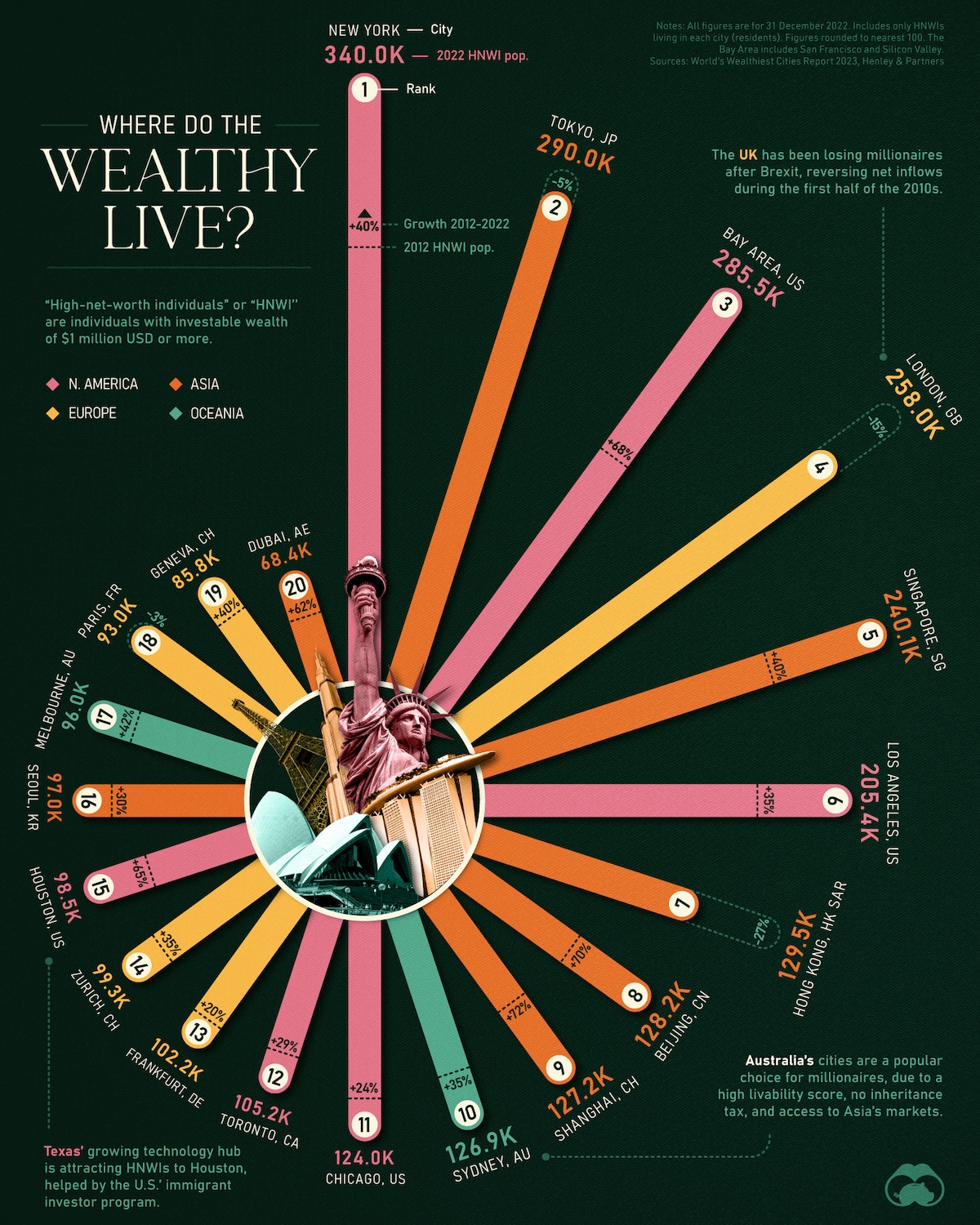
Finally, this interesting graph from The Economist magazine showing life satisfaction as it relates to income in different countries. This gets to the essence of Houston's competitive advantage: our low cost of living moves people further up these lines even with modest incomes. News flash: People are just plain happier when their salary goes further (surprise!).
As the Greater Houston Partnership develops Opportunity Houston v2.0, I hear more and more that Houston needs to not just attract jobs, but also well-educated talent to fill all those jobs. Don't get me wrong - as Joel Kotkin has pointed out, plenty of college grads are moving to Houston - but even that flow is having trouble keeping up with the massive numbers of jobs we're creating. Although Houston's image has been improving with more and more national accolades, we're still not an obvious "go-to" destination for talent (like, say, Austin), especially recent college grads outside of Texas. I'm not sure any general image/advertising campaign can fix that, but I do think a targeted approach with a modest budget has a lot of potential.
Step 1: Identify target universities with graduates and alums we want. It's really hard to pry people out of the coasts, but I think Midwestern and Southern graduates are more likely to consider Houston. I'd guess the best yield will be mostly from Big 10, Big 12, and SEC schools with strong engineering programs, plus a few high-quality extras like Tulane, Duke, Emory, Georgia Tech, U.Va, and Washington University in St. Louis.
Step 2: Help organize/support/sponsor alumni groups from those schools in Houston. Help them create social media communities and networking events, especially around sports bar meetups for their school's games.
Step 3: Sponsor a big Houston tent at the annual homecoming football games for those schools. In addition to the usual food, beer, and marketing materials, make sure it has plenty of Houston-based alums at it to talk up both the city and their alumni community here. The message is "Your school has a vibrant alumni community in Houston that you will be welcomed into, and they love living in Houston." This is a double win because the message gets out to both alums and students. Also consider ads and articles in alumni magazines.
Step 4: Here's the clincher. The idea came from a story my Dad told me about northern college students driving down here for spring break mixing service at Habitat with Humanity with some fun. Evidently they really enjoyed Houston. The more I thought about it, the more I realized Houston has to offer for college students on spring break: reasonable driving distance (at least for a groups trading off driving shifts), great weather, beaches/Kemah/Pleasure Pier/Schlitterbahn, the Rodeo, NASA, arts/theater/museums, and of course tons of restaurants, bars, shopping, and nightlife. I've heard and read multiple anecdotes that today's college students are looking for more than just "get drunk on a beach for a week." They like the excitement and sophistication of a big city. They'd like to do a service project. Houston could offer an amazing spring break experience, and we can certainly handle the crowds far better than the small beach communities of Florida and with fewer drug violence concerns than Mexico. And if they want to mix in a little SXSW time in Austin or South Padre beach time during their week, that's fine too. The goal is to get them at least some exposure to all Houston has to offer, so when they're interviewing for jobs their senior year, we're an attractive option... "Man, I had a blast on spring break in Houston - I could definitely see myself taking a job and living there."
Of course we'd want to try and schedule a slate of events, including concerts and festivals, during these spring break weeks. And offer an array of service projects like Habitat for Humanity and others. We'd also want to have private events where the students can meet their local alumni group - for example, Houston-based Purdue alumni hosting Purdue students on spring break for an event at the Natural Science or Fine Arts museums. Finally, of course, we have to promote Spring Break Houston on their campuses.
Again, another double win, attracting both talent and tourism dollars. And when you consider the secondary value of all those college students talking up their Spring Break Houston trip on their social media accounts, it's really a triple win.
So that's my 4-step plan for attracting more college-educated talent to Houston with a modest marketing budget. I'm looking forward to your thoughts in the comments...
The Rise of the Third Coast and Houston's Philanthropy with the TMC
Joel Kotkin has a great op-ed in the Wall Street Journal on the rise of the Third Coast (alternate link - hat tip to Stephen). I wanted to just include it in the next post of smaller misc items, but there are too many good Houston excerpts, so here there are:
The country's next great megacity, Houston, is here...
Together, Houston and Tampa have gained more than 1.5 million people over the course of the decade; in fact, in 2008 and 2009, net domestic migration to Houston was the highest of any major metropolitan area. An examination of migration flows to Houston, New Orleans, and Tampa by Praxis Strategy Group, where I work as a senior consultant, shows that many of their new citizens are coming from the East and West Coasts, especially New York and California. Also over the past decade, Houston has attracted as many foreign immigrants, relative to its population, as New York has—a considerably higher rate than in such historical immigration hubs as Chicago, Seattle, and Boston, though still lower than in San Francisco, Los Angeles, and Miami.
What's more, the Third Coast is winning the battle of the brains. Over the past decade, according to the Census Bureau, 300,000 people with bachelor's degrees have relocated to Houston.
...
Many of the region's new arrivals are attracted by the low cost of living. The median home-price-to-income ratio in Houston, Tampa, and New Orleans is roughly one-half that of New York, Los Angeles, San Francisco, or San Jose. Over the last decade, Houston boasted the highest growth in personal income of any of the country's 75 largest metropolitan areas.
...
Thanks largely to expansion in energy, manufacturing, and engineering services, Houston now boasts a considerably higher per-capita concentration of STEM jobs—those relating to science, technology, engineering, or mathematics—than Chicago, Los Angeles, or New York, according to an analysis by EMSI.
...
When Garreau published Nine Nations 30-some years ago, he predicted that as growth kicked in, the Gulf region would "clot" into an archipelago of cities similar to the Boston–New York–Washington megalopolis, or to the band stretching from San Diego through Los Angeles and San Francisco to Portland and Seattle. If he proves right, Houston will be the hub of this new system, much as New York anchors the East Coast and Los Angeles the West.
The greater Houston metropolitan area is one of the fastest-growing in the country; its population, now 6 million, is expected to double over the next 20 years. Houston is also the nation's third-largest manufacturing city, behind New York and Chicago. Over the past decade, the city and its surrounding communities have added almost 20,000 heavy-manufacturing jobs, the most of any metropolitan area in the United States. Further, Houston has the third-largest representation of consular offices, after Los Angeles and New York, and it hosts more Fortune 500 companies—22, as of 2011—than any city other than Gotham. Over the past half-century, says Federal Reserve economist Bill Gilmer, Houston has consolidated its position as the center of the global fossil-fuel industry. In 1960, Houston was home to just one of the nation's large energy firms, ranking well behind New York, Los Angeles, and even Tulsa; by 2007, 16 such companies were headquartered in Houston, more than in those three cities combined.
The burgeoning health-care industry is also finding a home in Houston, especially at the Texas Medical Center—"the largest medical complex in the world," its website boasts. Like so many things in Houston, this cluster of 48 nonprofit hospitals, colleges, and universities owes its existence largely to the energy industry. According to its chief executive, Richard Wainerdi, the center benefits from "probably the biggest confluence of philanthropy in the world, and a lot of it is oil money." Every day, 160,000 people enter the vast campus, equal in size to Chicago's downtown Loop; its office space, now over 28.3 million square feet, exceeds not only that of downtown Houston but also that of downtown Los Angeles. The figure is expected to surpass 41 million square feet by the end of 2014, making the center the seventh-largest business district in the nation.
Houston's solid business climate empowers entrepreneurs. Between 2008 and 2011, according to a study by EMSI, the number of self-employed workers grew more quickly in Houston than in any other large metropolitan area. Greater numbers of educated workers are coming, too: Houston's total increase in people with bachelor's degrees over the past decade bested Philadelphia's, was three times that of San Jose, and was twice that of San Diego. "I don't get the pushback I used to get" from potential recruits, says Chris Schoettelkotte, who founded Manhattan Resources, a Houston-based executive-recruiting firm, 13 years ago. "You try to find a city with a better economy and better job prospects than us!"
Though Houston has always been a good place to do business, it continues to suffer from a bad cultural image. In 1946, journalist John Gunther described Houston as a place "where few people think about anything but money." It was, he added, "the noisiest city" in the nation, "with a residential section mostly ugly and barren, a city without a single good restaurant and of hotels with cockroaches." The miserable city that Gunther described no longer exists, but residents on the other two coasts have been slow to acknowledge that development, despite Houston's first-class museums and lively restaurant scene. "Let's face it, we have a bad reputation," says L. E. Simmons, a legendary Houston energy investor. "But the good news is, it keeps the stylish opportunists out. It makes us kind of an urban secret."
All of that oil money has fueled a massive experiment in private, voluntary initiative—a major healthcare system that is more private than public, more charitable than profitable. Its scale can only be described as Texan. The campus is equal in size to the Inner Loop of Chicago. It currently has over 28.3 million square feet of office space—more than downtown Houston, even more than all of downtown Los Angeles. (By the end of 2014, its square footage is expected to exceed 41 million square feet, which would make the medical campus the nation’s seventh-largest business district of any sort.) Every day, 160,000 people enter the area, which has grown into Houston’s largest employer. Every year, TMC hosts about 7.1 million patient visits, including 350,000 surgeries and 28,000 newborns delivered.
Houston’s real philanthropic achievement, however, is not just the scale of the TMC. It’s the extraordinary quality of its institutions. In the 2013 U.S. News & World Report hospital rankings, TMC-affiliated institutions topped the charts. Methodist Hospital was a nationally ranked leader in 13 of 16 adult specialties. (Of the 4,793 hospitals included in the rankings, only 148 facilities—roughly 3 percent of the total—were considered a nationally ranked leader in even one of the 16 specialties.) St. Luke’s Episcopal Hospital, likewise on the TMC campus, earned national ranking in 10 adult specialties. The Texas Children’s Hospital was ranked fourth among all U.S. children’s hospitals. M. D. Anderson has been named the best cancer center in America for 9 of the past 11 years, including 2012.
There have been both online and group meetup discussions lately about cultivating a more vibrant entrepreneurial startup scene in Houston, possibly even a startup district (more here, esp. the full comment conversations here and here and here). There is a thriving scene, as evidenced by the recent rise of so many coworking spaces (coworking defined and HBR on the rise of them), but the general feeling seems to be that the Houston scene is too fragmented, decentralized, and lacking in technical talent availability (they're here, but the energy companies suck them up with big salaries and benefits).
Getting more concentration and critical mass seem like a good strategy. Dispersed = invisible, no critical mass. Concentrated = high-visibility, virtuous cycles of growth. If a decent chunk of the entrepreneurial activity in the city were concentrated in a single building/district, it would get a lot more notice and many good things would happen: media coverage (including from outside the city), connections, activity, investors, and overall growth.
It's over 50,000 square feet, in the bustling Merchandise Mart, and can accommodate up to 300 companies, both with long-standing desk arrangements and short-term desk arrangements. The space has been laid out ingeniously. There's a large open area built on a grid with desks, meant to mimic the design of the city of Chicago, and a winding wall through the area that symbolizes the river. It's a beautiful thing to walk into, even while it is under construction.
The thing that makes this space special, however, is just how much it can accommodate. There are multiple meeting spaces, meant to be both conference areas and classrooms. Entrepreneurs around the Chicago area will rotate within a regular schedule of speakers, on everything from sales to marketing to tech to PR...
There's a kitchen area, phone and rest areas, bathrooms that are frankly much nicer than they need to be, a coffee shop that will welcome weary travelers in the front as they stagger in each morning, and even a tiny equivalent of Sand Hill Road, in the form of a long hallway with offices down each side that investors from the area can conduct meetings in. Startups get access to phone systems, WIFI, copier services and so on, for no extra hidden fees. Which means that not only can entrepreneurs build companies within this space, they can grow, push their teams to grow and even seal funding without ever leaving the space (much less the building).
This is exactly what Houston needs. One of the ideas I floated around the event that got some strong positive reception was the idea of a large off-campus student dorm aimed at UH and Rice business, entrepreneurship, and technical/engineering students, combined with a large coworking/incubator/accelerator space open to the entire Houston startup community. The mixing could be very beneficial for both sides. The target building would be converting the old abandoned Holiday Inn/Days Inn tower downtown (Google Maps aerial view), which has 31 stories and 600 rooms. It also has 32,000 sq.ft. of former meeting room space that could become coworking/incubator/accelerator space. There are a lot of advantages to this approach:
It builds critical mass for a startup district near the Houston Technology Center as well as the walkable Bagby/Gray/Midtown district full of restaurants, bars, apartments, and young professionals.
It has plenty of parking with a six level parking garage.
Old, small, low-ceiling hotel rooms are much more easily converted to dorms than apartments, condos, or a hotel up to modern-day standards. Dorms don't need kitchens. Shared kitchens could be added to each floor or just a single large one at the base.
Rice forces ~1,000 undergrads to live off campus every year due to lack of space, generally in their junior year, which is perfect for exploring entrepreneurship since they have skills but aren't yet doing senior year corporate interviews.
Rice has ~2,000 grad students living off campus.
UH has tens of thousands of undergrads and grads living off campus.
If UH and Rice agree to send it students, that creates a predictable revenue stream to incent a developer and secure a redevelopment loan. It also can subsidize the startup space to make it very cheap or even free, which will help it achieve a critical mass of activity.
I think students would love the social dorm environment with other students as opposed to the usual cheap, sterile apartment. It could also offer key dorm amenities like a cafeteria, which is also likely to be popular with the startup employees.
For students who do not want to work for energy companies, it may help keep their talent in Houston rather than moving elsewhere after graduation.
It could be a truly incredible entrepreneurial environment, and put Houston on the map nationally as an innovator in encouraging entrepreneurship. In my seven years of blogging, this is one of my favorite Houston strategies so far, and I hope to connect to the right people that can make it happen.
Ashby, top rankings, smarter city, vs. Chicago way, importing talent, and more
Just back from a family visit to SoCal, and the smaller items have been stacking up fast...
NYT op-ed on how young people are less and less willing to move. I think the rise of the Internet is a big factor - it can satisfy those bouts of boredom or restlessness that push people to move, either virtually or by helping you discover new options in your own region - plus I think we might also be learning the true value of social networks and how they relate to our happiness. In any case, it means Houston will need to work harder on growing our own highly educated talent, because importing it is just getting harder and harder. UPDATE: NYT story on the depressing long-term homesickness often found in people who move for economic reasons.
"...the report documents a pattern of crime that has become synonymous with the Chicago or Illinois “way” of doing things. All the corrupt governors and 26 of the aldermen had tried to extract bribes from builders, developers, business owners and those seeking to do business with the city or the state. Those who paid bribes either assumed, or were told, that payment was necessary for zoning changes, building permits or any other government action."
Houston most diverse city in the country. I wish the Chronicle had put comparative U.S. metros and local cities data graphs from the print edition online. They were pretty interesting.
I was lucky enough to get to attend the premiere of Dr. Stephen Klineberg's new "Interesting Times" documentary (from Rice's Kinder Institute for Urban Research) on the past and future of Houston at the MFA. It is very well done - compelling and engaging - but unfortunately they are holding back from putting it online, at least for now (just an excerpt here). I'll let you know if that changes. In the meantime, you can read CultureMap's excellent coverage here or the Chronicle's here.
Pretty interesting NYT story on the topic of "how many people can Manhattan hold?" It's nowhere near full compared to some of the denser cities of the world.
The mayor has announced a settlement of the lawsuit, and the Ashby high-rise is moving forward. South Hampton residents should take solace in the fact that there are several high-rise towers around River Oaks, yet property values and quality of life are holding up quite fine there. And if the true concern was traffic, they should be thankful they didn't stick something much worse there, or even just a Whole Foods...
An open dialogue on serious strategies for making Houston a better city, as well as a coalition-builder to make them happen. All comments, email, and support welcome.