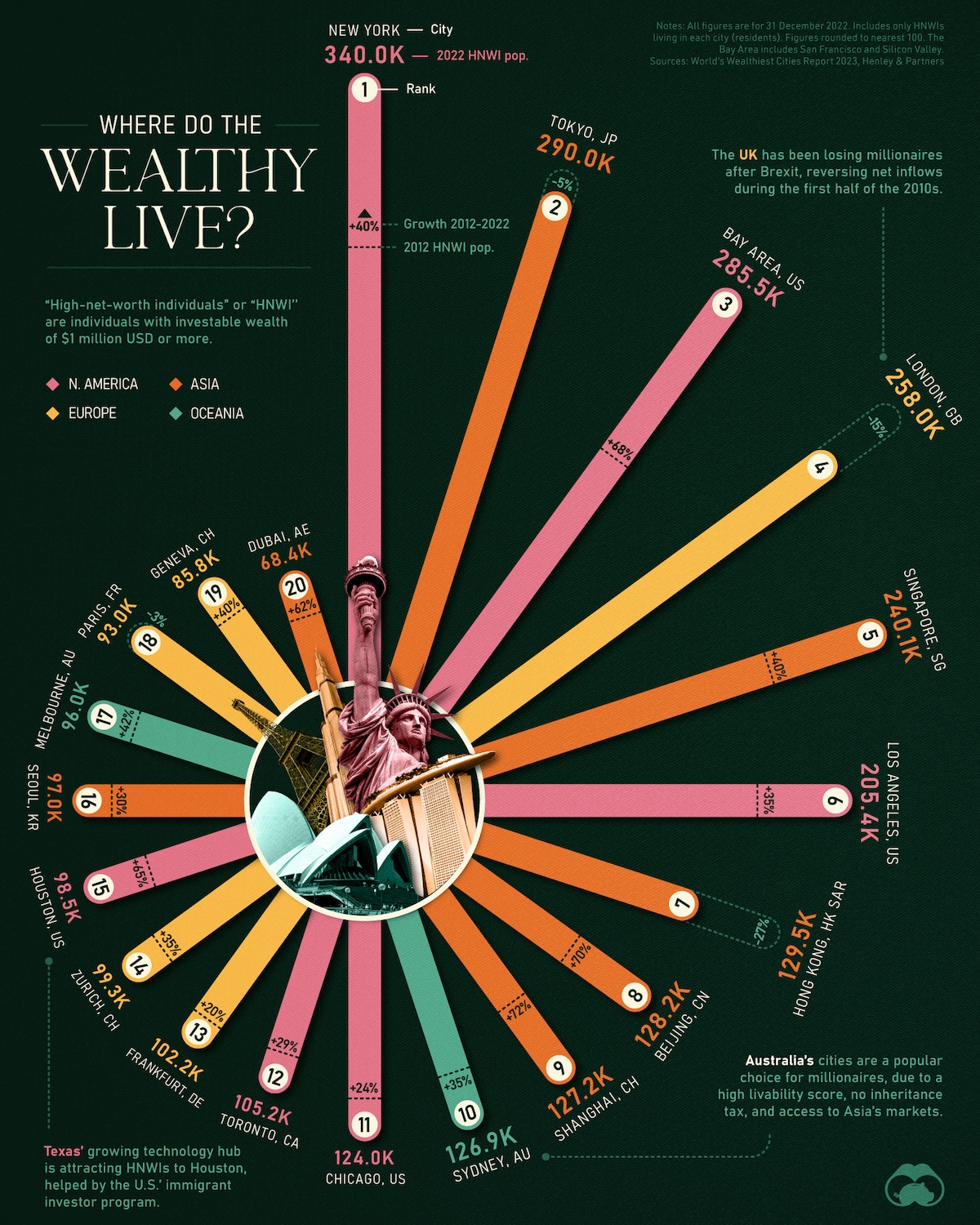
Minimum Lot Size Reforms big win for Houston, AI-resistant HTX economy, 'Abundance' and Housing, and Cloud Streets!
Life has been busy and I haven't posted in a while, so the smaller items have gotten backlogged:
Abundance and Housing: Ezra Klein has a new book out called "Abundance," and Evan covered it at Houstonia. The core idea is that we need more of things – housing, clean energy, etc. – and that often means overcoming local opposition and regulatory hurdles. Sounds familiar, right? Houston's approach, particularly on housing, often feels like a practical application of this "abundance" mindset compared to more restrictive cities. Separately, Evan notes the interesting political dynamic where YIMBYism (Yes In My Backyard) focused on housing abundance is finding allies across the traditional political spectrum, driven by the sheer need for more housing.
Minimum Lot Size Reforms: Speaking of housing abundance, the Pew Trusts did an analysis last year highlighting Houston's success with minimum lot size reform. They found it significantly unlocked affordable homeownership opportunities. Key takeaways include that these reforms allowed for thousands of new, more affordable homes closer to job centers without subsidies, providing a market-driven solution to affordability challenges. It's a prime example of how lighter regulations can yield positive results. Some key points:
The reform led to the construction of over 34,000 townhouses from 2007-2020, mostly on commercial, industrial, or multifamily properties.
The resulting townhouses provided more affordable family-sized housing in the urban core compared to other new homes.
The townhouses were larger than the single-family homes they replaced, offering more living space.
The increased housing supply did not lead to displacement of Black and Hispanic residents; instead, Houston saw population growth in these demographics.
An opt-out provision (block votes) helped minimize opposition to the reform but also limited development in some areas.
Houston's experience shows land-use reforms can spur housing, offer affordable options, and limit displacement.
Houston: AI-Resistant, Educated, and Affordable? An interesting academic paper analyzing metropolitan areas based on education levels, exposure to AI disruption, and housing costs puts Houston in a very strong position. According to the analysis (Table 5.1, p.23 of this SSRN paper, also mentioned in the NY Times), Houston stands out. Among large metros with high education, low AI job exposure, and affordable housing, Houston is by far the largest (7.5 million population vs. 1.5 million for the next largest). This suggests Houston may be uniquely positioned for resilience and growth in the coming AI-driven economic shifts.
Cloud Streets! On a final lighter note, Space City Weather was kind enough to post some cool "cloud street" photos I took during some interesting weather patterns. They were pretty cool and like nothing I've seen before.
Houston tops affordability and innovation, big US homes, Houston's winning secret sauce, and more
A few smaller items this week:
US vs European homes graphic below: "A good visual showing how huge US living spaces are compared to European. The average person below the poverty line in the US lives in more square feet of living space than the average European." (HT Michael). This is an often unsung advantage of Texas and especially Houston: not just lower home prices but how much home you get, plus the amenities of master-planned communities. But wow, those Mormons in Utah build some big homes for some big families! (click the graphic to enlarge it)
A great tweet from John Arnold: "Houston has bad weather, no natural beauty, and little history. But that’s a feature, not a bug. It means government has to be responsive to the people to create a place people and businesses want to locate. It must be efficient with taxpayer money and consider tradeoffs. It must create an ecosystem that leads to a high quality of life for its residents. Lose this focus and the city fails. There is no presumption that residents must acquiesce to the city; the city must work for the residents. Turns out there’s great demand for this concept: the city has gone from the from the 45th largest in the US to the 4th largest in 100 years. It's a simple concept but one I find wanting in many legacy cities with more natural advantages."
Houston needs this - more private operators covering suburb-to-work center routes that METRO doesn't.
"More than 25,000 establishments relocated to Texas from 2010 to 2019, bringing more than 281,000 jobs with them and resulting in a gain of nearly 103,000 jobs for the state, data compiled by the Federal Reserve Bank shows.
The report said Texas appeals to relocating businesses for a variety of reasons, including its central location in the continental U.S., access to multiple large cities and business-friendly environment...
However, research from the Federal Reserve Bank of Dallas found that attractive economic fundamentals — like low taxes, low regulations, a growing population, a relatively lower cost of living and less union activity — are far more important than incentive packages when businesses make location and expansion decisions."
Salim Furth at Mercatus: "How much are #Houston's different lot sizes in different eras showing up in real houses for real people? Here are single family houses built in the 22 years before reform, and the 22 years after - same scale." When minimum lot sizes shrank, a whole lot more small-lot houses got built because that's what the market wanted.
"Founded in Houston, Cart moved its headquarters to Austin in 2021, only to return to Houston in November.
The company moved to Austin to hire software developers, says co-founder Remington Tonar. But Cart is a logistics company as well as an e-commerce services provider, and its leaders found the company’s rapid growth required a bigger city with a larger and more diverse talent pool, including skills that go beyond just software development.
“If I’m looking for front-end software devs who can build beautiful tools to perform one task, a place like San Fran or Austin may be better,” says Tonar. “But if I need people who can integrate digital and physical systems, Houston is a lot more attractive, because people are coming out of logistics and energy.”
"Techstars isn’t the only entity scaling back in Austin, either. In November, unicorn Cart announced that it was moving its headquarters back to Houston after relocating to Austin in late 2021. The company, which describes itself as an e-commerce-as-a-service business, reached a $1.2 billion valuation in June after raising a $60 million Series C round of funding.
Mitch Goulding, director of communications at Cart, told TechCrunch via email that the company had originally relocated its headquarters to Austin “with the explicit goal of attracting more software talent.” But as the company continues to scale (it claims to have seen its revenue climb by 9x since the end of 2021), it decided it needs to “augment other areas of the company,” including HR, finance, accounting and legal.
“We feel the move to Houston will unlock a deeper talent pool in these areas based on its position as a hub for major business,” Goulding said.
It’s also a matter of cost and convenience.
“Costs in Austin are high relative to Houston’s affordability, [and] Houston is also more accessible,” Goulding said. “It is typically easier and cheaper for employees flying in. It also tends to be easier for employees who drive in from across the state.”
"In Houston, Black-owned businesses have been thriving, with the city now rivaling Atlanta as a destination for Black families and young people.
“Everyone is coming to Houston,” said Victoria Walsh, 30, who moved from New Orleans for a restaurant job in 2018. “There’s a whole lot of jobs, a whole lot of new concepts, a new pop-up each week.”...
The city of Houston has long had thriving Black communities, but in recent years, the new arrivals have driven a kind of renaissance that is fueled, in large part, by who they are: middle-class Black people from other states with good jobs and business ideas. ...
“When you look at other cities, they’re not as diverse as Houston,” he said. “They don’t have as many opportunities.”
"Now, Houston’s transformation to an international hub for a growing number of multinational corporations — backed by one of the nation’s busiest international airports and global shipping ports — has helped propel the city to the top of the second annual FT-Nikkei Investing in America rankings. ...
That reputation has drawn in businesses both big and small. The Houston area is home to 26 Fortune 500 companies, making it the third-ranking metro area in the country. ...
The transition to green energy is helped by the knowhow that made it a centre for oil and gas. Houston boasts unrivalled technical expertise in energy, including manufacturing, engineering, trading markets, and complex industrial project management. It also has a robust energy infrastructure and the nation’s biggest port by tonnage. ...
“Increasingly, people working in the energy transition space are saying, you know, actually where the action is, is here,” says Tudor. “It’s not really San Francisco. It’s not really Boston. It’s Houston, Texas.”
Pros 👍: pleasantly surprised by Houston; plays up affordability, inner loop density, diversity, and the amazing food scene ("strong candidate for best food city in the US")
Cons 👎: bike and anti-car snob, toured Houston on bike in wonderful late October - maybe try coming in August sometime and see how bike-over-A/C'd-car you are then?... 🥵🙄 I've said it before and I'll say it again: Houston was built around the car because it's the only way to bring an air conditioner with you everywhere you go!
“Although sometimes overshadowed by the cachet of Dallas, Austin, and San Antonio, Houston is absolutely a tech hub in its own right, attracting a mix of major tech companies and VC-backed startups to join its already established base of aerospace, defense, and energy companies,” Dice says.
Governing: Few Mayors Connect the Dots Between Zoning and Homelessness. Restrictive codes can severely limit housing development, but a new survey of mayors finds that few take them into account in their plans to address homelessness. This is definitely a major factor in Houston's relative success in alleviating homelessness vs. other major cities. Hat tip to Judah.
The Atlantic: Everything Is About the Housing Market (archive link) - High urban rents make life worse for everyone in countless ways. I expect this “housing theory of everything” to continue to catch on because it’s absolutely right. It’s related to what I’ve been talking about for years with the four factors that go into Opportunity Urbanism, including discretionary income that determine how vibrant a city can be. If you pay too much for your house, you don’t have money to put into other things. That has been covered up for decades now by the wealth accumulated by those homeowners, but that’s a short-term effect that’s diminishing.
"I can’t help but think that Vision Zero is really more about inconveniencing auto drivers than increasing safety. Just three policies — a motorcycle helmet law, bicycle boulevards, and moving homeless people away from major arterials — would save far more lives than anything in the adopted plan."
The Value of VMT (Vehicle Miles Traveled), and why trying to reduce them takes our economy the wrong direction:
"There is clear research showing that faster travel speeds means higher per capita incomes because such speeds give people access to more jobs and employers access to a larger pool of workers, which means more people can do the job that fits them the best.
...
Even if it was a good idea, no urban area anywhere has found policies, short of war or natural disaster, that can significantly reduce VMT. Yet planners keep spouting the same rhetoric while ignoring the fact that good intentions are meaningless, if not outright harmful, if they don’t produce actual results.
The lesson we need to stress to public officials is that it makes a lot more sense to make better automobiles and highways than it does to try to reduce driving. Since 1970, automobiles have become 50 percent more fuel efficient, 70 percent less likely to be involved in a fatal accident, and 95 percent less polluting of toxic chemicals. If anything, efforts to reduce driving have made these problems worse by forcing people to drive in more congested traffic where cars use more energy and produce more pollution.
I strongly suspect there is some class warfare going on here. Urban planners are by definition college educated and middle class. They probably drive cars, but the cars they drive are likely to be electrics, hybrids, or other high fuel-economy vehicles. The vehicles driven by the working class are more likely pickups, vans, and other large vehicles, partly because they need such vehicles for their work, but the planners see them as the deplorable enemy. So while planners pay lip service to low-income people and the working class, they want to design a society that has no room for them.
Those who truly care about helping low-income people and building healthy, wealthy urban areas need to take a stand in favor of more automobile ownership, more miles of driving, and better roads for those automobiles to drive on."
Warren Buffet calls bs on rail, remote work permanence, induced demand idiocy, HTX tech + construction + port growth, Ike Dike, and more
Happy new year everyone! Hope you all had a good holiday season and didn't get caught up in the Southwest airlines chaos. Sadly, I accidentally wiped out all my backlog of post topics and blogspot does not have any recovery functionality (why can't it keep history like Google Docs?!). So I'm combing back through my tweets to try to find at least some of them:
Richard Florida: “When I started with the creative class, places didn’t care about young people, they were only trying to attract a family with children to the lovely suburbs, and I’m saying, ‘No, no, no, no, no,’” Mr. Florida said in an interview. “Twenty years later, people forgot about the families. And now here’s a whole generation leaving cities again, for metropolitan or virtual suburbs.” ...
"A few feet away from her, another group of young workers was playing Jenga. One by one, they took blocks away from the structure, making way for the inevitable collapse."
NYT idiotically parrots the induced demand argument, including mentioning I10 and I45. Which type of infrastructure should government invest in: transit nobody will use, or lanes everybody will use? 🤔 Induced demand is a false argument. Nobody says "don't build a new airport runway - it will just fill up with new flights" 🙄
AP: Warren Buffett jumps into local politics to fight streetcar: "Billionaire investor Warren Buffett broke with his practice of staying out of local politics to urge his hometown of Omaha to abandon its planned streetcar project because he says it's too expensive and not as flexible as buses."
WSJ: The Blue State Exodus Continues: "Texas and Florida make up about 15% of the U.S. population but accounted for 70% of its population growth this past year. "
Houston ranks as the top market for tech job growth: “Although sometimes overshadowed by the cachet of Dallas, Austin, & San Antonio, Houston is absolutely a tech hub in its own right, attracting a mix of major tech companies & VC-backed startups + established base of aerospace, defense, & energy companies”
WSJ: California Long Ruled U.S. Shipping. Importers Are Drifting East. - Companies that depended on the West Coast as a point of entry for their goods are turning to other parts of the country as global trade gets upended. A chart inside shows Houston #1 in the country for port growth in containers. Looks like the port expansion is paying off!
"Bloom provided data showing strong economic incentives for both corporations and their employees to continue the work-from-home revolution if their jobs allow it:
First, “Saved commute time working from home averages about 70 minutes a day, of which about 40 percent (30 minutes) goes into extra work.” Second, “Research finds hybrid working from home increases average productivity around 5 percent and this is growing.” And third, “Employees also really value hybrid working from home, at about the same as an 8 percent pay increase on average.”
Clean energy entrepreneurship in Houston, densification, welcoming refugees, Dallas TOD failure, ADUs, population gains, rankings, and more
Continuing to clear out some backlogged smaller items. A lot of these I tweeted while I was out of town for much of the summer, but just now getting a chance to bring them to the blog:
“Every day I meet another oil and gas guy who is now a climate entrepreneur. I think there is going to be an explosion of clean energy activity out of the O&G sector, and we’ll be stunned in the next 5-7 years by how many of these problems they handle.”
"Austin isn’t the densest metropolitan area in Texas. That honor belongs to the nine-county Houston region, which increased from 1,560 residents per square mile in 2010 to 1,858 in 2020, an increase of about 19%."
"H-Town exudes Southern hospitality: The pace of life is more relaxed than many major cities, and they're welcoming, polite, and eager to share the delights of their city with visitors...make Houstonians less cliquey and more hospitable towards newcomers."
This makes me proud. Houston's doors are always open to those seeking a fresh start and new opportunity: "Volunteers from Houston Welcomes Refugees showed up with boxes of items to furnish the family’s new home." NYT: From Kabul Airport to a Houston Walmart
"In short, TOD is simply a scam. Like Portland’s light-rail mafia, which guided subsidies to favored developers who would build TODs, Dallas light rail and TODs are merely a way of transferring money from taxpayers to developers."
"There are more than 3,600 ADUs in Houston (according to HCAD data) of which the median size is 530 square feet (max allowed=900sqft). ADUs offer more housing options while maintaining the existing community character."
Infrastructure bill problems, Dallas TOD failure, CA vs TX, why transit has trouble competing, and more
I apologize for the sporadic posts over the summer while I was out-of-town with family, but I'm back and looking forward to catching up on a big backlog of smaller items that will probably take several weekly posts to get through.
"In short, TOD is simply a scam. Like Portland’s light-rail mafia, which guided subsidies to favored developers who would build TODs, Dallas light rail and TODs are merely a way of transferring money from taxpayers to developers."
"This page is not calling for abandonment of transit or extolling the virtues of the automobile. It is an attempt to lay out what transit is up against if it is to succeed. Pretending that the economic issues I describe can be made to go away is a guaranteed recipe for failure."
“Right now market forces are telling California, ‘Get your s-- together,’ ” said report co-author Mark Duggan, director of the Stanford Institute for Economic Policy Research. “This exodus thing — I think it’s a risk.”
"the number of companies relocating their HQs out of CA is running at twice the rate of recent years and is showing no signs of slowing...The winning state is Texas, which for many years has been the most popular destination for CA company relocations"
"Like many other tech executives, I think Texas is positioned to outpace California due to its proximity to the world's top companies in energy, healthcare, and aerospace, to name a few, and its willingness to innovate with technology in those industries."
Painted Into a Corner - It could be time to reconsider land-use laws that contribute to runaway housing costs. Hat tip to George. Really glad to see Houston avoid a lot of these issues. Conclusion:
"The role of cities in the 21st century has not yet been determined. Cities with outdated housing policies may no longer be aspirational. The future of successful cities must begin with enabling a broad set of people to live there, which necessitates affordable housing. Making housing affordable to a large set of people with a range of incomes has its advantages.
This allows people who have lower-paying, service-industry jobs to live near where they work. It promotes a broader set of cultures within a city. Multiculturalism should be one of the values of large cities. When a city is large enough, it can support such things as museums, art galleries, performing arts and professional sports franchises. The greatest thing that a city can provide is social mobility."
WSJ: Mass Spending for Mass Transit - Democrats want the GOP to rescue big-city rail and public unions. This is why I have mixed feelings about the $1T infrastructure bill - a whole heap of the money will be going into a black hole, especially Amtrak.
My online event Tues, HTX #1 BBQ and #2 tech growth, R voters moving to TX, post-pandemic city shifts, ATX vs. HTX home prices, housing craziness humor, and more
Before we get to this week's items, just a reminder that my Mercatus online panel event on Land Use without Planning is 2pm CT on Tuesday. I'll be covering some of Houston's land use and zoning history as well as what other cities can learn from Houston. You can learn more and register here.
Moving on to a large backlog of items for this week:
NYT: There’s an Exodus From the ‘Star Cities,’ and I Have Good News and Bad News. Excellent summary of many different analyses forecasting post-pandemic urban geography. I’m not sure they’re right that pandemic migration will push R counties/states more D though. A lot of frustrated Rs are using the pandemic to escape D states and move to R states. For every D techie moving from SF to Austin, I'd bet 2 frustrated California Rs are moving to Texas. Actually, a recent survey found 57% of California migrants to Houston voted for Ted Cruz, which validates what I've been hearing. Here’s the most upvoted comment:
"Kotkin nails it 'Meanwhile, the working class struggles to pay rent, possesses no demonstrable path to a better life and, as a result, often migrates elsewhere.' I mean seriously is there anything worse than being poor in New York City, working a job in food service, barely able to pay your rent, knowing that you'll never own anything but an endless struggle against being evicted? Or you can move to Georgia, live cheaply in a far larger house / apt, and work towards gaining equity of something. No smart poor person would ever stay in NYC."
Excellent analysis video and paper showing that even where the land values are the same in Austin and Houston (i.e. same market demand), Austin houses are far more expensive due to over-regulation. Thanks Kevin!
"Houston ranks second among 14 major U.S. labor markets for the number of relocating software and IT workers between March 2020 and February 2021 compared with the same period a year earlier.
Miami grabs the No. 1 spot for the gain in software and IT workers (up 15.4 percent) between the two periods, with Houston in second place (10.4 percent) and Dallas-Fort Worth in third place (8.6 percent), according to the LinkedIn data."
"The big story among the nation’s major metros over the past decade has been the persistence of urban core out-migration and suburban in-migration...Houston had the 2nd-largest gain at 1.2 million, with a 20.8% increase, and remains the 5th largest metro."
"Certainly, Houstonians will be pleased with that result, but the notion that Austin might be Texas' third best city for barbecue will likely cause considerable agita in the state capital." ;-D
"It’s a melting pot, and that’s one of the things that stood out that I absolutely loved about the city. The fact that there’s a lot of positivity going on and people doing great things here, those are really some of the main reasons I stayed in the city.
Their turkey legs are decadent, sure. Like other rodeo-adjacent foods, they’re large, indulgent and full of flavor. They, in essence, are Houston."
"Houston—whose median home values are only 76% of the national average—stands out. Since 2010, it has had America’s 2nd-highest net population growth but is #1 in permits issued. This has made it an affordable city even in core locations; 1-bedroom, 1-bath downtown condo units can be found for under $200,000.
How does Houston remain so elastic? Less regulation. The city famously lacks a zoning code, and many of its suburbs are also very pro-growth. This means it has fewer legal barriers to more housing than inelastic coastal metros, where proposed zoning changes can trigger lengthy and contentious review processes."
"Similar proposals show that the basic idea of hyperlocal zoning has precedent. Houston has been able to remain a city without zoning laws in part because residents had options in the form of deed restrictions, where neighbors could choose their own rules at the hyperlocal level. In 1998, policymakers were able to reduce the city’s minimum lot sizes by allowing residents on individual streets and blocks to opt out of that change, a move which helped overcome local resistance because residents felt they had control over the risks. The result? Some 25,000 more housing units, including denser townhomes, built close to job centers and transit, many of which Houstonians would not have seen built otherwise."
WSJ: How Remote Work Is Reshaping America’s Urban Geography (archive link) - Smaller cities and communities are turning into ‘Zoom towns’ and competing with coastal hubs as workers move to find more space and lower costs. Basically, Richard Florida articulates Creative Class 2.0, which is the same as 1.0 but for remote workers outside superstar cities. Key excerpts:
Eye-opening stat: "remote workers are often more efficient than their in-office counterparts. They don’t waste hours on mind-numbing commutes, and they aren’t distracted by unnecessary meetings and water-cooler chitchat. The productivity boost to the U.S. economy from remote work could be as high as 2.5%, according to research by Stanford University economist Nick Bloom and colleagues."
Conclusion: "The remote-work revolution promises to change the way that Americans work and live. It will allow smaller cities, suburbs and rural areas to compete with the superstar cities on the basis of price and amenities. It will shift the main thrust of economic development from paying incentives to big employers to investing and building up a community’s quality of life. As communities attract more remote workers, their tax bases will grow, allowing them to improve schools and public services, benefiting everyone. Eventually, companies will come too. That holds out the possibility of a better, more virtuous circle of economic development."
Finally, a couple items on Houston as a startup hub. First, we rank #4 on this list for annual startup formations and jobs created by startups (#10 for formation rate), behind DFW but - surprisingly - ahead of Austin! Second, the excellent Texas Startup Manifesto 2.0 is out (highly recommended), arguing for treating the Texas Triangle as one giant startup ecosystem (absolutely), with this excerpt on Houston:
"Houston (East and Gulf Coast) is the fourth largest, and the seventh most diverse city in the US. It’s the energy capital of the world and is home to the Texas Medical Center (TMC), the world’s largest concentration of healthcare delivery and research institutions; to the NASA Johnson Space Center, a hub for cutting-edge human space flight research and astronaut training; to the number one seaport in the nation for waterborne tonnage, for foreign waterborne tonnage, and for vessel transits. Houston is an international city — a seaport, a spaceport, a “health-port”, and an “energy-port.” As a result, Houston has a diverse, high-tech industry ecosystem, and is increasingly an industry destination, serving as the home to 22 Fortune 500 company headquarters (with Hewlett-Packard Enterprise becoming the latest addition)."
The future of superstar cities and Houston, CA's problems, warehouse glut, why tech in HTX?
Hope everyone's staying safe and warm during this way-way-way-too-cold Valentines+Presidents Day winter storm. The lead item this week is a really interesting piece my friend George sent me on the future of superstar cities by Matthew Yglesias. I think his observations are directionally correct, but he’s missing some pretty important nuances.
First, he’s completely ignoring extended family pulls that bring people back to regions.
Second, he’s seeing everything thru the lens of the footloose and fancy-free celebrity rich (the Matt Damon and NBA references), and that is an incredibly tiny part of the population. His alternate lens is 20-something tech startups – also a pretty narrow niche. Normal people have family ties and different reasons for picking places. A lot of the NYC/LA amenities he thinks are so key aren’t that valuable to families, and they’re the ones most likely to leave.
Third, he’s ignoring the *relative* impact of remote work. NYC and LA have a mix of people who want to be there for lifestyle and have to be there for work. Once the work reason is gone, a lot of them have left and will continue to leave (look at the Wall Street types moving to Miami). The lifestyle people may stay, but those cities are still declining relative to what they were when they could hold onto both groups. They will face massive budget deficits which will push them to raise taxes which will push even more people to leave.
As far as Houston, we’re not on the national media radar, but I have personally seen a *ton* of out-of-state plates around recently. The media forgets that they don’t drive most people’s location decisions – it’s what they hear from friends and family, and most Houstonians like it here and plug it to their extended friend/family networks (including talking about the kind of home they can afford), and those friends/family decide to move here based on that recommendation. But obviously the weak oil industry is not helping, and the GHP is absolutely right we need to diversify our economy and build our innovation economy (my latest idea for that). But our core engine is a good sustainable one – not oil, but having a great lifestyle (esp restaurants) at an affordable price (from lack of zoning) that people tell their networks about. As long as we sustain and keep improving that, we will keep growing, even as ‘hotter’ cities like Austin and Miami become ever more crowded and unaffordable. As long as articles like this are being written about us, we’ll do just fine:
Moving on to this week's items:
NYT: The Californians Are Coming. So Is Their Housing Crisis. 'Is it possible to import growth without also importing housing problems? “I can’t point to a city that has done it right,” said Lauren McLean, Boise’s Democratic mayor.'
Houston. Houston has done it right. (one of my more popular tweets) More of these cities should look to our model for handing rapid growth without unaffordable housing.
Ezra Klein in NYT: California Is Making Liberals Squirm. If progressivism can’t work there, why should the country believe it can work anywhere else?
"Conservatives do not resist many regulations of the sort seen in California because we want cities to be horrible or because we secretly are in the pockets of developers who for some reason want their cities to be horrible; rather, we are skeptical of such schemes because they tend to create artificial shortages, distort markets and investment decisions, and prevent solutions from emerging organically. “Markets work!” is cartoon libertarianism, but you know what? Markets work. And if you don’t let them work, you end up with artificial scarcity, high prices, and rationing."
"In some ways, Houston is anomalous. Its business-friendly regulation puts very few restrictions on building. “There’s no zoning,” said Ryan Byrd, a principal of Colliers International Houston. “If there’s land that doesn’t have a pipeline, wetlands or is in a flood plain, you can build a building in less than one year.”
Honestly, I think the second one is the more realistic option right now, and could be very popular. The simple pitch for the second one is the world’s largest climate-controlled park. People love going to parks, but not during Houston’s extreme weather, especially summers and thunderstorms. Having an activated park full of activities and festivals on weekends that is always protected from heat and rain would be a very popular spot for Houstonians, especially families desperate to find affordable activities every weekend. And it could easily start very modestly and then expand over time with philanthropy (like has been happening with the zoo, MFAH, and HMNS) as well as parking charges to cover operations.
Live and Lets Fly blog on 7 must-try restaurants in Houston. As a local, I’ll say this list is pretty solid, but really barely scratches the surface of the incredible depth of Houston's restaurant scene, honed from being where cultures mix – originally South + West + Mexico, but later from everywhere including Asian – plus the lack of zoning allowing absolute hypercompetition: good won’t cut it here, a restaurant better be great if it wants to survive. That Darwinian evolution has honed the scene over decades to where it’s finally getting the acknowledgment it deserves, like from GQ.
"But there’s another factor I hadn’t considered, one that so far appears to be the single largest driver of pandemic-era migration: family."
Bloomberg: Silicon Valley Won't Last Forever, and Texas Knows It - The birthplace of Dell and TI has been quietly building its tech industry since the 1930s. Now it has the chance to move into the spotlight (hat tip to George for archive link). Includes a nice excerpt on my alma mater:
"Part of the reason for this trajectory had to do with another institution that continues to play a key role in driving technological innovation in the state: Houston’s Rice University, which played a role comparable to Stanford's vis-à-vis Silicon Valley. In fact, many of the early players in Silicon Valley actually moved to California after graduating from Rice, constituting what is sometimes called the “Rice Mafia.”
How appropriate, then, that Rice would play a key role in the next step in the rise of Texas. In 1961, the university donated more than a thousand acres of land for the construction of what became known as the Johnson Space Center, flooding a once-provincial city with literal rocket scientists. Like Silicon Valley, where government contracts and connections proved essential in getting the region off the ground, Houston’s leadership in the space race kick-started a host of related industries."
"If California is a vision of the sort of future the Biden administration wants for Americans, expect Americans to demur."
The Atlantic: Superstar Cities Are in Trouble - The past year has offered a glimpse of the nowhere-everywhere future of work, and it isn’t optimistic for big cities. It includes four predictions and a conclusion I would never have expected to see in a magazine like The Atlantic!
The rise of the supercommuter
The decline of the coastal superstar cities
The rise of the rest
The next Silicon Valley is nowhere
"As an urban resident of Washington, D.C., writing from my dining-room table, my claim is not that I believe the internet could or should replace the riotous physical-world collision of urban work, culture, art, and life. My humbler assertion is that 2020 has punctured my confidence that the internet cannot encroach on the benefits of urban density and proximity. Going forward, many fledgling companies may agree, as they find that the city in the cloud essentially acts as a more accessible version of the city on the Earth, eerily reproducing its forces of agglomeration, specialization, and convenience. The past 12 months have offered a glimpse of the nowhere-everywhere future of work."
And fine, just one more about Austin: Texas Monthly: No, Austin Won’t Become Silicon Valley 2.0 - Attracting so many tech companies and workers from California isn’t going to transform the city into another San Francisco—for both the better and worse.
I've known about municipal utility districts (MUDs) in Texas for quite a while, but had no idea there were so many other types of special-purpose districts developers can choose from in Texas depending on the powers they need. Thanks to David and Amanda at Triton Consulting for generously sharing their General Powers of Special Purpose Districts Google Sheet clarifying all the options in an easy grid format.
"In LA, for example, rail lines costing at least $20 billion have been built since 1990, yet transit ridership dropped by one-quarter on the core Los Angeles county transit system from its 1985 peak to 2019. Yet population has increased 20 percent."
Finally, a fun little comment I posted on Market Urbanism Report's Facebook page (humorously responding to another commenter calling Houston ugly) that Scott chose to tweet:
Houston may be ugly, but that ugliness serves a purpose. It's how the city keeps the meddling pretentious aesthete NIMBY Karens away.
My HBJ piece on NZ adopting TX MUDs, Techxodus, video on Houston's identity, future of offices, HTX developments in 2021, Stack City, rich zip codes, and more
"Harris, the most populous county in fast-growing Texas with 4.7 million people, went to six zip codes on this year’s list from just one last year." ...
"Almost half of the richest zip codes, 49 of the 100, are in just seven counties: Manhattan & suburban Westchester County in NY, Connecticut’s Fairfield County, Chicago’s Cook County, California’s LA & Santa Clara counties, & Houston’s Harris County (6)."
Techxodus: The flight of terrified techies from California to Texas marks the end of one era, and the beginning of a new one
"Travel is a part of our lives. Instead of treating it like a cost, we should embrace it, using it to enhance our economic and social well beings. To the extent that government is involved in transportation, instead of trying to limit travel it should do what it can to enable it and to extend the benefits of travel to as many people as possible."
“There are a number of examples of the Texas-style stack in and around our larger metropolitan areas, including Houston, which, because of its large number of stack interchanges, is known as “Stack City””
My first time hearing that nickname - curious to hear in the comments if others have come across it before?
NYT: The Future of Offices When Workers Have a Choice (archive link) - Some work spaces in central employment districts may become housing, and some housing in residential areas may become work spaces. My prediction is that managers will try to get people back to the office, but it will be very bumpy (not everybody vaccinated, virus continues to circulate at a low level, employers sued by employees that get sick, people unhappy with returning to commute), and talent will start looking for employers that don’t require the commute, even a day or two a week. Also companies will find they can access much more affordable remote talent globally, and those companies will start winning vs. companies constraining themselves to limited, expensive local talent pools. Key excerpt:
“Even before the pandemic, there were signs of trouble with the office market in the handful of cities where the “creative class” had been flocking. In 2018, net migration to New York, Los Angeles and San Francisco was negative, while the U.S. economy grew at a healthy 2.9 percent. Creative magnets like London and Paris were experiencing similar declines.
The explanation for the declines — mostly high housing costs because of severe limits on new construction — obscures other forces that were destabilizing the traditional office market. In the middle of the 2010s, Amazon, Facebook, Google, Apple and others started splitting their headquarters into multiple locations. Stripe, one of the world’s most valuable start-ups, went a step further. In 2019, it “opened” a remote hub, hoping to “tap the 99.74 percent of talented engineers living outside the metro areas of our first four hubs” in San Francisco, Seattle, Dublin and Singapore.
For the fastest-growing companies, being able to tap into talent anywhere became more important than having all their teams in one place. Smaller cities were good enough. In retrospect, this shouldn’t have been a surprise, despite all the talk about the importance of giant, dense labor markets to fuel innovation. After all, Silicon Valley itself is not a city but a cluster of sprawling towns scattered along a highway.
The defining characteristic of this new version of the creative class may not be where it lives, but its ability to live anywhere it wants. Put differently, people move to certain cities in search of better-paying jobs, but it’s now possible to earn high (if not the highest) salaries from almost anywhere. That has been true in certain smaller cities in recent years (Austin and Denver in the United States, for example, and Manchester and Leeds in Britain). To a lesser extent, it has also been true for people who chose not to live in cities at all.”
Texas Monthly: Welcome to Texas, Elon Musk. You Don’t Have to Move to Austin - The founder of Tesla and SpaceX says he’s relocating to the Lone Star State. But which of our tech hubs is the best fit for the eccentric billionaire? Surprisingly balanced (even slightly negative) on Austin and very positive on Houston. Excerpt:
"In terms of tech hype, Houston isn’t Austin, but it does check an awful lot of boxes for Musk. Also, if he spends much time on Twitter—and we know he does—Musk might be aware that there is a robust argument among Texans on the platform about whether Austin has “jumped the shark” and been supplanted by Houston for the title of coolest city in Texas."
From the 1980s to the mid-1990s, cities suffered from high crime rates and numerous quality of life issues. New York City, San Francisco, Los Angeles, and some other major cities have recreated the environment of that era, with non-scientific pandemic restrictions that devastated local businesses and a penchant for placing the mentally ill directly in family-oriented, residential neighborhoods. These cities have stopped prosecuting many property and quality of life crimes, inevitably leading to bad quality of life and apathetic enforcement of more serious crimes.
The coronavirus has reset consumer expectations back to suburban living with the mental health benefits of living in greenspace. There has been an exodus from major industry centers to their suburbs and to the alt-cities. The alt-cities of Miami, Austin, and Nashville all offer car-friendly, suburban living, relatively cheap housing, and continual housing construction. With the acceleration of sustainable building materials and clean and cheap energy, the urban planning rationale to pack people into urban cores with mass transportation was already beginning to fray, and the coronavirus has sealed its fate.
...
Low taxes and quality government
People are not moving solely for tax purposes. New York and California’s tax rates are only a few points higher than they were twenty years ago. However, once people decide to move, of course tax rate is a factor in choosing a destination. Florida, Texas, and Tennessee seemingly offer everything that California and New York offer: highways, streets, schools, police departments, fire departments, and such. All the government services one would expect are there, and none of the capital gains taxes that entrepreneurs and venture capitalists typically pay.
As comedian and political commentator Bill Maher recently noted, California is reminiscent of a 1970s Italy, with high taxes and terrible government services. In return for high taxes, one would expect to go to Hunter's Point, East Palo Alto, or East San Jose and see excellent schools and services for disadvantaged people. A hyperloop instead of a failed high-speed train. Fire mitigation and stable power to complement long term climate change goals. A boom in middle-class housing rather than a $700K median house price. California and New York are becoming bad versions of Singapore, with a wealthy technocratic elite, an immigrant servant class, and a collapsed middle class."
"Buyers are paying more, too: The average sale price in Houston jumped by about 15 percent to a historic high of $341,765 in November. And luxury homes—or those going for more than $775,000—saw a staggering 80-percent increase in demand, as well."
Unfortunate that Houston is not on this list of top ten cities gaining residents during the pandemic (Austin and Dallas are), but with the severe oil recession, it's not too surprising. I have still seen a ton of out-of-state plates around town, and do think we are getting some significant migration during the pandemic.
Southwest announced new service from Houston Intergalactic to Dallas Love, Chicago Midway, Denver, Nashville, and New Orleans starting April 12th. I expect Dallas Love to be especially popular for The Woodlands and north Houston suburbs since United only goes to less convenient DFW.
Texas +3, California -3: More details on the HPE, Elon Musk, and Oracle moves to TX
The big news this week is all the different tech companies announcing their moves to Texas.
The big one for Houston is the announcement that HP Enterprise is moving its HQ from Silicon Valley to Spring just north of Houston - a long-term legacy benefit of Compaq Computer (which was acquired by HP and kept substantial operations here).
“Houston is also an attractive market for us to recruit and retain talent, and a great place to do business,” Mr. Neri said, adding that as one of the largest and most diverse cities in the country, “Houston provides the opportunity over time to draw more diverse talent into our ranks.”
And some more detail from their press release: (hat tip George)
"Why Houston?
Houston has long been our largest U.S. employment hub, and construction has been underway since the beginning of the year on a new, state-of-the-art campus in the area. Houston is also an attractive market for us to recruit and retain talent, and a great place to do business. The most diverse city in America and the fourth largest, Houston provides the opportunity over time to draw more diverse talent into our ranks – a key priority for HPE as we work to be unconditionally inclusive.
We also anticipate long term cost savings associated with this move that we can reinvest in key areas of our business and innovation."
And finally a repost from Facebook that digs into what that increased affordability really means for employees:
"Hewlett-Packard announced its leaving Palo Alto for Houston.
$1,100 is the average rent in Houston.
$3,350 is the average rent in Palo Alto.
Just to give a concept of how much the extra $2,250 a month that saves is.
$530 is the average monthly payment on a car.
$460 is the monthly individual cost of health insurance.
$400 is the average monthly cost of food.
$145 is the average monthly spending on gas for a car.
$130 is the average monthly cost of car insurance.
$1,665 a month total.
Those 5 things which are just as essential for people in Palo Alto as Houston and cost about as much in both places cost that much.
If an HP employee moved to Houston and cut rent cost down, but chose to save $585 more a month and put it in a 401k paying 5% for 10 years, they’d have $92,700 or 7 years average rent in Houston.
Those 5 things are also essential, so let’s just say an HP employee moved to Houston and saved the entire $2,250 a month for 10 years.
$27,000 saved a year.
$357,000 saved over 10 years.
27 years worth of rent in Houston.
9 years worth of rent in Palo Alto.
A lot of people have a lot of different reasons for companies leaving, but I think the rent factor and how it’s extremely hard for employees to live is the problem.
Hewlett-Packard was the birth of Silicon Valley and it’s leaving.
I don’t see it as unlikely a future where Facebook, Uber, Google and more could join."
Then there are the other stories on Elon Musk's and Oracle's moves to Austin:
"California, with its steep housing costs, raging wildfires and strict business regulations, has been losing residents to other states, with Texas as the most popular exodus destination. Of more than 653,000 people who left California last year, about 82,000 went to Texas, more than any other state, according to census figures.
Or, as The Stanford Review wrote in a nod to the native Texan George Strait, “All of California’s Exes Are Moving to Texas.” (😅) ...
California and Texas — two economic powerhouses, one led by Democrats and the other by Republicans, with respective populations of 40 million and 29 million — are in many ways natural frenemies. It is a rivalry made up of In-N-Out versus Whataburger, of Disneyland versus the State Fair of Texas, of tacos versus, well, other tacos."
"Taxes, a more affordable cost of living for employees, a lower cost of doing business, and less competition for talent are among the top drivers for the companies’ moves, though there is also a growing sense that culture is a factor, as well."
A new strategy for securing Houston's economic future
Talk has been growing in recent years about Houston's future in a less carbon-intensive energy world. Will we still be the world's energy capital in the coming decades, and what does that mean? The Greater Houston Partnership and Center for Houston's Future have taken the lead on this challenge with their Energy 2.0 and energy transition work, and I hope they're getting traction with it (despite pandemic distractions). We certainly have a lot of expertise here that can work on big problems like carbon capture with the right economic incentives.
Another strategy is growing our innovation and startup ecosystem to build the companies of tomorrow - especially in energy, space, and biotech - and I think there has been great progress made in recent years, including Rice's building of the Ion in Midtown. One area that has not been as successful is trying to attract tech companies building new offices. To be brutally honest, we can't out-Austin Austin.
The energy transition and innovation ecosystem are both great initiatives to help secure Houston's economic future, but I think there's a third opportunity we're overlooking. It plays perfectly to our strengths:
America's most affordable global city (vs. NYC, LA, Chicago, SF, Miami)
Being more attractive to global migrants than domestic ones (which seem to be more interested in places like Austin, Denver, and Nashville)
Large expat communities from countries all over the world
92 foreign consular offices, the third-largest set in the US after NYC and LA
One of the largest ports and industrial bases in the country
A huge United hub at IAH with nonstops covering all of the Americas in addition to European, Asian, Middle Eastern, and ANZ connections.
Put all those strengths together and what's the opportunity? To be the location of choice for foreign companies establishing their branch office for the Americas, especially industrial ones. There are thousands of fast-growing companies around the world that will need to establish a presence in the Americas at some point, and Houston is really the ideal place for them to put it for all the reasons listed above.
I think we already compete for these to some extent, but there's an opportunity to do it much more aggressively with a formal, well-funded program that cooperates closely with all our foreign consulates to identify their up-and-coming companies and start wooing them as early as possible. Without outside influence, they probably tend to end up in the cities that are more obvious and well-known to them like NYC, LA, and Miami. But if we intervene early and show them how much better Houston will ultimately be for both their business and their employees, I think we can win over a substantial number of them. Their expat employees used to small flats and public transport in crowded cities will be blown away by the equivalent home and car they can buy in Houston, Sugar Land, or The Woodlands!
These foreign branch offices aren't as sexy as green energy, tech, or entrepreneurial startups, but over time they could provide a very strong foundational component to Houston's economy with a whole lot less uncertainty and volatility. Even better, we won't have that much competition - it's an opportunity ignored by most cities as they chase the hot tech companies and try to cultivate their own startup scenes. Foreign corporate offices should definitely be the third strategy to secure Houston's economic future in a world increasingly hostile to oil and gas.
Would love to hear additional thoughts and feedback in the comments...
An open dialogue on serious strategies for making Houston a better city, as well as a coalition-builder to make them happen. All comments, email, and support welcome.