"Techstars isn’t the only entity scaling back in Austin, either. In November, unicorn Cart announced that it was moving its headquarters back to Houston after relocating to Austin in late 2021. The company, which describes itself as an e-commerce-as-a-service business, reached a $1.2 billion valuation in June after raising a $60 million Series C round of funding.
Mitch Goulding, director of communications at Cart, told TechCrunch via email that the company had originally relocated its headquarters to Austin “with the explicit goal of attracting more software talent.” But as the company continues to scale (it claims to have seen its revenue climb by 9x since the end of 2021), it decided it needs to “augment other areas of the company,” including HR, finance, accounting and legal.
“We feel the move to Houston will unlock a deeper talent pool in these areas based on its position as a hub for major business,” Goulding said.
It’s also a matter of cost and convenience.
“Costs in Austin are high relative to Houston’s affordability, [and] Houston is also more accessible,” Goulding said. “It is typically easier and cheaper for employees flying in. It also tends to be easier for employees who drive in from across the state.”
"In Houston, Black-owned businesses have been thriving, with the city now rivaling Atlanta as a destination for Black families and young people.
“Everyone is coming to Houston,” said Victoria Walsh, 30, who moved from New Orleans for a restaurant job in 2018. “There’s a whole lot of jobs, a whole lot of new concepts, a new pop-up each week.”...
The city of Houston has long had thriving Black communities, but in recent years, the new arrivals have driven a kind of renaissance that is fueled, in large part, by who they are: middle-class Black people from other states with good jobs and business ideas. ...
“When you look at other cities, they’re not as diverse as Houston,” he said. “They don’t have as many opportunities.”
"Now, Houston’s transformation to an international hub for a growing number of multinational corporations — backed by one of the nation’s busiest international airports and global shipping ports — has helped propel the city to the top of the second annual FT-Nikkei Investing in America rankings. ...
That reputation has drawn in businesses both big and small. The Houston area is home to 26 Fortune 500 companies, making it the third-ranking metro area in the country. ...
The transition to green energy is helped by the knowhow that made it a centre for oil and gas. Houston boasts unrivalled technical expertise in energy, including manufacturing, engineering, trading markets, and complex industrial project management. It also has a robust energy infrastructure and the nation’s biggest port by tonnage. ...
“Increasingly, people working in the energy transition space are saying, you know, actually where the action is, is here,” says Tudor. “It’s not really San Francisco. It’s not really Boston. It’s Houston, Texas.”
Pros 👍: pleasantly surprised by Houston; plays up affordability, inner loop density, diversity, and the amazing food scene ("strong candidate for best food city in the US")
Cons 👎: bike and anti-car snob, toured Houston on bike in wonderful late October - maybe try coming in August sometime and see how bike-over-A/C'd-car you are then?... 🥵🙄 I've said it before and I'll say it again: Houston was built around the car because it's the only way to bring an air conditioner with you everywhere you go!
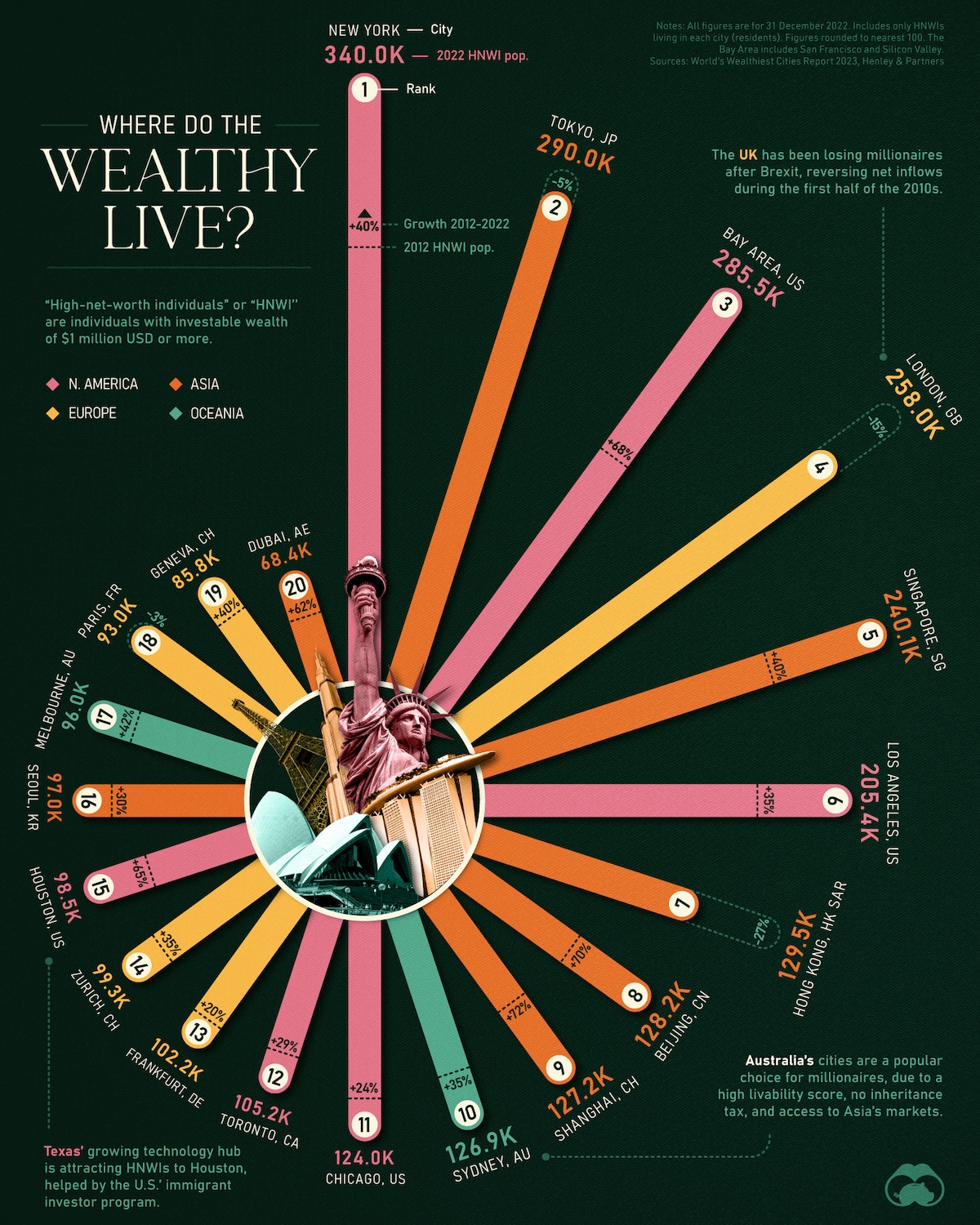
Clean energy entrepreneurship in Houston, densification, welcoming refugees, Dallas TOD failure, ADUs, population gains, rankings, and more
Continuing to clear out some backlogged smaller items. A lot of these I tweeted while I was out of town for much of the summer, but just now getting a chance to bring them to the blog:
“Every day I meet another oil and gas guy who is now a climate entrepreneur. I think there is going to be an explosion of clean energy activity out of the O&G sector, and we’ll be stunned in the next 5-7 years by how many of these problems they handle.”
"Austin isn’t the densest metropolitan area in Texas. That honor belongs to the nine-county Houston region, which increased from 1,560 residents per square mile in 2010 to 1,858 in 2020, an increase of about 19%."
"H-Town exudes Southern hospitality: The pace of life is more relaxed than many major cities, and they're welcoming, polite, and eager to share the delights of their city with visitors...make Houstonians less cliquey and more hospitable towards newcomers."
This makes me proud. Houston's doors are always open to those seeking a fresh start and new opportunity: "Volunteers from Houston Welcomes Refugees showed up with boxes of items to furnish the family’s new home." NYT: From Kabul Airport to a Houston Walmart
"In short, TOD is simply a scam. Like Portland’s light-rail mafia, which guided subsidies to favored developers who would build TODs, Dallas light rail and TODs are merely a way of transferring money from taxpayers to developers."
"There are more than 3,600 ADUs in Houston (according to HCAD data) of which the median size is 530 square feet (max allowed=900sqft). ADUs offer more housing options while maintaining the existing community character."
NYT: Smarter Traffic Lights, Calmer Commuters. Holy crap Houston needs this! I think Uptown and TMC would be really good test cases. The AI could learn optimal traffic light timings based on time-of-day as well as make dynamic adjustments for unexpected surges.
Cities Spending the Most on Eating Out in 2020. We found that Houston, Texas ranks #11 for spending their annual income at restaurants. Houston residents spend an average of $357 each month on eating out and 5.7% of their annual income at restaurants. Houstonians spend about the same amount eating out vs. in. We eat out a lot, but at low prices. We eat out a lot more than Dallas residents, which surprised me a bit until you think about how hyper-competitive Houston's restaurant scene is from the lack of zoning. That hyper-competition applies to grocery stores as well, which shows up in how much less we're able to spend on food than most of the cities in their graph. Houstonians spend $300 less per year on groceries than the average American, but $1,000/year more on eating out due to the high incomes and great affordable restaurants here.
City Journal: End of the Road for Parking Requirements - They serve as a tax on housing. Houston has been expanding its "market-driven parking" zone beyond downtown to Midtown and EaDo, and hopefully to additional areas in the future. Let developers decide how much parking they need, not arbitrary formulas. Hat tip to Jay.
This makes me nauseous. Planners actually like tight zoning regulations like high minimum parking requirements so they can extort more out of the developer to relax them!
Honestly, I think the second one is the more realistic option right now, and could be very popular. The simple pitch for the second one is the world’s largest climate-controlled park. People love going to parks, but not during Houston’s extreme weather, especially summers and thunderstorms. Having an activated park full of activities and festivals on weekends that is always protected from heat and rain would be a very popular spot for Houstonians, especially families desperate to find affordable activities every weekend. And it could easily start very modestly and then expand over time with philanthropy (like has been happening with the zoo, MFAH, and HMNS) as well as parking charges to cover operations.
Live and Lets Fly blog on 7 must-try restaurants in Houston. As a local, I’ll say this list is pretty solid, but really barely scratches the surface of the incredible depth of Houston's restaurant scene, honed from being where cultures mix – originally South + West + Mexico, but later from everywhere including Asian – plus the lack of zoning allowing absolute hypercompetition: good won’t cut it here, a restaurant better be great if it wants to survive. That Darwinian evolution has honed the scene over decades to where it’s finally getting the acknowledgment it deserves, like from GQ.
"But there’s another factor I hadn’t considered, one that so far appears to be the single largest driver of pandemic-era migration: family."
Bloomberg: Silicon Valley Won't Last Forever, and Texas Knows It - The birthplace of Dell and TI has been quietly building its tech industry since the 1930s. Now it has the chance to move into the spotlight (hat tip to George for archive link). Includes a nice excerpt on my alma mater:
"Part of the reason for this trajectory had to do with another institution that continues to play a key role in driving technological innovation in the state: Houston’s Rice University, which played a role comparable to Stanford's vis-à-vis Silicon Valley. In fact, many of the early players in Silicon Valley actually moved to California after graduating from Rice, constituting what is sometimes called the “Rice Mafia.”
How appropriate, then, that Rice would play a key role in the next step in the rise of Texas. In 1961, the university donated more than a thousand acres of land for the construction of what became known as the Johnson Space Center, flooding a once-provincial city with literal rocket scientists. Like Silicon Valley, where government contracts and connections proved essential in getting the region off the ground, Houston’s leadership in the space race kick-started a host of related industries."
"If California is a vision of the sort of future the Biden administration wants for Americans, expect Americans to demur."
The Atlantic: Superstar Cities Are in Trouble - The past year has offered a glimpse of the nowhere-everywhere future of work, and it isn’t optimistic for big cities. It includes four predictions and a conclusion I would never have expected to see in a magazine like The Atlantic!
The rise of the supercommuter
The decline of the coastal superstar cities
The rise of the rest
The next Silicon Valley is nowhere
"As an urban resident of Washington, D.C., writing from my dining-room table, my claim is not that I believe the internet could or should replace the riotous physical-world collision of urban work, culture, art, and life. My humbler assertion is that 2020 has punctured my confidence that the internet cannot encroach on the benefits of urban density and proximity. Going forward, many fledgling companies may agree, as they find that the city in the cloud essentially acts as a more accessible version of the city on the Earth, eerily reproducing its forces of agglomeration, specialization, and convenience. The past 12 months have offered a glimpse of the nowhere-everywhere future of work."
"Houston Public Works has pulled proposals to permanently close the Brazos Street bridge and implement new pedestrian features around a corridor threaded between the Montrose area and Midtown.
“Please be advised that the Houston Public Works Department along with Mayor Turner has made the decision to resume the project with the original design,” reads a Public Works notice sent to stakeholders on April 2."
"Of the 10 counties with the largest population growth in the country between 2010 and 2019, six of them are in Texas. Harris/Houston had the 2nd largest population increase adding more than 620,000 people just behind Maricopa/Phoenix."
"Large metro areas had the steepest decline over the course of the decade, Mr. Frey found in an analysis, with the growth rate down by nearly half. Rural areas, in contrast, grew slightly by the end of the decade, though that followed several years of declines.
Places that had once been popular destinations for young people — New York, Los Angeles and Chicago — ended the decade with some of the biggest declines. New York began losing population in 2017, and last year it registered a loss of more than 60,000 people, the biggest population decline of any American city, Mr. Frey found.
The housing market collapse of 2008 and the rising prices in suburbs prompted millennials to move to big coastal cities. But that pattern reversed by mid-decade, Mr. Frey said, as millennials fled rising rents and home prices.
Places with the biggest gains for the decade were Dallas, Houston, Phoenix, Atlanta and Washington, D.C. Medium-size metro areas, like Las Vegas, have also moved up the ranks of gainers, as have Charlotte, N.C.; Seattle; and Austin, Texas.
"The experience of Los Angeles County — with its dense urbanization and ideal weather — should be a warning to those, in California and elsewhere, who assume that high density, “transit oriented development” and substituting transit for driving alone naturally go together. In fact, they do not."
Solving the anti-vaxer problem, Houston's dynamic culture, TX #1 food state but needs VC, city govt vision vs. competence, and CA ineptness
Before this week's items, my idea of the week: I'm probably treading on dangerous ground here with the growing coronavirus pandemic, but I've been thinking about the child vaccination problem (anti-vaxers) and new laws in some states requiring the vaccines to enroll kids in public schools, which is really causing a lot of turmoil with many families. Now I'm a science guy all in favor of vaccinations (annual flu shot every Sept-Oct), but I also believe in more freedom and less government coercion (there are also some valid arguments on specific required vaccines and their timing). My solution is this: ~95% of a population needs a vaccine to protect the whole population. Instead of requiring 100% of students to be vaccinated, auction off up to 5% exemptions at whatever price that clears the market. The parents that really care the most about not vaccinating (vs. the more unsure/on-the-fence/going-with-the-herd ones) will pay that price for an exemption slot. They may not be happy about it, but it's a better option than not enrolling their kids in school.
Moving on to just a few small items this week:
Great piece from Alain Bertaud in the MIT Press Reader: Do We Really Want Our Mayors to Have a Vision?Mayors and their municipal staff should not be considered visionaries, but a coordinated team of managers and janitors. Key excerpts:
"An unfortunate trend has developed over the past quarter-century: Many municipalities have begun describing their development plans as a “vision,” a word once reserved for spiritual gurus and artists. Calling a simple municipal action and investment program — such as collecting tolls on bridges — a “vision” is symptomatic of the grandiose misunderstanding that municipalities have concerning their role. A city, after all, is entirely created by its citizens’ initiatives. These citizens are required to act within a set of “good neighbor” rules, and to be supported in their endeavors by a network of physical and social infrastructure managed by a mayor and a city council. Mayors and their municipal staff, including urban planners and economists, should be considered not visionaries or rulers, then, but a well-coordinated team (one hopes) of competent managers and janitors.
...
Visionary leadership implies a top-down approach, in other words, but a city is mostly created from the bottom up. A visionary mayor may feel compelled to impose her unique insights on the life of her Philistine citizens.
...
To be sure, a top-down approach is required to design infrastructure and services, but only as they are needed to support citizens’ activities. The support role involved in this top-down design is not trivial and requires good data and outstanding technical and financial skills, but a personal vision is not a requirement. It might rather be a hindrance.
... They did not need vision, but something much less romantic: extreme competence."
Great new report from Aaron Renn at AEI on Culture and Dynamism in Cities. I've always felt Houston has done pretty well on most of these, although education is certainly an ongoing weak spot.
"It’s a look at the role of the culture of cities in economic dynamism and resiliency. I examine a few case studies, and from these try to draw out some cultural traits that seem to be relevant to success, notably an open social structure, invested leadership and institution building by civic elites, and a high value placed on education."
Interested to hear your thoughts in the comments on how Houston does on those indicators?...
"...compel employers who provide free parking to offer transit benefits (like a pre-tax bus pass) or a cash payment to workers who find another way to the office. The goal here isn’t to stamp out cars, but to let the non-drivers “cash out” the value of "free" parking. Research suggests this sort of “parking cash-out” works. A series of LA-based case studies by UCLA urban planner Donald Shoup found these programs can decrease the number of drivers who motor alone to work by 17 percent, and increase rates of carpooling, transit riding, biking, and walking."
WSJ: Where High-End Renovations Cost $704,000: "Rising home prices fuel high-end renovations in Houston; homeowners are confident they’ll recoup costs when they sell." Key excerpts:
"Everything’s big in Texas—including home renovations. Houston homeowners, with a median budget of $704,000, outspent remodelers in 74 other U.S. metro markets, according to an analysis of building permits for high-end projects. ... “People are feeling really good about the city, and the amount of money they can put into their houses,” said Stephen McNiel of Creative Property Restoration, a builder in Houston."
Definitely a sign of the high standard of living here (average salaries adjusted for the cost of living) that people can afford to spend so much on home renovations.
"With full recognition that our credibility is suspect, I nonetheless come today to proclaim Houston one of the great eating capitals of America. I mean (and here I mount the mechanical bull) far better than anywhere else in Texas, better than anywhere else in the Southwest, better for that matter than in my current place of residence, Washington, D.C. That the nation’s fourth-largest city is no longer one gigantic steak platter for oil barons should not constitute breaking news. One can go on about the city’s indigenous assets, such as its array of Gulf Coast ingredients and its surprising multiculturalism.
But the main reason for Houston’s culinary ascent is economic. This became clear to me one afternoon last fall while eating at Étoile, a vibrant French restaurant that opened in 2012 near the city’s famed Galleria mall, and whose chef and owner, Philippe Verpiand, hails from Provence. After running a restaurant in San Diego with his wife, Monica, for seven years, Mr. Verpiand decided in 2011 to check out Houston. What he discovered, he told me, was that the Bayou City “is very affordable and full of people who like to go out at night and spend money.” It costs probably one-third less to build and design a restaurant here than in California, he said, adding, “I can afford to pay sous-chefs full time and be able to spend the weekends fishing and duck hunting with my boys.”
Such cost savings are passed on to Houston’s consumers, who can enjoy a first-rate meal here for maybe two-thirds of what such a dinner would come to in New York or San Francisco."
Finally, continuing our series of COU videos on Texas cities, this week's focus city is San Antonio, a city I visited last weekend and really enjoyed despite the 100+ degree heat. The Pearl District is the most impressive industrial re-adaption I've ever seen - Houston needs something similar!
"According to Charity Navigator, Houston sits near the top among major U.S. metros in total philanthropic assets, percentage of income given to charity, and financial health of its largest charities. In 2015, the organization ranked Houston number one, just ahead of San Diego, in overall philanthropic culture."
"Chicago ... you have a Houston problem. Chicago is no longer the only global game not on the Atlantic or Pacific seaboard. The Texas Triangle beckons Iowa college grads. "
"With full recognition that our credibility is suspect, I nonetheless come today to proclaim Houston one of the great eating capitals of America. I mean (and here I mount the mechanical bull) far better than anywhere else in Texas, better than anywhere else in the Southwest, better for that matter than in my current place of residence, Washington, D.C. That the nation’s fourth largest city is no longer one gigantic steak platter for oil barons should not constitute breaking news. One can go on about the city’s indigenous assets, such as its array of Gulf Coast ingredients and its surprising multiculturalism.
But the main reason for Houston’s culinary ascent is economic. ...the Bayou City “is very affordable and full of people who like to go out at night and spend money.” It costs probably one-third less to build and design a restaurant here than in California, he said, adding, “I can afford to pay sous chefs full time and be able to spend the weekends fishing and duck hunting with my boys.”
Such cost savings are passed on to Houston’s consumers, who can enjoy a first-rate meal here for maybe two-thirds of what such a dinner would come to in New York or San Francisco."
Our food beats NYC, increasing METRO's P&R ridership, canal expansion impact, solving civic problems, Katrina refugees did better in Houston, and more
Happy New Year everyone! New year, new mayor, new 4-year term - it'll be interesting to see how the city addresses its challenges and goes forward from here. Time for some fiscal new year's resolutions? Lots of small items stacked up over the holidays:
"Houstonians know our city offers great food, and now the rest of the country is learning that, too. In an article published Monday, Washington Post critic Tom Sietsema ranked the Bayou City as the fifth best food city in America.
That puts Houston ahead of traditional powers like New York (eighth) and Chicago (seventh) and just behind New Orleans (fourth). Portland tops Sietsema's list.
...
And there were plenty of surprises on the journey. I can’t wait to eat in Houston again, but New York let me down, at least for the present.
...
Houston, where have you been all my (food) life? Your best Vietnamese cooking returns me to Saigon, and some of your Chinese menus rival those I’ve dipped into in Beijing. As for Mexican, the seafood-themed Caracol and Cuchara, staffed by female chefs from different regions of Mexico, set the pace. Meanwhile, locals of all persuasions gather around the city’s signature: not fajitas, but Asian-Cajun seafood boils. Few food scenes enjoy the easy, Texas-size camaraderie found in the country’s fourth-largest city; the chef of the popular Underbelly goes so far as to promote the competition by sharing a list of his favorite eats with his customers. As one discerning palate put it, “If L.A. and New Orleans had a baby, it might be Houston.”
"Houston-area builders permitted more new houses and apartments between 2011 and 2014 than their counterparts in every other large U.S. metro, equal to almost 10 percent of this area's housing supply in 2010" Center for Opportunity Urbanism ranking in Forbes. Chronicle article here. That is a pretty staggering amount of new housing stock!
"Higher tax-free benefit for mass-transit commuters: One of the expiring tax breaks the huge new federal spending bill has made permanent is a gift to those who pay for mass-transit commuting costs. The bill raises the monthly amount allowed to be paid with pretax income to $255 starting in 2016. The current limit is $130, so this will be a big benefit. The same amount will also apply to the pretax monthly amount car commuters can use for parking costs (which was $250 per month)."
Air New Zealand arrives in Houston! “With the beginning of Air New Zealand’s service from George Bush Intercontinental to Auckland, Houston becomes the only city in North America with nonstop air service available to all six inhabited continents,” said Houston Aviation Director Mario Diaz."
"The women weren’t going to Fayetteville but, rather, to places like Houston. “For low-income people in the South, Houston is a pretty darn great place,” Hendren said. “It’s not a beacon of phenomenal upward mobility like Salt Lake City. But it’s kind of the Salt Lake City of the South.” The odds of going from the bottom to the top in Houston are 9.3 per cent, which puts it fifteenth out of the top fifty U.S. metro areas.
...
Those who preferred Houston saw things very differently:
Better schools in Houston: 35%.
Found a better job in Houston: 35%.
Overall quality of life in Houston: 33%.
Lower crime in Houston: 31%.
Better housing in Houston: 27%.
Better access to health care in Houston: 21%."
Finally, our comment-of-the-month for December with good, practical suggestions for Houston on improving HOV/HOT/MaX lanes. Hat tip and thanks to John Augusto.
Lots more where those came from, but that's enough for this week. More next week. Good luck to everyone with their new year's resolutions!
Avoiding CA's mistakes, Astrodome talk, great rankings, cool H-town video, and more
Let's kick off this week's post with an event announcement: if you have even the slightest interest in the Astrodome, don't miss Jim Gast's talk this Thursday. I saw him speak at Rice, and he has a really compelling mix of great slides and stories of the Astrodome's history - so good I suggested he get it turned into a documentary. As an added bonus, he'll sign a copy of his Astrodome book ("The Astrodome: Building an American Spectacle - A book about the people, technology, and times that built the biggest room in the world") for you. Not to be missed. Details here.
In other news, our new Center for Opportunity Urbanism think tank had an incredible inaugural luncheon event last week, with over 200 in attendance (!) and yours truly got some nice pics and quotes on the front page of the Chronicle. California land use attorney David Friedman gave a scary talk about how environmental good intentions went awry in California starting in the 1970s and, combined with judicial activism, led to complete development and infrastructure stagnation as well as a gutting of the middle class there (housing and jobs). You can see his slides here. A cautionary tale for Houston and Texas.
"Paradoxically, perhaps the city’s biggest strength is its sprawl. Unlike most other big cities in America, Houston has no zoning code, so it is quick to respond to demand for housing and office space. Last year authorities in the Houston metropolitan area, with a population of 6.2m, issued permits to build 64,000 homes. The entire state of California, with a population of 39m, issued just 83,000... Joel Kotkin of Chapman University in California argues that thanks to cars, even over its vast size, Houston creates the same possibilities for people to meet and share ideas that generate wealth in denser cities such as New York. Sprawl may not be pretty—but it seems to work."
"Since 2009 the area has welcomed some 1,500 corporate relocations or expansions—and that’s just counting those that created 50 or more jobs, leased 20,000 or more square feet of office space, or invested $1 million or more in capital improvements.
...
In the past four years, greater Houston grew by half a million people—half from moves, half from births. Population growth means housing demand, and realtors sold more than 425,000 homes in the last five years, amounting to a home-closing rate of one every six minutes, according to the Greater Houston Partnership. What’s more, jobs boost construction, which is why last year Houston topped our list of Building Boom Towns: metro areas with the most new construction.
What’s behind the boom, besides the obvious oil explosion? Exports. Between 2009 and 2013, the value of Houston’s exports grew 74.5%. More than 3,000 companies in greater Houston do business internationally, by Jankowski’s count, from oilfield services giant Schlumberger to Universe Technical Translation. The metro area is now the nation’s top exporter, ahead of New York, Los Angeles, Seattle and Detroit. "
Finally I'd like to end with this really well done short promotional video of Houston by the GHP. It'll make you proud to be a Houstonian (you can make it a more impressive full screen size with a click on the lower right corner brackets).
TX doomed to repeat CA mistakes? plus tops for affluence and food, first class buses, densification, and more
First this week, an event announcement: on Thursday March 12th, our new Center for Opportunity Urbanism will have it's inaugural event - "TEXAS…DOOMED TO REPEAT CALIFORNIA’S MISTAKES?", a luncheon event featuring speaker David Friedman, a California land use attorney, with yours truly serving on a panel after the keynote. Here's the description:
California’s tough environmental rules and planning represent the wave of the future to many planners and pundits, as well as to large parts of the federal government. The goal is to rein in “sprawl,” based largely on questionable environmental and urban design considerations California consciously seeks to impose a high-density, transit-focused future on the residents of the state.
But California’s policies do not just affect Californians. Many federal agencies, including the EPA and US Fish and Wildlife Service, have embraced the Golden State’s regulations on climate change, wetland and endangered species protection, as role models to be adopted nationally. As California-style regulations diffuse through the federal government, Texas business could soon be subject to many of the same programs and policies.
In this unique program, the Center for Opportunity Urbanism has invited David Friedman, a leading California land use attorney, to discuss the evolution of California land use and environmental regulation. California’s current regulatory programs were largely invented in the 1970s, when the state’s impressive job creation and economic opportunities made it the Texas of that era. By 1990, however, the California economy increasingly came to resemble the slower growing northeastern and upper Midwestern states, albeit with still-significant population growth.
Dr. Friedman, who holds a PhD in political economy from MIT, will explain the social and economic impacts these regulations have had on the people of the state. He will also discuss how EPA and other federal agencies, as well as changing demographics and political pressure, could bring similar policies to Texas and the greater Houston area.
Dr. Friedman’s talk will be followed by an insightful panel discussion, moderated by the Center’s executive director Joel Kotkin, that includes Architect Tim Cisneros, Houston Developer Walter Mischer, Senior Fellow and urban demographer Wendell Cox and Senior Fellow and Houston Strategies blogger Tory Gattis.
According to graph 6 in this Richard Florida article on sprawl, free market Houston has actually densified since 2000 while tightly regulated places like NYC and SF *increased* their sprawl! We were also the only metro in Texas to densify.
"HOUSTON — If you set out to visit the nation's most diverse city — one with world-class dining, a flourishing arts scene, top-tier academic institutions and an influx of job-hungry college graduates — you'd be forgiven for setting your sights on New York City.
You'd also be mistaken.
But Houston, the city in question, would forgive you. That's just the kind of place she is.
Over the past decade, the USA's fourth-largest city has quietly become not just a powerhouse of intellect and culture in Texas, but a major player on the world stage. The Bayou City's economic boom and urban renaissance have made Houston not just a magnet for travelers, but a permanent residence for many casual visitors."
Little news item I caught in a recent issue of Surface Transportation Innovations:
"In addition to services to more cities by Megabus, Red Coach, and other express carriers in 2014, at least two new luxury operators began service. Vonlane began first-class nonstop service between Austin and Dallas and Houston. Their buses have only 16 seats, an onboard attendant serving drinks and snacks, and a private six-seat boardroom. Vonlane partners with hotels in each of its cities. "
I've never seen them or tried them - if you have, I'd love to hear about it in the comments. Their web site has nice pics, but only seems to be showing Dallas-Austin right now.
Surprisingly simple congestion solution, Houston dominates web hosting (?!), H-town accolades, low taxes, and more
It's been a while since the last post with smaller misc items, and they've been stacking up so much I'll need to spread them over at least two posts and possibly more. Here we go with the first round:
Event announcement: Jeb Brugmann will be speaking on "Can India’s Cities Be Made to Work?" this Wednesday night at Asia Society Texas. Details here.
Great Chronicle op-ed today by a Rice student on how they came to love Houston over their four years here.
Excerpt: "Where I had once seen a homogenized concrete blanket, I now see a diverse quilt with intricate and innumerable connections. Each section of Houston, from Chinatown to Midtown, not only forms a distinct and unique town unto itself but adds to the color and character of the rest of the city. Taken together, they form the most dynamic city in America. My hometown of Albuquerque might cherish its past and tradition, but Houston constantly evolves toward the future. To outsiders, this makes Houston look like an unplanned mess, but those who live here know to embrace the lack of predestined plan. It is why the city eschews zoning laws with pride."
In the surprising stats category, Houston is the #1 web hosting city, with 1 out of every 20 sites (out of the million most popular) hosted here. Hat tip to Nathan.
Finally, let me end with this great TED talk on reducing traffic congestion based on the congestion charge experiment in Stockholm (hat tip to Jay). A token 1-2 euro congestion fee in the core reduced cars by 20% and nearly eliminated congestion. Because traffic congestion is nonlinear, just a small reduction in cars can lead to a large reduction in congestion. It incentivized a lot of people with schedule flexibility to shift their trips outside of rush hour. Also, even though it was very unpopular at first, it quickly became overwhelmingly popular with 70+% support. I suspect it's politically impossible, but I think something similar for freeways coming inside the loop or getting on the loop at rush hour could have a similar impact here. Something to ponder...
U-line bus, Houston advantages, survey on our future, #1 for parks, TX vs. CA humor, and more
After the Metro referendum last week tabled any more light rail in the near-term, we're stuck with my prediction-come-true: we (more than) used up our resources on the less valuable lines and left the most important one, Universities, unbuilt. Sigh. What Metro now needs to seriously consider is matching Uptown and implementing the Universities line in the near term as some sort of signature bus or BRT: special buses, same stops as the U-line was planned to have. Let the ridership build, and if it ever gets saturated, then we'll know it's time to consider an LRT upgrade (I'm skeptical, but it's possible). Update: front page Chronicle story on Metro's new emphasis on improving bus service.
Moving on to the big backlog of smaller items...
Lesson from Hurricane Sandy: underground power lines/infrastructure is not a panacea when flooding is a risk. It was a big topic around here after Ike until the incredible costs were considered. Now we know they're not only costly, the benefits are dubious.
Interesting Freakonomics story sent to me by Chris on mass transit and the environment (i.e. energy use and CO2 generation). Bottom line: transit doesn't help if it has low ridership (and can actually be worse than cars), so we're better off encouraging ridership of existing transit and carpools than creating new transit (which is likely to be even less efficient with lower ridership).
An announcement: "We like to shout about it and other cities around the nation are starting to take notice: Houston is a playground for the talented and Culture Pilot is sponsoring a month-long celebration highlighting our innovative city. The month-long celebration, entitled COHouston, focuses on a different theme each week including: maker/craft, film and multimedia, design and innovation, food and well-being, and, last but not least, arts and music. Intellectual wonderment and creativity are encouraged through various events held in tandem throughout the city. This month’s focus isn't just about celebration but it also aims to raise questions about local and regional challenges and foster sustainable relationships within the community." More here.
Check out this "Keep Houston Houston" blog post on Houston's density, annexation, anti-NIMBY, and regional advantage vs. stagnant cities like Philly. I wanted to do excerpts, but the whole thing is great, including the comments. Read it. Really gets at some of our key strengths.
Love this front page Chronicle story about how best-selling author Justin Cronin had his perspective inspired by moving from the northeast to Houston and eventually getting his "Houston goggles".
NYT op-ed asking what's going to happen to Austin's "weird" brand in the wake of Lance Armstrong's fall and the ongoing gentrification/"Dallasification" trend.
H-GAC is conducting an online survey of preferences for the future of our region in 2040. I highly recommend readers of this blog take the survey, since you might have a better grasp of the complexities and tradeoffs behind these scenarios than the average citizen. Hurry, the survey ends November 16th.
Apparently ParksByYou, the Prop B item that passed on the November 6th ballot, will make Houston the city with the most parks and green space in all of America. Pretty cool.
To illustrate the real differences between Texas and other states, Fisher finished his talk with a story. (Having gone to school at U.C. Berkeley, worked in New York City and lived the last 8 years in Texas, this story really registers for me.)
“The governor of California is jogging with his dog along a nature trail. A coyote jumps out and attacks the governor’s dog, then bites the governor. The governor starts to intervene, but reflects upon the movie Bambi and then realizes he should stop because the coyote is only doing what is natural.
“He calls animal control. Animal control captures the coyote and bills the state $200 for testing it for diseases and $500 for relocating it. He calls a veterinarian. The vet collects the dead dog and bills the state $200 for testing it for diseases. The governor goes to the hospital and spends $3,500 getting checked for diseases from the coyote and getting his bite wound bandaged.
“The running trail gets shut down for six months while the California Fish and Game Department conducts a $100,000 survey to make sure the area is now free of dangerous animals. The governor spends $50,000 in state funds implementing a ‘coyote awareness program’ for residents of the area. The Legislature spends $2 million to study how to better treat rabies and how to permanently eradicate the disease throughout the world.
“The governor’s security agent is fired for not stopping the attack. The state spends $150,000 to hire and train a new agent with additional special training, re: the nature of coyotes. People for the Ethical Treatment of Animals (PETA) protests the coyote’s relocation and files a $5 million suit against the state.
“The governor of Texas is jogging with his dog along a nature trail. A coyote jumps out and tries to attack him and his dog. The governor shoots the coyote with his state-issued pistol and keeps jogging.
“The governor spent 50 cents on a .380-caliber, hollow-point cartridge. Buzzards ate the dead coyote.
“And that, my friends, is why California is broke and Texas is not.”
Ashby, top rankings, smarter city, vs. Chicago way, importing talent, and more
Just back from a family visit to SoCal, and the smaller items have been stacking up fast...
NYT op-ed on how young people are less and less willing to move. I think the rise of the Internet is a big factor - it can satisfy those bouts of boredom or restlessness that push people to move, either virtually or by helping you discover new options in your own region - plus I think we might also be learning the true value of social networks and how they relate to our happiness. In any case, it means Houston will need to work harder on growing our own highly educated talent, because importing it is just getting harder and harder. UPDATE: NYT story on the depressing long-term homesickness often found in people who move for economic reasons.
"...the report documents a pattern of crime that has become synonymous with the Chicago or Illinois “way” of doing things. All the corrupt governors and 26 of the aldermen had tried to extract bribes from builders, developers, business owners and those seeking to do business with the city or the state. Those who paid bribes either assumed, or were told, that payment was necessary for zoning changes, building permits or any other government action."
Houston most diverse city in the country. I wish the Chronicle had put comparative U.S. metros and local cities data graphs from the print edition online. They were pretty interesting.
I was lucky enough to get to attend the premiere of Dr. Stephen Klineberg's new "Interesting Times" documentary (from Rice's Kinder Institute for Urban Research) on the past and future of Houston at the MFA. It is very well done - compelling and engaging - but unfortunately they are holding back from putting it online, at least for now (just an excerpt here). I'll let you know if that changes. In the meantime, you can read CultureMap's excellent coverage here or the Chronicle's here.
Pretty interesting NYT story on the topic of "how many people can Manhattan hold?" It's nowhere near full compared to some of the denser cities of the world.
The mayor has announced a settlement of the lawsuit, and the Ashby high-rise is moving forward. South Hampton residents should take solace in the fact that there are several high-rise towers around River Oaks, yet property values and quality of life are holding up quite fine there. And if the true concern was traffic, they should be thankful they didn't stick something much worse there, or even just a Whole Foods...
Kotkin on CA vs TX and Hou, BRT, HSR, dining, bikes, and more
Before I get to a collection of smaller misc items for your holiday reading pleasure, a blatant self-promotion unrelated to the normal content of this blog: yours truly was notified last night that I had won the first ever M-prize for management innovation by the Management Innovation eXchange community lead by the Wall Street Journal's #1 ranked management guru, Gary Hamel. I won in the category of "Reinventing Leadership" with my proposed 'hack' "The Bossless Organization: from Bosses to Mentor Investors", which competed against hundreds of other submissions over the course of this year. The winners will get recognition in a variety of venues--from the McKinsey Quarterly to the Wall Street Journal to the 2011 World Innovation Forum (WIF). If the concept is something of interest to you, drop me a line, especially if you might consider trying it inside your own organization. And you can find out more at my work blog here. End of grandstanding. Thanks for your indulgence.
"The author’s advice to Houston - “Keep being who you are, and don’t try to be Boston, Chicago, or any other city.” This, Kotkin says, has brought us where we are, and will earn us the well-deserved recognition as an undisputed City of Opportunity."
"Houstonians should keep a close eye on Austin’s BRT. The nationwide push for conservative government spending may reduce or end Houston’s light rail expansion. If that should come to pass, a stellar BRT will be one of the few remaining ways to prevent gridlock as Houston’s population grows over the next three decades."
He also found this interesting concept called "Cellular Mass Transit for Austin". Maybe those of you with more transit expertise than I can evaluate this and let me know in the comments if it's something Houston should consider.
Peter Wang sent me a pretty interesting (and Houston-centric) slide pack called "A Tea Partiers Guide to Bicycle Advocacy" (with preface here - and not necessarily just for Tea Partiers), which he then permitted me to pass along to all of you. Definitely worth a look.
"Americans want many kinds of cities. They want Midtown Manhattan (a nice place to visit). They want Houston (whose seeming chaos actually provides some of the most affordable decent housing for middle-class Americans). They want quaint towns and edge cities. When it comes to city life in America, there is no one size that fits all."
Finally, a dump of recent interesting items from the Houston Digital Ambassadorship email newsletter:
Houston featured nationally, gondola transit, rankings, and more
Before I get to some smaller misc items, I wanted to mention Joel Kotkin's new book, "The Next Hundred Million: America in 2050". Houston features prominently in it, and he actually launched the book at an event here. NPR has a review here (scroll down), with an audio interview here (also scroll down; hat tip to Peter). Have a read and let me know what you think.
Continuing the entrepreneurship theme from last month, here's a great article on how Brigham Young aggressively uses tech transfer to create startups, something Rice, UH, TAMU, BCM, and other local universities could learn a lot from.
Interesting thread over at HAIF on items that might make Houston 'better'. I don't necessarily agree with all of the suggestions, but it's still interesting reading.
In case you missed it, I was recently interviewed by local NPR affiliate KUHF for a story titled "Despite Slowdown, Downtown Houston Still Building." My clip is at the 2:09 mark in the audio. Of course, we recorded several minutes of interview to get this one ~20 second clip in. But it's still kinda cool.
Most of you probably caught my Opportunity Urbanism op-ed on the front of the Houston Chronicle Sunday Outlook section today, but even though it's too long for a typical blog entry, I'd like to put a copy here for comments and permanent archival (Chronicle links aren't usually permanent). In many ways, it sums up a lot of my thinking in this blog over the last two years. More on Opportunity Urbanism can be found here.
BLOOMTOWN HOUSTON Ours is an opportunity city with a style uniquely its own. Let's quit wishing we were something else and let Houston be Houston.
By TORY GATTIS
Houston is at a turning point. With a boost from noted urbanist Joel Kotkin, our city has begun recasting its national reputation from "that ugly, sprawling, weird city without zoning" to the exemplar city for "Opportunity Urbanism," a compelling new paradigm for cities in the 21st century. This paradigm asserts that the fundamental (but recently forgotten) core mission of cities is to accelerate the upward social and economic mobility of its inhabitants.
This may sound obvious to the average person, but in the wonkish world of urban policy and planning, the themes of the past decade have been environmentalism (smart growth), pedestrian aesthetics (new urbanism), and meeting the desires of the educated elites (the "creative class"). Each of these movements raised important points— the need for urban core renewal and infill, a lack of quality pedestrian spaces and neighborhoods, and talent as the new basis of global competition, respectively. But they also went a step too far — denying suburban homeownership to those who desire it, demonizing the car and excessively focusing on attracting a narrow class of outside talent by being "hip and cool" instead of developing skills broadly in the existing population. Improving life for the typical resident got lost in the clamor.
What do we mean by "improving life" and "upward social and economic mobility?" Kotkin's research team, of which I was a part, identified four enablers: additional education for self or children; affordable homeownership; entrepreneurship; and getting a superior job, better matched to the jobholder's skills with improved productivity and pay. Urban policies and planning can have a direct effect on each of these drivers.
How can a city make more of these positive changes happen for more people? Our prescription — and Houston's great strength — revolves around the theme of maximizing residents' "opportunity zone."
What constitutes a rich environment for these four enablers to do their positive work? The more education, job, start-up, or affordable home options they have within their personal travel-time/cost tolerance, the more likely most people are to take advantage of them. That's their opportunity zone, and Houston has managed to maximize it in four key ways.
The first and most obvious way to expand the opportunity zone is transportation mobility, whether by car or transit. What parts of the city can people access in 10, 20, 30 or more minutes? That represents their education, job and homeownership opportunities, as well as their potential customer and employee base if they decide to start a business. The longer the travel time, the less likely they are to take advantage of any given option. Most critically, mobility determines access to affordable housing within a reasonable commute. Houston has invested aggressively in congestion reduction and transportation infrastructure, especially freeways.
In many cities, mobility investments have lost popularity in recent years, usually due to the lament that any new capacity "will just fill up eventually anyway." The benefits of increased capacity — like more access to more jobs and affordable housing for more people — are not obviously apparent, and therefore are often ignored, while the direct costs in money, neighborhood impacts and construction hassles are all too visible.
Local leaders need to do a much better job articulating the real value of these investments to residents and voters.
Another common belief is that freezing mobility infrastructure (or refocusing most resources on transit) will help curb suburban sprawl and return people to the core.
The reality is that employers will follow their employees to areas with good schools and affordable, high-quality housing if employees cannot reasonably commute to them from such places. The end result is a sprawling, vibrant suburban fringe with a stagnant core as jobs flee outward. And the biggest irony is that sprawl actually increases under such policies. Once employers have moved to the suburbs, employees then feel comfortable moving another half-hour beyond that into the exurban periphery. As long as employers stay in the core, sprawl has practical limits if employees want to maintain a reasonable commute.
The second key factor is maximizing the number of people and jobs inside the opportunity zone. People have been migrating to cities for hundreds of years for the simple reason that more people equals more opportunity. More people can support more education and employment options. Businesses have access to more potential customers and employees.
The implications for policy? Well, for one, growth is good, despite becoming more and more unfashionable in many cities. It creates more options and opportunities for more people — existing residents as well as newcomers. Studies have shown that larger cities generate more wealth and innovation per person. Another implication is that reasonable infill and density are also good. Growth, infill and density increase the number of people and jobs in a given opportunity zone.
More people and jobs in a given opportunity zone also mean more discretionary income in that zone, the economic fuel of opportunity, and the third driver of opportunity zone vitality. Discretionary income is defined by economists as income left over after the basic costs of living like housing, groceries, transportation, utilities, health care and taxes. This money can be spent directly on post-secondary education or training, endow the seed money to start a business, support a charity or provide the consumer purchasing power to support local businesses and start-ups that in turn provide jobs.
Maximizing the discretionary income in an opportunity zone involves maximizing incomes with high-paying jobs (traditional economic development, championed by the Greater Houston Partnership here), and minimizing the cost of living, which, in addition to low taxes, involves having the most competitive markets possible in goods and services providers as well as housing (with minimal supply constraints).
Discretionary income supports urban vibrancy and amenities such as restaurants, bars/nightclubs, museums, sports, arts, entertainment, shopping and other leisure activities — which in turn helps the city attract new high-paying jobs. The Zagat Survey notes that Houstonians dine out more frequently than residents of any other major U.S. city — 4.2 times per week on average, which is 30 percent above the national average and 24 percent above the average for New York City.
Our last major element for maximizing opportunity zones is minimal zoning, permitting and land-use regulations. These restrictions often increase commercial and residential costs, as well as preventing population density where there is housing demand.
Easy availability of affordable commercial space is critical to entrepreneurship. More commercial space also means more competition, lowering prices and increasing discretionary income. The same effect applies to residential space: The more there is, the more affordable it will be and, therefore, the more discretionary income that will be created.
Finally, minimizing these restrictions increases the vibrancy of the local construction industry, a good source of skilled and unskilled jobs that provide important rungs on a city's ladder of upward social mobility.
So if Houston is doing these things better than other cities, what have been the results?
One measurable result: Houston's population in hard-core poverty areas fell by 107,272 (47.8 percent) during the 1990s, one of the largest urban declines, according to the Brookings Institution. Another good indicator can be found in Stephen Klineberg's Houston Area Survey, which notes that 83 percent of residents said Houston is a "much better" or "slightly better" place to live than other U.S. metros (up from 78 percent in 2005). Eighty-five percent of Houstonians also believe that "if you work hard in this city, you will eventually succeed." That's some pretty impressive happiness and optimism in our city.
These policies also have kept our cost of living extremely low. The most recent Greater Houston Partnership economic report notes that the cost of living in Houston is 12 percent below the nationwide average for 293 urban areas, and 22 percent below the average for 23 metropolitan statistical areas with more than 2 million residents.
Houston owes this advantage largely to relatively inexpensive housing. Houston housing costs, as measured in early 2007, were 25 percent below the nationwide average and 43 percent below the major metro average. Houston also enjoys the lowest grocery prices among the major metros, 16 percent below the nationwide average.
But the most impressive result of our data analysis is that Houston may be able to legitimately claim the highest standard of living among major metropolitan areas in America, and possibly the world, in terms of the lifestyle that can be afforded on the median income.
According to the Census Bureau, the average payroll per employee in Harris County was $46,714 in 2005; 21 percent above the national average of $38,539. Combine that with a cost of living 22 percent below average for the 23 largest metros in America, and our cost-of-living adjusted incomes are among the highest in the country and the world. Other cities, like New York and San Francisco, have higher average incomes, but also a much higher cost of living. There are also many cities with a lower cost of living, but they also have much lower average incomes. Houston has managed to find the "sweet spot" of high productivity and high incomes combined with a competitive, affordable cost of living.
Despite this great success, Houston still faces one large challenge and another subtle risk. First, the great challenge is to provide quality education to large numbers of low-income and minority children — the first critical step on the opportunity ladder. The Houston Independent School District, among others, has made great strides addressing this need with better accountability and innovative partnerships with top charters like YES and KIPP. But more must be done, including addressing near-50 percent high school dropout rates, by providing more programs tailored to non-college-bound teens who need marketable job skills.
The risk we face now is failing to recognize our own uniqueness — what makes us special versus the highly controlling, bureaucratic approach of other cities around the world. We risk diluting our distinctiveness as we try to emulate others, especially when it comes to creeping government control.
The best way of summing up this difference between opportunity cities like Houston and others comes from a dust-jacket description of the book The Future and its Enemies by Virginia Postrel:
"[Postrel] shows how and why unplanned, open-ended trial and error— not conformity to one central vision — is the key to human betterment. Thus, the true enemies of humanity's future are those who insist on prescribing outcomes in advance, circumventing the process of competition and experiment in favor of their own preconceptions and prejudices. Some prefer a pre-industrial past, while others envision a bureaucratically engineered future, but all share a devotion to what she calls 'stasis,' a controlled, uniform society that changes only with permission from some central authority. On the other side is an emerging coalition in support of what Postrel calls 'dynamism': an open-ended society where creativity and enterprise, operating under predictable rules, generate progress in unpredictable ways. Dynamists are united not by a single political agenda but by an appreciation for such complex evolutionary processes as scientific inquiry, market competition, artistic development and technological invention. Entrepreneurs and artists, scientists and legal theorists, cultural analysts and computer programmers, dynamists are, says Postrel, 'the party of life.' "
Houston is the ultimate "dynamist" city, with a pioneering urban model to be proud of and promote to others. We're a city that's always self-renewing, with innovations like voluntary deed restrictions instead of zoning, which push controls down to the neighborhood level instead of a giant centralized bureaucracy.
In a global economy that has uniformly embraced free markets as the best way to fight poverty and provide opportunity, Houston is one of the few cities to bring that mind-set to urban development vs. the predominant centralized-control standard. We need to continue to refine and improve that model, including innovative market-oriented approaches.
Most importantly, we must deeply weave this "Open City of Opportunity" identity into our civic DNA at all levels so the city continues to strengthen what makes us distinctive. That "brand," which has been promoted by Mayor Bill White for many years, best sums up our friendliness, hospitality, entrepreneurial energy, minimal regulations (including no zoning), open-mindedness, diversity, affordability, social mobility, optimism, and charity (especially after Hurricane Katrina).
Let us declare the end of Houston's inferiority complex, and the beginning of an era of deep regional pride as a city that is home to the flag-bearers for Opportunity Urbanism.
Gattis coordinated the Opportunity Urbanism study team and writes the Houston Strategies weblog.
An open dialogue on serious strategies for making Houston a better city, as well as a coalition-builder to make them happen. All comments, email, and support welcome.


 ". Houston features prominently in it, and he actually launched the book at an event here.

