Monday, April 04, 2022

With low ridership, should Metro's huge excess cash pile go to flood control?

Today we have an excellent analytical guest post with some fantastic charts from Oscar Slotboom (highlights mine).
---
Metro's 2021 annual report, for the fiscal year ending September 30, recently became available.
Fiscal year 2021 is the first annual report entirely affected by Covid (see chart 1). As expected, metrics for ridership and cost per trip became much worse. However, more concerning are Metro's long-term trends prior to Covid, as the plots below will show.
In spite of ridership being cut in half due to Covid, Metro's financial position became stronger than ever due to a huge influx of federal grants, a total of $714 million in Covid relief in 2020 and 2021.
Chart 1: Fiscal year 2021 shown on the ridership trends. (Source: Metro ridership reports)
Data source for the charts is Metro's annual reports. Inflation adjustment uses the official CPI calculator.
Chart 2: Boardings and operating expense since 2001
The first impression from this chart is that both trends are going in the wrong direction! Prior to Covid-19, inflation-adjusted operating expense was up 77.5%, from $514.2 million in 2001 to $912.5 million in 2019, while ridership was down 11.7%. Ridership peaked in 2006 at 102.8 million boardings, and by 2012 had declined 21.2% due to the Great Recession. By 2016 ridership had recovered to 90 million boardings, down 12.5% from the peak, where it held steady until Covid-19. 2021 ridership of 45 million was down exactly 50% from 2019.
Chart 3: Cost, subsidy and average fare per boarding since 2001.
Of course, the cost per boarding goes up with rising operating expense and declining and/or flat ridership. Cost per boarding is calculated by (operating expense)/boardings, and subsidy per trip is (operating loss)/boardings. Prior to Covid-19, the cost per boarding in 2021 dollars was up 101%, from $5.05 in 2001 to $10.14 in 2019. The inflation-adjusted subsidy per boarding in the pre-Covid period rose 119%, from $4.27 in 2001 to $9.25 in 2019. In 2021 the cost per boarding was $17.57 and the subsidy per boarding was $16.98. Stated another way: in 2021 taxpayers handed over $16.98 every time someone stepped on a Metro bus or train.
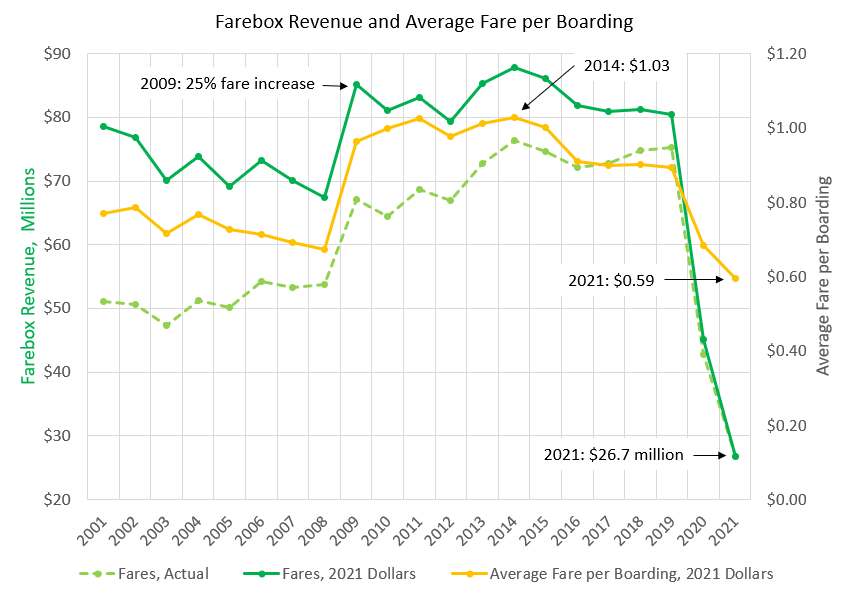
Chart 4: Total fare revenue and average fare per boarding since 2001.
Inflation-adjusted fare revenue was generally flat in the 11 years prior to Covid, varying between $79 and $88 million, with the average fare per boarding between $0.89 and $1.03. The base Metro fare is $1.25 but many riders qualify for discounts. In 2021, fare revenue dropped to $26.7 million and the average fare per boarding was $0.59.
Chart 5: Fare revenue as a percent of operational expense per boarding.
With fare revenue generally flat and operating expense increasing 77.5% between 2001 and 2019, the percent of operating expense covered by fares has steadily decreased. It was 15.3% in 2001, and then held steady around 12% from 2003 to 2014. (The increase in fares in 2009 was offset by increased operational expense per boarding due to the ridership decrease caused by the Great Recession.) The percent was flat around 9% from 2016 to 2019, and dropped to 3.4% in 2021.
This low farebox cost recovery was the reason Tory advocated consideration of eliminating fares entirely, which was subsequently studied by Metro but found to be infeasible. Metro recently approved spending $48.3 million to modernize its fare collection.
Chart 6: Major budget line items in 2021 dollars. Grants include both operational grants (such as Covid relief) and capital grants.
All previous plots were based on Metro's operating budget, but that's only part of Metro's overall budget, which includes infrastructure assistance (also called general mobility funding) and federal grants. In this chart we can see that Metro received a massive financial windfall from federal Covid relief. 2020 farebox revenue was down $32.5 million compared to 2019, and Metro received $248.8 million in Covid relief. While Metro sustained some extra costs relating to Covid, the 2020 operating budget of $847.4 million was actually below the 2019 budget of $854.4 million. 2021 farebox revenue was down $48.6 million and Metro received a mind-boggling $465.6 million in Covid relief. The 2021 operating budget was $789.2 million, well below 2019 and 2020. The formulas for relief disbursement may have been designed for other cities which are more dependent on fares. Or, it was political payoff to Democratic-led large cities. Metro's 2021 total revenue of $1.425 billion shattered the previous record high of $1.279 billion (2021 dollars), which was unusually high due to grants for MetroRail expansion. Total revenue for 2021 was $636 million above the operating expense of $789 million. Of course, these excessively large payouts to transit agencies was piled on the $30 trillion national debt.
Chart 7: Infrastructure assistance
A major line item in Metro's budget is infrastructure assistance, which is also called general mobility funding. This budget feature has existed since 1988 and has returned around 25% of sales tax revenue to cities subject to Metro's 1% sales tax. These funds are used for streets and other infrastructure improvements. Infrastructure assistance fluctuates substantially year-by-year, as the chart shows, but has been in a general downward trend in the last 10 years, and was $187 million in 2021 which was 22.2% of sales tax revenue. This downward trend may be due to adjustments approved in 2012.
Chart 8: Metro employees
This chart shows the number of Metro employees, which has been between 3356 and 4106 in the last 20 years and had a noticeable upward trend in the 2010s. Metro had its lowest headcount of 3356 in 2006, the year of its peak ridership. Headcount in 2021 was 3848.
Observations
Most of us would like to see government steadily improve its efficiency and productivity. But in the case of public transit, the money flows in and gets spent, regardless of any performance metric. Prior to Covid, Metro's key metrics deteriorated due to both increased costs and generally flat/declining ridership (although there was an upward trend after the Great Recession ridership loss). And then Covid hit, totally wrecking performance metrics.
For context, it would be useful to compare Metro's statistics to comparable agencies such as Dallas, Phoenix or Atlanta. (That could be a topic for a future post.) We can easily compare Metro's operating expense to national averages reported by APTA, which publishes a spreadsheet which includes tab 73 reporting operating expense per unlinked passenger trip (i.e. a boarding). Metro's 2019 operating expense per boarding of $9.50 (actual value, not the inflation-adjusted $10.14 in the chart) is far above the industry average of $5.39 for bus, $5.14 for light rail and $5.20 overall. (It is not known if accounting standards are identical for the APTA and Metro numbers, and APTA numbers may be skewed by high-volume agencies like New York City.)
Public transit ridership was in a downward trend nearly everywhere in the 2010s, even in cities which were spending much more heavily on public transit. I recently reported that transit-focused Los Angeles sustained a 22% drop in ridership between 2013 and 2019. While Houston Metro ridership was better than most agencies in the 2010s, mainly due to the bus service improvement program, it appears to have been achieved at a high cost in increased boarding subsidies.
Improvement in key performance statistics of cost and subsidy per boarding is mostly dependent on a recovery in ridership, since government agencies generally don't shrink to match lower demand and Metro's spending may resume an upward trajectory due to MetroNext. So the question is: How much of the Covid-induced ridership loss can be recovered? How long will it take?
2021 ridership was down 50% compared to 2019. The first five months of fiscal year 2022 are running at about 55% of 2019, and there is an upward trend visible in chart 1, so getting back to 60% in FY 2022 is plausible. Metro is also better positioned than many transit agencies, since severely-hit commuter ridership was only around 12% of overall ridership and Houston's regional population growth is among the highest in the country. Looking at the recovery from the ridership loss caused by the Great Recession (see chart 2), there was a slow recovery which took six years, and the ridership plateau from 2016 to 2019 was 12.5% below the 2006 peak.
Chart 9: Possible range for future boarding subsidies for recovery scenarios
This plot shows some likely future scenarios. Since operating expense tracks sales tax revenue (reference chart 6), the medium option for sales tax revenue in the 2021 annual report page 20 is used to estimate the operating expense. A slow, 5-year recovery is assumed since transit ridership is recovering very slowly everywhere. Using estimated ridership recovery between 75% and 90% of 2019, the boarding subsidy is in the range of $12 to $15, compared to $9.25 in 2019 and $16.98 in 2021. Recovery to 85% of 2019 ridership, somewhat optimistic but plausible, has a subsidy around $13 per boarding in 2027. Note that there is no inflation adjustment on future values. Simple math dictates that getting back to the 2019 subsidy requires a 100% ridership recovery with the same operating expense, and lower ridership requires a lower operating expense.
Questions
  • Was Metro's pre-Covid operating expense of $9.50 per boarding excessively high?
  • What is a tolerable level for subsidy per boarding? Should Metro have a goal of getting it back below $10 per boarding? Or is a future range of $12 to $15 acceptable?
  • If ridership is permanently reduced due to Covid and associated societal changes, mainly work-from-home and hybrid arrangements, should Metro operating budgets be lowered to match the actual ridership?
  • In the last 10 years, boarding subsidies have been increasing and infrastructure assistance has been decreasing. Should infrastructure assistance continue in a downward trend, especially with the forecast of increasing sales tax receipts?
  • Harris County is diverting hundreds of millions in toll funds to flood control, initially $300 million in 2020 and an expected $90 million per year in future years as part of the Harris County Flood Resilience Fund. Metro's current assets, basically cash and liquid investments, grew from $591 million in 2019 to $1.204 billion in 2021 (reference 2021 annual report page 82). Since Metro is swimming in money with its strongest financial position in its history, how about increasing infrastructure assistance (from sales tax receipts) with the incremental increase earmarked for flood control? (Tory: even if Metro is not legally allowed to directly fund flood control, they could fund City and County street infrastructure through increased infrastructure assistance/general mobility transfers so those entities could free up budgets for flood control while keeping overall street infrastructure budgets the same. It can certainly be argued that flood control is a much higher priority for the region than adding capacity to an already severely underutilized transit system!)
Appendix: Tabular data
This is the data used in the plots. Source is the annual reports. CPI=consumer price index inflation adjustment factor. CPI is for September of the year, to align with the end of the fiscal year.
Operating Expense millions $ Operating Loss millions $
Year Boardings CPI Actual 2021 Dollars Actual 2021 Dollars
2001 101,914,157 1.538 334.3 514.2 282.8 434.8
2002 97,704,392 1.515 373.4 565.7 322.2 488.1
2003 97,740,511* 1.481 395.6 585.9 348.3 515.8
2004 96,428,515 1.444 435.9 629.4 384.7 555.5
2005 94,959,198 1.379 430.4 593.5 380.3 524.4
2006 102,827,629 1.352 435.7 589.1 381.5 515.8
2007 101,310,353 1.316 459.6 604.8 406.4 534.8
2008 100,348,037 1.254 496.5 622.6 442.7 555.1
2009 88,517,657 1.270 558.6 709.4 491.5 624.2
2010 81,158,905 1.256 562.6 706.6 498.0 625.5
2011 81,032,075 1.209 570.5 689.7 501.8 606.7
2012 81,020,887 1.185 573.5 679.6 506.6 600.3
2013 84,266,386 1.172 591.9 693.7 519.1 608.4
2014 85,389,587 1.152 641.8 739.4 565.5 651.5
2015 86,089,171 1.153 694.8 801.1 620.1 715.0
2016 89,970,895 1.136 783.2 889.7 711.2 807.9
2017 89,940,735* 1.111 807 896.6 734.2 815.7
2018 90,156,382 1.086 811.1 880.9 736.3 799.6
2019 89,951,217* 1.068 854.4 912.5 779.0 832.0
2020 66,069,965 1.054 847.4 893.2 804.6 848.0
2021 44,914,325 1 789.2 789.2 762.5 762.5
*Discrepancy in values in different years of annual reports. Discrepancies are small and don't affect plots.

Labels: , , , ,

Tuesday, October 26, 2021

The Post-Pandemic Future of Cities

Our Urban Reform Institute - A Center for Opportunity Urbanism recently held a great webinar panel on the post-pandemic future of cities. A highly recommended watch when you have some time. Description and panelists below:

"The Covid-19 pandemic has cut a scar through our society, and particularly our cities. What does the future look like? How will we work and where will we live?  This panel is designed to give insights into the future trends that will shape real estate, work-life, and society in the next decade."


Moderator:

Joel Kotkin - Joel Kotkin is a fellow in urban studies at Chapman University in Orange, California, and Executive Director of Urban Reform Institute.

Panelists: 

Tiffany Thomas - Tiffany Thomas is a Houston City Council Member representing District F. As Chair of Housing and Community Affairs for the city, she oversees priorities related to Housing, Veteran Affairs, Homelessness, and Solid Waste. Thomas also currently serves as Program Coordinator and Assistant Professor of Community Development at Prairie View A&M.

Luis Bernardo Torres -  Formerly with Mexico’s central bank, Banco de Mexico, Luis brings critical international expertise to the Texas Real Estate Research Center at Texas A&M. Having served four internships with the El Paso office of the Dallas Federal Reserve, Luis understands the workings of central banking, a key driver of U.S. and world economies.

Wendell Cox - Wendell Cox is an American urban policy analyst and academic. He is the principal and sole owner of Wendell Cox Consultancy/Demographia, based in the St. Louis metropolitan region and editor of three websites, Demographia, The Public Purpose, and Urban Tours by Rental Car. Cox is a fellow of numerous think tanks, including Urban Reform Institute.

Andrew Segal -Andrew Segal formed Boxer Property in September 1992. Under his oversight, the company has successfully reached into segments as diverse as resort hotels, retail centers, office, and other real estate businesses, accounting for approximately 20 million square feet of space across the United States.

Labels: , ,

Sunday, May 16, 2021

My online event Tues, HTX #1 BBQ and #2 tech growth, R voters moving to TX, post-pandemic city shifts, ATX vs. HTX home prices, housing craziness humor, and more

Before we get to this week's items, just a reminder that my Mercatus online panel event on Land Use without Planning is 2pm CT on Tuesday. I'll be covering some of Houston's land use and zoning history as well as what other cities can learn from Houston. You can learn more and register here. 

Moving on to a large backlog of items for this week:

  • NYT: There’s an Exodus From the ‘Star Cities,’ and I Have Good News and Bad News. Excellent summary of many different analyses forecasting post-pandemic urban geography. I’m not sure they’re right that pandemic migration will push R counties/states more D though.  A lot of frustrated Rs are using the pandemic to escape D states and move to R states. For every D techie moving from SF to Austin, I'd bet 2 frustrated California Rs are moving to Texas. Actually, a recent survey found 57% of California migrants to Houston voted for Ted Cruz, which validates what I've been hearing.  Here’s the most upvoted comment:

"Kotkin nails it 'Meanwhile, the working class struggles to pay rent, possesses no demonstrable path to a better life and, as a result, often migrates elsewhere.' I mean seriously is there anything worse than being poor in New York City, working a job in food service, barely able to pay your rent, knowing that you'll never own anything but an endless struggle against being evicted? Or you can move to Georgia, live cheaply in a far larger house / apt, and work towards gaining equity of something. No smart poor person would ever stay in NYC."
"Houston ranks second among 14 major U.S. labor markets for the number of relocating software and IT workers between March 2020 and February 2021 compared with the same period a year earlier.

Miami grabs the No. 1 spot for the gain in software and IT workers (up 15.4 percent) between the two periods, with Houston in second place (10.4 percent) and Dallas-Fort Worth in third place (8.6 percent), according to the LinkedIn data."
"The big story among the nation’s major metros over the past decade has been the persistence of urban core out-migration and suburban in-migration...Houston had the 2nd-largest gain at 1.2 million, with a 20.8% increase, and remains the 5th largest metro." 
"Certainly, Houstonians will be pleased with that result, but the notion that Austin might be Texas' third best city for barbecue will likely cause considerable agita in the state capital." ;-D
"It’s a melting pot, and that’s one of the things that stood out that I absolutely loved about the city. The fact that there’s a lot of positivity going on and people doing great things here, those are really some of the main reasons I stayed in the city. 
Their turkey legs are decadent, sure. Like other rodeo-adjacent foods, they’re large, indulgent and full of flavor. They, in essence, are Houston."
Finally, I'll end with an absolutely hilarious short video skit on the current craziness in the housing market - enjoy ;-D


Labels: , , , , , , , , , , ,

Sunday, April 25, 2021

My Land Use without Zoning event, TX #1 for small biz, HTX #1 for diversity, urban transit after covid, sinking I69 in Midtown, and the Be Someone sign is back!

The lead item this week is an event announcement: I'll be one of the speakers/panelists at the Mercatus Center's "Land Use without Zoning: Putting Ideas into Practice" online event on May 18th.  Here's the overview:

"Zoning and land use policy regulations present the greatest barriers to affordable housing and increased urban density. 

Understanding how to navigate and remove these barriers allows for a dynamic housing market and paves the way for successful community development efforts. 

The study of the impact of land use and zoning policy began with Bernard Siegan in his pioneering 1972 study, "Land Use Without Zoning." In his book, Siegan first set out what has today emerged as a common-sense perspective: Zoning not only fails to achieve its stated ends of ordering urban growth and separating incompatible uses, but it also drives housing costs up and competition down. 

Drawing on the unique example of Houston—America’s fourth-largest city, and its lone dissenter on zoning—Siegan explored the impact of a different approach to land use policy and demonstrated how land use will naturally regulate itself in a non-zoned environment and yield a greater availability of multifamily housing. 

While we have gained a greater understanding of the issues created by overly burdensome land use restrictions, these policies still remain in place, restricting the growth of communities and keeping housing costs high. Join us for a discussion of how land use reform battles have evolved over time, how community groups are working to remove these barriers and increase urban density, and how barriers to development can be challenged in court."

Register here - hope to see you there!

Moving on to this week's items:

  • Big piece of good news buried in this one - let the sinking and debottlenecking begin! 
"Though TxDOT has halted development of many segments, the portion along I-69 from Spur 527 to Texas 288 — which includes Wheeler — remains on pace for construction to start next year."

"As of December 2020, the most fuel-efficient means of commuting was the car, followed by light trucks—but only because occupancy embedded in the transit calculations was so drastically low. ...

A major premise of the Biden administration’s transportation agenda is to greatly increase federal spending on transit, compared with only modest, constrained increases for highways (with very little scope for adding highway capacity). This approach poses major risks of putting billions of taxpayer dollars into projects that will have costs far greater than their benefits (e.g., light rail systems for medium-sized cities, megaproject expansions of heavy rail and commuter rail systems, etc.).

At the very least, it is premature at this juncture to commit funding for major new rail transit projects before we have some idea of the extent of transit ridership in the first several years after nationwide vaccinations."
Finally, I'd like to end with a small celebration for whoever repainted the iconic Be Someone bridge - love it!


Labels: , , , , , , , ,

Sunday, April 18, 2021

Transit tips from Harvard and Japan, shrinking office space, HTX life science, foreign offices for economic growth, MUD videos, and more

Lots of small items to catch up on this week: 

  • "40 years of Harvard transportation research can be summed up in 4 words: BUS GOOD, RAIL BAD." -Ed Glaser, Harvard economics professor, The Bush Center Leadership Forum April 15, 2021
  • A bit dated but still incredible: "As can be seen on the following chart, during the period from January 2011 to March 2014, there have been slightly more single-family housing starts in Houston (95,037) than in California for the entire state (94,993)." That's a metro of 7 million building more housing than a state of 40 million - crazy!

“The cities with the lowest [office] return rates are on the coasts like New York, San Francisco, and Washington, Kastle said, where long commutes, often on dysfunctional transit systems, are common.”

"In fact, tuck-under townhouses are probably the most successful middle housing type around. In lightly-regulated Houston, builders small and large have been building townhouses, sometimes on courtyards perpendicular to the road. Parking is tucked. Townhouses are usually three stories tall (bad!), sometimes four. A few are even five stories. Their courtyards are driveways (also bad!)."

Finally, some fun, short animated videos on MUDs and property taxes in Texas you might enjoy exploring, courtesy of Triton and hat tip to David. That video on shutting off water to your home would have been real handy for a lot of people during the February winter storm...

Labels: , , , , , , ,

Monday, April 05, 2021

Are we entering the Distributed Age? Plus perspectives on Houston, TX #1 for infrastructure, and more

My leads this week are a couple of great quotes about Houston:

"Houston has actively deregulated, with the result that it's the only major city in the U.S. today undergoing a transformational change from suburban to urban densities. Houston makes thinkable the unthinkable." 

-Mercatus Center at George Mason University, Land Use without Zoning book letter 

"Once a planning pariah, Houston, with its peculiar lack of zoning, increasingly looks like the future." 

-Nolan Gray in the afterword of the newly updated Mercatus edition of "Land Use without Zoning" by Bernard Siegan.

If you're curious about the recently re-released book on Houston, "Land Use without Zoning" by Bernard Siegan, you can find it here.

Moving on to this week's smaller items:

"Other American cities—notably Houston, Dallas, Atlanta and Miami—are challenging NYC’s supremacy in communications, legal and financial services, the arts and business. Political and economic leaders in those cities encourage inclusive growth, development and change." 
"No state handles more of America’s cargo than Texas. In fact, no state comes close. According to the latest figures from the U.S. Census Bureau, the Lone Star State handles around $2 trillion worth of commodities per year. And Texas has the infrastructure to handle it. Port Houston, the nation’s second biggest, has surpassed Rotterdam as the world’s largest petrochemical complex, officials say."
“A year after the coronavirus sparked an extraordinary exodus of workers from office buildings, what had seemed like a short-term inconvenience is now clearly becoming a permanent and tectonic shift in how and where people work. Employers and employees have both embraced the advantages of remote work, including lower office costs and greater flexibility for employees, especially those with families.” … 
Still, about 90 percent of Manhattan office workers are working remotely, a rate that has remained unchanged for months, according to a recent survey of major employers by the Partnership for New York City, an influential business group, which estimated that less than half of office workers would return by September. … 
“We believe that we’re on top of the next change, which is the Distributed Age, where people can be more valuable in how they work, which doesn’t really matter where you spend your time,” said Alexander Westerdahl, the vice president of human resources at Spotify, the Stockholm-based streaming music giant that has 6,500 employees worldwide.
"As Houston prepares for unprecedented population growth in the coming decades, I predict that the versatile ADU concept will continue to help make our inner-city neighborhoods more affordable and sustainable."
"In 1976, New York Times architecture critic Ada Louise Huxtable declared that Houston was “the American present and future. It is an exciting and disturbing place,” one that “scholars flock to for the purpose of seeing what modern civilization has wrought.” In her account the city's distinctive character lay in its decenteredness, its seemingly limitless capacity for shape-shifting, and its utter lack of history. Like many observers then and since, Huxtable was struck by the experience of juxtaposition—of form, scale, type, and space—that was a consequence, in part, of the city's infamous lack of zoning regulations and its unapologetic accommodation of private real estate interests"

Labels: , , , , , , , , ,

Thursday, April 01, 2021

Baylor forfeits to UH after positive covid test - UH goes straight to national championship game!

In an absolutely unprecedented occurrence in NCAA March Madness tournament history, Baylor is being forced to forfeit its upcoming Final Four semi-final basketball game against the University of Houston after their star player Davion Mitchell tested positive for Covid-19, sending UH directly to the national championship game Monday, April 5th! UH is now redefining the classic March Madness "Cinderella story" after being the first team to make the Final Four without defeating a single-digit seeded opponent and now skipping right past the semi-final game straight to the National Championship game - just when you thought pandemic craziness couldn't get any crazier! 

Baylor is of course completely devastated by the news and trying to appeal, but the NCAA covid safety protocols are very strict and pretty clear. Even if every other player tests negative, there's no way to know if they haven't already been exposed and will develop it before the game Saturday.

UH Chairman and Rockets owner Tilman Fertitta issued a statement congratulating the Cougars on getting to the national championship while offering a generous consolation prize to the Baylor players after their sudden season-ending disappointment: once they clear covid protocols they're all welcome to immediately join the cellar-dwelling 13-34 Rockets as an "obvious and immediate upgrade," according to Fertitta.

-----------------

Hope you enjoyed this year's April Fools post ;-D 
Here are previous years if you missed 'em and would like a chuckle:

Labels: ,

Saturday, March 27, 2021

Repurposing River Oaks Theater, grid resilience, Dallas insanity, reinventing inferior jets, Houston's diversity advantage, TX migration, NYC losing half its commuters, and more

Our first lead item this week is an in-depth follow-up from Jim Crump on targeted solutions to improve the electric grid in Texas. Highly recommended if you're interested in the nuances of improving grid reliability without extraordinary costs.  Speaking of which, it's been verified that we don't necessarily need to spend billions on winterization, we just need to treat gas pumps like critical infrastructure during blackouts! "This simple paperwork blunder left Texans cold during the deadly freeze" 

One more lead item so the blog lives up to its name this week ;-) Assuming the River Oaks Theater won't be taken over by a live theater group (really the best option), my suggested best realistic option in a streaming world: since Weingarten wants another high-rise there, preserve and repurpose it as a cool public lobby and coffee bar, marquee and all. Sure it's sad to lose the actual movie theater, but does that have any chance when you can stream pretty much any independent film at home any time?

Moving on to lots of backlogged items to catch up on this week:

  • Dallas insanity: $1.7 billion for 2.4 miles of mostly subway. That's $708 million per mile! Glad Houston METRO is being a lot more pragmatic and prudent with their resources than this. Hat tip to Oscar.
  • Several think tanks published their Metropolitan Blueprint for Texas.
  • Antiplanner on Reinventing the Jetliner (i.e. high speed rail) with some compelling opening paragraphs:

"Suppose I told you that I have reinvented the jet airliners that carried Americans more than 750 billion passenger miles–about 10 percent of all passenger travel–in 2019. My reinvented jet will go less than half as fast as existing jets. It will cost six times as much to operate, per passenger mile, as existing jets. Unlike existing jets, which can go anywhere there is air, the reinvented jet will only be able to go on a limited number of fixed routes. 
This wondrous invention will become a reality if the federal government spends a mere one, two, or possibly three or four trillion dollars. Does that sound like a good deal? No? Yet that is exactly what high-speed rail advocates are proposing. Some proposals, such as the Green New Deal, even call for almost completely replacing low-cost, fast jet airliners with high-cost, relatively slow trains."
Now on an opportunity cost basis, just imagine if those trillions went directly into carbon reduction instead of white elephant high-speed rail lines??
"Less than 50 percent of people who worked in Manhattan offices in 2019 will be working from those offices in the coming years, according to a recent survey by the Partnership for New York City."
"One thing I always admired about Houston is how confidently immigrants claim public space for themselves—how working families picnic in Hermann Park or elated quinceañeras roam the Galleria with their brightly attired entourages and pose for portraits before the Waterwall."
"Cities do not thrive by having more cutting-edge coffee shops, trendy restaurants and edgy boutiques; they need safe streets, decent schools and jobs for middle and working-class families." 
Finally, I'd like to end with a well-done in-depth video by CNBC on why so many businesses and billionaires are moving to Texas. Worth the watch. "Embrace the freedom!" 

Labels: , , , , , , , , , , ,

Sunday, March 21, 2021

The future of remote work and what it means for Houston

This week I want to focus on a single CSM story, because it's the most insightful I've seen on what post-pandemic work might look like: Remote work is here to stay – and it’s changing our lives. There are so many great nuggets, insights, and excerpts in it, which I'll follow with what I think it all means for Houston:

An IBM poll found that 54% wanted to keep working from home post-pandemic, and 75% wanted the option of working from home occasionally. 

“What the pandemic made blazingly obvious,” says a Manhattan entertainment lawyer, “is that there is no need for a physical office.” Only a complete lack of imagination, he says, kept the realization from dawning sooner. “Before the pandemic, we wouldn’t have taken the question [of going virtual] seriously. It wouldn’t have seemed possible.” ... 

It’s hard to find a management expert who doesn’t judge the work-from-home experiment a resounding – and somewhat unexpected – success. A survey by the recruiting firm Robert Walters found that 77% of professionals believe they’ve been equally or more effective when remote, and that 86% of employers plan to continue remote work “in some form” after the pandemic ends. A January survey by the consulting firm PwC revealed that employer satisfaction had risen even as the year dragged on, with 83% now assessing remote work successful for their company, up from 73% last June. 

Wrote one top manager in an email posted by economist Tyler Cowen: “Speaking from personal experience as a white-collar Exec, the productivity gains for our highest value workers has been immense. The typical time-sucks and distractions of in-office work have been eliminated.... Mental focus on productive efforts is near constant. Perhaps most importantly, work travel is not happening.” ... 

Among venture capitalists and venture-backed entrepreneurs, 74% now expect their companies to be majority or fully remote. ... 

“Even before the pandemic,” he says, “big cities like New York, Los Angeles, and Chicago were losing population to suburbs, lower-cost metro areas, and less expensive states in what Zillow called ‘a great reshuffling.’” 

The trend has accelerated, Mr. Kotkin says. “In just the past six months, New York City lost almost as many residents as it gained since 1950.” He notes that a recent report by Upwork, a freelancing platform, suggests that 14 million to 23 million Americans are seeking to move to a less expensive and less crowded place. Welcome to the “Zoom towns.” ... 

The market research firm Forrester predicts a 60-30-10 split among organizations: post-pandemic, 60% will be hybrid, 30% will be all-in-the-office, and 10% will be all-remote. ... 

Experts can point to only one other work style “experiment” like the one caused by COVID-19, though its sample size in comparison was minuscule. When a 2011 earthquake demolished Christchurch, New Zealand, the entire community turned immediately to telework. Then the city rebuilt, renewing its stock of office space. Yet years later a study revealed that Christchurch’s workers continued to operate remotely, away from their freshly available workplaces. “When [the crisis] was over,” said a researcher, “they didn’t go back.” 

If the expert consensus proves right, Americans won’t go back, either. 

“As remote working has boomed during COVID-19,” summarizes a study by the University of Utah, “the rise in the number of people working from home has prompted many to reconsider where they wish to live.” Which means, as the survey data already indicate, that as many as 40% of office workers could scatter outward from the name-brand cities to places more spacious and affordable. ... 

“As life at work [when remote] will be less social, people will have to get more of their socializing from elsewhere. So people will choose where they live more based on family, friends, leisure activities, and non-work social connections. Churches, clubs, and shared interest socializing will increase in importance. People will also pick where to live more based on climate, price, and views. Beach towns will boom, and the largest cities will lose.” 

So workers will be more dispersed, and more of their working hours will be spent where they live instead of elsewhere in an office. The question is: Could all this lead to a “reset” of the locus of community in America? 

Might the center of gravity shift at least somewhat from the office to the neighborhood – back, in a sense, to something closer to a pre-industrial model? What might it mean for our culture if the human contact that offices used to provide is replaced by closer-to-home human connections? And how might that affect the health of local communities and even levels of societal trust? ... 

Here Mr. Kotkin quotes Lenin: “There are decades when nothing happens; and there are weeks when decades happen.” 

So what does it mean for Houston?...

Working against us:

  • Not a classic lifestyle-destination city (think Austin, Denver, Miami) - no mountains or beaches
  • Big city problems, including traffic and crime
  • Climate: flooding, hurricanes, heat and humidity
Working in our favor:
  • Lots of Houston ex-pats that can come home to be closer to friends and family
  • Industries that are less amenable to remote work: manufacturing, refineries, port, health care, NASA, even energy to a significant extent
  • The most affordable global city in America - big-city amenities at an affordable price
  • Strong community culture for such a large, diverse city
  • High pull among immigrant networks
Overall I'd say we're likely to come out fairly well - not as good as the popular lifestyle cities, but much better than the unaffordable superstar cities like SF and NYC. Would love to hear your own thoughts in the comments...

UPDATE: Houston Innovationmap picked this up!

Labels: , , , , , , , ,

Sunday, March 14, 2021

Texas Startup Manifesto 2.0, new top rankings, Houston housing elasticity, remote work reshaping America, and more

 Real backlog of smaller items this week...

"Houston—whose median home values are only 76% of the national average—stands out. Since 2010, it has had America’s 2nd-highest net population growth but is #1 in permits issued. This has made it an affordable city even in core locations; 1-bedroom, 1-bath downtown condo units can be found for under $200,000. 
How does Houston remain so elastic? Less regulation. The city famously lacks a zoning code, and many of its suburbs are also very pro-growth. This means it has fewer legal barriers to more housing than inelastic coastal metros, where proposed zoning changes can trigger lengthy and contentious review processes."

"Similar proposals show that the basic idea of hyperlocal zoning has precedent. Houston has been able to remain a city without zoning laws in part because residents had options in the form of deed restrictions, where neighbors could choose their own rules at the hyperlocal level. In 1998, policymakers were able to reduce the city’s minimum lot sizes by allowing residents on individual streets and blocks to opt out of that change, a move which helped overcome local resistance because residents felt they had control over the risks. The result? Some 25,000 more housing units, including denser townhomes, built close to job centers and transit, many of which Houstonians would not have seen built otherwise."
  • WSJ: How Remote Work Is Reshaping America’s Urban Geography (archive link) - Smaller cities and communities are turning into ‘Zoom towns’ and competing with coastal hubs as workers move to find more space and lower costs.  Basically, Richard Florida articulates Creative Class 2.0, which is the same as 1.0 but for remote workers outside superstar cities. Key excerpts:
Eye-opening stat: "remote workers are often more efficient than their in-office counterparts. They don’t waste hours on mind-numbing commutes, and they aren’t distracted by unnecessary meetings and water-cooler chitchat. The productivity boost to the U.S. economy from remote work could be as high as 2.5%, according to research by Stanford University economist Nick Bloom and colleagues." 
Conclusion: "The remote-work revolution promises to change the way that Americans work and live. It will allow smaller cities, suburbs and rural areas to compete with the superstar cities on the basis of price and amenities. It will shift the main thrust of economic development from paying incentives to big employers to investing and building up a community’s quality of life. As communities attract more remote workers, their tax bases will grow, allowing them to improve schools and public services, benefiting everyone. Eventually, companies will come too. That holds out the possibility of a better, more virtuous circle of economic development."
Finally, a couple items on Houston as a startup hub. First, we rank #4 on this list for annual startup formations and jobs created by startups (#10 for formation rate), behind DFW but - surprisingly - ahead of Austin! Second, the excellent Texas Startup Manifesto 2.0 is out (highly recommended), arguing for treating the Texas Triangle as one giant startup ecosystem (absolutely), with this excerpt on Houston: 
"Houston (East and Gulf Coast) is the fourth largest, and the seventh most diverse city in the US. It’s the energy capital of the world and is home to the Texas Medical Center (TMC), the world’s largest concentration of healthcare delivery and research institutions; to the NASA Johnson Space Center, a hub for cutting-edge human space flight research and astronaut training; to the number one seaport in the nation for waterborne tonnage, for foreign waterborne tonnage, and for vessel transits. Houston is an international city — a seaport, a spaceport, a “health-port”, and an “energy-port.” As a result, Houston has a diverse, high-tech industry ecosystem, and is increasingly an industry destination, serving as the home to 22 Fortune 500 company headquarters (with Hewlett-Packard Enterprise becoming the latest addition)."

Labels: , , , , , , , , , , , , , ,

Tuesday, February 09, 2021

Astrodome campaign ideas, MaX Lanes, pandemic migration, SV to TX, 4 post-pandemic predictions, superstar cities are in trouble, and more

The lead item this week is the Astrodome Conservancy spring campaign to re-engage the public on what to do with the Astrodome.  My blog has had two main ideas over the years on the Astrodome - a “go big” one that requires big money, and a far more modest, affordable one as a climate-controlled weekend festival park.  (other ideas here)

Honestly, I think the second one is the more realistic option right now, and could be very popular. The simple pitch for the second one is the world’s largest climate-controlled park. People love going to parks, but not during Houston’s extreme weather, especially summers and thunderstorms.  Having an activated park full of activities and festivals on weekends that is always protected from heat and rain would be a very popular spot for Houstonians, especially families desperate to find affordable activities every weekend. And it could easily start very modestly and then expand over time with philanthropy (like has been happening with the zoo, MFAH, and HMNS) as well as parking charges to cover operations.

Moving on to this week's items:
"But there’s another factor I hadn’t considered, one that so far appears to be the single largest driver of pandemic-era migration: family."
"Part of the reason for this trajectory had to do with another institution that continues to play a key role in driving technological innovation in the state: Houston’s Rice University, which played a role comparable to Stanford's vis-à-vis Silicon Valley. In fact, many of the early players in Silicon Valley actually moved to California after graduating from Rice, constituting what is sometimes called the “Rice Mafia.”

How appropriate, then, that Rice would play a key role in the next step in the rise of Texas. In 1961, the university donated more than a thousand acres of land for the construction of what became known as the Johnson Space Center, flooding a once-provincial city with literal rocket scientists. Like Silicon Valley, where government contracts and connections proved essential in getting the region off the ground, Houston’s leadership in the space race kick-started a host of related industries."
"If California is a vision of the sort of future the Biden administration wants for Americans, expect Americans to demur."

  • The Atlantic: Superstar Cities Are in Trouble - The past year has offered a glimpse of the nowhere-everywhere future of work, and it isn’t optimistic for big cities.  It includes four predictions and a conclusion I would never have expected to see in a magazine like The Atlantic!

    1. The rise of the supercommuter
    2. The decline of the coastal superstar cities
    3. The rise of the rest
    4. The next Silicon Valley is nowhere
"As an urban resident of Washington, D.C., writing from my dining-room table, my claim is not that I believe the internet could or should replace the riotous physical-world collision of urban work, culture, art, and life. My humbler assertion is that 2020 has punctured my confidence that the internet cannot encroach on the benefits of urban density and proximity. Going forward, many fledgling companies may agree, as they find that the city in the cloud essentially acts as a more accessible version of the city on the Earth, eerily reproducing its forces of agglomeration, specialization, and convenience. The past 12 months have offered a glimpse of the nowhere-everywhere future of work."

Labels: , , , , , , , , , , , ,

Sunday, January 10, 2021

My HBJ piece on NZ adopting TX MUDs, Techxodus, video on Houston's identity, future of offices, HTX developments in 2021, Stack City, rich zip codes, and more

The lead item this week is my short piece in the Houston Business Journal on New Zealand adopting the Texas Municipal Utility Districts (MUDs) model to encourage more homebuilding in a country with an extremely limited supply of overpriced housing. I helped host a research delegation from New Zealand in 2018 that brought our MUDs model back and successfully crafted and passed similar legislation there - a huge win for our Urban Reform Institute think tank and endorsement of the Texas model for supplying a continuous flow of new, affordable housing.

Moving on to this week's items:

"Harris, the most populous county in fast-growing Texas with 4.7 million people, went to six zip codes on this year’s list from just one last year." ... 
"Almost half of the richest zip codes, 49 of the 100, are in just seven counties: Manhattan & suburban Westchester County in NY, Connecticut’s Fairfield County, Chicago’s Cook County, California’s LA & Santa Clara counties, & Houston’s Harris County (6)."
"Travel is a part of our lives. Instead of treating it like a cost, we should embrace it, using it to enhance our economic and social well beings. To the extent that government is involved in transportation, instead of trying to limit travel it should do what it can to enable it and to extend the benefits of travel to as many people as possible."

“There are a number of examples of the Texas-style stack in and around our larger metropolitan areas, including Houston, which, because of its large number of stack interchanges, is known as “Stack City””
My first time hearing that nickname - curious to hear in the comments if others have come across it before?
  • NYT: The Future of Offices When Workers Have a Choice (archive link) - Some work spaces in central employment districts may become housing, and some housing in residential areas may become work spaces.  My prediction is that managers will try to get people back to the office, but it will be very bumpy (not everybody vaccinated, virus continues to circulate at a low level, employers sued by employees that get sick, people unhappy with returning to commute), and talent will start looking for employers that don’t require the commute, even a day or two a week. Also companies will find they can access much more affordable remote talent globally, and those companies will start winning vs. companies constraining themselves to limited, expensive local talent pools. Key excerpt:
“Even before the pandemic, there were signs of trouble with the office market in the handful of cities where the “creative class” had been flocking. In 2018, net migration to New York, Los Angeles and San Francisco was negative, while the U.S. economy grew at a healthy 2.9 percent. Creative magnets like London and Paris were experiencing similar declines. 
The explanation for the declines — mostly high housing costs because of severe limits on new construction — obscures other forces that were destabilizing the traditional office market. In the middle of the 2010s, Amazon, Facebook, Google, Apple and others started splitting their headquarters into multiple locations. Stripe, one of the world’s most valuable start-ups, went a step further. In 2019, it “opened” a remote hub, hoping to “tap the 99.74 percent of talented engineers living outside the metro areas of our first four hubs” in San Francisco, Seattle, Dublin and Singapore. 
For the fastest-growing companies, being able to tap into talent anywhere became more important than having all their teams in one place. Smaller cities were good enough. In retrospect, this shouldn’t have been a surprise, despite all the talk about the importance of giant, dense labor markets to fuel innovation. After all, Silicon Valley itself is not a city but a cluster of sprawling towns scattered along a highway. 
The defining characteristic of this new version of the creative class may not be where it lives, but its ability to live anywhere it wants. Put differently, people move to certain cities in search of better-paying jobs, but it’s now possible to earn high (if not the highest) salaries from almost anywhere. That has been true in certain smaller cities in recent years (Austin and Denver in the United States, for example, and Manchester and Leeds in Britain). To a lesser extent, it has also been true for people who chose not to live in cities at all.”
Finally I'll end on a couple of fun items: some very exciting items Houston can look forward to in 2021, including some really cool developments, and a really well-done video by the Rockets on Houston's identity where they hit on a lot of great aspects and moments from our history. Actually choked me up a bit during the disaster parts. Proud of H-Town! 


Labels: , , , , , , , , , , , , ,